Debra Prinzing

Get the Email Newsletter!

Archive for the ‘Gardening’ Category

A winter bouquet: arranging flowers from the January garden

Sunday, January 9th, 2011


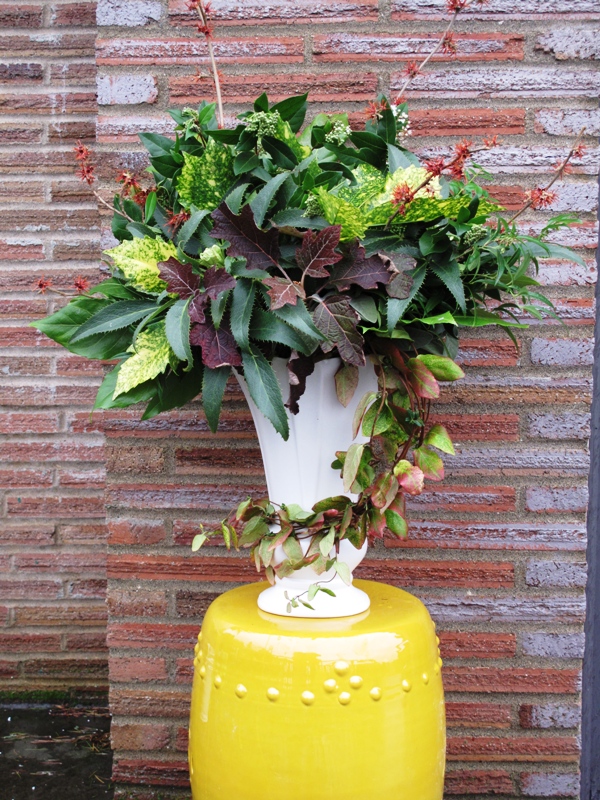
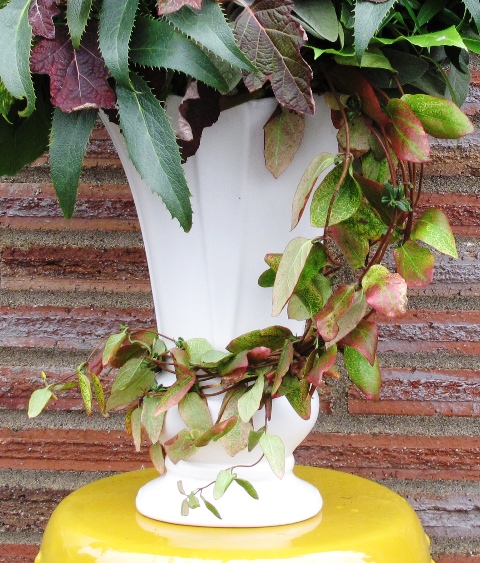
By borrowing this lovely cream urn from my friend Lorene, and by clipping ingredients from her garden and that of Jean Zaputil's, I created a dramatic winter bouquet.

Earlier this week, my collaborator David Perry and I were the “program” for Woodinville Garden Club’s first meeting of 2011. It was an auspicious beginning for what we anticipate to be a great year gathering stories both visually and with words for our book project, A Fresh Bouquet.

Frequently, the feedback to our “seasonal, local and sustainable” mantra has to do with the argument that one can only follow this practice in the peak growing seasons when annuals and perennials are in their glory (you know what we mean – roses, peonies, dahlias, even sunflowers….they don’t usually sing in January!)

That’s true, but living in the seasons means that of course you don’t want a vase filled with August bloomers in the dead of winter. That’s like eating a mealy hothouse tomato out of season. Yes, it’s red in color, but that’s about as much in common the January grocery store tomato has with the off-the-vine, warm, juicy, flavorful heirloom you grow in the garden and add to your late summer salads.

So after our illustrated lecture on “A Year in Flowers,” featuring some pretty incredible images that Dave has captured on our joint and his solo excursions, we set out to design and demonstrate some great ideas for winter bouquets. Suffice it to say, David created an uniquely “David” arrangement. Yes, it involved power tools and an unexpected combination of leaves and blooms. When he blogs about it, I’ll add the link here.

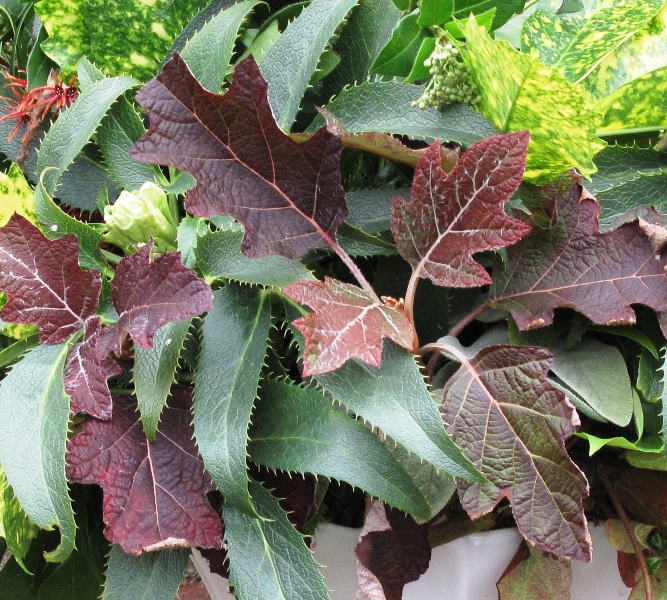
This detail shot shows how the oakleaf hydrangea adds wine to the bouquet, showcased against the hellebore foliage; a glimpse of the yellow-and-green acuba foliage is in the upper right corner.

For me, I wanted to fill a vase with winter beauty. Some of you may know that our family is in a bit of transition. We finally sold our house in Southern California, but we are still living in a rental house in Seattle, while house- and garden-hunting for a permanent residence.

I yearn for my previous Seattle garden where I could gather more than enough ingredients for any impromptu bouquet (does this come close to admitting that I’m an over-planter? YES! But I don’t own that garden anymore, sadly). I’m a bit limited with the offerings at our rental house and I don’t want to denude all the plants my landlords consider theirs!

So, on Tuesday, I went “flower shopping,” which means I visited the amazing gardens of two friends, clippers in hand. It was sunny out, and very cold. Some of the shrubs showed signs of frost damage. After all, It was January 4th! But I was not disappointed and my garden designer friend Jean Zaputil walked me around her backyard and entry garden, encouraging me to take a little of this and a little of that.

Her bounty included Fatsia, which has huge, palm-like foliage. Green and glossy, this is good stuff – perfect for adding drama to a vase. We clippped branches of green Boxwood, another hardworking shrub that is just as hardworking in an arrangement. Oh, and the Sarcococca, or sweet box – divine. If you have never grown this evergreen shrub, which has little pointed leaves and hard-to-see, super fragrant white winter flowers, think about planting it now. It’s hardy in the Pacific NW….not in the midwest, unfortunately, according to my friend Danielle.

I also left with a few stems from Jean’s Acuba shrub, which is another one of those plants you sometimes ignore in the summertime when everything else looks so swell. But even the famed Christopher Lloyd admired this plant – its bright yellow foliage is splashed with green flecks. And there’s nothing like something golden to offset all that greenery. It ended up as one of the magical ingredients that perked up my bouquet. I also talked Jean into letting me clip two branches from her about-to-bloom Helleborus argutifolia – with its leathery, serrated, olive-green foliage and the pale green flower in bud.

Here's how the honeysuckle vine looks, wrapping around the base of the urn.

After leaving Jean’s, I headed to Lorene Edwards Forkner, plantswoman, designer, blogger and fellow writer — another incredibly talented friend (I am blessed with many of them!). Lorene’s garden is very close to Puget Sound, which is often a bit milder than the rest of Seattle. That’s the only reason I can come up with to explain why her Oakleaf Hydrangea shrub was still hanging onto several deep burgundy leaves in pretty sets.

Like the golden Acuba, the wine-colored Hydrangea foliage added great contrast to the bouquet. Oh- and the ‘Jelena’ witch hazel – yes, this glorious, fragrant shrub is just beginning to flower in Lorene’s front yard, so she allowed me to clip a few branches. The blooms of the witch hazel are little puffs of burgundy-copper – and it doesn’t take many of them to perfume a room. I made this bouquet on Tuesday and four days later, the dining area where I set the urn was still heady with the scent.

You can look closely to see most of these ingredients in the photos here. One more thing I want to share about this abundant bouquet. Notice the draping vine? That’s a cascading and twining length of a rugged honeysuckle, also from Lorene’s property. I wanted it to spill elegantly from the mouth of the cream-colored urn, but it was a little too stiff to give me the look I envisioned. So I started wrapping it around the base of the urn and – well, that looked better. I employed a trick I learned from a Portland floral designer we recently interviewed, Jennie Greene. She uses tiny lengths of twine-wrapped wire to secure branches and stems in place. Easy t0 find at craft stores, I pulled out a roll of the wire, cut off a couple inches and secured the honeysuckle in place.

Now who says there’s nothing to put in a vase in January? This creation illustrates just one way to gather from the winter garden. Go see what you can create!

Hoe, Hoe, Hoe: Vintage Garden Tools as Holiday Decor

Wednesday, December 15th, 2010

A Gardener's Holiday Welcome at Old Goat Farm

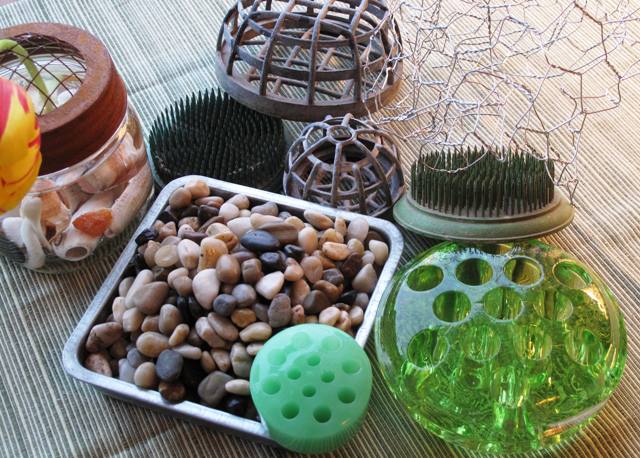
If you’re like many of my gardening friends who can’t resist the charming character of old farm implements or tools, you probably have a few elderly hand-trowels in your collection. I know I’m not the only one who actually begs, buys and forages for old nozzles, flower frogs, watering cans and metal implements for digging soil! 

Whether displayed on a shelf or hanging from a wall inside the potting shed, that slightly rusted, weathered and distressed garden trowel, cultivator, hoe or rake appeals to many of us because the paint is chipping and the handle is probably made from real wood and screws rather than plastic and staples. 

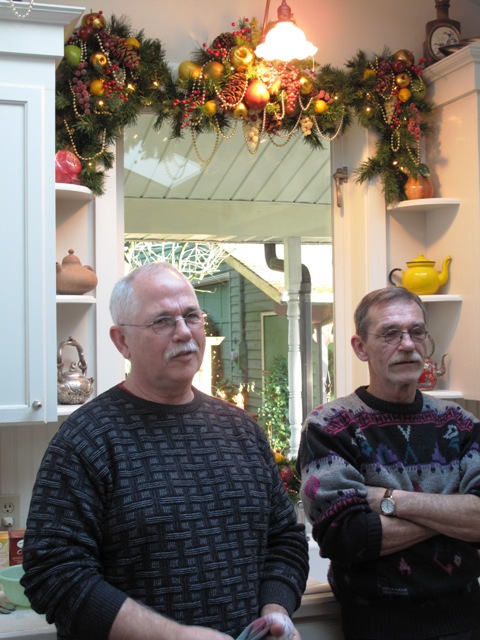
You might call them our holiday elves! In the kitchen with Greg Graves and Gary Waller

My pals Greg Graves and Gary Waller, owners of Old Goat Farm in Graham, Wash., are two such hunter-gatherers. 

It helps that the men acquired a Victorian farm house and a similarly pedigreed landscape (and a barn and several outbuildings) several years ago. Greg and Gary moved from the city to the country where they have created an appealing lifestyle-business that includes raising poultry, peacocks and goats (yes, there are a few goats here, even an “old” goat), propagating and selling unusual plants, and hosting legions of visitors to their Open Garden days in summertime and to their Holiday Teas in December. 

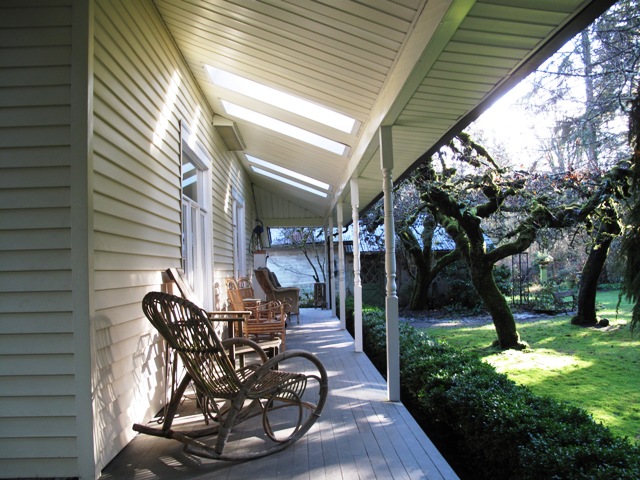
The farm house's irresistable covered porch overlooks the garden.

Gary, an award-winning floral designer, has amassed an impressive collection of holiday decorations (that’s what the barn is for – to store everything from santas and snowmen to ribbons, ornaments and lights). 

He and Greg decorate each room of the farmhouse with a specific Christmas theme and then invite their customers, friends, local senior groups and word-of-mouth partakers to attend their Holiday Teas.

People walk from room to room (bath included!), enjoy the highly-detailed decorations, sip a warm drink and sample the mouthwatering desserts. Greg tells me that Old Goat Farm will serve tea to 450 persons this month.

Two of the teas are fund-raisers for causes they support, but basically the entire endeavor is a gesture of community outreach. “We keep the price low because we don’t want to make it too costly for the senior groups to come,” Greg says. 

Here's Lorene, studying the tiny kitchen tree that's an ode to poultry on the farm (Gary hollowed-out all sorts of the eggs and decoupaged them with hen images).

One of Gary's hand-made egg ornaments.

Greg invited fellow garden writer Lorene Edwards Forkner and me to join last Friday’s tea when a last-minute cancellation opened up two slots at the table.

We donned our festive attire and drove to Graham/Orting. If you know about the city of Tacoma, the Graham/Orting area is due east of it. The Garden Conservancy-supported Chase Garden is a nearby horticultural destination. 

Let me set the scene up on our arrival: 

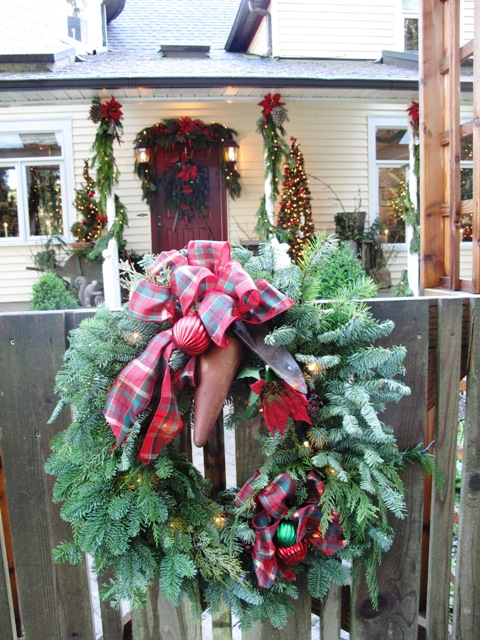
Festooned in garlands, plaid ribbons and old garden implements (!) the soft yellow farmhouse greets its guests. The entry wreath hangs from the front gate with a trowel and worn wood dibble (a planting device for enlarging seed or bulb holes). 

The front gate's wreath begins the decor theme with a trowel and dibble

Who wouldn’t love a huge covered porch that wraps around three sides of the 100-year-old Victorian residence? Each post is dressed in holiday finery, a pair of rusty old tools gathered up with an enormous lodge pole pinecone and the red-and-green plaid ribbon. 

The cheerful door decor has at its center a set of vintage child’s set of play tools – a rake and a shovel. Criss-crossed with more ribbon and cones, they welcomed our arrival (see photo at top). 

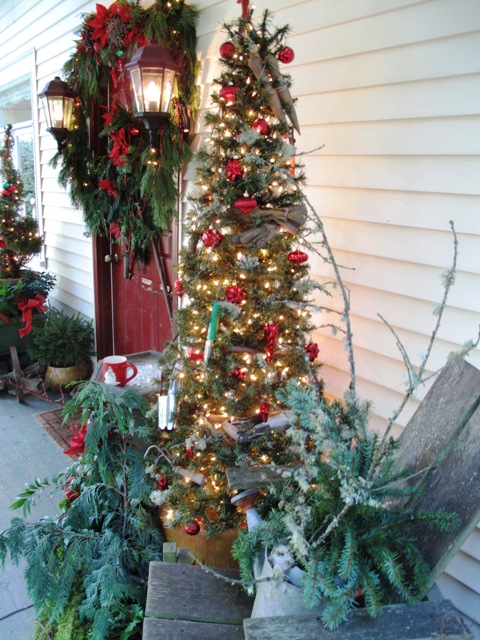
Front porch decor: love it!

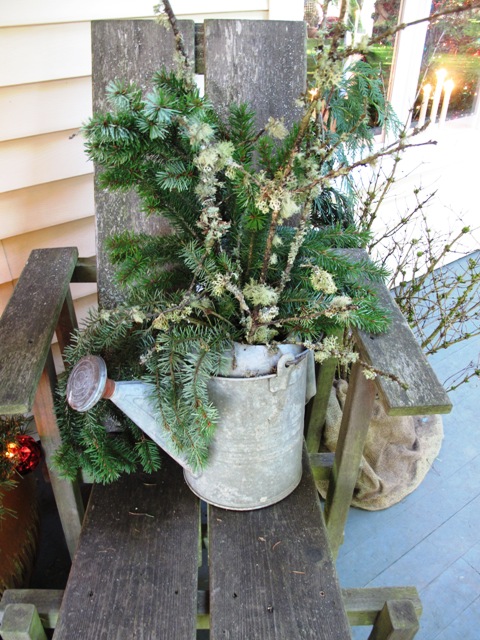
A galvanized watering can becomes an impromptu vase, filled with greenery gathered from the wooded landscape. And we feel transported to a century ago (almost) while touring the garden and the home. 

One of our favorite destinations at Old Goat Farm is “Linda’s Garden,” designed by Greg to memorialize the late, dear friend to us all, Linda Plato.

We lost Linda five years ago this month, a premature death brought on by breast cancer. Linda and Greg met in horticulture school as they both began their second careers. They worked together at the Elizabeth C. Miller Botanical Garden (where Greg is still on the staff as head gardener). They traveled the world to see gardens. Lorene and I were just happy to be small stars in Linda’s orbit. And we miss her. 

In Linda's garden, the double boxwood topiaries line the path that leads to the garden shed.

Linda’s garden is an homage to topiary. For you see, Greg and Gary would never have moved here to Old Goat Farm if it was not for Linda dragging Greg out there six years ago to buy topiary from the former owner who was liquidating her stock.  As Greg tells the story on his web site: 

Story of Old Goat Farm
In December of 2004, quite by accident, we found this beautiful little place while plant shopping with our good friend Linda. It is located just outside of Orting, WA, tucked below Mt. Rainier. We fell in love with this place, and by March of 2005, we were the owners of Old Goat Farm.

It is kind of a throwback to a simpler time with its 100-year-old farmhouse and cute barn and nursery. The garden is dotted with topiaries which give it a magical quality. 

“Linda once said: ‘What’s better than a row of topiaries? A double-row of topiaries!,'” Greg explains.  And that’s why you will see double-boxwood balls, pyramids, ovoid shapes and cubes lining both sides of the pathway that loops through the shaded, secluded and peaceful Linda’s Garden. Hurrah! It never fails to put a smile on my face. Please enjoy the photos of our visit to Old Goat. May we all be so lucky to have people like Greg and Gary, Lorene, and our dear Linda pass through our lives!

A small Christmas scene adorns the front porch.

A cedar garland wraps around the porch columns and each is topped with a huge pinecone and more vintage tools.

The full view of the farmhouse front door. Naturally, it's RED!

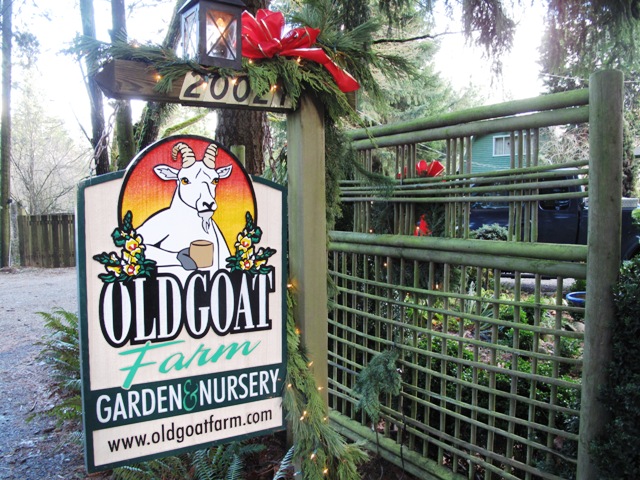
The perky old goat welcomes visitors to the garden and nursery.

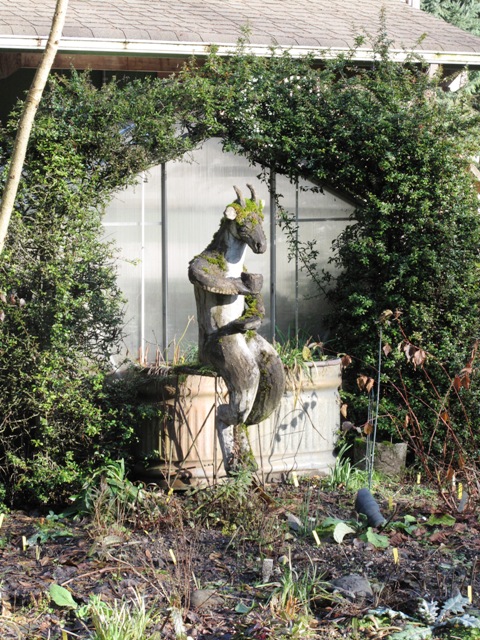
Here is the "old goat," carved from wood and sipping a mug of coffee in the garden.

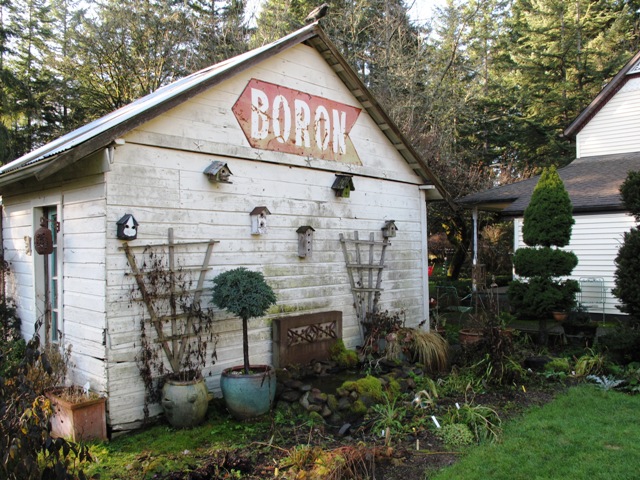
One of the wonderful barn strutures.

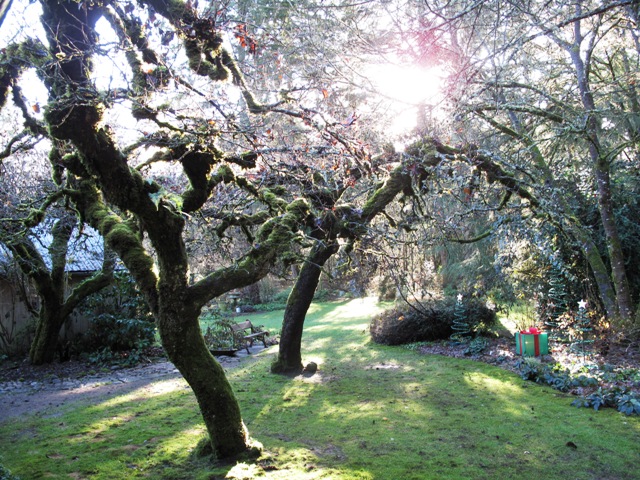
The ancient, moss-covered apple trees, backlit by the dim December sun.

A topiary bunny of variegated box, a work in progress by Greg (and an homage to Linda).

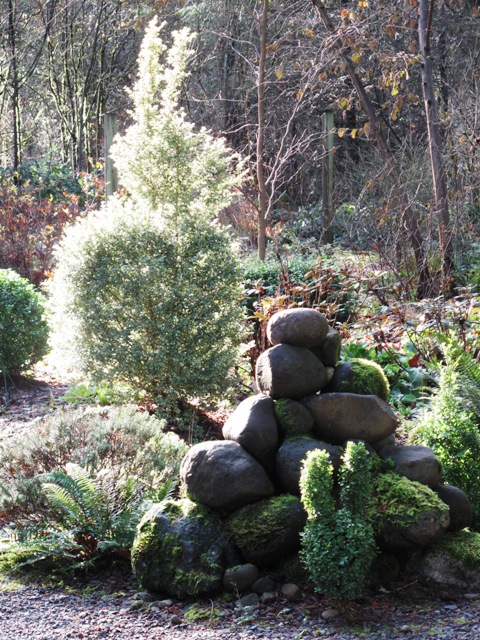
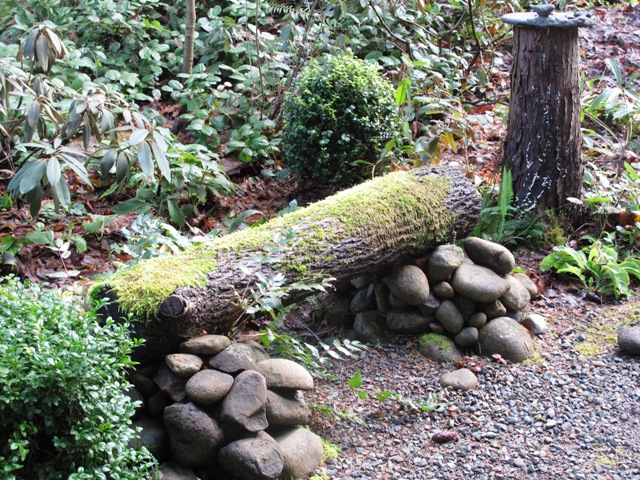
A moss-covered "bench" resting on two piles of stones. Note the mahonia that has seeded itself in the rockery.

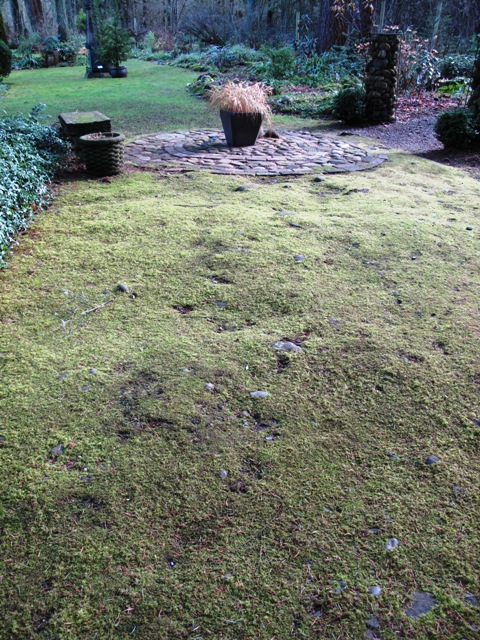
Yes, you can grow moss lawns here in the Pacific Northwest and this is one terrific example!

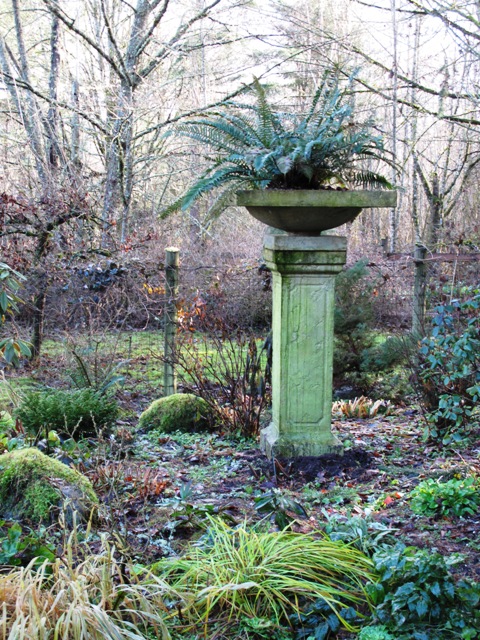
For amazing drama in the winter landscape, place an evergreen fern in an urn on top of a pedestal. Wow.

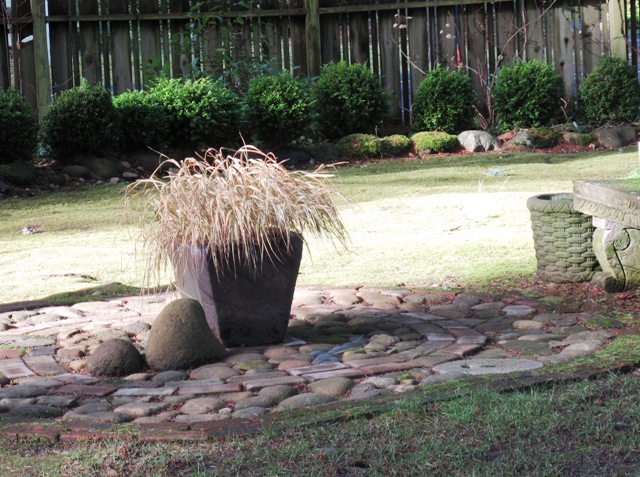
A circular stone "rug" that Greg recently added at the entry to Linda's garden - the ideal place to sit and be quiet.

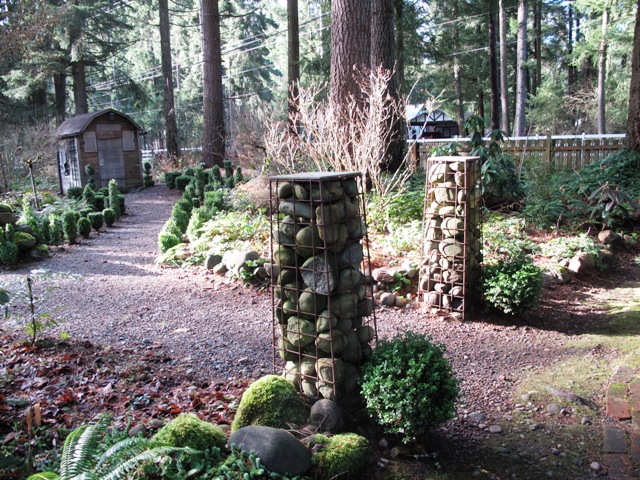
Stone gabion pillars guard the entry path to Linda's garden.

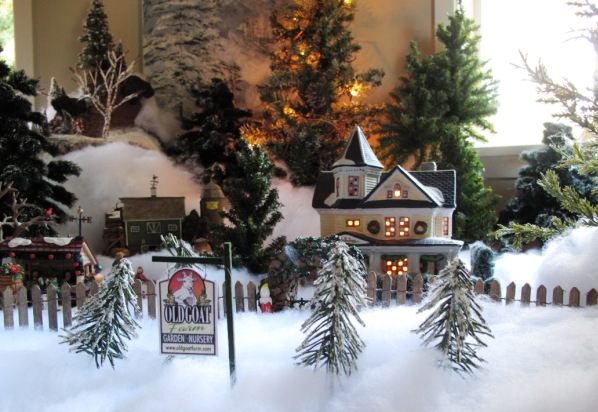
Merry Christmas from Old Goat Farm. This is a miniature version, complete with sign, created by Gary Waller.

Makeover ideas for your concrete garden ornaments

Saturday, December 4th, 2010

Meet Mark (aka "Marco") Henry ~ in his garden

On Friday, I enjoyed a rare luxury – a return to a favorite garden I’ve written about twice in the past decade: 

I hopped in the car and drove to Snohomish, Wash., where I lunched with two long-time friends from my days working for The Herald, the daily newspaper in Everett, Wash. (it’s a mid-sized city located about 30 miles north of Seattle). 

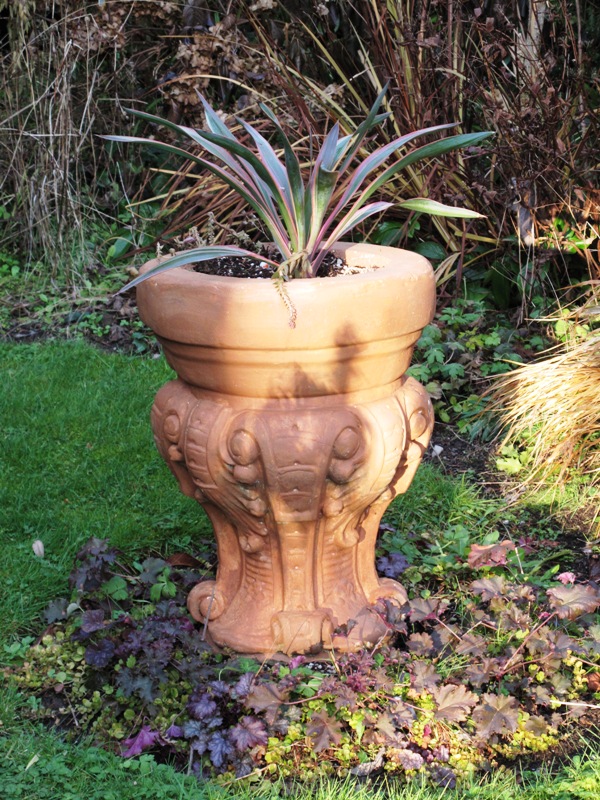
Here is a beautiful planter; once dreary gray concrete, it has been warmed up with a coating of terra cotta-colored Latex paint.

In the process, I learned something new about how to save drab, lifeless cast-stone (concrete) containers and garden ornamentation.

Read on for the simple steps

Marco Henry, a gifted artist, garden and interior designer and Venetian expert, hosted a little luncheon at his amazing home. We were joined by our mutual friend Darlene Huntington, one of my very first “sources” when I joined The Herald’s Home & Garden section in 2000.

Over the years, I have had the privilege of writing about both of these incredibly talented gardeners and their verdant, plant-filled environments. The two introduced me to other Snohomish County plant fanatics, owners of vintage homes, collectors of antiques and garden-makers. I have been so enriched as a writer and gardener from that 4-1/2-year episode of my life. 

After lunch we, of course, ventured out to Marco’s garden. Yes, it’s winter here in the Pacific Northwest, but when you have structural plants (such as Italian cypresses and ball-shaped boxwood shrubs), there’s lots to appreciate. When you see these elements, you understand what people mean when they say to design the “bones” of the garden for year-round interest.

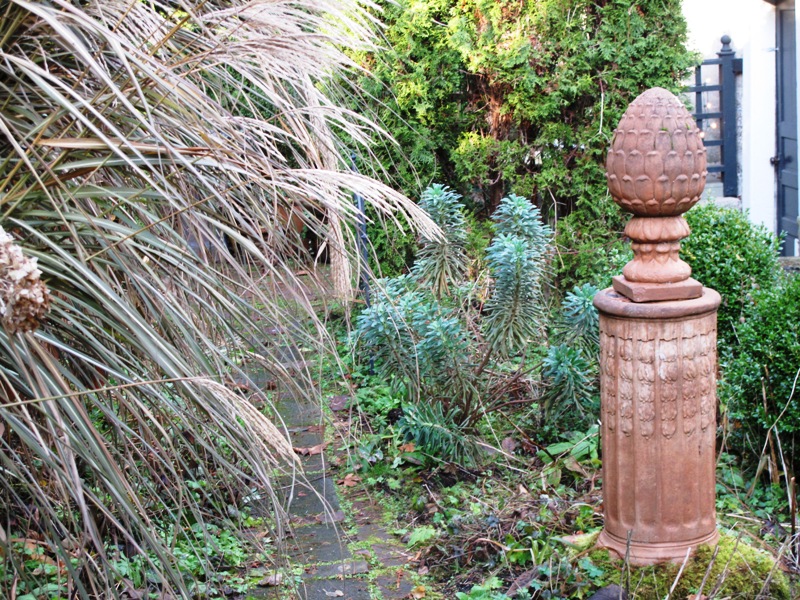
A simple coat of Terra Cotta pigment, from a can of Latex paint, transformed an old concrete pedestal and finial into a work of art.

I first wrote about Marco and his garden when it was included on the Northwest Perennial Alliance’s “Open Garden” tour  in 2000. Darlene marched me over to Mark’s home for an introduction. When I entered the Gothic-inspired wood gate, mounted into a niche in the beautifully-groomed hedgerow, I gasped and gazed in awe at what I saw inside: plant collections, art collections, vintage furniture, water features, sculpture and more – all surrounding a circa 1912 farmhouse and yard, complete with chicken coop and green house. 

This garden has the power to transport its viewer to a horticultural world we all yearn to possess. Is it a formal Italian garden? Or a cottage-style English estate? Maybe it’s a a landscape in the South of France. Each of these influences has a voice in Marco’s garden.

A teacher early in his career, Marco can be credited with giving a generation of fortunate kindergardeners an appreciation for art, color and beauty. Now, the grown-ups in his world can learn from his garden design techniques and his unique aesthetic.

My June 2000 article was called “Secret Garden.” I just unearthed that article and re-read it, savoring some of Marco’s choice quotes: 

“I’m a plant collector, a collector period. Some people put all of their collection together in one place. I don’t. I like to make something artistic out of it. 

“If I buy one of something I like, it’s the beginning of a collection. I could be Chinese porcelain or it could be coleus.” 

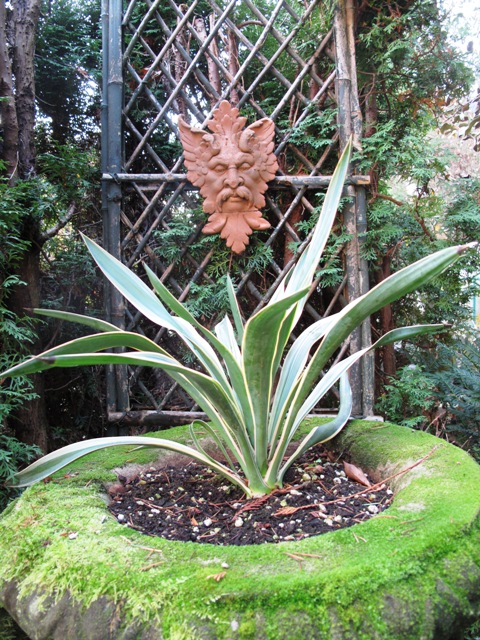
My eyes were drawn to the Green Man plaque, all the more noticeable now that he's been coated in Terra Cotta paint

Looks like original Terra Cotta, doesn't he?

In 2006, I was asked by Cottage Living magazine to again write about Marco’s garden. We had fun with that story, which was photographed by Richard Warren. I loved sharing Marco’s gardening style with a national readership, especially his tips on growing and designing with hydrangeas. 

Marco is passionate about Venice, a city he first visited in 1968 as a young man.  In a post-card written to his parents that year, he said he could imagine living in Venice. Now that dream is practically true, since Marco travels to Venice at least twice annually. He has guided many tours there for fans of Venetian architecture, art and gardens, and he lectures on the lessons we can learn from the gardens of Venice. 

Today’s lesson was all about Terra Cotta and the way it can warm up a garden, especially ones here in the Pacific Northwest that exist under a grayish cloud cover all winter long. Marco showed me several ornamental pieces that began their lives as uninteresting blobs of concrete. Concrete, he says, often recedes and is visually obscured by the greenery around it. Now he’s infused these pieces with the sun-drenched character of Italy. It’s a simple process and one I’m eager to try myself:

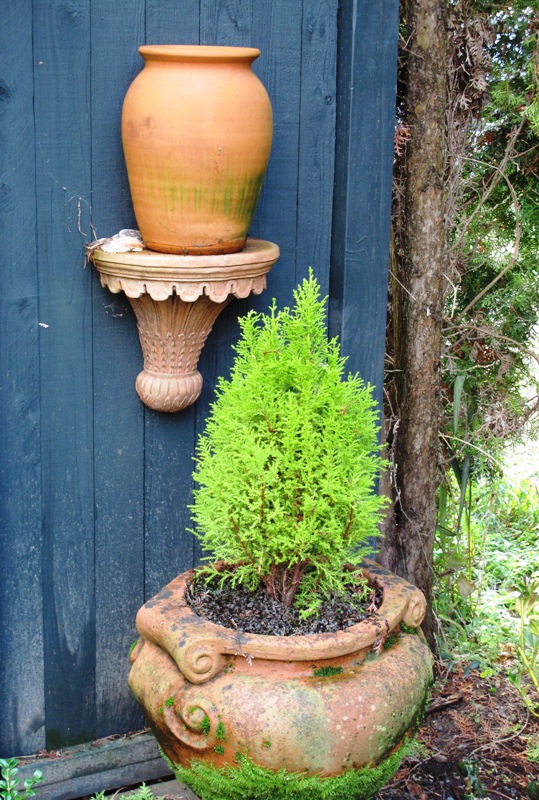
The little Terra Cotta "shelf" was transformed from gray cast-stone concrete to rich Terra Cotta - with Latex paint!

1. Find a piece of broken Terra Cotta pottery or a flowerpot with the perfect red-pink shade you love.

2. Take it to the paint store and ask the guys to mix up a can of paint that matches your sample. Be sure to order exterior Latex (water base) paint.

3. Fill a plastic bucket with some of the paint and drizzle in a bit of water to dilute it to a consistency that’s easy to work with. It can be more like a glaze or a stain in thickness.

4. Start painting any old piece of ordinary garden concrete. You may wish to coat the concrete with one, two, or three coats. The water-base pigment will “take” to the concrete differently, depending on how porous it is. Marco says the Terra Cotta-colored paint definitely “soaks” into the pores of the concrete.

5. Finally, you will enjoy what looks like perfectly-cast Terra Cotta. It weathers nicely and may soon take on a patina of age, moss, or lichen.

You’ll be pleased with the resulting appearance of your efforts. Old concrete gets a Mediterranean-style upgrade – to classic Terra Cotta. How easy is that? Thank you, Marco – great tip!

POST-Script: Thanks to Jim Bishop of San Diego-based Bishop Garden Design, who originally saw this post on my Facebook page, I want to share his cool ideas for painting concrete:

If you want to give (terra cotta) an immediate aged look, get a second can of (paint) in a darker version of the first color.

Water this down too or add a glazing agent and paint lightly over the object especially in the recesses. Rub off the excess until you get the aged look you want. Oil based gel stains work well too for creating an aged look and give you a longer working time.

Get out that paint, people! Have some fun!

New Garden Products for 2011 – Part Two

Tuesday, November 30th, 2010

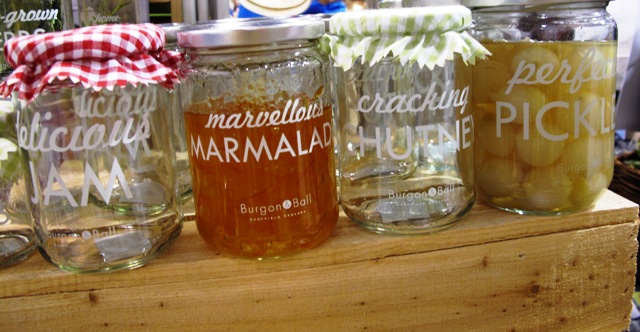
Preserve the Harvest with Burgon & Ball's charming jam, marmalade, pickles and chutney jars.

Trend-spotters are reading the horticultural tea leaves these days.

It’s an annual practice that I remember so well from my newsroom career when, without fail, we reporters were asked to compile the obligatory “forecast” story. I covered retail, and you could imagine how loathe Seattle’s major retail CEOs were to tell me anything about the coming year when it was just days after Christmas and they hadn’t tallied up the current year’s performance.

But, alas, we all want a glimpse into the future. And that’s what going to industry trade shows can help reveal. A peek into the products, plants, tools and design items you may be seeing in 2011’s backyards.

This post continues with even more interesting offerings. Or the ones that caught my interest anyway. I welcome your reaction. Are these items you can see yourself purchasing for your garden? Do you even NEED more products? (That’s a long conversation, isn’t it?).

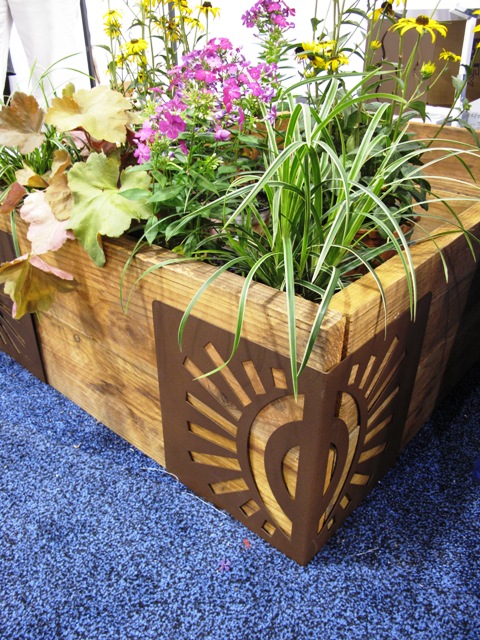
Here is the "sun" bracket from M Brace - simply brilliant!

I really enjoyed meeting Jill Plumb, a school teacher who came up with a brilliantly simple method of building raised beds.

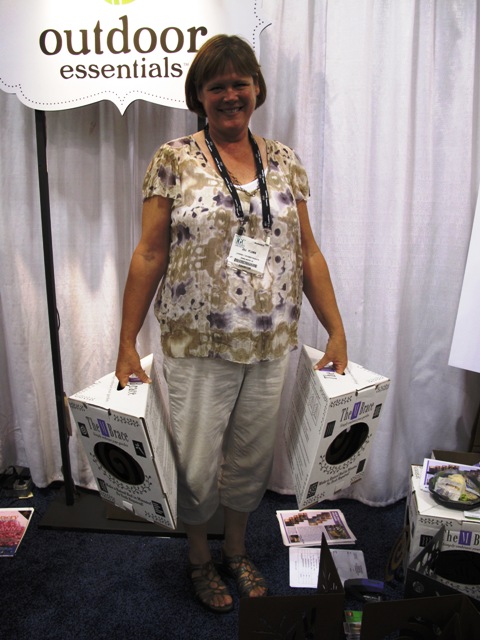
Her product is called M Brace. It is a decorative steel corner bracket that holds lumber at a 45-degree angle WITHOUT HARDWARE (note: this is a big selling point for anyone who has dragged the electric drill and 100-foot-long orange extension cord out to the backyard to try and wrestle together a box for the tomatoes).

Here's Jill demonstrating the nifty packaging for a pair of brackets.

Jill told me that she got this “big idea” one day while re-loading paper napkins into a “slot” style napkin holder.

Something clicked and she saw in her mind’s eye how easy it would be to have a bracket that emulated that napkin holder. Just larger, more durable and also pretty. Several prototypes later, including the support of her students who she involved in the design process, packaging development and marketing, Jill’s M Brace is looking very professional and has already hit garden center shelves in some markets.

Made from recycled steel (natural or powder-coated), with decorative cut-outs including a squiggle, sun, carrot or bamboo fronds, the set of 4 brackets has a $165/set recommended retail price. Jill continues to offer new product ideas such as “edging” made from the leftover swirl pieces or plant stakes from the leftover carrot cutouts. Brilliant!

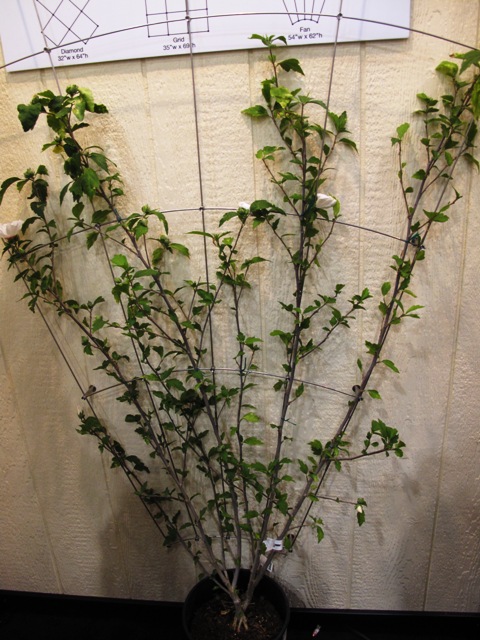
The Feeney 3-in-1 trellis, shown in a fan pattern

I spotted another clever system to corral plants – especially in this case, vines – in the Feeney Architectural Products booth.

A detail of the Somerset II Trellis

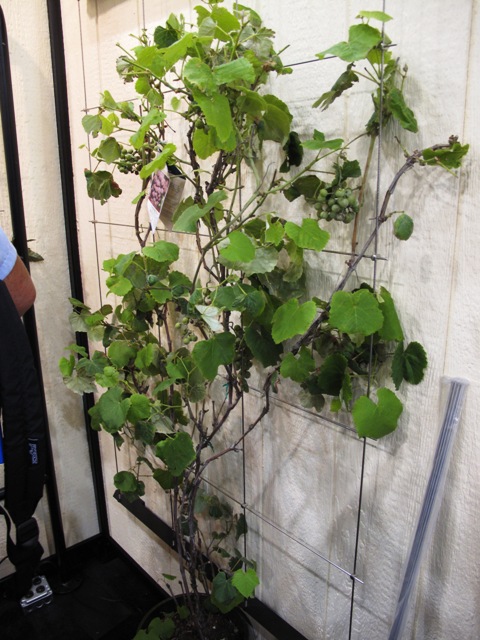
We see so much over-designed crap in the marketplace, which is one reason why I appreciated Feeney’s simple use of stainless steel cables to create a trellis for climbing plants. Feeney’s 3-in-1 Trellisis an easy-to-assemble wall-mount trellis kit with 1/8-inch diameter rods and special mounting components that can be configured into a Fan, Grid or Diamond design. This is a lightweight solution that does require measuring and drilling skills to install, but can turn a blah wall or fence into something quite beautiful. Just add a vine of your choice and voila! Something quite pretty. Suggested retail: $199.

Feeney also uses stainless steel cables in its inexpensive “It’s a Cinch” plant hanger and in a freestanding trellis panel kit. The Greenway Trellis has a frame of aluminum tubing and a square-grid pattern for the vines. The frame legs can be set in compacted gravel or concrete footings, or they can be base-mounted on a deck or patio. That square-grid pattern also shows up in the Somerset II Trellis, which has top and bottom powder-coated aluminum brackets. It is also a wall-mount system but a little larger than the 3-in-1.

READ MORE…

New Garden Products for 2011 – Part One

Saturday, November 27th, 2010

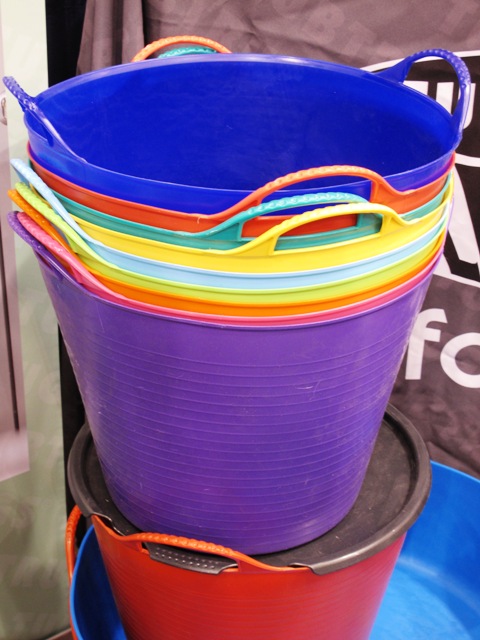
Here is an array of new 2011 Tub Trug colors

Part One of Two Consecutive Blog posts:
I was invited  by the producers of The Independent Garden Center Show, an annual trade show held in Chicago each August, to give two talks about garden and consumer trends. It was easy to say “yes,” because I had heard so much about this massive event. It’s the place to be and be seen for anyone in the gardening industry!

By experiencing the extravaganza first-hand and seeing what all the buzz was about, I got a real workout. With thousands of other attendees, I navigated the aisles and aisles of new garden products, tools, furniture, accessories and even plants. I managed to see it all over the course of three days – and here are my picks for the best new ideas that gardeners will see in 2011. 

You’ll likely discover these goods on the shelves of your local indy garden center, nursery or emporium. Follow the links to the web site for each company (some only sell wholesale, but many have store locator tabs). 

Ethel work glove

I’ve previously endorsed and written about the Ethel Glove so I wanted to stop by the booth of this cool Valencia, Calif.-based company to see what was new. The Ethel Work Glove, with an $8 price tag, is at first glance similar to the everyday rubber-dipped knit glove you’ll see at hardware stores and garden centers. But the Ethel staff explained that this glove is made from a durable knit material with a rubber palm, pads and fingertips formed by painting (rather than dipping) the gloves into a polypropylene finish. 

Ethel also has a new, slim and fashionable, black knit glove made from a bamboo-derived fine knit (protecting the cuff, back of the hands and fingers). The durable palm and pads are coated with a synthetic leather. 

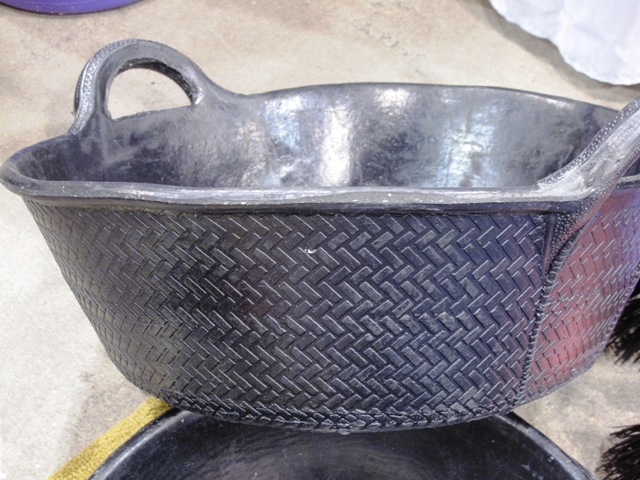
A reimagined rubber tire-turned-trug

Tub trugs come in a rainbow of colors. I own several of these excellent plastic garden carriers with handles. They’re great for hauling anything around the garden and useful for pruning,  dead-heading and weeding projects. 

The designed-in-the-UK and made-in-Spain tubs will soon be available in 10 new colors. There are also a few fun new products, including a color-coordinating push broom ($29.99 retail) and two sizes of trugs made from recycled tires. To me, these look like a riff on the Southern tire planters – they even smell like old Goodyears! Thicker and a little less refined than the sleek, Pantone palette-trugs, the black rubber ones will be available in January for $9.99-$12.99. 

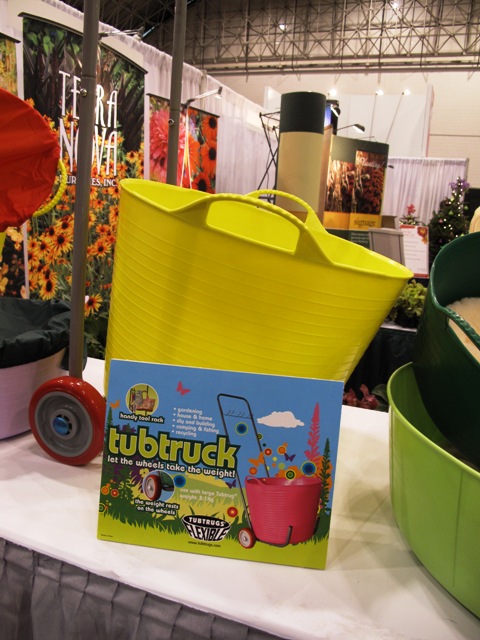
The tub truck - take it with you to the farmer's market!

For those of you who already own a medium or large trug, look for the January release of Tub Truck, a rolling carrier ($37.99). You can pop the bucket onto the frame and take it with you to a plant sale or farmer’s market. The handle has hooks for hanging additional bags. It’s a fun cart to pull behind you and a brilliant solution for gardeners. 

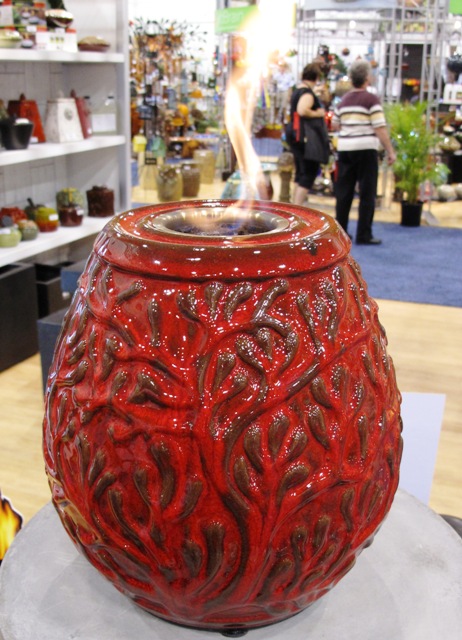
'Serenade' ~ a Napa Firelite, 12 in. tall

“Firelites” or fire bowls are all the rage. As Martyn Fernambucq of Napa Home & Garden puts it: “Fire is such a hot commodity right now.” 

I first noticed this new product category when an editor at Better Homes & Gardens sent me a photo of a small ceramic lantern with a flame (not a wick, mind you, but a 2-inch diameter flame that was flickering 2-3 inches above the round opening in the lantern). That’s when I went online to learn more and discovered that the lanterns are fueled by a long-burning smoke- and odor-free gel.

Like many things that bubble up to one’s consciousness and elbow their way onto one’s radar, it’s not really a surprise that the very next day I went to an al fresco dinner party for a friend where the hosts’ boathouse was illuminated by these flaming lanterns. Clearly they are decorative. The flame can’t  be blown out by a gust of wind (as would be the case with a candle).

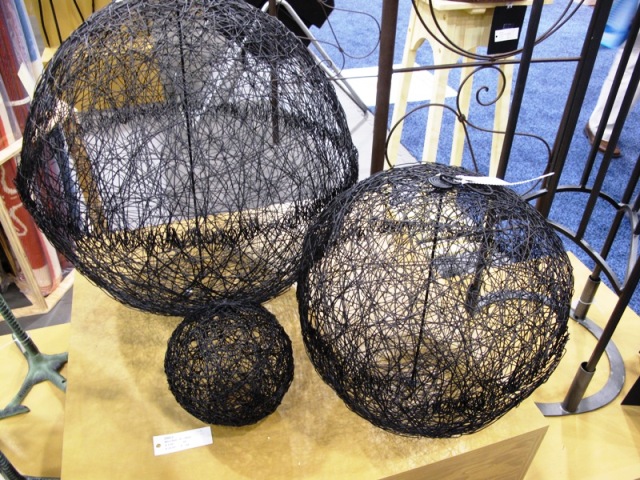
Mesh orbs by Achla Designs

I’m all about orbs, spheres, globes, and balls as sophisticated garden ornamentation. My favorite piece of sculpture features a filigree-style wire mesh ball with a random “scribble” pattern. It was designed by artist Jennifer Gilbert Asher of TerraSculpture and fabricated by Mario Lopez in his Los Angeles metal shop. 

If you like this custom-designed and fabricated look, you might like the black wire orbs that are slightly reminiscent of Jennifer’s designs. I spotted them in Achla Designs booth. Nice design in small (6-inch), medium (12-inch) and large (18-inch) sizes. 

A sunflower pillow - perfect for the patio

Outdoor textiles are more interesting than ever, moving way beyond awning striped polyester choices. 

So of course, the Liora Manne booth lured me in and I was eager to learn more about the gorgeous, patterned pillows made with a felting-like process. 

The Lamontage pillows are made of 100% antimicrobial polyester microfiber for indoor/outdoor use. They measure 20-by-20 inches or 12-by-20 inches with removable, hand-washable covers. The collection includes place mats and outdoor rugs, as well. 

According to the Liora Manne web site, Lamontage is a technique “in which acrylic fibers are intricately structured by hand and then mechanically interlocked by needle-punching to create a nonwoven textile. Lamontage is based on the idea of versatility; breaking the boundaries of traditional textiles and creating a unique textile with unlimited possibilities.” 

READ MORE…

Meet the new generation of mums

Tuesday, November 23rd, 2010

Seatons Toffee, a 'quill' form with deep bronze petals.

I have great memories of the giant yellow chrysanthemum corsage my dad bought me for a college homecoming when I was a little girl. That curly ball of petals was so unwieldy it was hard to keep from crushing it with my chin. To me, that mum didn’t even feel real – it was like something from a fantasy world of my dreams.

My relationship with mums hasn’t really changed much since then. I’ve always kept them at arm’s length, both in garden design and in floral arranging.

The only time mums registered on my radar in the past decade was the celebrated arrival of ‘Kermit’, a lime green mum with a button-like flower that gained a huge following for its zesty color and knack for looking good in a vase for up to two weeks. But what about other mums?

Lots to learn

'Yoko Ono' is a top pompom-style mum with that awesome green hue.

Any ambivalence I’ve had about mums changed for the positive after I met two leading mum experts at the Association of Specialty Cut Flower Growers annual symposium in Tulsa, Oklahoma earlier this month.

On one of the long bus rides, I sat with Ray Gray of King’s Mums, an Oregon City, Ore.-based grower of “exhibition, specialty and vintage chrysanthemum rooted cuttings.”

Ray shared a bit of the story behind how he and his wife Kim purchased King’s Mums in 2008. The Grays are longtime wholesale nursery owners who were looking for ways to diversify their crops. They learned from Janet Foss, another grower, that King’s Mums was for sale.

'Yodogimi' is a semi-double mum with dark red petals tipped in gold.

For more than 40 years, the King family operated a huge Chrysanthemum-growing operation in Central California. The business served the amateur gardener and professional grower with more than 200 cultivars of exhibition and spray mums, one of the largest sources in the U.S.

After buying the business, Ray and Kim in January 2009 moved this amazing collection to their small family farm in Oregon City. They are carrying on the tradition begun by the Kings while also implementing new technologies and growing methods.

'Two Tone Pink' has petite pink-purple petals with white tips.

Ray gave me a copy of the King’s Mum catalog and right away I started drooling over the cultivars between the covers. As a cut flower choice, the mum is superb. The palette leans toward the warm end of the color spectrum, which is very en voguewith today’s floral designers: bronze, gold, terra cotta, salmon, champagne, orange, crimson, pink-red, lime green, apricot, burgundy, and all sorts of luscious bi-colored petal combinations. And of course, there are also pastel, cream and white flowers.

'Senkyo Kenshin' is a dark bronze 'spider' form - magical!

I know this is probably all old news to people in the National Chrysanthemum Society, and to specialty cut flower growers and their floral design clients. But I found it thrilling to meet Ray and learn how he and Kim are keeping alive this important cut flower category. Yes, I started to fantasize about growing some of these blooms in my own garden.

Note to self: King’s Mums is open to the public each October. Located about 20 minutes south of Portland (Oregon City is the end of the historic Oregon Trail), you can visit during business hours and see these yummy flowers up close and personal.

A beautiful punch of color comes from mums filling the hoop house at Bear Creek Farm.

There is another reason why mums stayed on my mind at the ASCFG conference. After meeting Ray and flipping through the beautiful flowers in his catalog, I was stunned to walk into one of Vicki Stamback’s hoop houses at Bear Creek Farms to discover rows of these very mums I’d just seen in that catalog.

I have to confess, I was a bit antisocial while skipping out of the demonstration of releasing beneficial insects in the greenhouse. But I wasn’t the only one climbing between the shoulder-high rows of mums, taking photos of these really superb blooms and making sure to jot down the name of each. These flowers were impossible to ignore as you can see here.

The following day, I sat in on “The Comeback of the Mum,” a presentation by Chehalis, Wash., grower Janet Foss. I learned enough to become a confirmed mum fanatic. You can read a summary of her presentation at A Fresh Bouquet.

I’ve got to share the rest of these incredible specimens:

A mini terrarium to hang from your tree boughs

Monday, November 22nd, 2010

Okay, I know that there is still one more week left in the month of November, but we had a big Seattle snowstorm today and so visions of sugarplums are dancing in my head.

One other reason I’m dreaming about my holiday decor is the just-arrived December issue of Better Homes & Gardens. It hit newsstands with a really gorgeous wreath on the cover and all sorts of design, entertaining and gift-giving ideas filling 275 beautiful pages.

A medium-sized glass "world" to gaze upon in wonder.

I was asked to pick my favorite garden gift for the holidays and you can read about it on page 153. Or you can see it here: An alluring “Forest Floor” ornament created by San Francisco designer Flora Grubb. It is a winner! Thanks to Flora for suggesting we feature one of her custom ornaments and for sharing the photograph you see here.

Living Ornaments:

It’s fun to use living elements and wild-gathered souvenirs from nature in your holiday decorating. I love this “Forest Floor” glass ornament created by San Francisco designer Flora Grubb. Lichens, moss, feathers and seeds cushion a living Tillandsia air plant inside a tiny glass ball – an enchanting, diminutive naturescape to hang from branch or bough.

An occasional spritz of water is all this tiny terrarium needs to continue looking beautiful – even after you take down the tree. Available from www.floragrubb.com; 3-inch, $19.95; 4-inch, $24.95; set of three 2-inch balls, $19.95.

Cool, huh?

Some good news for the print world:

For those of you who subscribe to the New York Times, you can’t have missed a full-page advertisement on the back of today’s Business section. It’s so huge that I couldn’t scan the entire contents of the colorful spread on my tiny printer. But here’s the gist of it:

Better Homes & Gardens, along with Meredith Corp. sister title Family Circle, are the magazine world’s #1 and #2 top books for women consumers, in terms of total advertising pages sold.

Under the leadership of editor-in-chief Gayle Goodson Butler and SVP, Group Publisher James T. Carr, Better Homes & Gardens has earned the support of 1,739 advertising pages this year. 

Just when everyone thinks magazines are a dying breed, here’s a report that “these magazines have held the top two positions in the women’s lifestyle category for 2010 and 2009.”

Just sayin’.

A tour of the Chartreuse House garden

Saturday, November 20th, 2010

You can't miss the Chartreuse House, seen through the similarly-colored plant palette.

Today’s Los Angeles Times’ HOME section features my architecture/interiors story about Lisa Little and Phil Brennan’s makeover of a pair of tiny cottages in Venice, Calif.

The Venice-based architect and her special effects wizard husband painted the exterior an acid-chartreuse color and trimmed the house in charcoal gray.

Click on over to the story and you’ll see a fabulous web gallery of images shot by photographer Katie Falkenberg.

I also included a sidebar on Stephanie Bartron’s amazing work in the postage stamp-sized front yard, which faces a Venice walk street, which appears in LA at Home, the Home section’s daily design blog.

But you really can’t see much of the garden in the Times’ web gallery.

I promise you – it’s something to behold, featuring a dazzling palette of plants that enliven the small entry garden and play beautifully with the rugged materials Stephanie selected.

So I will share those photos here, along with the sidebar text:

A Chartreuse garden

As a color-packed accent to the renovated 1905 Craftsman bungalow, the Chartreuse House’s front yard is a example of how much great design can occur in a tiny patch of soil.

Yet before choosing a zesty palette of drought- and salt-tolerant plantings, designer Stephanie Bartron, of SB Garden Design, had to address some of the less visible challenges of the property’s postage stamp-sized entry. Prior owners had piled layers of topsoil over the sandy native soil, which created a drainage mess.

A wave-like pattern gives lots more interest to the raised bed.

“I needed to lower the grade of the front yard in order to move water away from the house,” Bartron says. “We calculated the volume of soil to excavate and used that amount to fill two raised planters. That way we didn’t have to haul away any material.”

Divided by a permeable walkway of concrete tile, the raised planters are formed by boxes of thick steel plate that have been roughly finished to encourage rusting. Now weathered, the boxed-beds replicate the Cor-Ten steel used to make the vertical planter in Little and Brennan’s courtyard.

The same weathered steel forms a slender raised planter at the base of the charcoal fence facing the walk-street. It is filled with a ribbon of golden oregano and Sedum rupestre ‘Angelina’ — which dazzle against the darker fencing.

The chartreuse scheme continues outside the gray composite fence.

Bartron asked the metal fabricator cut a “wave” detail along the top of the larger planting box and in it she installed a sedge meadow, a nod to the nearby beach.  Privacy screening comes from a “hedge” of weeping Mexican bamboo and alternating chartreuse and yellow-flowering kangaroo paws.

“The plants create a punch of color in  such a small space,” Bartron says. The lacy bamboo fronds, the tall kangaroo paw stalks and the undulating drifts of sedge are constantly moving, thanks to the ocean breezes. Little added a eucalyptus tree to the front area, situated so that it will eventually grow high enough to screen the house’s topmost windows.

Such a simple yet sophisticated combination of plants in the smaller of two raised beds.

For the smaller of the two planter boxes, Barton paired dramatic clumps of smooth agave (Agave attenuata), known for growing well near the ocean, with Mexican feather grasses, dark purple Aeonium arboreum ‘Zwartkop’ and yellow-and-green variegated New Zealand flaxes. The entire bed is under-planted with the chartreuse Sedum rupestre ‘Angelina’. Filled with detail, it is a diminutive landscape that causes visitors to slow down and experience while approaching the front door.

The garden has many sustainable features, including low-maintenance plantings and permeable surfaces. Yet, says Bartron, its main design motivation is a response to the architecture. “This is such an artsy, whimsical place and I see the garden as a colorful jewel box for Lisa and Paul to enjoy.”

–Debra Prinzing

I’ll close with just a few more photos:

The larger of the two raised beds is planted mostly with Carex, to emulate the waves of the nearby Pacific Ocean.

This view shows how the Mexican bamboo and the kangaroo paws provide ample screening from the walk street traffic.

Playful and suitable for the setting, the lemon yellow kangaroo paw sways in the breezes.

What to do with salvaged shutters

Thursday, November 18th, 2010

Read on to learn what I'm going to do with these amazing shutters!

I recently spent the morning at a cool local flea market in Seattle. I was up early and out the door by 7:15 a.m., ready to get my creative juices going.

My mission: to discover as many castoffs from others that could make their way home with me.

The destination: 2nd Saturdayz, a popular flea market where vendors, dealers and designers come together to do business with salvage-savvy shoppers.

The apt motto: A Saturday Market of Fine Tastes and Curious Treasures.

Once inside the doors of a huge hangar (yes, the flea market is held at a decommissioned Naval base), I met up with Jean and Gillian. But not too much socializing is encouraged at these events. That is, IF you want to get the best deals. First-come, first-serve is the motto. Or: Every woman for herself.

I shouldn’t limit this endeavor to the female salvager because there were many men in attendance at 2nd Saturdayz. But still, you know what I mean. It’s a gal’s paradise.

Galvanized chicken feeder. 30 sizeable oval openings. A succulent planter or a flower holder? Or both?

Lately, I’ve been collecting vintage flower frogs, which makes sense since I’m living and breathing floral design. But this time, instead of finding glass and metal frogs, cages and stem-holders to displace the dreaded florist’s Oasis, I picked up a galvanized metal chicken feeder.

Think of a loooong ice-cube tray with oval cutouts. In metal. Very cool. Now that I’m looking at it again, I may just use this nifty piece as a planter for hardy succulents. It’s probably leaky so that’s going to give the drainage I’ll need.

A nearly-pristine child's typewriter complements my grown-up Underwood.

I also picked up a vintage child’s typewriter. It can play nicely with my retro black Underwood typewriter that we bought back in 1985 at the Rotary Club Auction on Bainbridge Island. I think I paid $5 back in the day.

Those old typewriters, truly relics, are now priced at $50 on up. And to think so many of them have been dismantled to make jewelry from the letter keys. I’m guilty of buying one of those alphabet bracelets, too.

When I walked into one small “booth” with my friend Jean, an awesome Seattle landscape designer, I found myself absent-mindedly stroking the frame and spindles of a cast iron baby crib. The vendor had taken off one of the crib’s side-rails and piled pillows and cushions on the springs and against the three remaining railings.

Here's the end of the baby crib. Next time you see this, I'll be lounging against some cushy pillows, perhaps under a shade tree. This crib will become my garden bench.

What did it recall? Yes, a very fashionable garden daybed or bench. And for $100, I totally lucked out. My friend Gillian, who is a pro at this sort of buying-and-selling of antiques and vintage items at Ravenna Gardens, pulled me aside to share the secret that she’s seen other dealers selling cast iron baby cribs for $600. I don’t have a “garden” in which to place this bench right now, since I’m in a rental house and I’m not yet ready to invest energy on land I don’t own. But . . . I did decide to bring this crib home and store the pieces in the garage until the next garden comes along. Luck-ee me!!!

I couldn’t ignore the central element inside the warehouse – a little hamlet of potting sheds. Their perky corrugated metal roofs, topped with finials created from shiny bits and pieces, stood high above the flea market’s landscape.

While gazing at the rustic but stylish potting sheds, I met designer/builder Bob Bowling. Owner of Bob Bowling Rustics of Whidbey Island, this engaging shed artist greeted me and generously shared his story.

Turns out, like some of the talented folks we featured in Stylish Sheds and Elegant Hideaways, Bob makes unique structures using reclaimed and recycled materials. Whimsical and playful, and finished off with salvaged windows, doors and other artifacts, the Rustics sheds are each a delight to see.

Bob's cool garden shed was hard to miss.

The "stripes" come from variously-stained boards.

The prices are reasonable, too. I should know. For $3200, you can get this “Rasta” shed. It measures about 7-by-7 feet in diameter (plus or minus) and features cool details, like the exterior of alternating stripes of differently-stained boards and the window boxes, door hardware and towering finial.

You could easily spend this much for a pre-fab storage or tool shed on the lot of your local big-box store. Which would add more art and style to your life, while also being quite functional?

All this thrifty flea-market shopping had energized me and made me feel quite artistic.

And then I met that shutter duo that called my name. Loudly. They appear to be half-circle crowns or eyebrow tops from a set of plantation shutters.

Wooden, with 2-inch deep slats, these pieces were displayed separately. Once I noticed both of them, I was not going to leave with just one! I don’t think I got a huge bargain, since I paid $28 apiece (but the seller insisted she had just cut the price in half). Whatever. When you spy something so uncommon, you have to act.

Other than changing the depressing buff-colored paint job to something more lively, what on earth do you suppose I will do with these crescent-shaped pieces?

Hello! You two are pretty darned cute. That Baylor Chapman is uber-talented!

Here's another small shutter-turned-wall garden, compliments of Baylor Chapman.

For inspiration, I hearkened swiftly to my visit to Baylor Chapman, a talented San Francisco floral and garden designer I recently profiled for A Fresh Bouquet. After my friends Susan and Rebecca took me to meet Baylor at her floral studio, the three of us accompanied her to her loft apartment in SF’s Mission District.

And there on the outside roof deck, were some pretty amazing succulent gardens – PLANTED IN SHUTTERS!!!

Naturally, I am going to draw from this incredibly clever idea and put those twin shutters to very good use with a vertical planting of hardy succulents. It may take until next spring, but stay tuned. And if you have any suggestions on what color I should use to upgrade the crappy paint color, please chime in.

The trick, according to Baylor, is to secure a layer of landscaping cloth like a little pocket or envelope behind each shutter opening. Then you can add potting soil and plant your sedums, succulents or whatever else seems fitting. You know, I really do love that chocolate brown finish on the shutters. Doesn’t it nicely offset the silver, gray, blue and green foliage of the succulents?

Well, all in day’s work. More to come as I execute these big plans.

Sunday in the park with Debra

Saturday, November 6th, 2010

Dahlia 'Duo'

Last Sunday morning, while staying a few extra days in San Francisco after my Garden Conservancy talk, I took two Muni buses (47 & 5) to Golden Gate Park where all things artistic, botanical and cultural seem to reside.

My objective was to see the amazing living roof at the California Academy of Sciences, but once I realized I only had 90 minutes, my plans took a slight detour. Art and flowers beckoned.

The Conservatory of Flowers, with Dahlia Dell in the foreground

First stop was the Conservatory of Flowers, circa 1879. It is one of the last remaining Victorian-era conservatories on the West coast (the other resides in Seattle’s Volunteer Park). Before I could even approach the conservatory, my attention was diverted by a late autumn display of dahlias.

Called “Dahlia Dell” and dating to 1924, two demonstration flower beds thrive here, located to the east of the conservatory. They are maintained by volunteers from the San Francisco Dahlia Society for the simple purpose of educating local gardeners and flower lovers about the diversity of dahlia color, form, size and culture. I have a feeling that Paula Jaffe, a dahlia expert and educator who I profiled in “Dazzling Dahlias,” a 2008 Perennials magazine article, is one of the passionate individuals responsible for this joy-inducing floral display.

It was fun to play around with the “tulip” Macro button on the back of my Canon G10 camera and take pics of the fading beauties. These dahlias have withstood the combination of late-season rain, fog and sunshine and they’re still producing pretty blooms. I can’t wait to grow dahlias again, especially because they play well with flower vases. Really well. Enjoy this diverse display. Most (but not all) of the plants were labeled, thankfully.

Dahlia 'Western Spanish Dancer'

Dahlia 'The Phantom'

Dahlia 'Sir Richard'

Dahlia 'Shipley Spot'

Dahlia 'Shea's Rainbow'

Aptly named: Dahlia 'Pooh'

Dahlia 'Pink Paradise'

Dahlia 'Horse Feathers'

Dahlia 'Green D'Or' orange sport

Dahlia 'George C'

Dahlia 'Elvira' (a miniature)

Dahlia 'Delta Red'

Dahlia 'Creamy Beige'

Dahlia 'Bo De O'

Dahlia 'Belle Fiore'

Dahlia 'Badger Twinkle'

Dahlia 'Arulen Princess'

MORE TO SEE

The de Young's tower - against a blue autumn sky.

After spending an hour with the dahlias, I moseyed over to the California Academy of Sciences, but discovered that – from ground level – it is nearly impossible to see, let alone get a sense of its scale and magnificence, Renzo Piano’s green living roof.

So I compromised and spent my museum admission budget to enterthe de Young art museum where “Van Gogh, Gauguin, Cezanne and Beyond: Post-Impressionist Masterpieces from the Musee d’Orsay” was in full swing. It was exciting to see the many amazing and exciting canvasses on display. I’ve been to the Musee d’Orsay twice before when in Paris and so I enjoyed revisiting some of the paintings and drawings again. Twelve galleries of paintings were incredible to take in. You can never have too much of this artwork. The show continues through January 18, 2011.

Here's a closer look at the pointillistic-style perforated copper exterior.

After I left the galleries, I took the elevator to the viewing tower.

Actually, this was the first time I’ve been to the de Young since it was renovated and reopened in October 2005. The “new” building is clad in a perforated copper sheath, which may sound rigid but has a sensual fluidity that reacts to the light and dark.

Depending on how the sun moves through the sky, the building’s surface has dot-like patterns and a shimmery quality. The 144-foot tower is one of the most alluring aspects of the new design, by Swiss architecture firm Herzog & de Meuron and Fong & Chan Architects in San Francisco. From way up high, you can see the best of San Francisco – a 360-degree, mind-blowing perspective.

This roof is incredible - a horticultural masterpiece on top of the California Academy of Sciences in SF

A closer look of one of the roof's mounded forms

From here, I got some photographs of that green, living roof.

 I’ve already decided that on my next visit to San Francisco, I will have to see that installation up close and personal. Because while peering down on it and photographing it (through the glass-walled viewing gallery), I noticed that people were up on the roof doing just that.

Not a bad lineup for a few hours at Golden Gate Park, huh?