Debra Prinzing

Get the Email Newsletter!

Archive for the ‘Creativity’ Category

Art in the garden

Monday, January 5th, 2009

Here’s my January 2009 “In the Garden” column for 805 Living magazine, featuring artist and designer Jennifer Gilbert Asher and her beautiful sculpture.


GARDENS AS GALLERIES: Choose and place ornamentation with a thoughtful eye toward your garden’s overall design.

Why do artful objects – such as sculpture, salvaged architectural fragments or even a birdbath – make such an impression in the garden?

Like adding jewelry to a little black dress, or a few bright pillows to a tired sofa, artwork, sculpture and ornamentation can take any garden from ordinary to extraordinary. Well-placed art adds to, rather than detracts from, the overall composition. In the winter, when the garden is quieter, artwork often takes center stage.

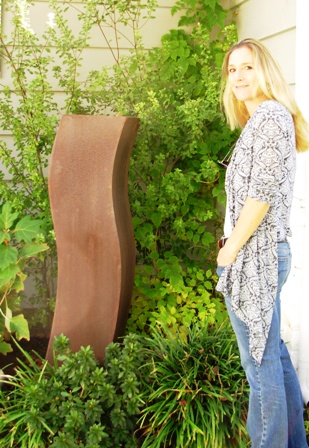
“Even though sculpture is a four-season element in the landscape, it becomes the star of the show when everything else is going dormant,” says Jennifer Gilbert Asher, principal of Woodland Hills-based Chilmark Gardens. [see Jennifer, right, with “Curvas,” placed in her own garden.]

Precious objects, displayed side-by-side with foliage and flower – or partially hidden among the stems and branches of a favorite plant – give a garden its personality. They also communicate volumes about its owner’s taste and style.

“I place sculpture not just to complement the garden, but to transform it,” Asher says. “A captivating sculpture can spike curiosity and provoke thought. It can be playful or energetic; meditative or even sensual.”
Asher was inspired to design a collection of bold, modern pieces after she had trouble finding affordable artwork for her client’s landscapes. “I was shocked at the lack of accessible fine art for the garden. I heard the same thing from other designers, all over the country. You shouldn’t have to be a millionaire to transform your landscape into an outdoor art gallery,” she says.

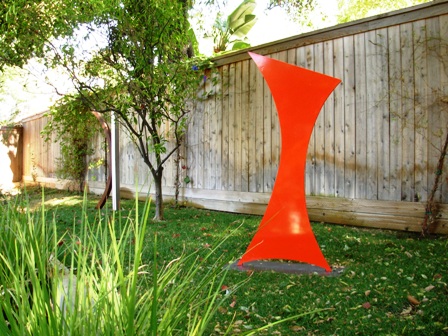
She teamed up with Los Angeles entrepreneur Karen Neill Tarnowski last fall to launch TerraSculpture, an online art gallery and sculpture studio. Asher design and create abstract, graphic forms in stainless, weathered and powder-coated steel.  TerraSculpture uses durable, outdoor-friendly material such as 11-gauge steel; finishes vary from brushed stainless to eye-popping primary colors. [at left: “Leap”]

With names like “Embrace” and “Closer,” many of the pieces evoke human emotions. And unlike the type of sculpture you’d see in public parks or museums, which is far too large for the domestic landscape, TerraSculpture’s designs range from 4-1/2-feet-tall to 6-1/2-feet-tall. (For customers whose homeowner-association covenants restrict anything that appears above backyard fences or walls, these dimensions offer added benefits.)

READ MORE…

Recycled column debuts in LA Times

Saturday, January 3rd, 2009

You spy a weathered castoff, a tarnished this or a timeworn that. What is the first thing that comes to mind? “Don’t throw that away! I can find a good use for it.”

The designer’s mind will recycle, reinvent or re-imagine the piece of “junk,” giving it a new purpose as an object of style. Read on for the first installment of a new column that features local designers and resources for transforming otherwise unusable objects into home décor.

Today’s HOME section of the Los Angeles Times introduces a new feature about recycling old objects for home and garden decor. It’s the brainchild of editor Craig Nakano and we hope this is just the beginning of the “hunt” for cool ideas that give new life to elderly castoffs.

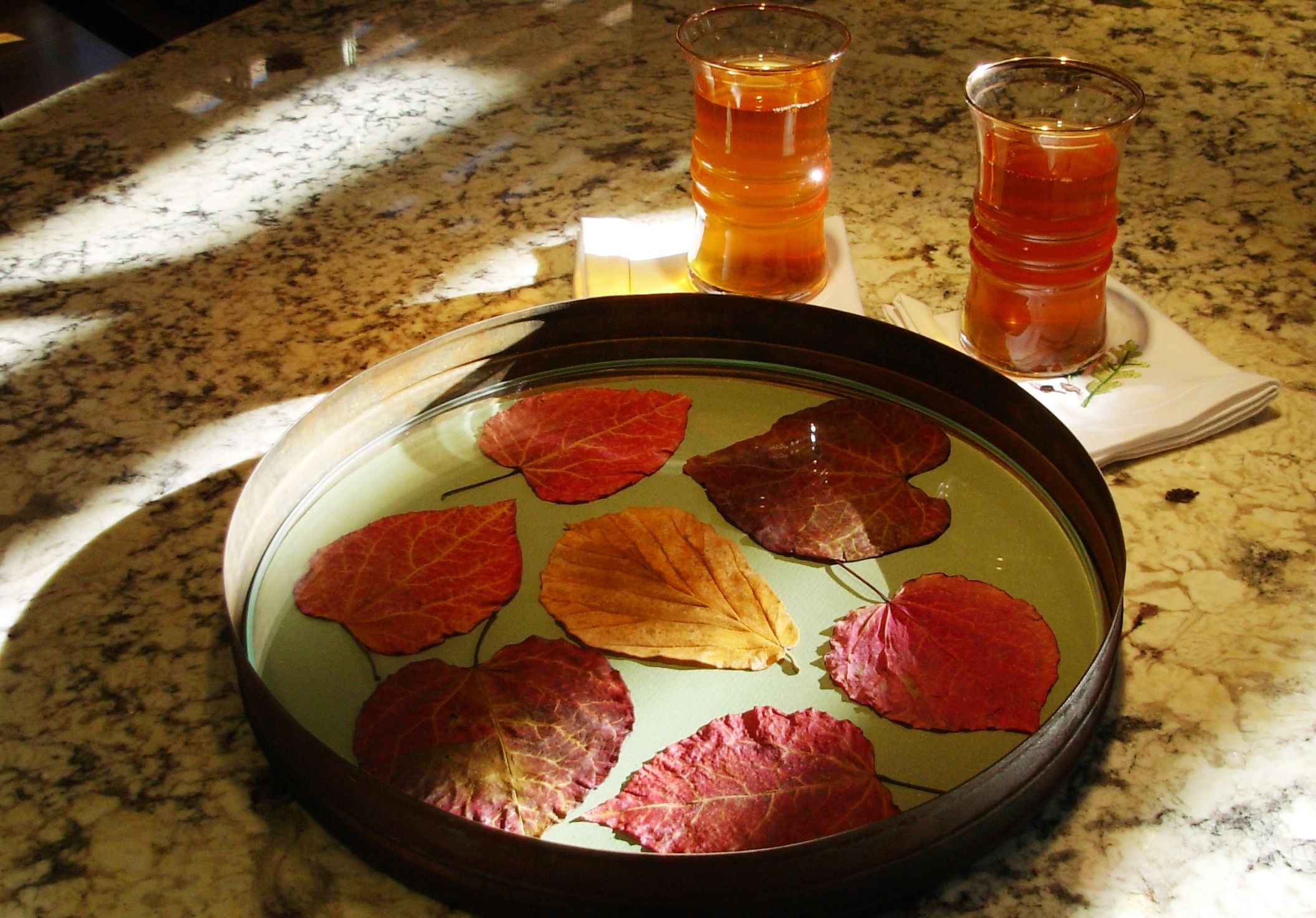
To get things going, I created the first product – a cocktail tray made from a vintage feature-film canister. I found the 14-inch diameter tins at Pasadena Architectural Salvage, a store filled with carefully salvaged columns, doors, windows, corbels, gates, hardware and more. Most everything there is pricey (we’re not talking junk-shop rates) but worth it if you want to factor in the “value added” of someone else seeking, securing, and transporting rare or hard-to-find objects.

When I visited Pasadena Architectural Salvage, I got lucky. The tins (bottom and lid as a set) were $5 each. I found similar ones for $15 to $25 each on eBay, so I know I got a steal.  My Recycled story, “A second serving,” gives readers the background of these vintage 35 mm film tins and step-by-step instructions for making their own. My finished photo appears above, with two heirloom ridged and gold-rimmed juice glasses that were my grandmother Helen Winslow Ford’s (thanks, mom!).

P.S., I used “a lust for rust” in my lede sentence. Credit must be given here to my friends Beth, Lisa and Amy of the Salvage Studio. It’s one of their favorites and I’m sure they coined the phrase!

January 1st – a day to garden

Thursday, January 1st, 2009

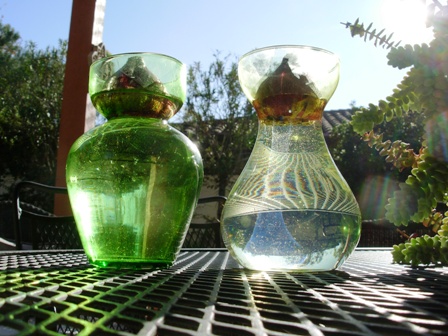
Enjoy this photo gallery of some of my New Year’s gardening projects, accomplished today. I’ll add a few comments with each image to explain what I did. Above: Two hyacinth bulbs from Brent and Becky Heath’s care package – I saved them to grow in these glass bulb vases in my kitchen windowsill.

The blogosphere and Twitter world have been busy today, with my friends and those whose work I admire/read writing about resolutions, garden mission statements, and more. I have really tried to tear myself away from the keyboard and screen. It’s ironic that I spend more time here at my desk – looking through the open shutters to the backyard – than I do actually touching, breathing and engaging with said yard.

So today I decided to spend time on gardening projects. I am stiff and tired. Six hours straight – pruning and deadheading, digging up, wheeling the barrow to and fro – is not my typical schedule these days. And I am determined to return to this routine (or an edited version of it) in 2009.

Because you know what? I’m feeling very happy.

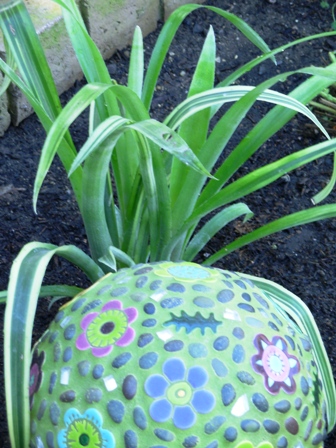
At left: I finally planted this beautiful Billbergia nutans ‘Variegata’, which I am embarrassed to say I purchased in March 2008 at Western Hills Nursery in Occidental, Calif., during our post-SF Flower & Garden Show garden-gals’ field trip. Miraculously, this plant has not only endured, but seemingly thrived in a 6-inch pot all these months. It is a beautiful, strappy, striped plant and doesn’t it look nice with the Clare Dohna mosaic orb?

What’s been holding me back anyway?
Since leaving behind my cherished garden in Seattle in August 2006, and moving to what many people think is heaven on earth – Southern California – I have been fairly disengaged with my new yard. As I’ve said before, I can’t really call it a garden. It’s really just a yard filled with plants I don’t understand or particularly like. I’ve had bursts of energy now and then to try and tackle things, including hiring someone a year ago to dig up and haul to a landscaping dumpster a yard’s worth of big red lava-rock mulch that covered every surface of soil.

But my heart hasn’t been in it. My heart is so torn between my past life and my present life. Surely, I am a lucky woman. I have my family who I cherish. I have so many wonderful friendships that continue, regardless of whether I’m in Washington State, California or other places around the globe. I manage to keep writing articles about gardens and design topics that really get published by tangible publications (that’s a shocker) and so what’s the problem?

At right: Senecio cristobalensis is another survivor from the Western Hills plant-shopping excursion in March, now given a special place in my front border. What pretty leaves! It’s supposed to reach 6-ft x 6-ft so I will eventually have to relocate this fuzzy-leafed beauty. This is one of those plants I once purchased from Heronswood (I just found the original plant tag from 2001!) that never wintered over in Seattle. See? I already have a new reason to be grateful for living in Zone 10~

I don’t have all the answers, but I’ve been pondering on how to get out of my rut. And the answer is staring me right in the eye. I need to return to the garden. The one that I see if I lift my eyes away from the computer screen and look through the slats of the shutters. Sometimes we have to start moving forward even before we know the path. “Putting wheels on it,” is how my friend Stephanie would describe it. Moving anywhere is better than staying put. There’s a lot of safety at this keyboard. But I don’t want to be just an observer of other people’s gardens, homes, plants and collections. I need to have my own relationship with the land, the plants, and the wildlife that occupy my suburban backyard.  I’ll say it again:  I need to return to the garden.

Today, I did just that. And while I’m in no position to write a garden mission statement, I do have a simple goal (dare I say Resolution?) for myself. And that is to spend 1 hour a day, at least 5 days a week, in the garden. Lord knows, I waste that much time reading emails each day. I think there’s a much better use of my physical and mental energy – and that’s to get outdoors and garden.

I don’t have money to hire a landscaper to do all the things I dream of accomplishing here, but my investment of time and attention is bound to improve my environment. It’s bound to improve my emotional attitude about this place. I’ll try and use this blog to document my progress.

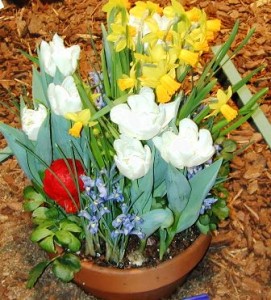
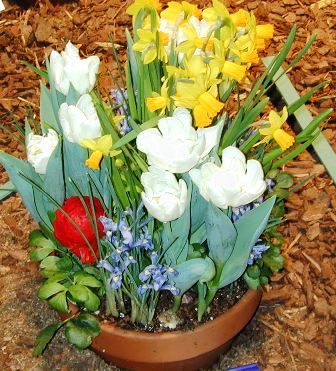
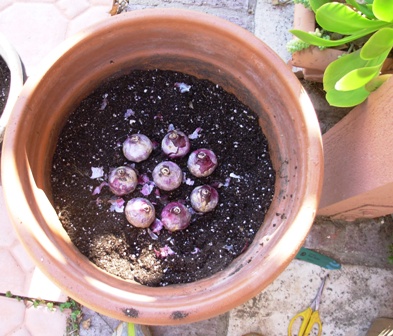
Above: I guess any month of the year is bulb-season here in LA. It’s just that my bulbs will have to be annuals. That’s something I will have to get used to, after investing in and planting hundreds of spring flowering bulbs back in Seattle. The hyacinths, narcissus, tulips and muscari I planted today were a surprise gift from Brent and Becky Heath. The box filled with 70 bulbs arrived a few weeks ago ~ what a treat! I planted layers of bulbs in 2 terracotta pots this afternoon. Then I sprinkled annual seeds on top of each (dwarf cosmos on one; nigella on the other). Who knows if you can pair annuals with bulbs? It’s worth a try! This is my chance to experiment, so stay tuned!

And Happy New Year to all of you. Let’s cherish what we have!

Gardener’s Resolutions

Tuesday, December 30th, 2008

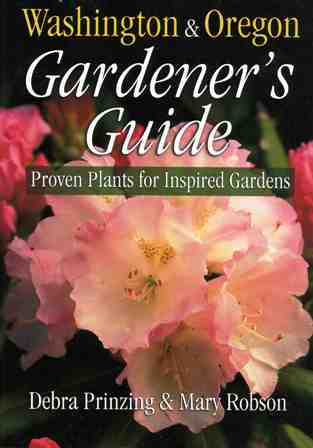
In early 2005, Cool Springs Press published the Washington & Oregon Gardener’s Guide, a book I co-authored with the wise and gifted garden writer Mary Robson. We combined our talents to share years of garden experience to help readers plan, plant, and maintain a beautiful and healthy garden.

The book is filled with our personal recommendations of plants that thrive in the Northwest, presented in a concise, helpful format. The major challenge of writing WOGG, as we called it, was to limit ourselves to 186 individual plant selections, from annuals to vines. No gardener wants to be told she has to “choose” a finite plant list!

Our fabulous publicist, Lola Honeybone, who now runs Media Workshop, a Nashville-based book PR shop, suggested that Mary (shown at left) and I develop a lecture to accompany our book-signings and appearances. She dreamed up the title “Seven Habits of a Highly Successful Gardener.” Lola’s clever angle brought Mary and me together for a 2005 lecture at the Northwest Flower & Garden Show in Seattle. It was so much fun to plan this talk knowing Mary and I would have a friendly give-and-take as we walked the audience through our Seven Tips.

Later, our friend Richard Turner, editor of Pacific Horticulture, asked us to turn the lecture into an article. Here is the article, from the journal’s Winter 2006 issue. It seems appropriate to share this as we approach 2009 – and I encourage you to adapt these tips for your own New Year in the Garden:

Seven Habits of a Highly Successful Gardener

Gardeners in the west enjoy the unique luxury of living with few rules about what’s right or wrong in the way we grow our plants. We appreciate and adapt to our garden’s cultural conditions. We are overwhelmed with a seemingly endless selection of excellent, healthy and suitable trees, shrubs, perennials, annuals, vines, bulbs and ground covers from which to choose for our landscapes.

In the Pacific Northwest [my former home], we’re particularly lucky to have temperate conditions where it’s not too hot – and not too cold. This welcoming, plant-friendly climate bestows added blessings. Imagine how hard it was for us to compile a regional gardening book and limit ourselves to only 186 great plants!

Perhaps the horticultural excesses in our lives call for a little discipline. Certainly, we want to be good stewards of our gardens, both to ensure our immediate enjoyment and the long-term health of the plants and places we tend.

So, with apologies to the original “7 Habits” author Steven R. Covey, we offer the following Seven Habits of a Highly Successful Gardener:

READ MORE…

A beautiful brick dining pavilion inspired by a royal “Orangery”

Sunday, December 21st, 2008

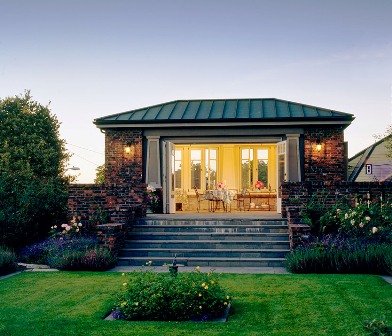
A modern-day dining pavilion, rooted in history [William Wright photograph]

This stately dining pavilion is the setting for the best garden parties. Start with impromptu dinner invitations for a few friends, add a bottle of wine, ripe tomatoes and bunches of basil harvested fresh from the garden. Joan Enticknap’s al fresco destination infuses her events with a carefree spirit. After dinner, guests usually wander off and enjoy her garden.

Bill Wright and I were fortunate enough to discover, write about and photograph Joan’s dining pavilion in 2002. She also owns the charming potting shed that graces the cover of our book, Stylish Sheds and Elegant Hideaways, photographed by Bill. 

For Joan, a rare double city lot accommodated the construction of a two-car garage at street level. Above it sits her 12-by-22 foot, freestanding dining pavilion.

Designed by Seattle-based Bader Architecture, the inviting structure is connected to her restored 1914 home by a stone terrace. The architects incorporated accordion-fold glass doors across the pavilion’s width, linking it to an herb- and rose-filled garden beyond.

“The open doors allow Joan’s parties to spill out into the garden,” says principal Gregory Bader. Shutters cover 16 pair of windows, each of which opens via tilting or swinging hinges. The windows reinforce the perspective that overlooks the street-scape below and territorial views to the north. In fact, the building is situated perfectly to shelter Joan’s garden from northern winds.

Project architects Dan Umbach and Andy Salkin drew from local carriage houses and English conservatory influences to create the pavilion. “We loved the orangery at Kensington Palace in England and this really comes from that tradition,” Bader says.

Wanting her garage and pavilion to echo the home’s origins, Joan instigated an extensive search for vintage clinker brick.

“I placed ads in (local) newspapers and eventually found a fellow who had saved clinker brick from a Craftsman bungalow.” Seven thousand bricks, combined with the passion of a talented stonemason, constructed the carriage house-inspired pavilion.

When the weather is warm, Joan slides open the pavilion doors and encourages her guests to enjoy seating on the blue stone patio. A wide staircase descends into the fragrant garden below. And that’s when a wonderful meal and beautiful landscape conspire with the senses to lure the party outdoors, any time of day.

A version of this story originally appeared in Seattle Homes and Lifestyles, with text by me and photographs by Bill.

Read further to learn more about The Orangery or L’Orangerie, a new addition to the Shed Glossary.

Backyard Bliss: prefabricated sheds reviewed

Friday, December 19th, 2008

I’m honored to be the featured “expert” on prefabricated sheds in Dwell magazine’s upcoming February 2009 issue. How cool is that? (In September I wrote about the photo shoot with the very talented Los Angeles-based photographer, Amanda Friedman. . . now it’s finally appearing in print).

I received a sneak preview of the article when associate editor Miyoko Ohtake mailed me a few complimentary copies, which arrived in yesterday’s post. The article is also available online; not on Dwell.com, but on the very cool digital magazine site, Zinio. Even though the hip “prefab issue” isn’t out on the newsstand yet (because the December-January issue is still for sale), you can order it for the $5.99 cover price at Zinio. Check it out.

I love what Miyoko wrote in the Dwell Reports feature titled “Out Back.”

From city slickers to country bumpkins, homeowners have always longed for a special place from which to escape the toils of day-to-day life. In 1783, Marie-Antoinette notoriously commissioned architect Richard Mique to design a Petit Hameau (Little Hamlet) of small buildings on the grounds of Versailles. Feeling the scrutiny of the royal court, Marie and her attendants would run off to the mock farm, dressing up as milkmaids and shepherdesses and pretending to live “normal” peasant lives – which we can only assume involved eating cake.

Nearly 150 years later, British author Virginia Woolf heralded the benefits of a private abode in her 1929 book A Room of One’s Own with its famous phrase “a woman must have money and a room of her own if she is to write fiction.”

A more modern, unisex version of backyard escapism comes in the form of miniature prefabricated outbuildings. “The traditional definition of a shed is a lean-to or stand-alone structure that provides shelter or storage,” says Debra Prinzing, a freelance garden and design writer and our expert reviewer this month. “I tried to come up with a contemporary definition: a space that contains whatever you’re passionate about.”

READ MORE…

a word about tiny Christmas trees

Wednesday, December 17th, 2008

Those of us who attended the September 2008 Garden Writers Association annual symposium in Portland were in for a big treat when we boarded the coach buses (seven or eight in all) and took a ride to Boring, Oregon, home of Iseli Nursery.

We were introduced to a world of ornamental conifers, in every shape and size. Even though Washington is called the “Evergreen State,” in the nursery trade, it seems, the folks in Oregon claim the title. 

Iseli Nursery grows all sorts of amazing woody plant specimens – trees, shrubs and more. They sent us home with a gift bag packed with five delightful little conifer specimens – perfect for a container planting, rock garden or tablescape. You can see the incredible variety in Iseli’s “Fanciful Gardens” collection depicted above (including some dwarf broadleaf evergreens in the front row). My photos, from left: A colorful “knot garden” of mostly dwarf conifers mixed with barberry, Iseli entrance; tiny, just-propagated woody cuttings of mugo pine.

The next day, I found myself sitting on yet another the bus ride/garden tour with with Sandy Dittmar, a horticulturist at Iseli. We talked about how many gardeners are only now discovering conifers, and how dwarf conifers are so versatile for smaller landscapes. She planted a seed of insight and got me thinking.

So when I saw my local Trader Joe’s stocked with miniature Leyland cypress and Lawson cypress (we’re talking 4-inch pots for $4.29 or so), I called Sandy and said: Remember when we talked about dwarf conifers? Are those Trader Joe’s mini-trees yours?

It turns out, the tiny live trees in shiny pots are supplied by BloomRite Nursery, a wholesale grower in Half Moon Bay, California. But Iseli’s tiny Alberta spruces, mugo pines, and blue-star junipers, and countless other dwarf conifers are showing up in specialty nurseries and retail florists around the country. Cute, they are. Versatile, too. And perfect for a scaled-back Christmas!

In this cost-conscious holiday season, it was a fitting “tiny tree story” for the Los Angeles Times’  Home section, page F2 (December 13th).

Here is the piece I wrote under the “Seen” heading, in its entirety:

A pint-sized forest at home

Looking for evergreen decor – something that can last long past Christmas? Turn tiny potted conifers into a miniature forest across a fireplace mantle, or create a tabletop landscape with dwarf pines. Tiny trees are “a cheap luxury,” says Lisa Tsui, a product manager at BloomRite, a wholesale grower in Half Moon Bay, Calif., that supplies potted pines and Leyland cypress to Trader Joe’s. “In this economic environment, people are using them to supplement decorations they already have,” she says.

Iseli Nursery in Boring, Ore., ships tens of thousands of dwarf conifers to garden centers during the holidays. Even though some customers treat the evergreens as throwaway décor, they can be transplanted in the garden or an outdoor container, Iseli sales manager Jock Demme says. The challenge is to keep the plants alive indoors. “The home setting has drier and warmer air than these plants require,” he says. “I suggest submerging the pot in a larger container of water and soaking the roots every day.” The trees at Trader Joe’s sell for $4.29 to $5.99 each; you’ll find variations for $9.95 at the Empty Vase in West Hollywood, (310) 278-1988, www.emptyvase.com. Also try Red Envelope, (877) 733-3683, www.redenvelope.com.

Here’s a little gallery of dwarf and miniature tree photographs, shared by Iseli and Nurserymen’s Exchange (which is the company behind BloomRite).

December: Garden Bloggers’ Bloom Day – My First Installment!

Monday, December 15th, 2008

My bougainvillea’s lipstick-pink bracts look almost iridescent in Southern California’s December sunshine

Dateline: Thousand Oaks, California

USDA Zone: 10

The journalist-observer in me couldn’t help but notice that when the 15th of each month rolled around, many of my favorite fellow bloggers wrote about this phenom called “Garden Bloggers Bloom Day.” They even included images of that day’s blooms in their own garden.

The instigator behind this movement is Carol of May Dreams Gardens, and somehow I thought I had to be invited by that select inner circle of garden bloggers to participate. Kathy Purdy of Cold Climate Gardening recently set me straight on that assumption and assured me that all I have to do is post photos of my flowers. She sent me an email with “No Rules for Bloom Day” in the subject line and a link to May Dreams Gardens with the “rules,” of which there really are none:

All you need to do to participate in Garden Bloggers’ Bloom Day is post about what is blooming in your garden on the 15th of the month, or thereabouts, depending on your personal schedule. Then leave a comment on my bloom day post so we can find your blog and check out what is blooming in your garden.

I sort of cheated because I took these photos yesterday, Dec. 14th. I’m glad I did, though because today, Dec. 15th, we experienced a rare occurrence: RAINFALL. Don’t worry – I managed to spend plenty of time outside soaking up the raindrops while letting my dog, Zanny, run around and play catch with her favorite (now muddy) yellow tennis ball. It was a glorious day and everything is refreshed – in the garden and in our spirits. All the air pollution and dust has been washed off of the foliage and the soil looks wet and dark brown. We’ll see how long that lasts!

Here’s what I have to contribute:

Bougainvillea, seen here and above. It was inherited from the previous owner when we moved here in 2006. The first time I really noticed a bougainvillea was in 1999, when my sweet husband took me to Palm Springs for a surprise 40th birthday weekend. We were staying at the former Merv Griffin Resort and Givenchy Spa (how mid-century!) and there was an entire wall covered with the raspberry-colored display of bougainvillea. Little did I know then that I’d live in Southern California some day and actually have one in my garden. I’m trying to train it up to the the patio-covering arbor.

Scabiosa atropurpurea ‘Black’, also called pincushion flower – and also called ‘Ace of Spades’. This perennial (for me) has a delicious, dark-plum bloom. It’s a favorite of butterflies because they can use it as a landing pad while doing their thing. I purchased this plant in 2007 on a “garden gals’ field trip” to Annie’s Annuals (we actually took a road trip from SoCal to the Bay Area for the San Francisco Flower & Garden Show and Annie’s was a side trip). The scabiosa thrives and re-blooms so often I can’t keep up with the job of cutting back the old growth. So pretty as a cut flower, especially when combined with anything chartreuse.

Mystery rose, another “gift” from the former owner of our property.

I really like the delicate form of its single flowers, the crimson petals and the yellow centers. This rose, which is taller than me, has thrived despite little or no water in the area outside my dining room window. I have plans to renovate this bed, but first I have to hand-dig and remove the red lava rock “mulch” out of the bed, which may explain why this to-do remains on my list!

Echeveria hybrid in bloom. This is a close-up of the beautiful, costume-jewelry-like flowers, the stem of which emerges from the center of an echeveria. I have a wonderful display of echeverias, crassulas, sedums and other succulents in my kids’ old red wagon. It was once planted with spring bulbs or summer annuals (back in Seattle), but here, it is a perfect, low-maintenance container for a wagon-full of succulents. According to Lorraine Schulz and Attila Kapitany in “Echeveria Cultivars” (Schulz Publishing, Australia) the cut blooms of echeverias alway outlast more conventional flowers when brought indoors for an arrangement.

Well, that was fun! I’m happy I could join the Bloom Day party!

An elegant boathouse where I would like to hide away

Sunday, December 14th, 2008

Last Friday, I enjoyed a wonderful “field trip” to Church Estates Vineyard in Malibu, owned by Robert Church Haggstrom. This was one of those magical behind-the-gates visits that reminds me how very fortunate I am to be a writer in this town.

I was invited by publicist Dienna D’Olimpio, with whom I’ve been corresponding for a few months. She originally contacted me to share photographs and background info about Church Estates Vineyard, its chateau and garden settings. I haven’t even tasted the wine yet (the winery’s first Chardonnay will be bottled soon and its Pinot will be ready this fall), but the beauty of the setting appealed to me immediately.

A tiny building, situated at the edge of a pond, captured my imagination. I later learned that Bob calls it his “boathouse,” and to me, it is the most beautiful, romantic boathouse I’d ever seen. Truly an elegant hideaway. (see interior, right).

Once I saw photographs of the gardens (not to mention the boathouse), all of which share the nine acres with 3,000 grapevines, I knew I wanted to visit and develop a story.

The estate is available for weddings, corporate events, and other private parties. Robert Church Haggstrom’s personable daughter, Maja, is the go-to gal for brides, corporate event planners, and anyone else who wants to rent the lovely haven for an unforgettable day.

As impressive as are the vineyards and well-appointed chateau, I couldn’t take my eyes off of Bob’s little getaway by a pond. The boathouse photos – seen above – are courtesy of Church Estate Vineyards.

Dienna arranged for me to visit and I managed to persuade my husband, Bruce, to come along for the tour. He’s not really into gardens, but he is into real estate. We drove to Malibu, about 30 minutes from home, and arrived at Church Estates in time to meet Maja just inside the entrance. Thank goodness she was driving a golf cart because the elevation change from the parking area (near a sunken clay tennis court and horse stables) to the upper gardens and chateau would have required sturdy shoes and perhaps a walking stick to navigate on foot.

We hopped onto her golf cart and made our way up the winding drive, through the garden, to the grand French-style chateau. Out of the corner of my eye, I spied the pond and boathouse. The table on the dock was set for lunch! Oh, goodie, we were going to end up there at the water’s edge for our meal.

Maja narrated our tour: She grew up in Malibu and knows the ins and outs of every square inch of Church Estate Vineyards. To listen to Maja describe the gardens here, you can tell she still has that childlike wonder and curiosity about nature’s beauty. It is infectious.

The story of Church Estate Vineyards is one that I will tell in a future article, after I spend a proper amount of time with “Malibu Bob,” as Mr. Haggstrom is affectionately called around here.

But in the meantime, I will touch on highlights of his boathouse.

  • It was the first thing he built here after purchasing the property five years ago
  • Bob wisely situated the structure at the bottom of the hill, nestled under a stand of mature sycamore trees – facing the man-made pond, which he has since landscaped and stocked with swans.
  • The boathouse measures about 20-by-20 feet in size; the exterior is finished in weathered wood and the standing-seam metal roof is aging nicely.
  • The interior features a lovely fireplace and comfy furniture (but not a bed, darn it! Bob said he figured if there was a bed, all of his guests would argue over who would get to sleep here)
  • The floor is made from antique boards, and when one of Bob’s friends accidentally knocked over a container of oil (after a fondue party), Bob decided to have the entire floor rubbed with oil – which adds a soft, aged patina to the space. 

Thank you Bob, Maja, Marie and Dienna – we had a wonderful visit, enjoyable conversation, delicious food — and were thoroughly enchanted with the magical setting you’ve created at Church Estate Vineyards. I can’t wait to return!

[photo above, from left: me, Maja, my husband Bruce Brooks, and Robert Church Haggstrom].

A week filled with Stylish Sheds

Saturday, December 13th, 2008

About a month ago, while reading Alex Johnson’s wonderful blog, Shedworking, I saw his post about an artist named Sarah Lynch. She has spent 2008 posting an original painting EVERY DAY on her blog.

Alex had discovered one of Sarah’s posts from July, featuring a charming garden shed entitled “Shed with Hollyhocks.” It was enchanting and I immediately went to her blog and subscribed to receive her daily artwork. Sarah is an English-Canadian woman living in Southern Ontario. You can find her work for sale via her blog (where there are links to some online galleries also selling her art).

I don’t know her at all, but Sarah has brought me a small dose of happiness every morning. Opening the link to see her next piece is one of the very first things I do after making my cup of tea and sitting down to read email at the start of the day.

I think Sarah may love sheds as much as I do, because today she offers a charming piece entitled: The Lonely Shed (7″X5″ WC pencil on paper):

The year is almost over and I’m worried that Sarah may stop posting her artwork. I like reading her brief, personal artist statements that accompany each drawing, illustration or painting. She has alluded to her readiness for a slower pace, perhaps creating three paintings a week instead of seven. Get in on the last few weeks of the year and subscribe to this little piece of joy that will arrive in your in-box each morning. I, for one, am hoping for MORE SHEDS!

IN OTHER NEWS. . .

On Sunday (12/7) we received a mention in Irene Virag’s column in Newsday. She included Stylish Sheds and Elegant Hideaways in her “Gift List,” featured at the end of her longer piece on Ken Druse. 

Stylish Sheds and Elegant Hideaways (Clarkson Potter, $30): Author Debra Prinzing and photographer William Wright showcase 28 sheds from Southampton to Seattle. From clematis-covered potting sheds to writers’ retreats, these structures enhance lifestyles and landscapes.

READ MORE…