SEEDPODS AND PETALS

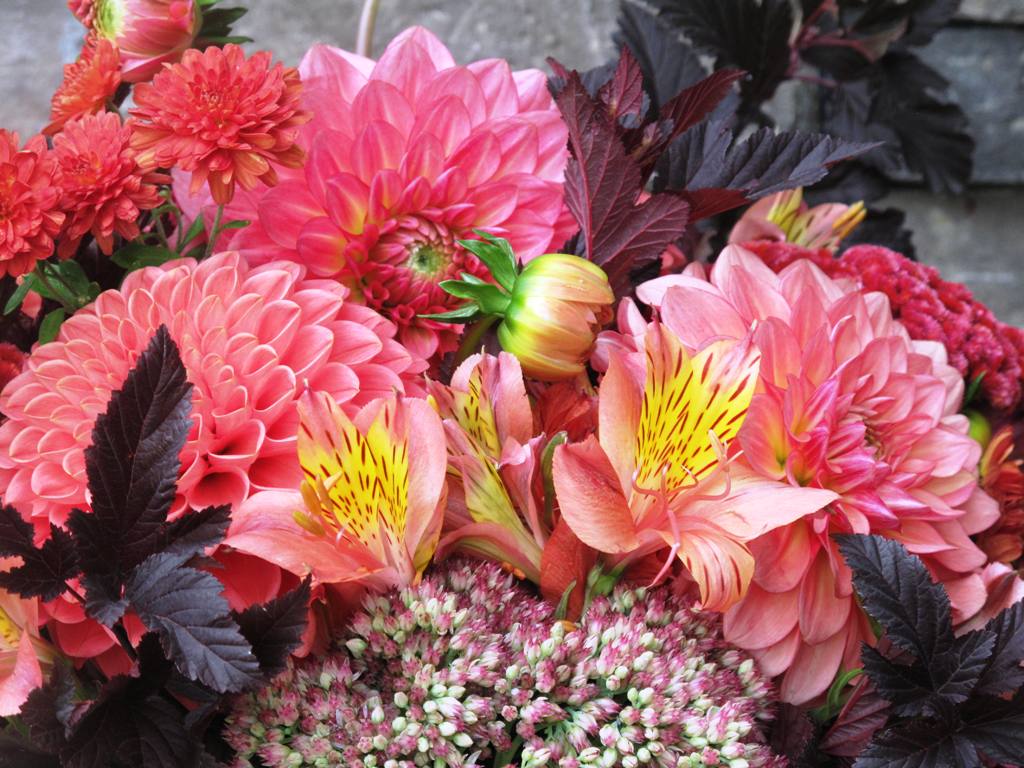
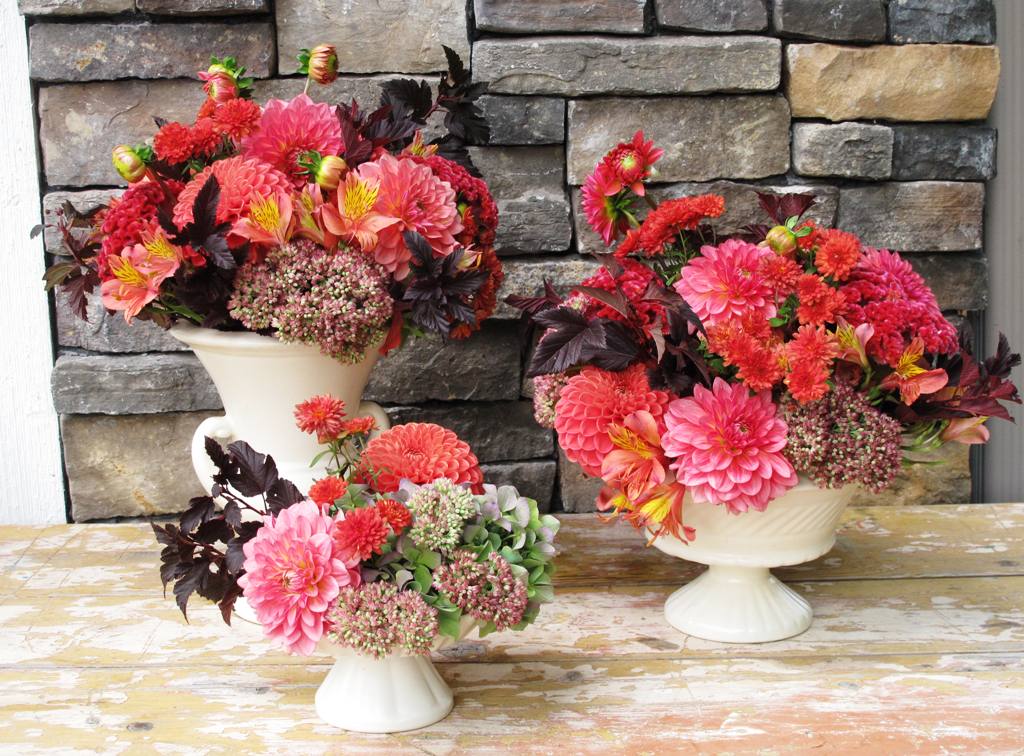
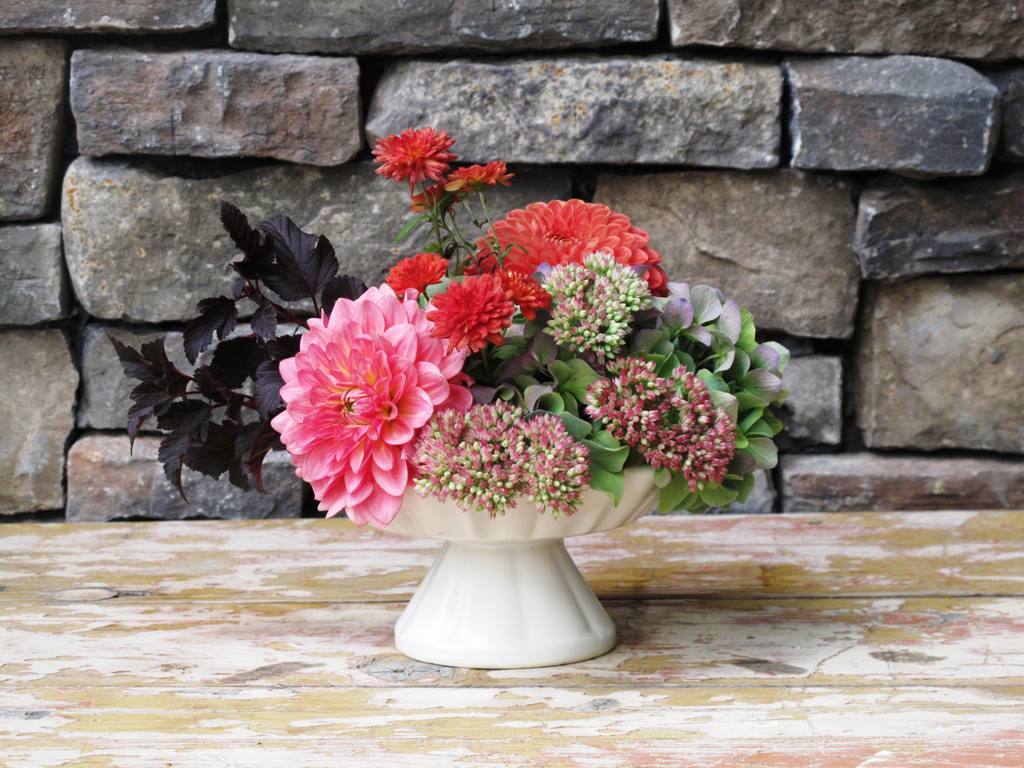
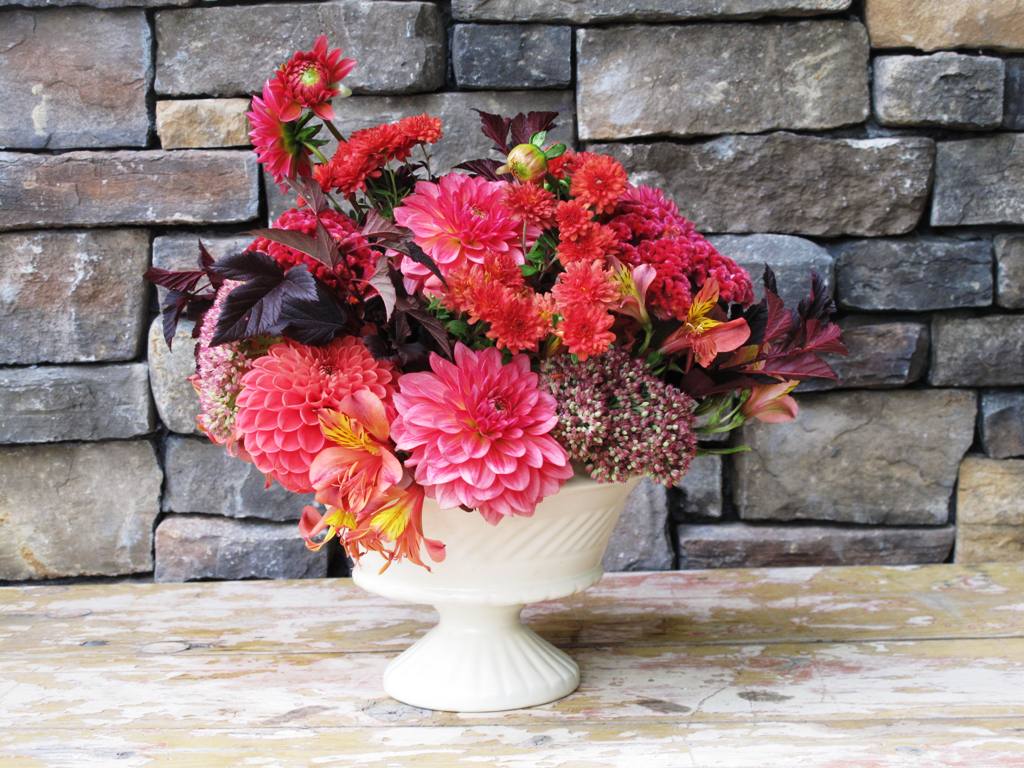
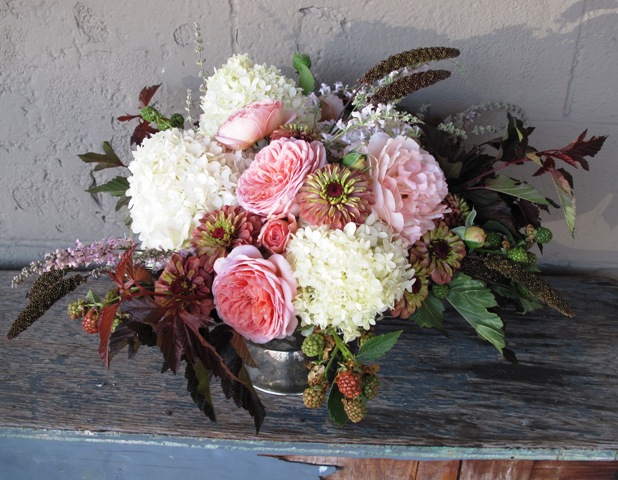
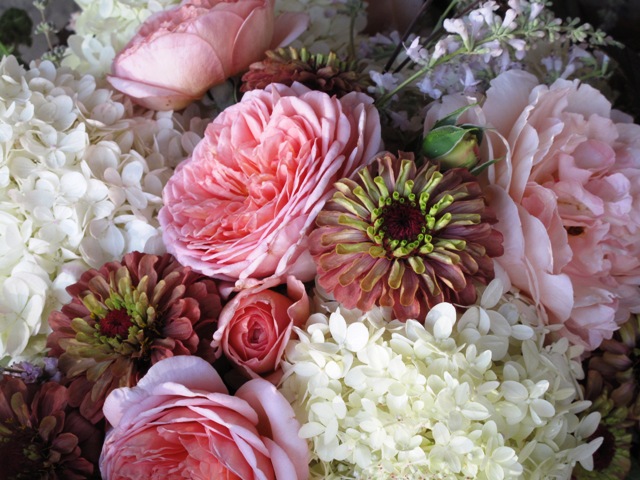
Dan Pearson of Dan’s Dahlias grew the two types of dahlias – one leans more toward the pink end of the spectrum; the other is more like that faded terracotta color I mentioned.
The antique pink-hued Celosia were grown by Diane Szukovathy and Dennis Westphall of Jello Mold Farm.
As I was leaving the Seattle Growers Wholesale Market the other day, Janet Foss of J. Foss Garden Flowers handed me the bunch of alstroemeria as a gift. These little beauties have flecks of dark maroon on a pale orange-pink throat. I love the way they tie together the more solid colored flowers.
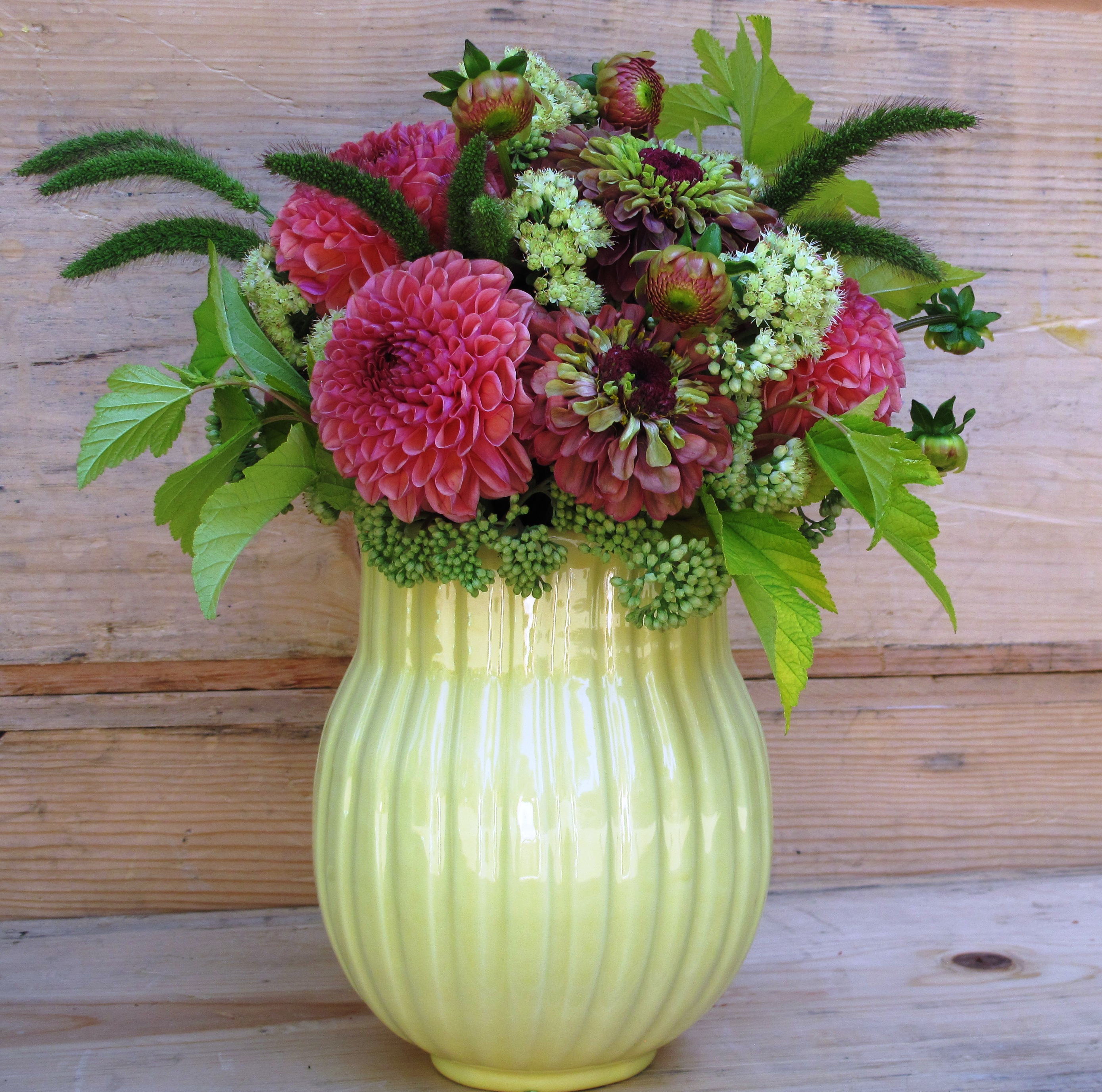
I came home wondering what to do with these evocatove botanical elements. I pulled down three ivory vases – one is vintage Haegar; two are vintage Hull (from my recent trip to Iowa). It felt right to use these vessels, each of which has an eggshell-like color and texture.
I walked around my garden and snipped dark maroon foliage from the Ninebark shrub, which as you can see really helped to define the spaces between the flowers. I also snipped Sedum ‘Autumn Joy’ in pinkish bud and a few sprays of an inherited chrysanthemum, the flower heads toned dark terra cotta.
A few more shots, showing the designs for my medium and small vintage pedestal bowls:

This little saucer didn’t have a lot of room for stems. So I used a hydrangea flower as a fresh “frog” to organize the other short stems.

A fabulous, creamy white vintage compote-style bowl, used with a cage-shaped flower frog for this color-intensive bouquet.

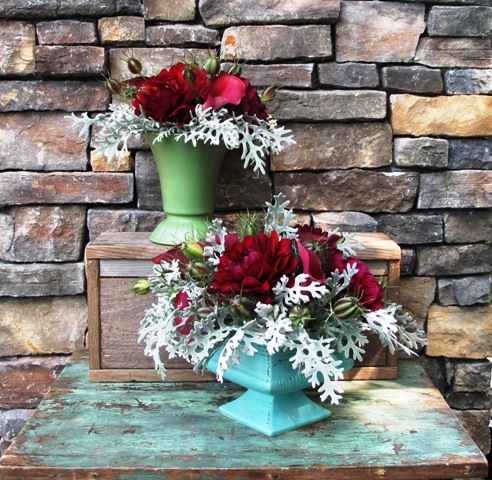
Two vintage vases with lovely matte glazes contain simple bouquets of ruby-red dahlias and calla lilies. The silvery Dusty Miller foliage ties it all together.

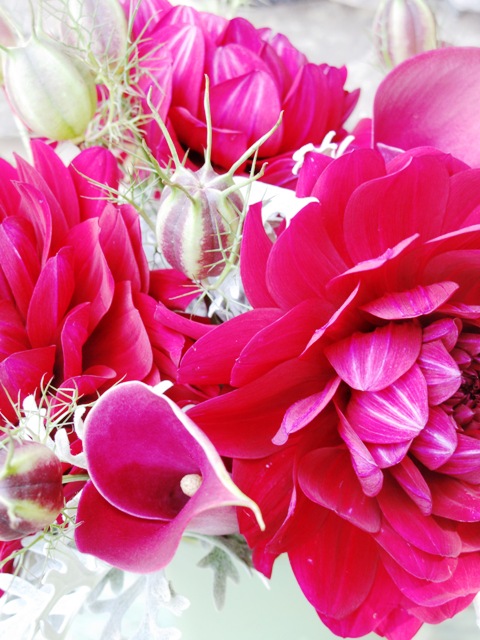
This detail photo shows how the calla lilies and dahlias are in perfect harmony with the little strips of the love-in-a-mist.
Eco-technique

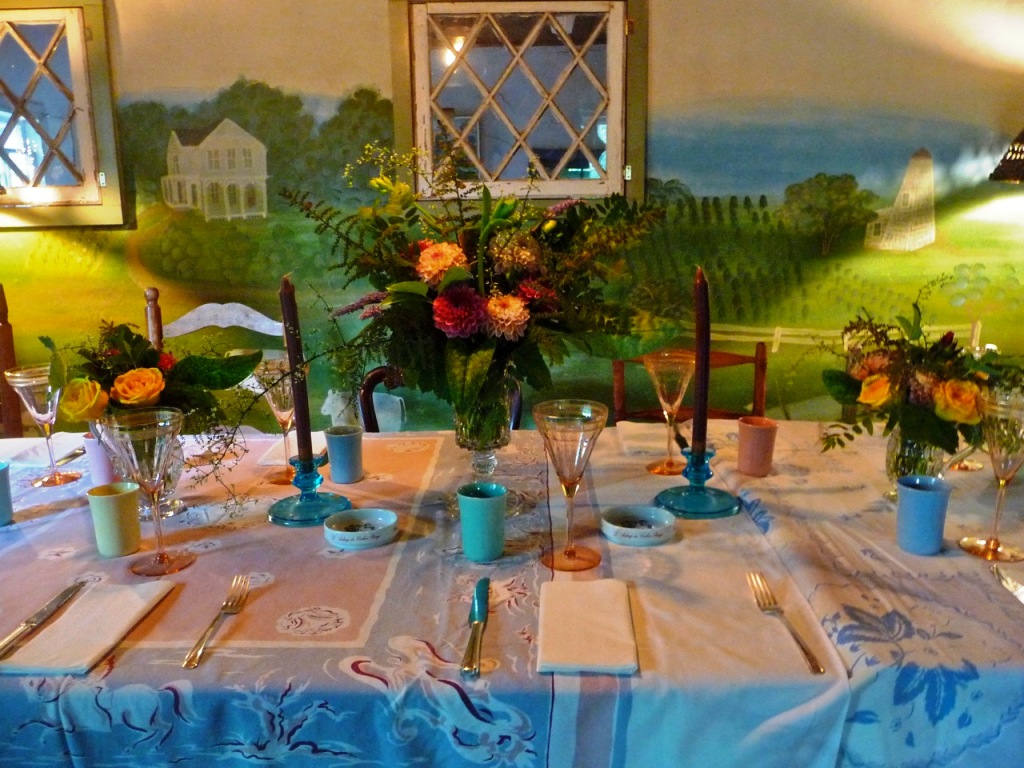
A lovely table arrangement where the vases seem to blend into the primitive wall mural of Orient, New York . . . as imagined and painted by Skip many years ago.
Last April 2012, I wrote about the beautiful memoir by my late friend Clyde “Skip” Wachsberger.
The book is called Into the Garden With Charles. It was first published privately by friends of Skip’s (under the guidance of editor and friend Karen Braziller) in December 2010. Farrar, Straus and Giroux published it commercially in early 2012, although Skip did not live to see that event. Read more about the book here.
I have not been able to visit Orient, New York, or see Charles Dean, Skip’s surviving husband, since January 2012, when I traveled there for the memorial service honoring Skip’s life. I love this place and all of the friends I’ve met through these two men. The garden during summertime at Adsworthy, where Skip and Charles made their home, is very special. And for some reason, my trips in recent years were during fall or winter, so I hadn’t toured that verdant place during its peak since 2005 or so. Too long!
Last week I was fortunate to return for a mere 36 hours. It wasn’t nearly enough time, but every moment was filled with wonder, delight, friendship and memories.
One of the highlights was getting ready for a big, yummy, community dinner prepared by the man Charles has now found to spend his life with. That is Charles’s very personal story to tell, so I won’t say more. I’ll only add that he is now with a dear, charming person and I’m pleased to see Charles so happy.
Skip’s presence is still very much evident in his garden. I was mindful of his exuberant spirit watching over me as I snipped stems, leaves and flowers from uncommon specimens that he originally selected, planted and tended to over the years. The opportunity to create the centerpieces for our wonderful dinner party was all the more special for the connection I felt between those plants and Skip. While the bouquets’ dahlias came from a local flower farm stand and the yellow roses were a gift to Charles from a family friend visiting his sister, artist Frieda Dean, everything else came from Skip’s garden. I relied on his plants for bold and fine foliage, tiny buds, fern fronds and seed heads. Charles supplied the beautiful cut glass urn and two small cream pitchers for the vases.
Our table sparkled with vintage linens, pottery, silver and stemware. You can see how it looked above.
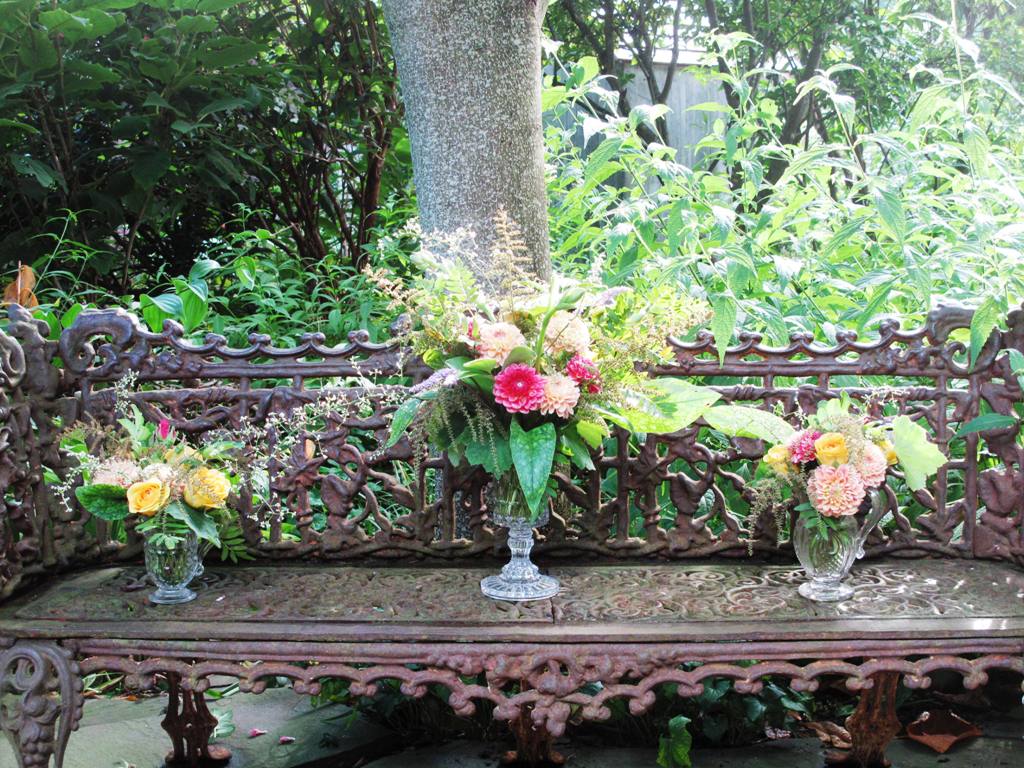
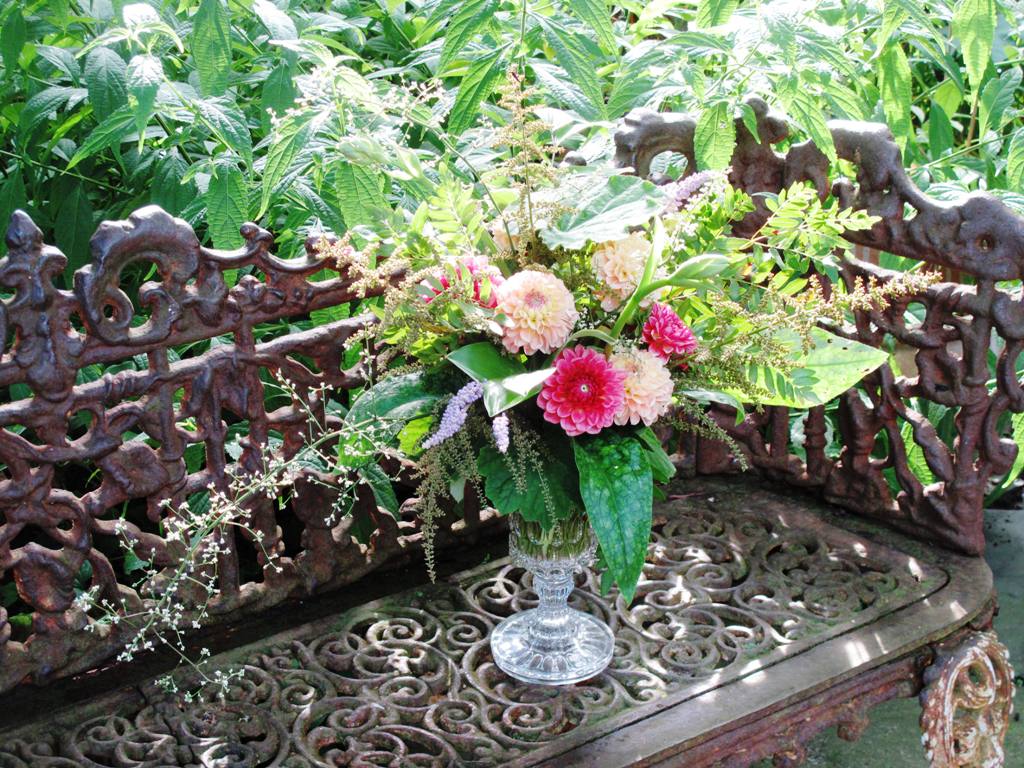
Here are some more images of the bouquets, in the garden:

A small glass pitcher looks so beautiful in the dappled light that spills onto an iron garden chair.
I’ll close with one of Skip’s quote about his garden, excerpted from Into the Garden with Charles:

Red, white and blue American-grown flowers, featured in a patriotic display at Sun Valley’s Oxnard, CA, farm.
Here is a summary of the remarks I gave last month at during a gathering at Ocean View Flowers in Lompoc, Calif.
I shared three observations about the Local Flower Movement and its importance today (and in the future).
We are at a unique point in time when consumers are yearning for authenticity and the high-touch human narrative. From the explosion of interest in heirloom vegetables and fruit, with the Rock Star chef and farm-to-table menu to an anti-mass-produced desire for artisanal and hand-crafted products to ever-popular farmer’s markets, consumers are drawn to the raw materials of life. Even major companies are moving the human face and compelling stories of people, not products, to the forefront.
American Grown flowers and those who farm them and design with them are ideally positioned to respond to a hunger for story. The back story is compelling and engaging. It is authentic. John Donati, of Ocean View Flowers in Lompoc, California, summed up this sentiment beautifully: “We may be big, but we want to look small.”
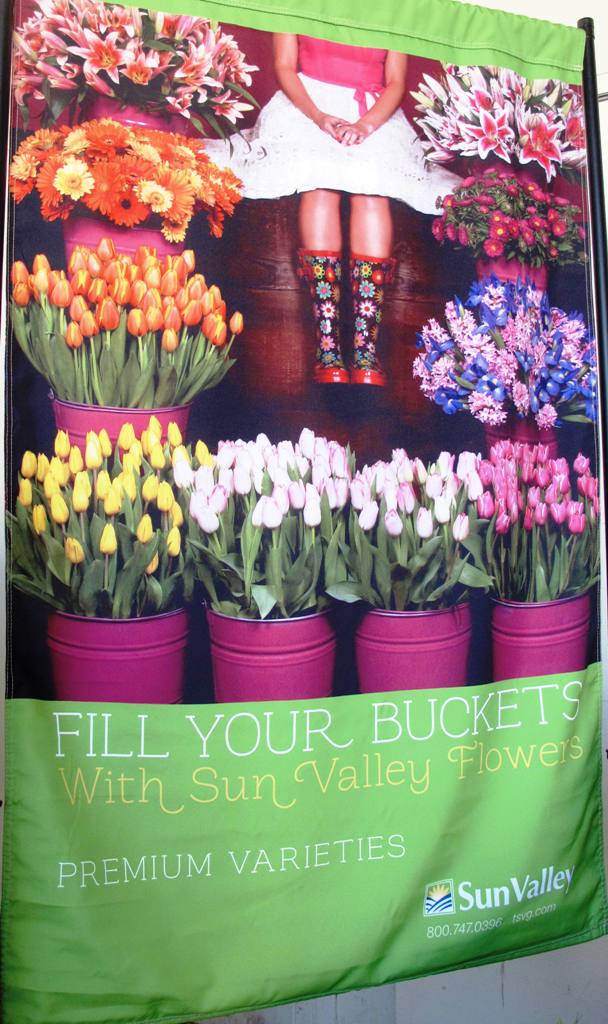
I saw many examples of this during the Fun ‘N Sun conference in Santa Barbara, presented by the California Association of Flower Growers & Shippers. In his presentation at Sun Valley’s Oxnard facility, CEO Lane DeVries discussed the company’s investment in breeding better floral varieties. He showed us images of the Ilex that’s currently available on the market and then revealed several new varieties that Sun Valley is hoping to introduce in the future. Those options are clearly superior, with berries arranged all the way to the tip rather than clustered lower on each branch. The collective buzz in the room increased in volume as the questions flew Lane’s way: How long before the new variety will be in production? I can guarantee that those in the audience will be bugging Sun Valley for the next few years for those “new” Ilex cultivars. No one will forget his presentation.
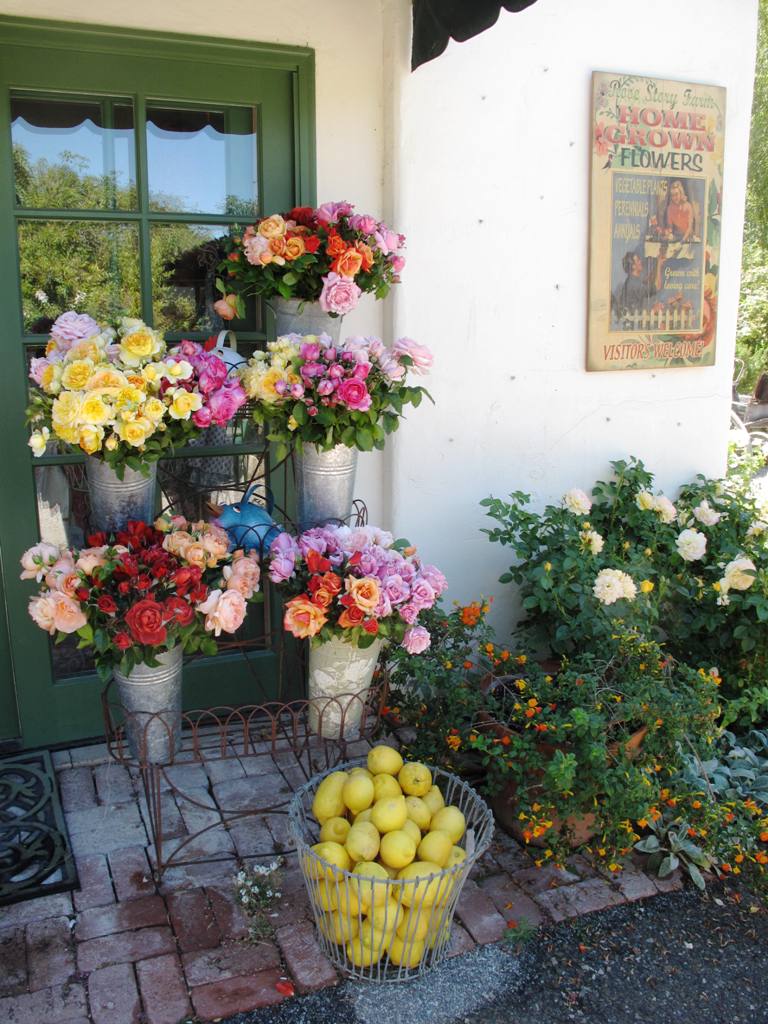
Similarly, when we visited Danielle Hahn at Rose Story Farm in Carpiteria, where a delicious garden-style luncheon was served at umbrella-covered tables laden with country pitchers of roses, the commodity flower crowd gained newfound appreciation for the garden rose. Dani told many stories of the 150 old garden rose varieties that grow here, explaining how she selects for fragrance, petal color and flower form.
The history and provenance of each rose variety is at her fingertips. She is a compelling storyteller and the narrative only served to personalize each beautiful bloom and its value. No matter that garden roses have a “four hour vase life,” Dani joked (they really last for several days, if properly harvested and cared for). Their romance and beauty trump vase life. And when a bride sees (and inhales) Dani’s roses, she has a sensory response that is not based on budget, but story.
2. The power of Quality

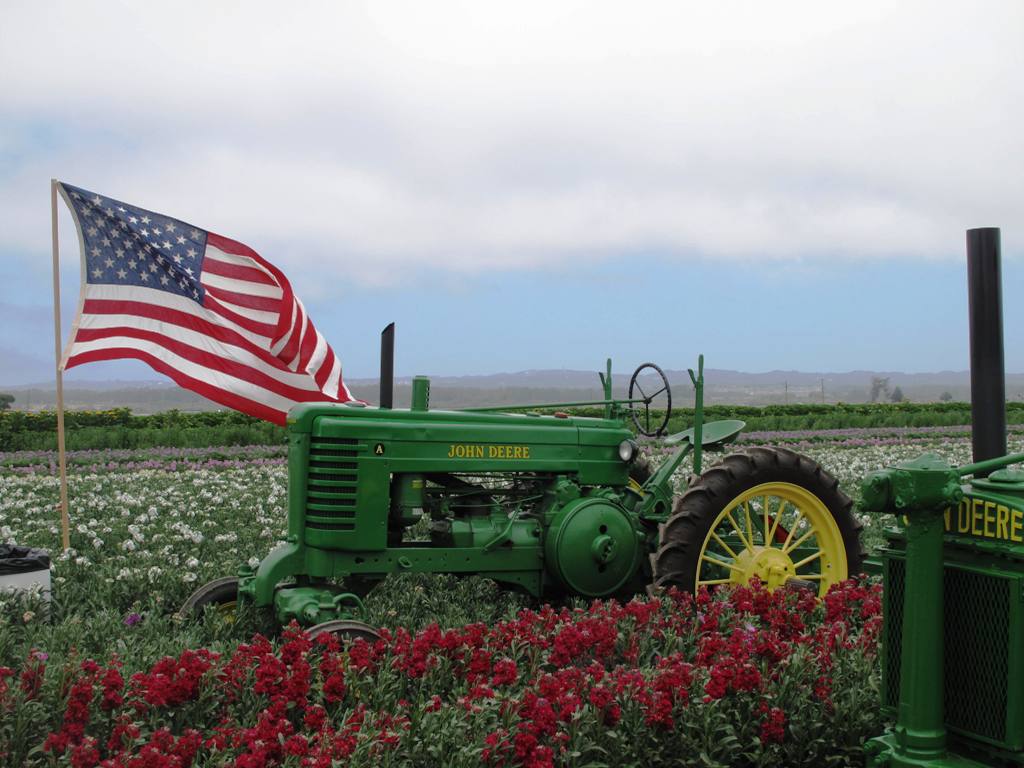
Old-timey John Deere tractors – how nostalgic is that? On display in the beautiful fields of flowering stock at Ocean View Flowers.
Stories underscore the value-added nature of American Grown flowers. The local farmer should be selling quality, freshness and uncommon variety. Why? Because those attributes get our flowers out of the price race. And American Grown flowers will not win the price battle with imported flowers. Price alone turns flowers into a commodity. And commodities are generic, which means that cheap, cheaper and cheapest sells to unimaginative florists who need YOU to help them retreat from the low-cost battle.
Of course, communicating about American Grown quality product requires a lot of what I just covered above, in Point #1 – storytelling. They go hand-in-hand. Be transparent and forthcoming. It gives you an edge that makes you and your flowers memorable. None of us will forget the story that John Donati shared about Ocean View’s approach to specializing in only field-grown cut flowers. Enjoying our country-style lunch in the middle of that flower field, surrounded by vivid rows of clove-scented stock, we won’t forget the message of quality that was conveyed by everything around us.
3. Know and employ your Customers

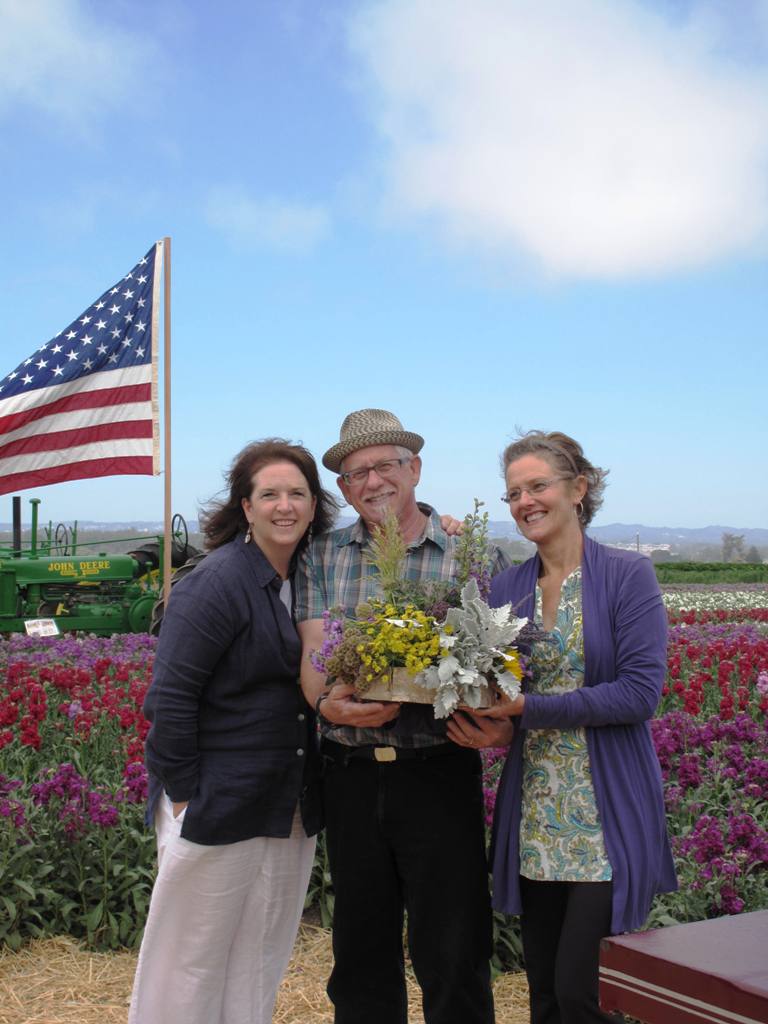
A gathering of friends at the July 18th Flower Fields luncheon, hosted by John Donati and the staff of Ocean View Flowers. I’m at left, joined by fellow writers/bloggers Billy Goodnick and Nell Foster.
The designers who use your floral product are ultimately your best marketers. In some industries, this approach is called “crowd-sourcing,” which sounds a little crass. But with the right approach, you can engage the people who create beautiful arrangements, bouquets and events to tell your story better than you can.
How can you do this?
The bottom line is that the more authentic we are, the more likely people will be drawn to each one of us, our flowers, our stories. I was reminded of this recently during an interview with Ed McMahon, senior research fellow from the Urban Land Institute. He was talking about real estate development, but I think his comment is so incredibly appropriate for the American Flower industry, too:

Bowls and urns are ideal for low tabletop arrangements. And this vintage silverplate bowl is perfect for summer’s best blooms.

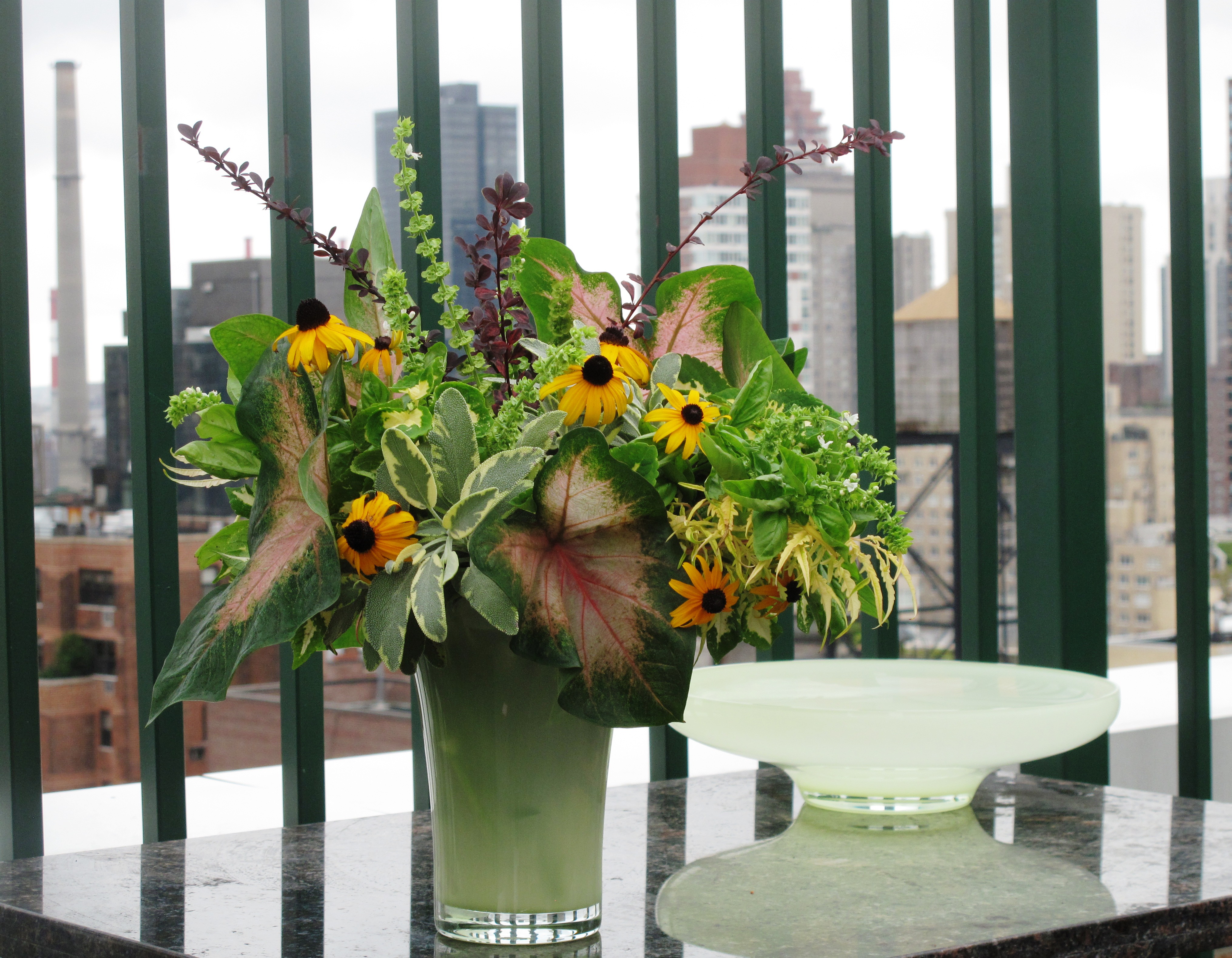
I made this bouquet at the invitation of Ellen Spector Platt, a fellow garden writer who shared her NYC rooftop bounty with me
Ingredients:

Long after I left Manhattan, Ellen redesigned the longest-lasting floral elements, using several bud vases to each display a single Caladium leaf (c) Ellen Spector Platt

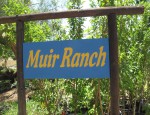
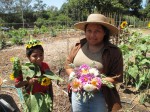
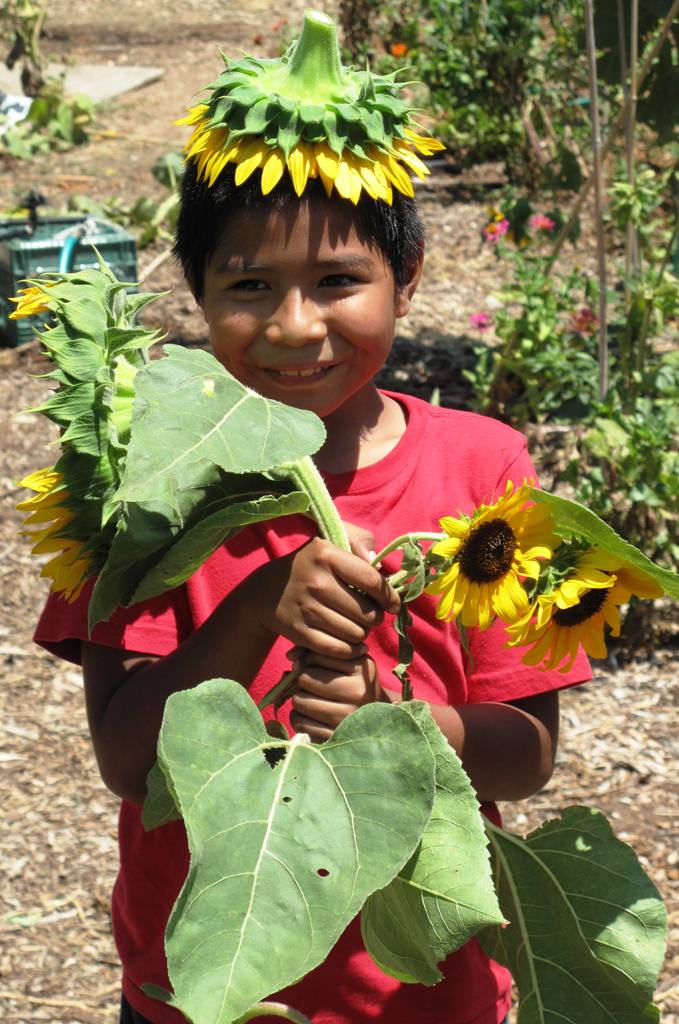
The little brother of a summer teen farmer donned a sunflower hat that Mud Baron gave him at Muir Ranch. Adorable~!
Here’s some more great news about the Urban Farming Movement.
In 2011, a dedicated team of volunteer teachers and students began converting 1.5 acres of Pasadena, California’s John Muir High School campus into a school-based farm.
Today, Muir Ranch grows a variety of flowers, vegetables and fruits that are included in weekly CSA boxes as well as school cafeteria lunches. Students can complete community service or internship graduation requirements by enrolling in classes at the Ranch. Muir Ranch also provides paid internships to students, which are funded by private donations, special events, farmer’s market sales, and subscriptions to the produce box program (CSA). Every week, Muir Ranch CSA subscribers get a box or bag of about 7-10 different types of fruit and vegetables grown without the use of pesticides or chemical fertilizers. Customers pick their shares up at central distribution sites throughout Pasadena. Muir Ranch CSA partners with several local farms for seasonal fruit and vegetables to supplement what they can produce, providing tax-deductible weekly boxes to over 100 subscribers. It is the CSA program that generates much of the income that keeps this place operating.
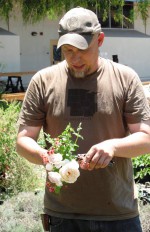
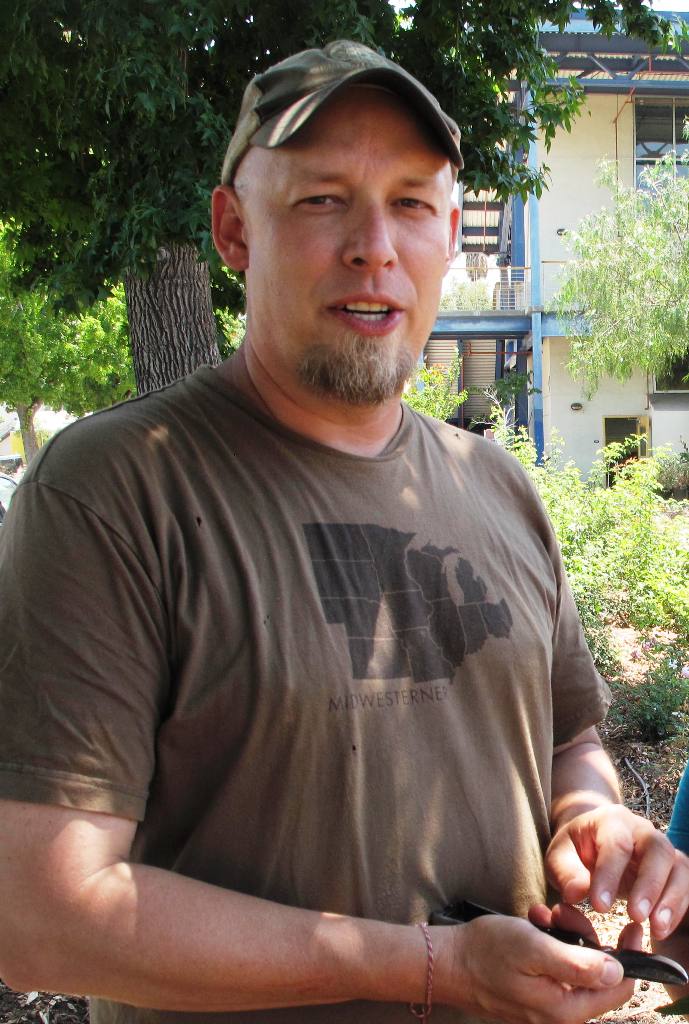
“Mud” Baron, Executive Director of Muir Ranch, is an urban farming activist and proud bouquet-maker.
One of the people at the hub of this fast-rolling wheel is Mud Baron, a passionate school garden advocate who serves as the Executive Director of Muir Ranch. That sounds like a high-falutin’ title, but in all reality, he is true to his nickname. Mud gets down and dirty – and REAL – with his kids, teenagers whose horizons are much brighter after they’ve learned to grow and sell food and flowers to local customers.
How did this former design-build contractor end up teaching gardening and farming skills to urban youth? I’m still trying to figure out the exact path of Mud’s career, but suffice it to say he’s in his element growing food and flowers. He totally lights up whether he’s shooting the breeze with one of the teen-CSA interns or sharing drinks with me and a board member (Mud ordered the Stone IPA, brewed with dandelion greens).
Board member Leelee Clement Doughty discovered Muir Ranch through the Pasadena Garden Club, which brought expert Rosarians to the farm to teach students about rose growing and rose care. She got hooked and started volunteering. “The best sales pitch is the Ranch itself,” she told me. A lifelong gardener and corporate finance escapee, Leelee digs the lessons she sees young people learning: Cooking and Catering, Marketing, Nutrition, Math and Business, Science and more. Right now, Muir Ranch is a “fiscally sponsored proeject of the Pasadena Education Foundation,” but if Leelee and Mud’s vision is realized, it will soon be a standalone nonprofit.
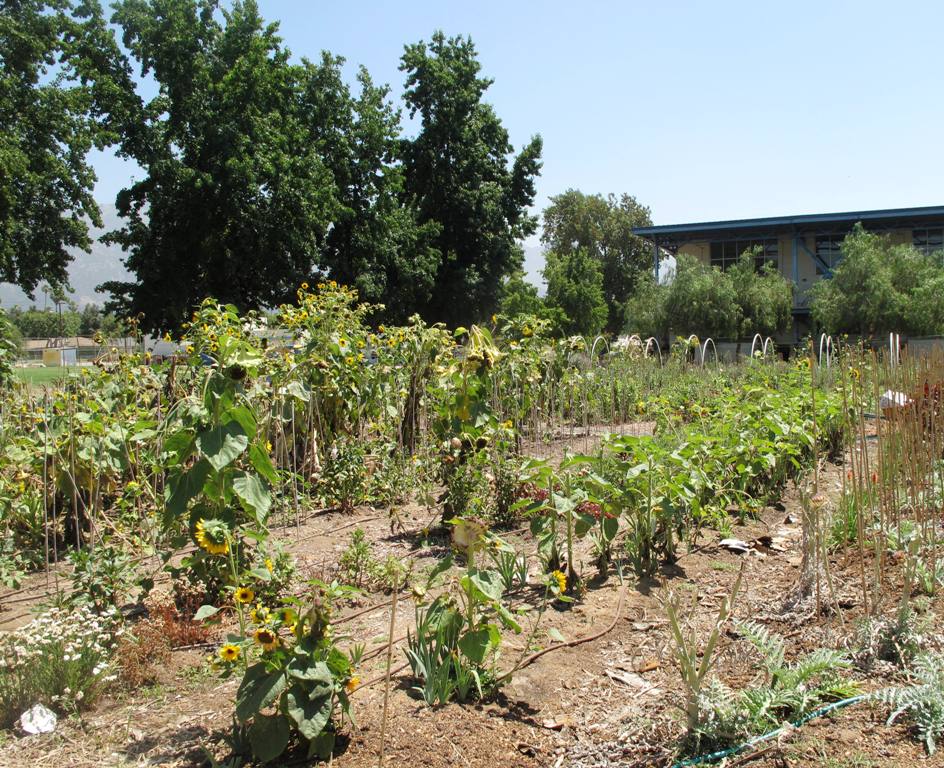
Many programs besides the CSA are supported under the umbrella of Muir Ranch, such as partnerships CSAs run by with other local schools and learning gardens. Muir Ranch also and hosts monthly “Plug Mobs” to help the community start their own gardens. In Mud’s mind, no Southern California-based teacher should go wanting for school garden supplies. “The Plug Mob program means that finding seeds and plants is no longer a factor for 2,000 schools,” he says. Muir Ranch operates like a plant nursery, helping source and distribute seeds, bulbs and flats of plant starts. Like modern day Johnny Appleseeds, Mud and his supporters share what they have and spread around the love.
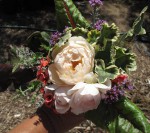
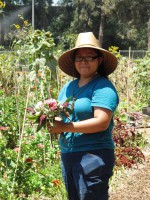
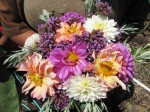
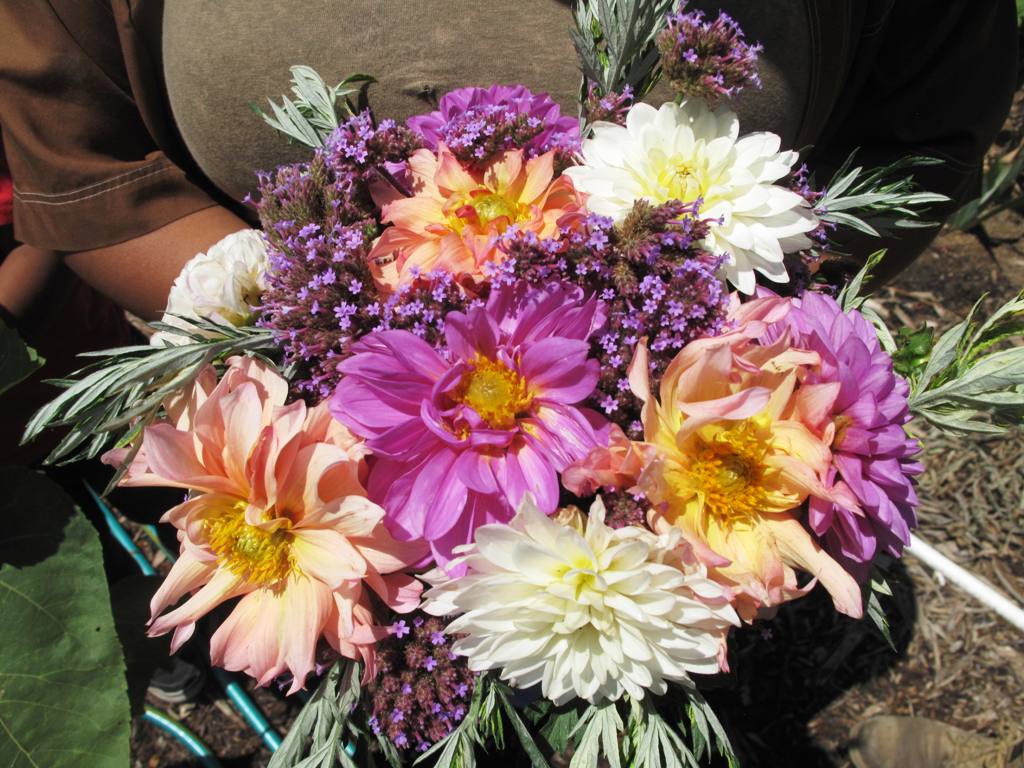
Muir Ranch hopes to add a culinary program that will connect students more closely to food systems. As young people “connect the dots,” they become involved in how food it is grown, distributed, and finally cooked into healthy meals. Besides being a center for education, Muir Ranch hosts a variety of ongoing and special events. The program is known for its floral arrangements, and I love that Mud has taught his interns and student workers how to harvest and assemble bouquets. When I visited last month, he gave two young women a challenge to create a bouquet for me. I loved the ease and confidence with which each gather flowers – mostly annuals and summer dahlias — into a custom-made bunch.
And the word is getting out about Muir Ranch’s flowers. One of Mud’s interns just earned $400 selling wedding flowers to a market customer. According to Mud, that experience has opened her eyes to possibilites for a bright future.
Volunteers are welcome (and needed) at this innovative program, especially to weed, prepare beds, turn compost, plant seeds and plugs, move worm “tractors,” maintain irrigation systems, water nursery plants and harvest crops. If you’d like to stop by and help, the regular Muir Ranch Workdays take place Monday-Friday from 8 to 11:00 a.m.
If you want to feast your eyes on more beauty from this place, follow Mud’s Instagram posts here: http://instagram.com/cocoxochitl
And follow his Twitter feed, here: @muirranch or @muirranchcsa

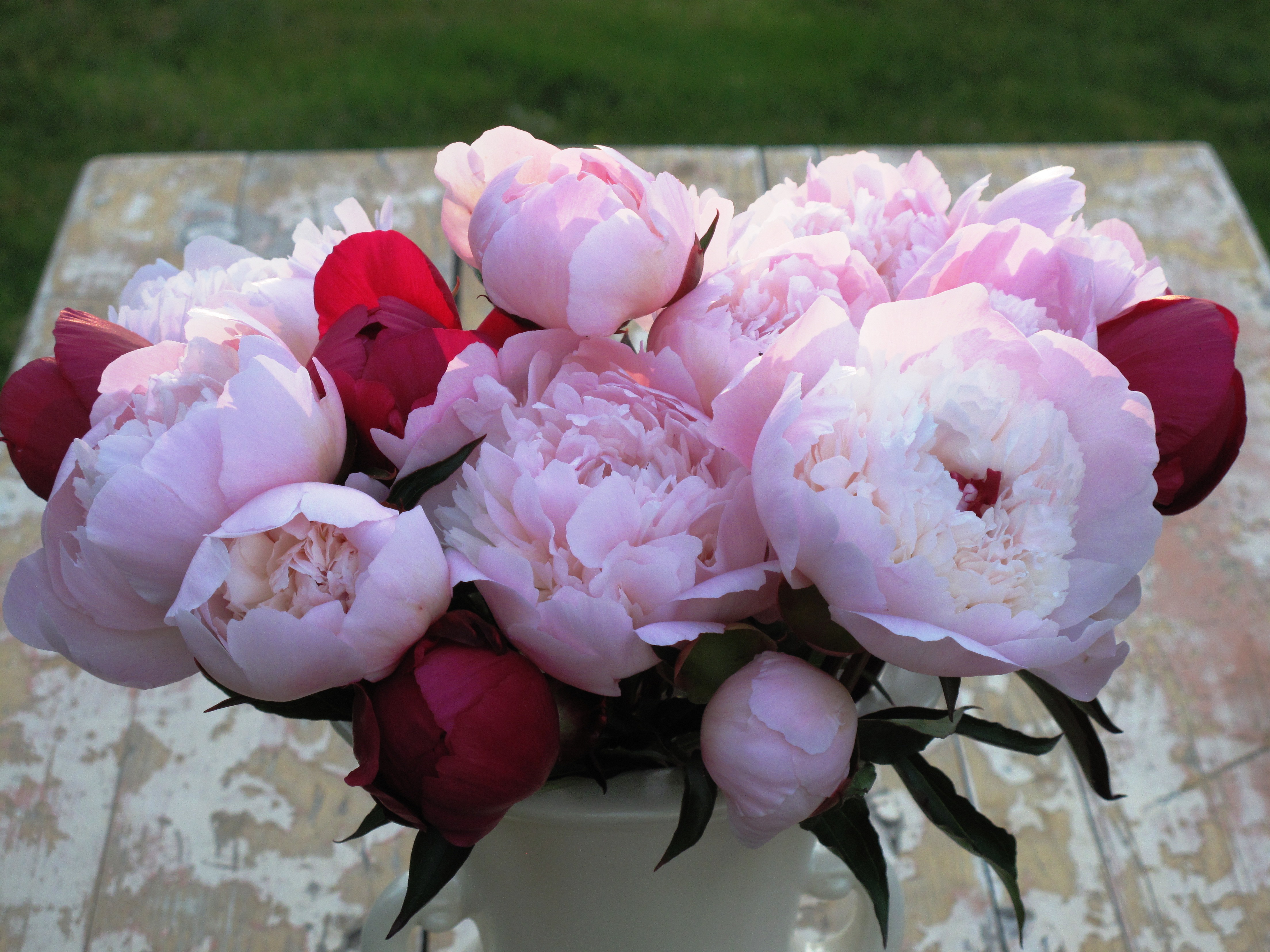
I came home from Alaska with these luscious peonies – and it seemed as if no other flower could compete for room in the vase.
© Debra Prinzing, all written and photographic content. Website design/development by Willo Bellwood/Metric Media