Debra Prinzing

Get the Email Newsletter!
Archive for the ‘Blog Posts’ Category

A July 4th Homegrown Bouquet, from an American flower farm

Friday, July 4th, 2014
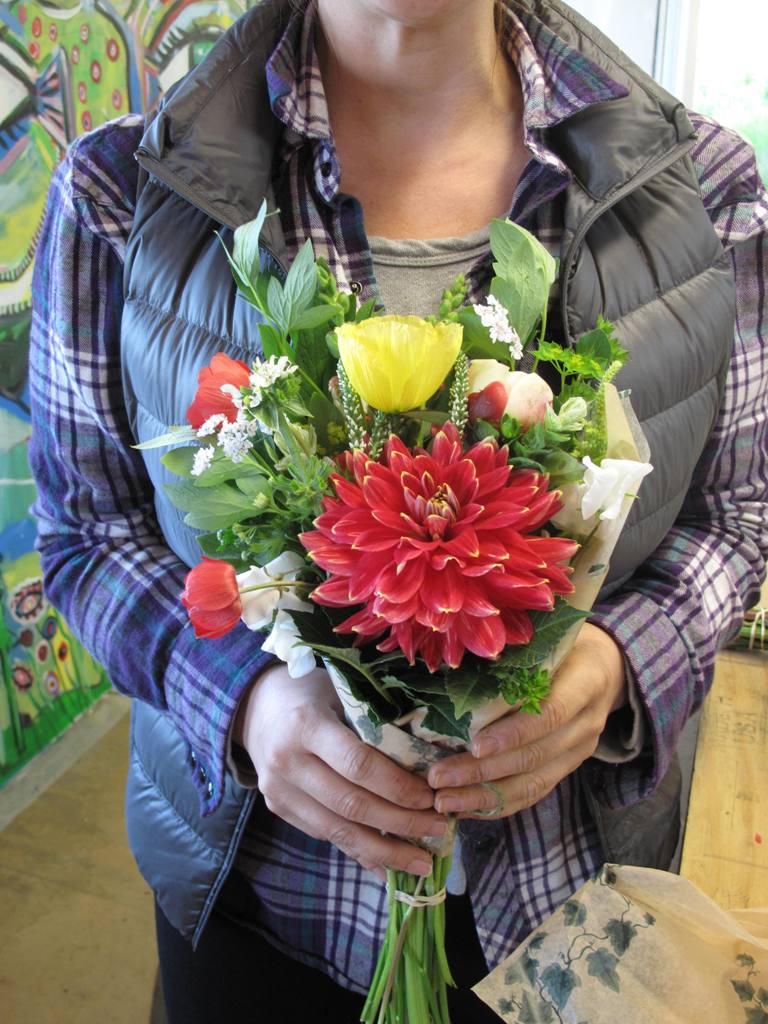
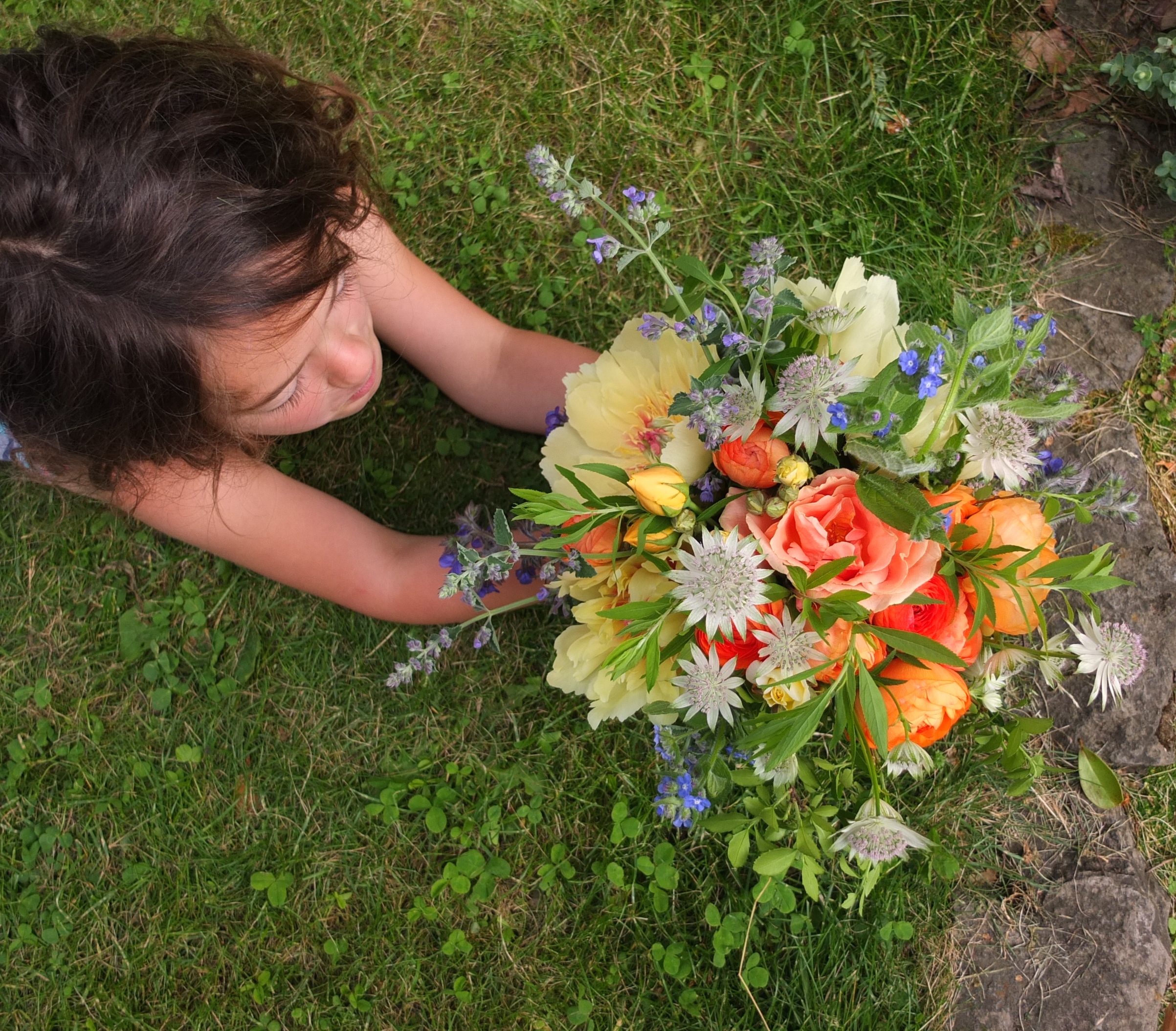
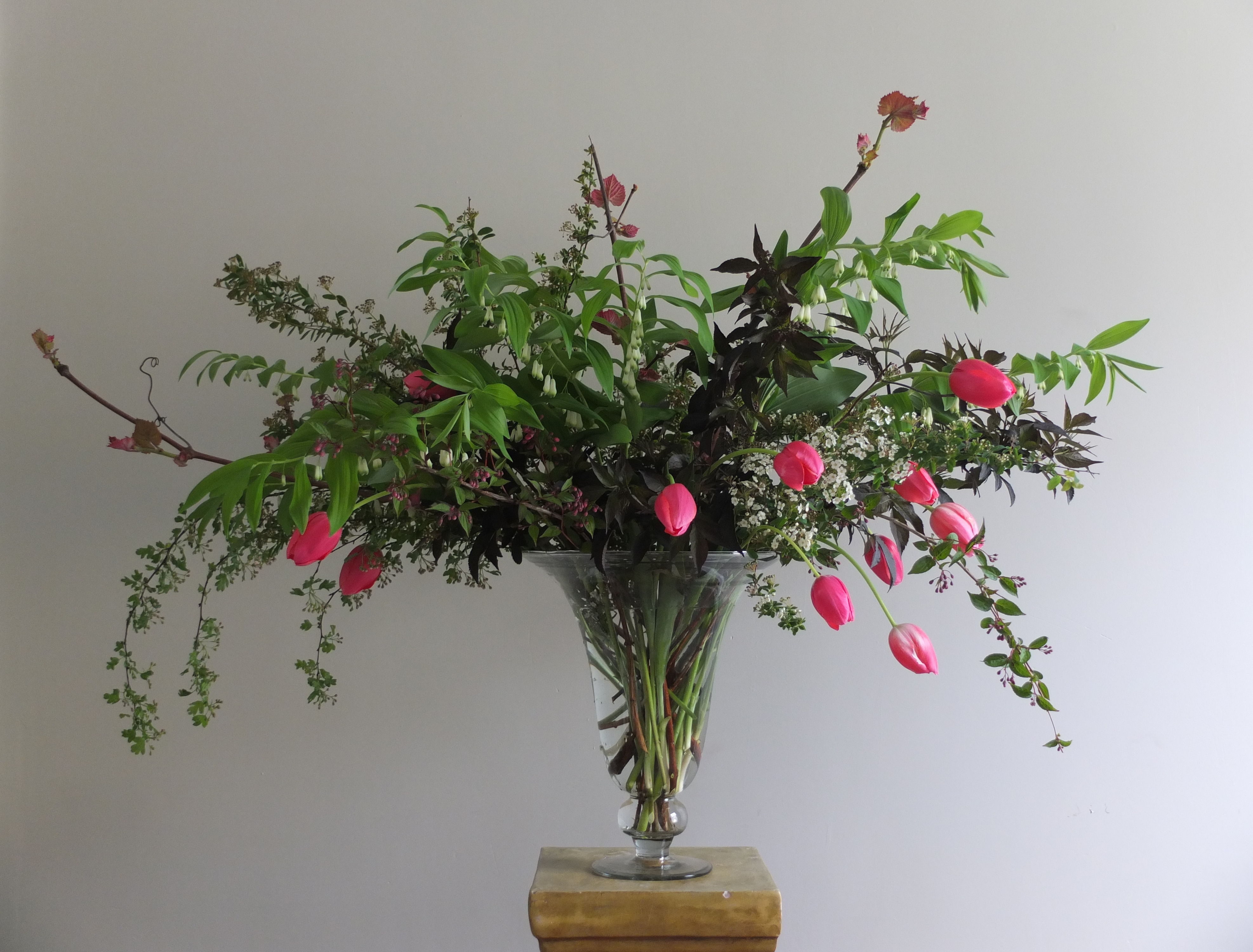
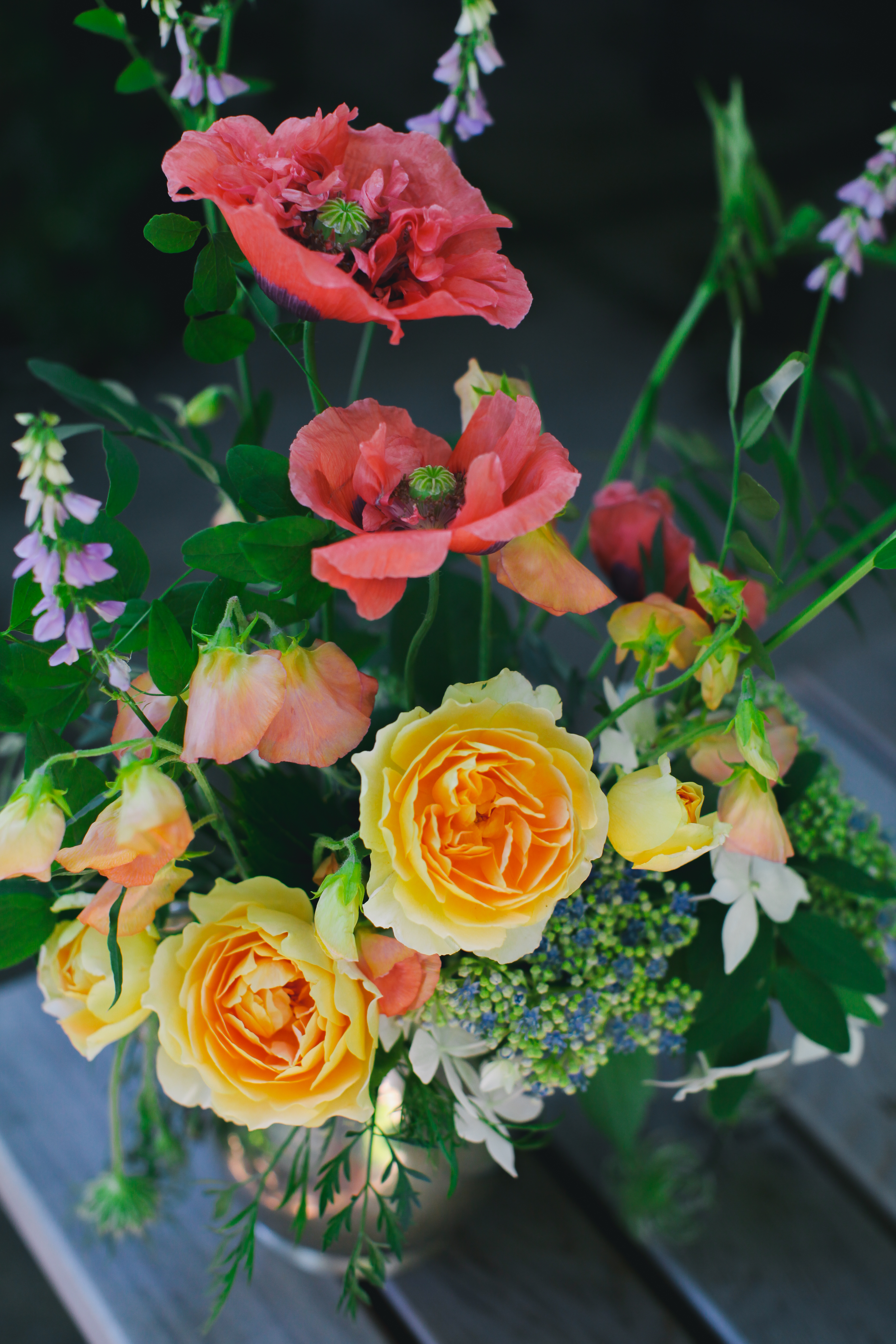
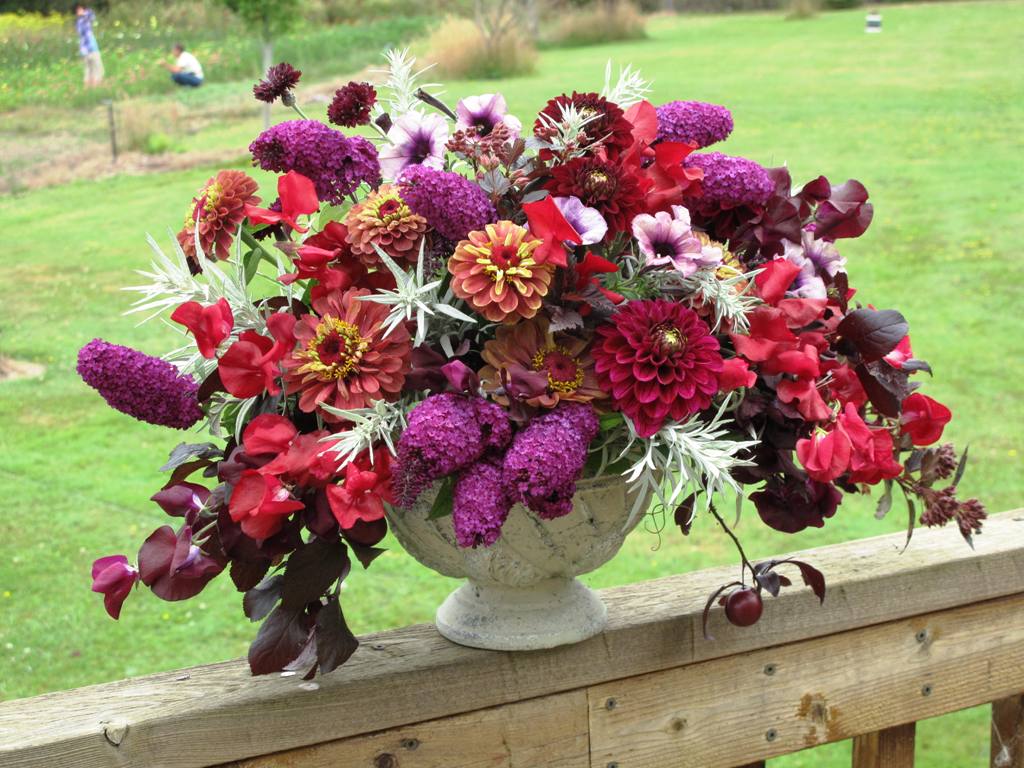
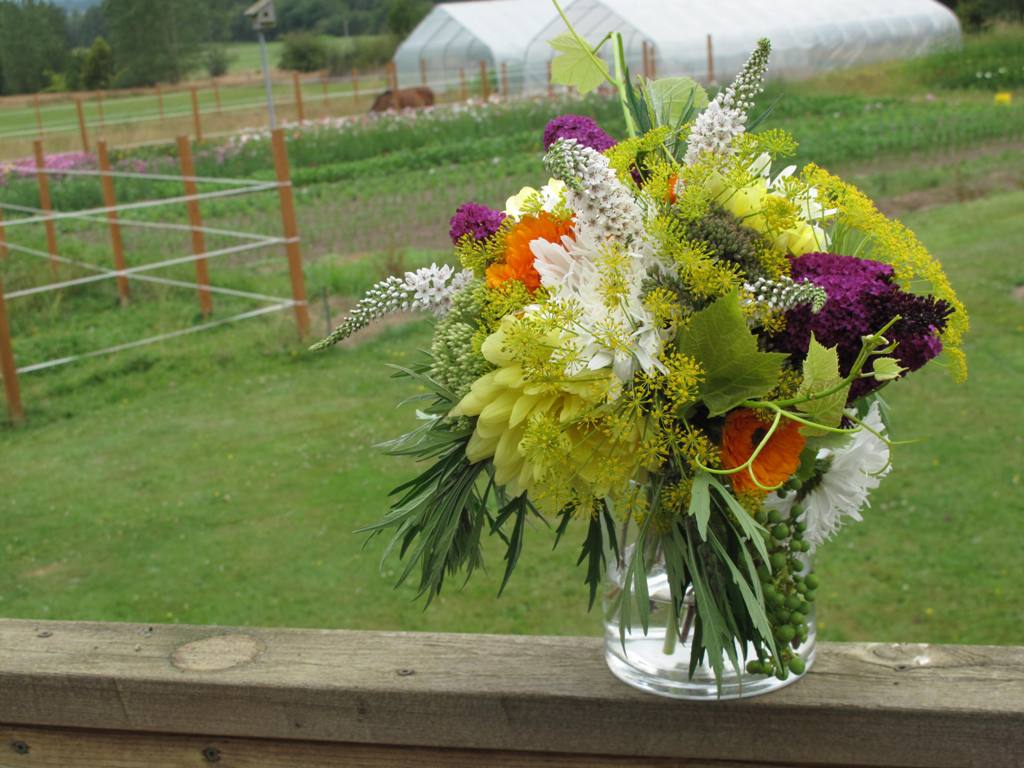
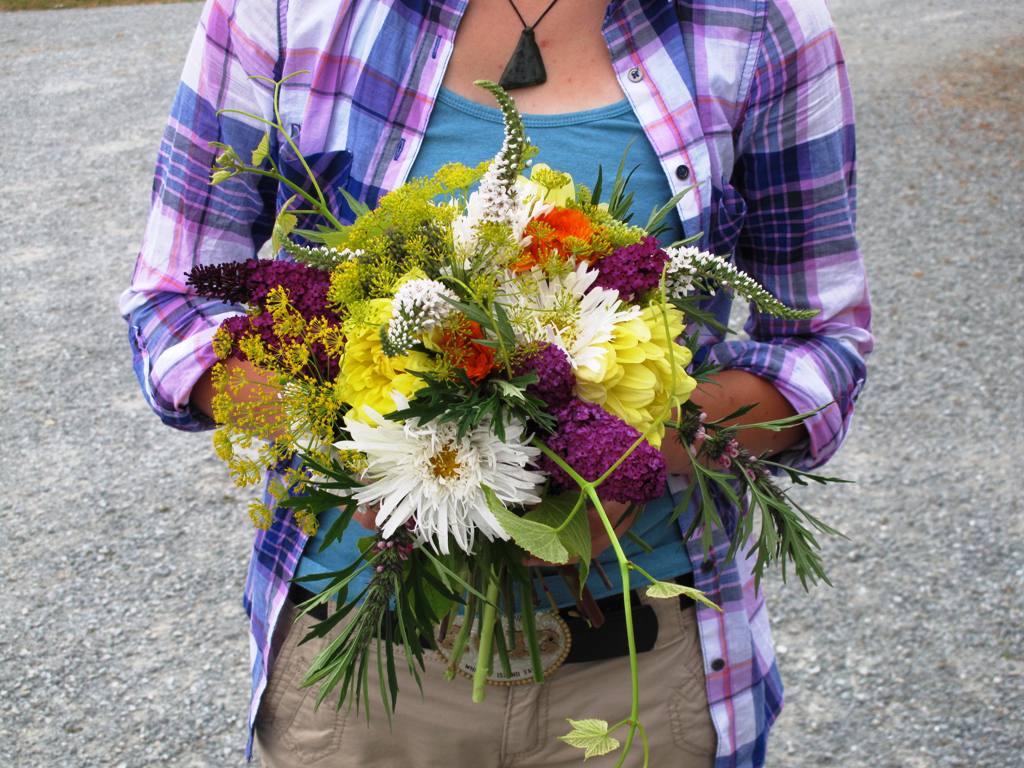
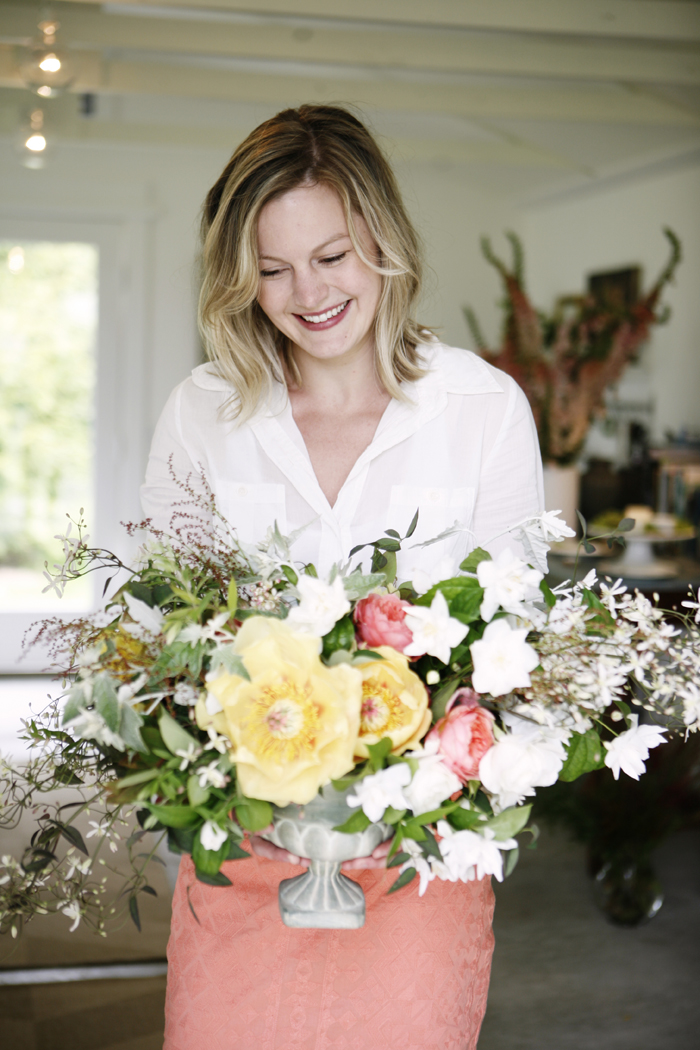
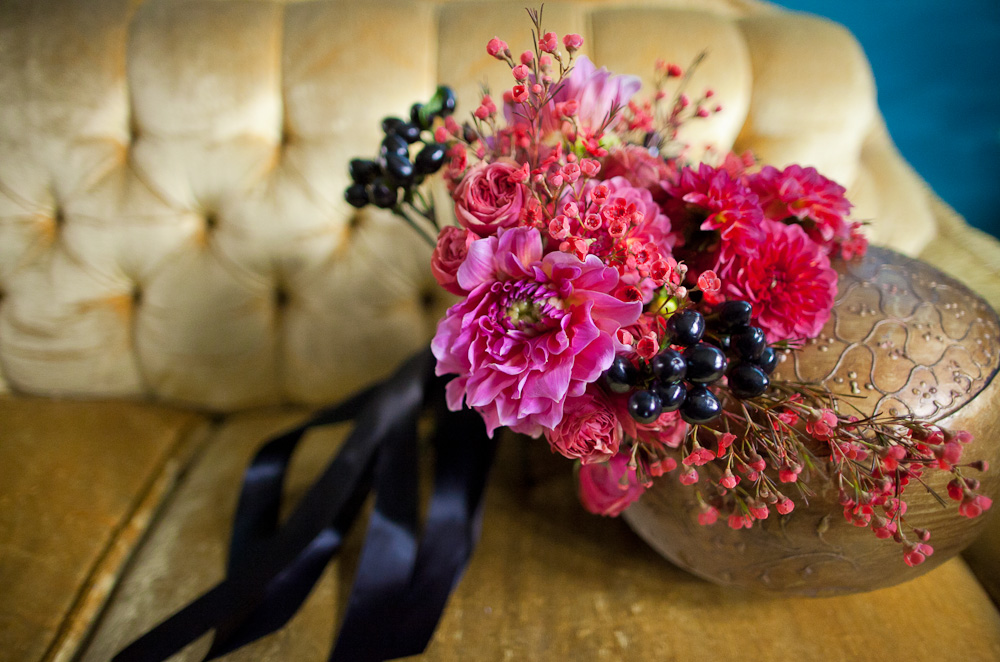
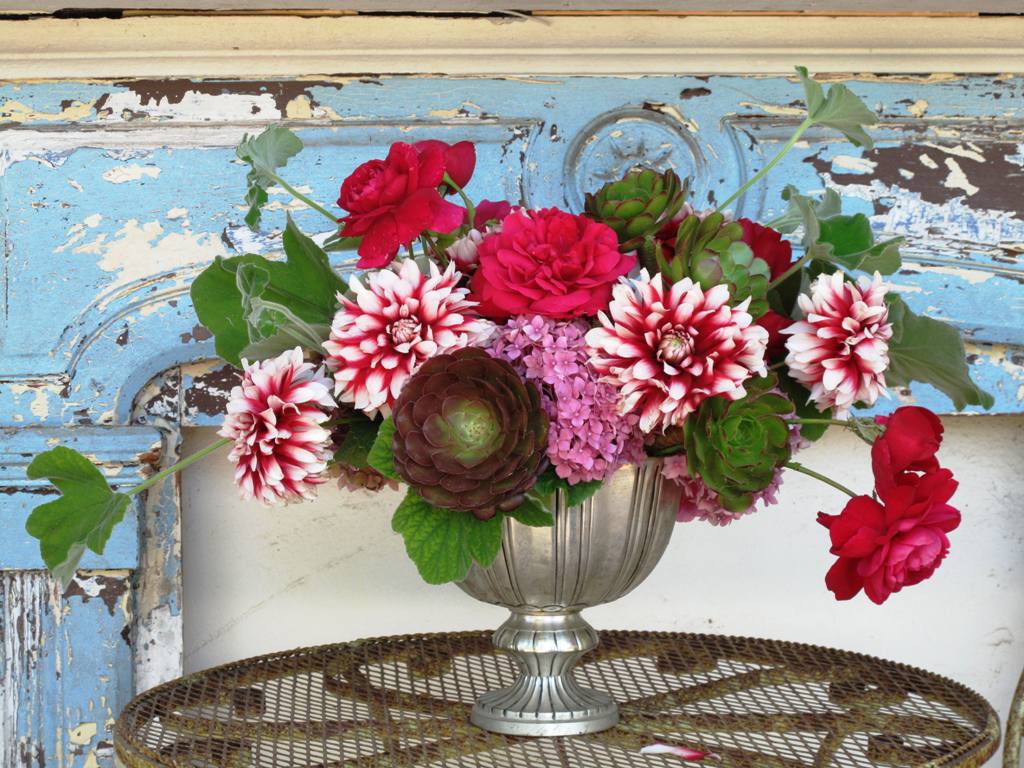
Just picked, from the cutting garden and fields at Rose Story Farm in Carpinteria, CA

Just picked, from the cutting garden and fields at Rose Story Farm in Carpinteria, CA

Composing this arrangement for the July 4th holiday is my reward for 48 hours of hard work.

I’ve been here in Southern California on assignment for Country Gardens magazine and Deck, Patio & Outdoor Rooms magazine.

I worked with Michael Garland, an LA-based photographer, to capture two wonderful garden stories that you’ll see in the pages of these publications next year (summer 2015). 

Today, after wrapping up at Rose Story Farm in Carpinteria, which has been the subject of past blogs and a podcast interview with founder Danielle Hahn, I got to play with the extra flowers from our photo shoot.

Everything that grows here is lush, and organic, and seasonal and simply devine! Here’s what my flower playtime yielded. Only in Santa Barbara area do the dahlias, roses, hydrangaes and succulents look at their peak on the same day.

If you have to work on a holiday, let it be July 4th and let it be at a American flower farm, right?

SLOW FLOWERS Podcast: Heidi Joynt and Molly Kobelt, two dynamic flower farmers and owners of Chicago’s Field and Florist (Episode 148)

Wednesday, July 2nd, 2014
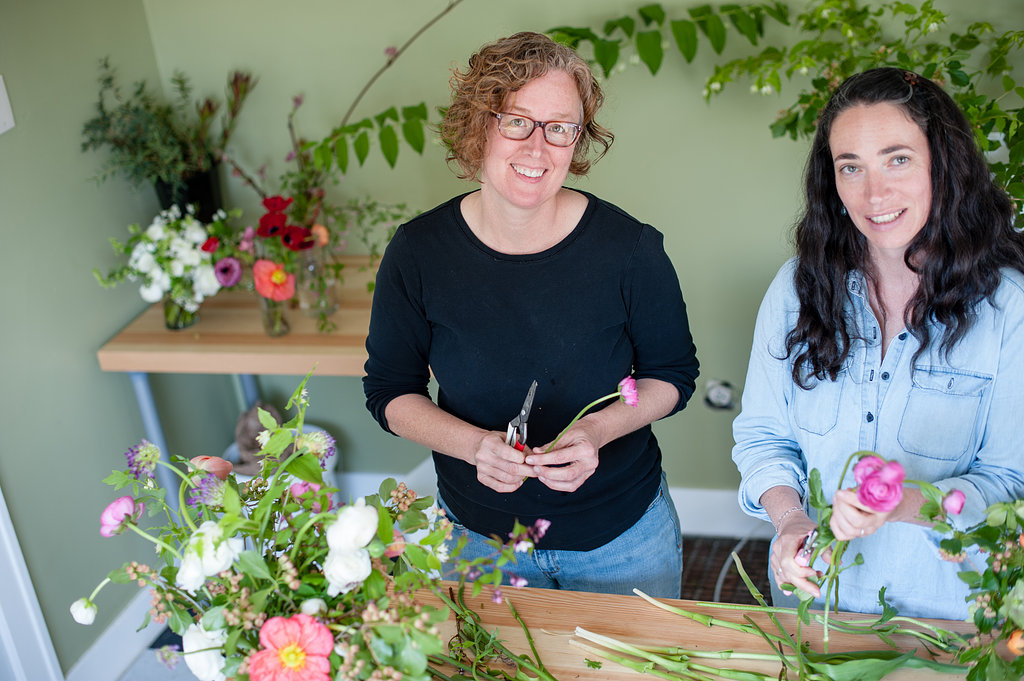
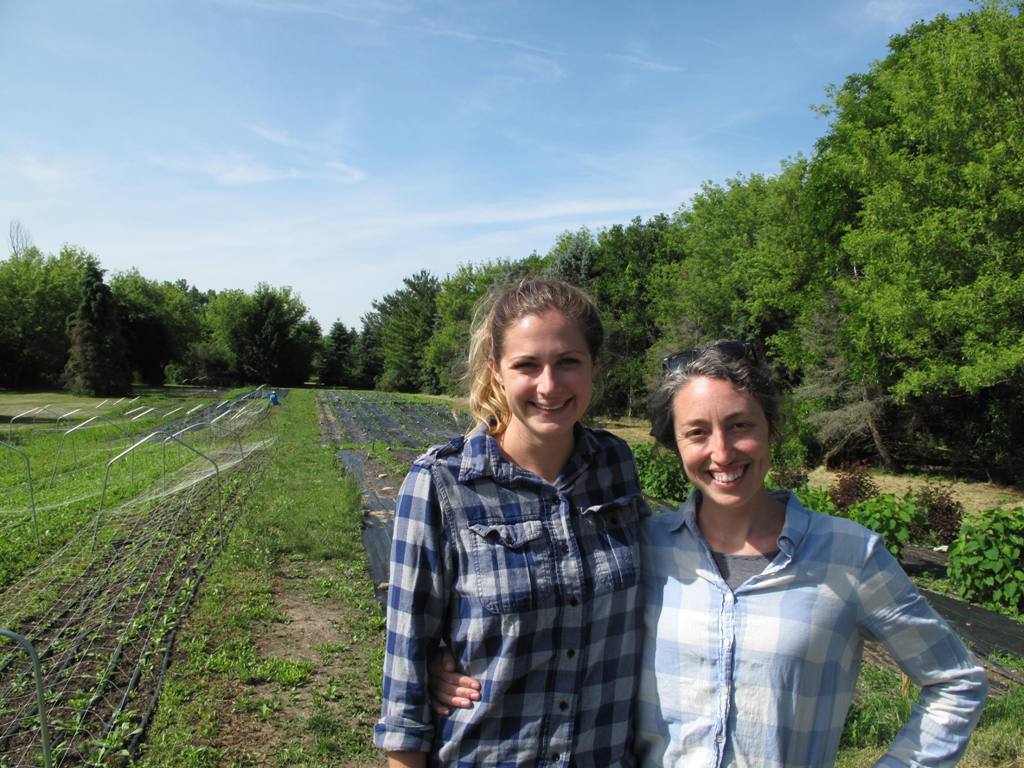
Molly Kobelt and Heidi Joynt of Field & Florist, pictured at their flower farm outside Chicago.

Molly Kobelt and Heidi Joynt of Field & Florist, pictured at their flower farm outside Chicago.

Before introducing you to this week’s guests, I want to share some of the highlights that have recently come my way, thanks to friends and members of the Slowflowers.com site.

These incidents may seem small, but when gathered together, they encourage me that the message of this podcast and the usefulness of Slowflowers.com are increasingly important.

WebFirst, we recently added “Floral Workshops & Classes” as a listing category. Maryann Nardo, owner of 7 Petals Floral Design in San Rafael, California, just let me know she booked her first student through a Slowflowers.com customer who was searching for floral design classes. That’s awesome news!

Second, Sarah Pabody of Triple Wren Farms, a recent guest of this podcast, shared news that a floral designer in her Bellingham, Washington, area – someone who’s taken a workshop of mine — found Triple Wren on the Slowflowers.com site and has since subscribed to the farm’s flower CSA for the rest of this summer. Sarah wrote: “I thought you might like to know both that it helped our farm and that she is super inspired to continue in what you taught her.”

And finally, Kate Richards of the Farmhouse 38 blog, sent this awesome piece of news.

“One of my guests at my blogger dinner this weekend is getting married in Rhode Island in September. She’s incredibly ecologically minded, and had opted to not do any flowers at the wedding because she is pretty much ‘over’ the current floral industry. Between my recent blog post about the Slow Flowers movement and my blogger dinner featuring all local, CA-grown flowers (and food), my friend had her eyes opened to the idea of slow flowers (she called it ‘life-changing’, lol). She hadn’t even considered that there could be a proximate flower farm where she could get local, responsibly raised flowers. So she went on slowflowers.com and sure enough, she discovered Robin Hollow Farm, not too far from where she’s getting married—and they are officially doing her wedding flowers now! Huzzah!!!”

These stories are simply fantastic – just what I had hoped for when I created Slowflowers.com. If you want to make my day, I’d love to hear how this movement, this podcast and the online directory is helping you as a flower farmer, retailer or florist.

fieldandflorist

It’s no surprise to learn that today’s guests are also part of the Slowflowers.com directory. Pictured above, Heidi Joynt and Molly Kobelt of Field & Florist, are based in the Chicago area. A few weeks ago, I was able to visit their idyllic growing grounds in Barrington, IL, about 30 minutes northwest of the city. After touring the fields to see what flowers are emerging from those lovely long rows, we sat down for a fun interview.

Field & Florist Farm. Photo by Jaclyn Simpson Photography

Field & Florist Farm. Photo by Jaclyn Simpson Photography

I first met Heidi when she attended the Association of Specialty Cut Flower Growers’ conference that was held in Tacoma during the fall of 2012.

We ended up sharing a car ride back to Seattle from a farm dinner in Skagit Valley, along with several other awesome young farmer-florists. For me, it was a memorable 90 minutes: ideas and energy bounced around the inside of my Subaru. Each person had something vital to share and we were all eager to learn about how our fellow passengers were developing their own floral businesses – from Seattle to Chicago to Columbus, Ohio — similar things are happening to connect local flowers with eager floral customers.

In the two subsequent years, Heidi and I have stayed in touch and corresponded about her business. She’s a model farmer-florist who has done so many exciting things to educate and inspire her customer base — from holding fun “work parties” on the farm that gets city folks out to the country and leaves a little dirt under their nails; to producing pop-up shops at hip Chicago venues, to designing beautiful seasonal wedding flowers for many happy couples.

Engagement photo bouquet. Photo by Ashley Bosnick Photography

Engagement photo bouquet. Photo by Ashley Bosnick Photography

Heidi is no longer a solo farmer and in this interview you will meet her new business partner Molly Kobelt. The two women have known one another for a couple years, through Dose Market – an innovative Chicago hub for all things local. Molly worked for Dose Market handling promotions and marketing; Heidi brought her flowers to sell. They recognized in each other a kindred spirit in their philosophy that being passionate about one’s work is important. Earlier this year, they joined forces when Molly came onboard as a partner in Field and Florist.

Ampersand Pop-Up Dinner Arrangement. Photo by Michael Litchfield

Ampersand Pop-Up Dinner Arrangement. Photo by Michael Litchfield

Check out “A Taste of a Floral Arrangement,” an awesome video produced by Rabbit Hole Magazine at Kinmont Restaurant in Chicago with Field and Florist. In the “small world” category of our intersecting lives, my son Ben works at this restaurant – and he originally shared the clip with me before he knew Heidi and I were friends. That connection makes me very happy.

Field and Florist grows and harvests a wide array of beautiful blooms from April to October – that’s about the maximum amount of time you can source locally in Chicago’s climate. In the winter months, Field and Florist sources from certified sustainable sources within the U.S.

I hope you enjoy hearing from these two talented farmer-florists, as we talk about all the successes and challenges of their venture.

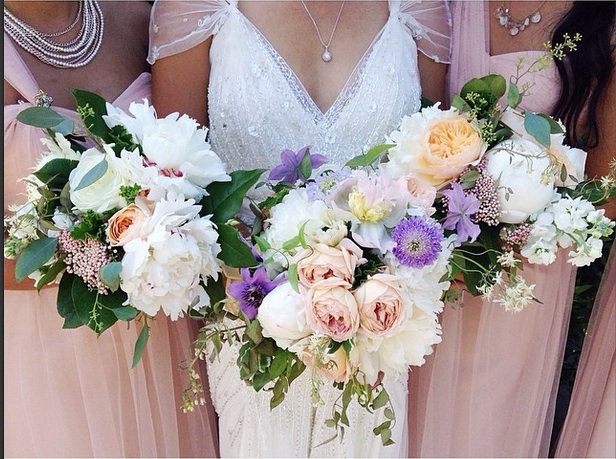
Recent bridal + bridesmaid bouquets. Photo by Averyhouse

Recent bridal + bridesmaid bouquets. Photo by Averyhouse

Thank you for joining today’s conversation with Heidi and Molly.

Here are links to sign up for the Field and Florist newsletter

Consider subscribing to their floral CSA – they’re taking orders for September right now.

Thanks to listeners like you, this podcast has been downloaded nearly 15,000 times.

If you like what you hear, please consider logging onto Itunes and posting a listener review.

Until next week please join me in putting more American grown flowers on the table, one vase at a time. 

The Slow Flowers Podcast is engineered and edited by Hannah Holtgeerts and Andrew Wheatley. Learn more about their work at hhcreates.net.

Make a Bouquet: Step-by-Step

Wednesday, June 25th, 2014
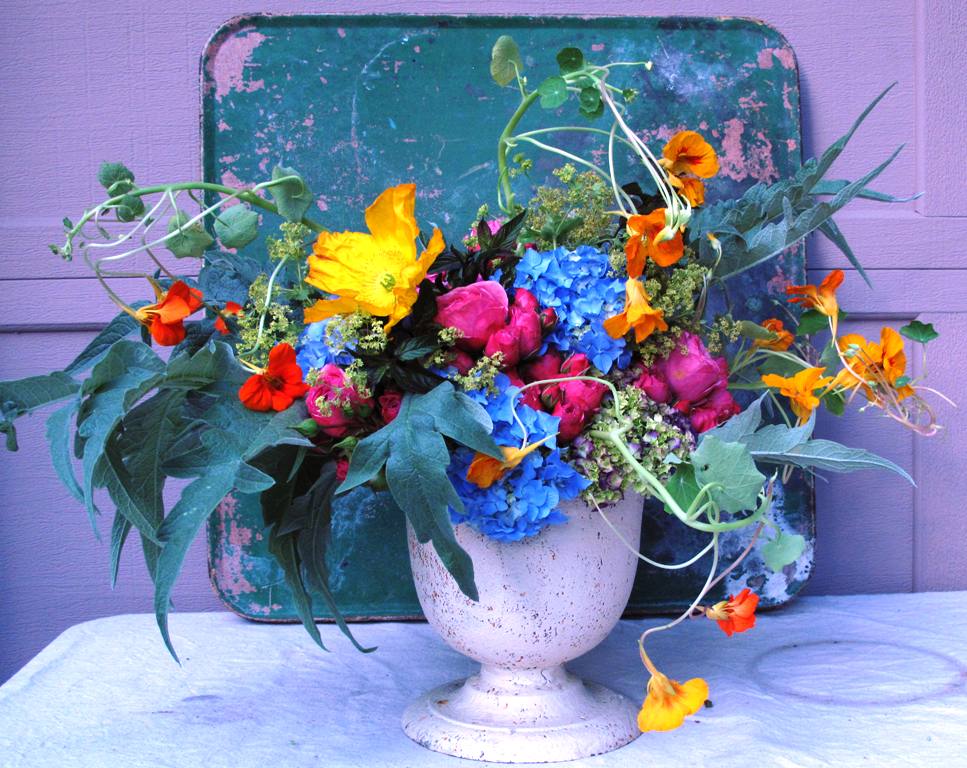
June Bouquet with ornamentals and edibles.

June Bouquet with ornamentals and edibles.

Last weekend I was involved with the Hardy Plant Study Weekend as a speaker and a participant. This is an annual event, held every June. I rotates between Washington, Oregon and British Columbia, and this year was hosted and produced by the Northwest Perennial Alliance.

I was asked to present a floral design demonstration at Saturday night’s gala, held at Wells Medina Nursery. What could be better than attending a fun dress-up party with the theme “50 Shades of Green” (get it?). Surrounded by horticulture friends old and new, many of them who wore awesome green outfits, I demonstrated “The Marriage of Ornamentals and Edibles in the Vase.”

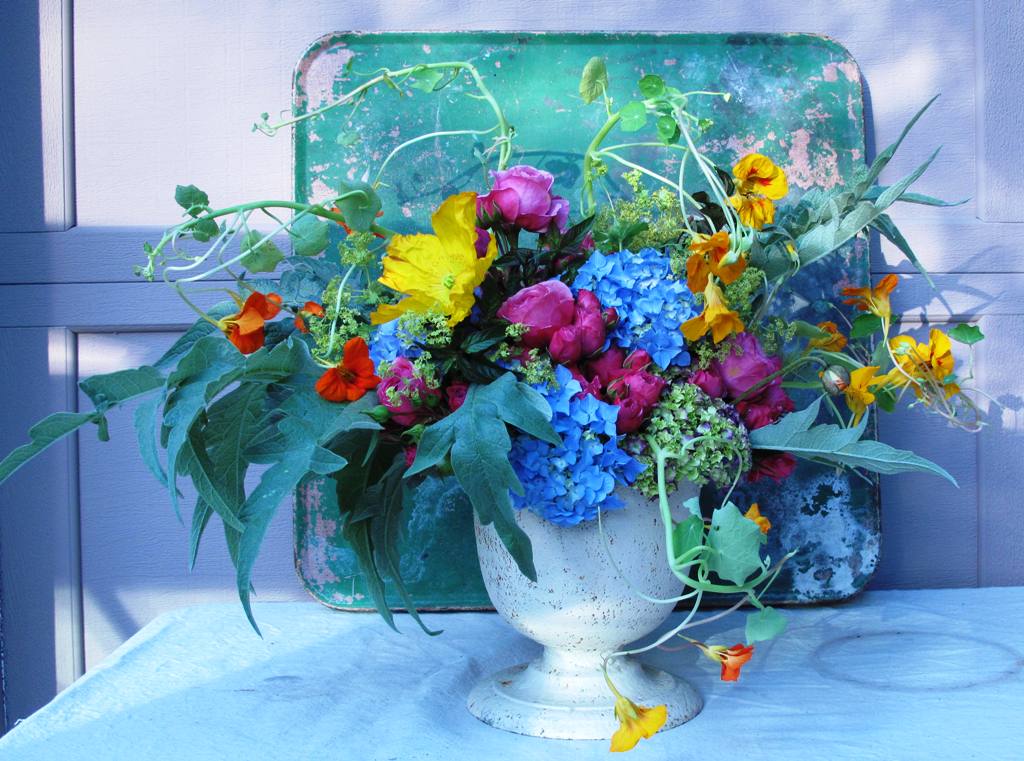
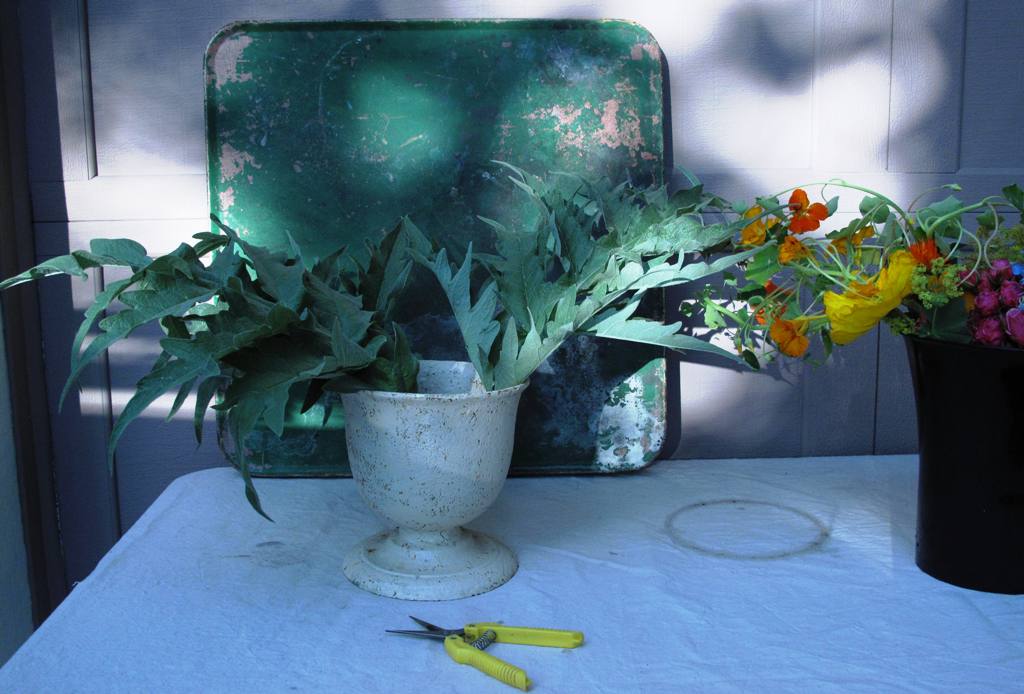
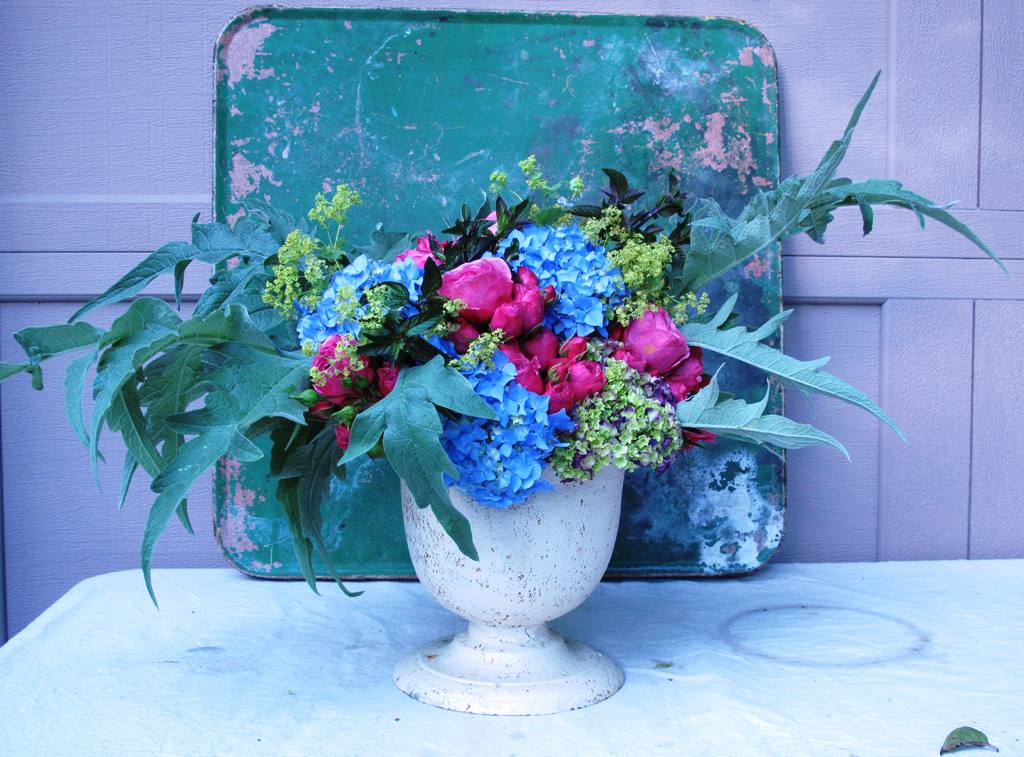
Here is a recreation of that arrangement, using most of the same flowers that I included in the first arrangement. I used a sizeable cast-iron urn (7 inches wide x 9 inches high) and filled it with a 5-inch vintage flower frog (cage style). NO FOAM, people! It’s not necessary and it actually shortens the vase life of flowers like these.

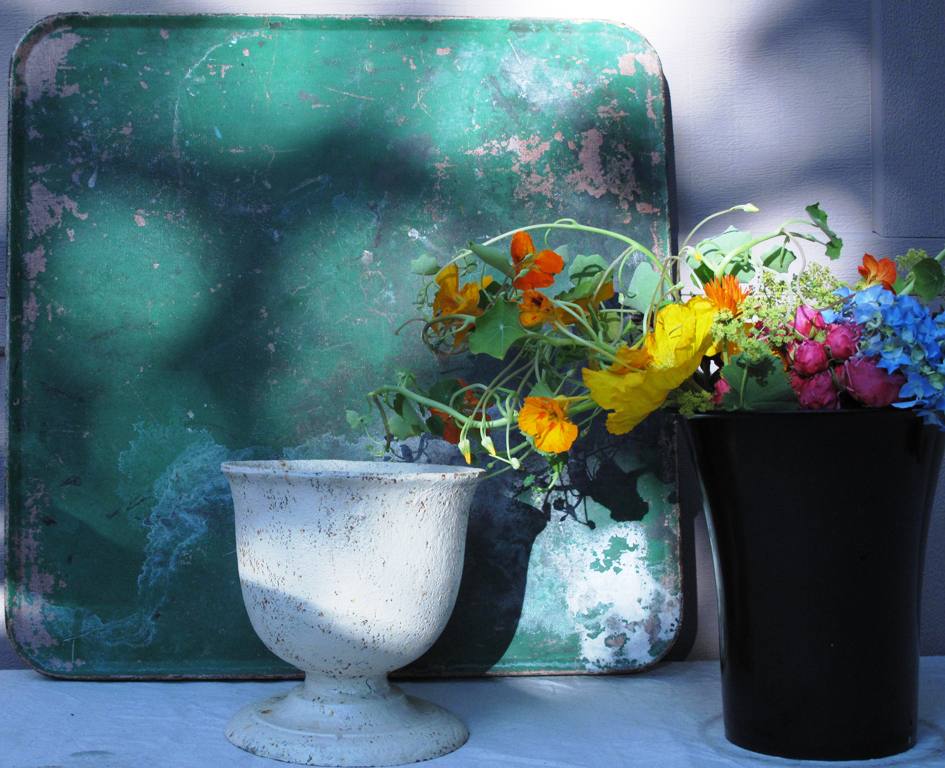
Step One: Choose an awesome container. This image gives you a good idea of the vessel's shape and scale.

Step One: Choose an awesome container. This image gives you a good idea of the vessel’s shape and scale.


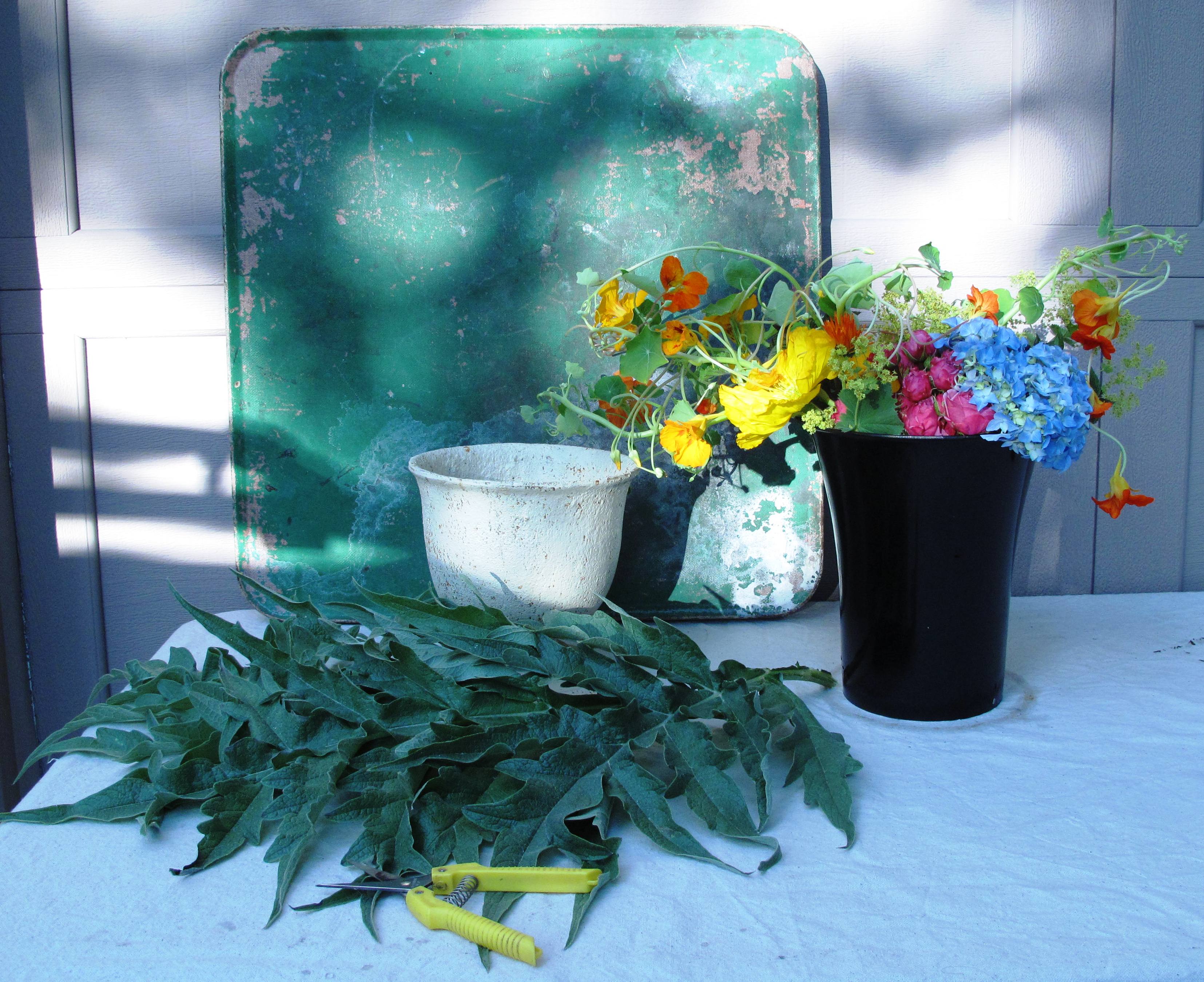
Gather together your foliage. Start with something large and dramatic.  Artichoke/Cardoon foliage is a great summer element- straight from the veggie garden.

Gather together your foliage. Start with something large and dramatic. Artichoke/Cardoon foliage is a great summer element- straight from the veggie garden.


Step Two: Add the largest foliage first. I placed three leaves asymmetrically.

Step Two: Add the largest foliage first. I placed three leaves asymmetrically.


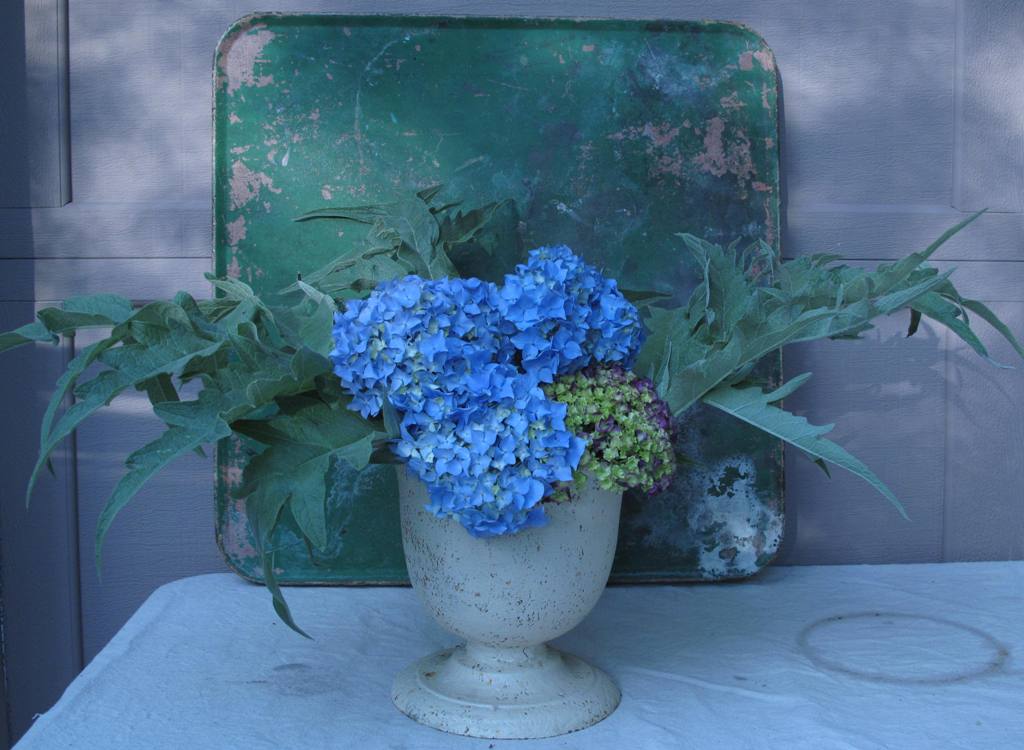
Step Three: Add the larger textural elements, like hydrangeas - straight from my garden.

Step Three: Add the larger textural elements, like hydrangeas – straight from my garden.


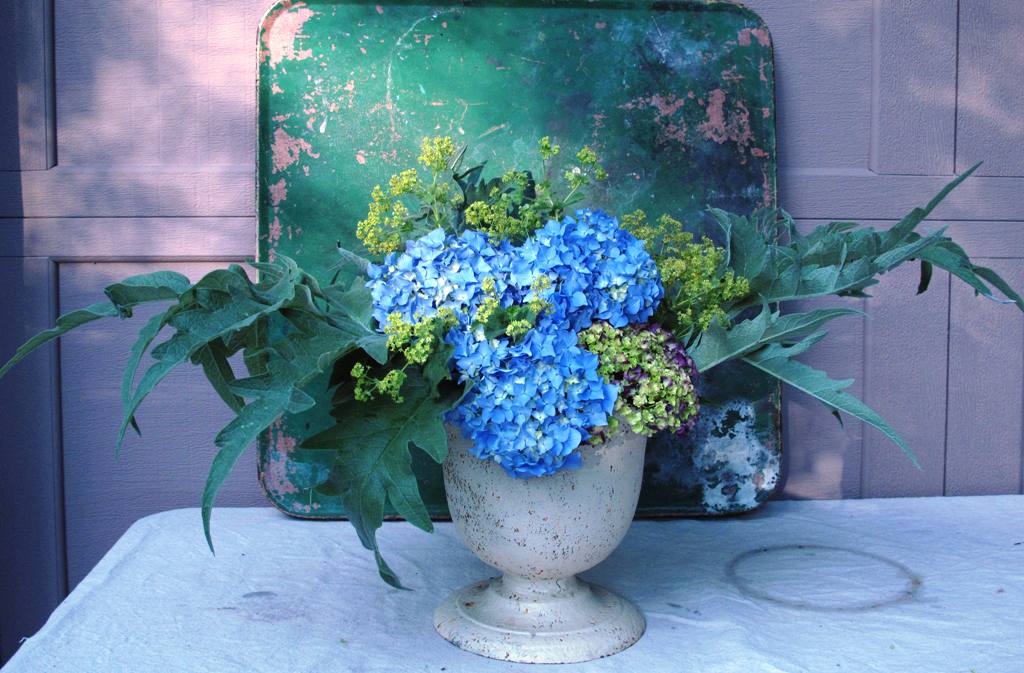
Step Four: Add more texture for contrast. Here, I added ladies mantle - lime green and super fluffy. Also straight from my garden.

Step Four: Add more texture for contrast. Here, I added ladies mantle – lime green and super fluffy. Also straight from my garden.


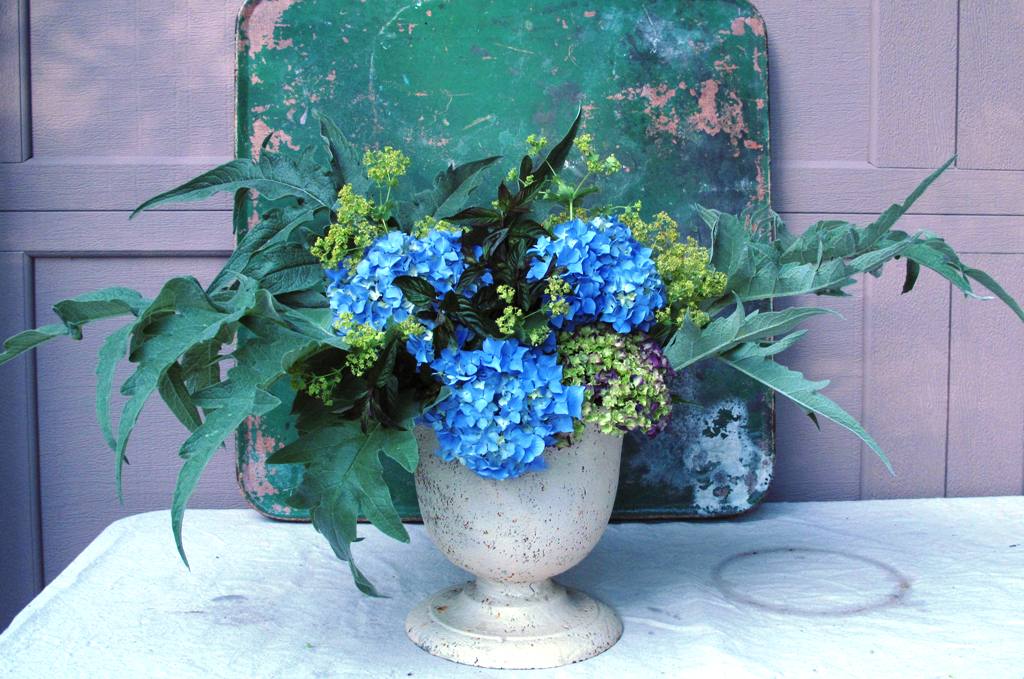
Step Five: Add smaller, darker, glossier foliage. Like sprigs of mint. They smell fantastic!

Step Five: Add smaller, darker, glossier foliage. Like sprigs of mint. They smell fantastic!


Step Six: Now, the diva flowers. Like these locally-grown garden roses.

Step Six: Now, the diva flowers. Like these locally-grown garden roses.


Step Seven: The final "viney" elements! Love the nasturtium. It lasts surprisingly long in the vase. PS, one vivid yellow poppy!

Step Seven: The final “viney” elements! Love the nasturtium. It lasts surprisingly long in the vase. PS, one vivid yellow poppy!

How do you keep this looking fresh for an entire week? Place this urn down inside the sink and run water inside (using the nozzle on the sink faucet). Give this vase a drink for 2-3 minutes and let the excess water spill over the edge. You’ll basically replace old, clouded water with fresh, clean water!

SLOW FLOWERS Podcast: Media entrepreneur Margot Shaw, creator of flower magazine (Episode 147)

Wednesday, June 25th, 2014

Before we get started with today’s awesome guest, I’ve got a little self-promotion to share. The Slow Flowers “brand” is a lovely bouquet with several unique blooms in the vase.

PodcastLogoThere is this podcast, of course, and we’re coming up on our one-year anniversary on July 23rd (we’ll have an exciting announcement from a special guest to celebrate our 52nd episode!).

 Web

And there is the Slowflowers.com online directory, which is growing every day – up to 325 vendors on the site as of this week.

600_600_SLOWFLOWERSFrtCvrrevBut it all started with the book: Slow Flowers, four seasons of locally-grown bouquets, from the garden, meadow and farm. St. Lynn’s Press published this little gem in early 2013 and it has been the creative inspiration to launch the Slow Flowers Movement.

14-silver-logoWe just got word that Garden Writers Association has awarded Slow Flowers with one of two Silver Medals of Achievement for Overall Book product this year. I couldn’t be happier and I’m so pleased to receive the recognition because it reflects what together our American grown floral community has achieved in changing the dialogue and changing the relationship consumers have with their flowers. Congratulations to the entire St. Lynn’s Press creative team for making my words and images into such a beautiful little book: Paul Kelly (Publisher), Catherine Dees (Editor) and Holly Rosborough (Art Director). They are the dream team! 

TODAY’S GUEST: MARGOT SHAW, flower magazine

Margot Shaw, "flower magazine" founder and editor-in-chief

Margot Shaw, “flower magazine” founder and editor-in-chief  


"To Flower" ~ the definition embodies the spirit of this magazine.

“To Flower” ~ the definition embodies the spirit of this magazine.

Now, it is entirely fitting that I introduce you to Margot Shaw of flower magazine, my interview subject today. Margot has coined the phrase “a floral lifestyle,” a term I thoroughly embrace – and I know you will, too.


Margot calls herself a “late bloomer” when it comes to the art of floral design. A self-proclaimed “call-and-order-flowers girl,” Margot’s “a ha moment,” her view of flowers, changed when planning her daughter’s at-home wedding.

Working alongside the floral and event designer, she recognized the artistry and inspiration involved in “flowering” and soon began apprenticing with that same designer.

After a few years, enamored with all things floral but unable to locate a publication that spoke to her passion, she set about creating one. 

With a clear vision, a deep appreciation for beauty, a facility with words, a hometown uniquely geared towards publishing, and the advice and counsel of generous industry professionals, Margot launched flower in March of 2007. 

I snapped this photo of the flower magazine staff back in January 2011 when I visited Birmingham, Alabama, for a get-to-know meeting. That's Margot, second from the left.

I snapped this photo of the flower magazine staff back in January 2011 when I visited Birmingham, Alabama, for a get-to-know meeting. That’s Margot, second from the left.

Originally filled with floral, garden, and event design, the niche publication has gradually broadened to include content that trumpets a floral lifestyle—interiors, art, travel, fashion, jewelry, and entertaining.

“It has something for everyone who likes flowers—and who doesn’t like flowers?!” Shaw proclaims.

Since its debut, flower has continued to grow at a steady pace, recently moving from quarterly to bimonthly, and available in all 50 U.S. states and 17 countries.

Here’s some more information on the publication and its influence on our floral community:

Here's what you'll find on the pages of flower magazine ~

Here’s what you’ll find on the pages of flower magazine ~


Here's who reads the magazine.

Here’s who reads the magazine.


Here's more about the circulation and geographic distribution.

Here’s more about the circulation and geographic distribution.

Want to check out the current issue of flower magazine? Margot has generously shared the “secret” log-in password with listeners of the SLOW FLOWERS Podcast. Click here to read the digital edition and use TUBEROSE as the password. 

Next week’s guests are Heidi Joynt and Molly Kobelt, partners in Field & Florist of Chicago. You won’t want to miss it!

Thanks to listeners like you, this podcast has been downloaded 13,700 times.

If you like what you hear, please consider logging onto Itunes and posting a listener review.

Until next week please join me in putting more American grown flowers on the table, one vase at a time. 

The slow flowers podcast is engineered and edited by Hannah Holtgeerts and Andrew Wheatley. Learn more about their work at hhcreates.net.

SLOW FLOWERS Podcast: Kathleen Williford, passionate “locaflor” and American-grown floral advocate (Episode 146)

Wednesday, June 18th, 2014

One of Kathleen's arrangements for a CCFC Field to Vase dinner earlier this year - in her coveted McCoy  vase!

One of Kathleen’s arrangements for a CCFC Field to Vase dinner earlier this year – in her coveted McCoy vase!  


Kathleen Williford

Kathleen Williford

Today’s guest is my friend Kathleen Williford of the lifestyle blog Bloemster, the California Cut Flower Commission, the Monterey Bay Greenhouse Growers Open House & Tour, and Staff of Life Natural Foods in Santa Cruz, California.

 Yes, Kathleen is involved in all these endeavors, thanks to her talents, her tendency to say “yes” to all sorts of opportunities, and her genuine love for all-things local when it comes to flowers. In fact, it seems as if everything Kathleen does professionally and personally intertwines like flowers, stems and tendrils in a lovely bouquet.

We recorded this interview on June 1st while working together at the Sunset Celebration Weekend in Menlo Park, California. Kathleen had just pulled off her largest floral design commission ever the night before – she designed the tabletop flowers for a VIP dinner hosted by Sunset’s editor in chief Peggy Northrop. The setting was gorgeous and everyone raved about the all-California-grown centerpieces, which were an important reminder of the weekend’s local and seasonal theme. 

Kathleen teaming up with Kasey Cronquist, CEO/Ambassador of the California Cut Flower Commission.

Kathleen teaming up with Kasey Cronquist, CEO/Ambassador of the California Cut Flower Commission.

I’ve worked with Kathleen off and on for a couple of years, thanks to our mutual association with the California Cut Flowers Commission. Kathleen has helped me source flowers from the Monterey Bay area farms for my demonstrations at the San Francisco Flower & Garden Show and for a Garden Conservancy workshop I taught in the East Bay Area two years ago.  She is a social media whiz, prompting all of us involved in the American Grown movement to hustle to catch up with her.

Kathleen created the new ALL LOCAL floral department at Staff of Life in Santa Cruz.

Kathleen created the new ALL LOCAL floral department at Staff of Life in Santa Cruz.

Kathleen is the first one to notice a trending topic, a new voice on twitter, a new source of gorgeous local flowers on instagram. I can count on her to always bring me up to speed. Case in point, when a group of us wanted to cheer on the only all-California-grown float in this year’s Tournament of Roses Parade, it was Kathleen who compiled an exhaustive list of the twitter addresses for every single broadcast personality on the various local, national and cable networks . . . just so we could be strategic with our messaging. She was one step ahead of the rest of us.

Social media has been a tool for her promotional work as the special events planner for CCFC’s Monterey Bay Greenhouse Growers Tour, which will take place this coming Saturday, June 21st.

One of the lovely California grown bouquets Kathleen designed for the Sunset Celebration Weekend VIP dinner earlier this month.

Here’s one of the lovely California grown bouquets Kathleen designed for the Sunset Celebration Weekend VIP dinner earlier this month.

I was invited to participate last year as a speaker and as the guest designer for a delightful field-to-vase dinner that Kathleen organized with her colleague Janice Wills Curtis of CCFC.  We had a total blast and I’m truly disappointed that I have to miss the fun this year due to another lecture commitment.

It was through social media that Kathleen also connected with Holly Chapple of The Chapel Designers, a previous guest on this podcast. Kathleen found her way to the Chapel Designers’ conference that was part of Florabundance Design Days in Santa Barbara this past winter. (Actually, it was Kathleen’s husband Paul who gifted her the two-day design intensive as a surprise Christmas present).

One of many arrangements that graced Sunset Celebration Weekend.

One of many arrangements that graced Sunset Celebration Weekend.

Since that experience earlier this year, Kathleen has been on a floral fast-track, adding special event floral design to her plate, launching a website to support her personal design work – called Bloemster – and further, taking on the floral department management for Staff of Life, where she also handles marketing and special events.

I think she needs to clone herself, because there never seems to be enough hours in the day to accomplish all these to-do’s, but Kathleen knows how to pull it off.

 I thought you’d enjoy hearing about the many ways one person can live out the values of supporting local and seasonal agriculture – from design, to retail, to communications and more. One person can make a difference, and Kathleen demonstrates that every single day.

If you are in the Bay Area this weekend, take a drive to Santa Cruz County for a free tour of several flower farms, nurseries and greenhouses where you can meet a flower farmer, buy cut flowers and plants, and enjoy a slice of the true California floral experience. I’ll add all the details on my web site so you can check out the Monterey Bay Greenhouse Growers Tour. You might just run into Kathleen. She’ll probably be wearing a large-brimmed hat and carrying a clipboard, an armload of flowers, a phone, a tote bag, a camera, or all of the above!

Follow Kathleen at these places:

Twitter

Facebook

Bloemster Blog

More McCoy + CA Grown Blooms.

More McCoy + CA Grown Blooms.


Love this hot orange and dark teal combo of Kathleen's.

Love this hot orange and dark teal combo of Kathleen’s.


Locally grown flowers made the Field-to-Vase Dinner a huge success.

Locally grown flowers made the Field-to-Vase Dinner a huge success.

The Slow Flowers Podcast is engineered and edited by Hannah Holtgeerts and Andrew Wheatley. Learn more about their work at hhcreates.net.

SLOW FLOWERS Podcast: The Emerging Family Flower Farm, with Sarah & Steve Pabody of Triple Wren Farms (Episode 145)

Wednesday, June 11th, 2014
Steve and Sarah Pabody of Triple Wren Farms, Ferndale,Washington

Steve and Sarah Pabody of Triple Wren Farms, Ferndale,Washington

Earlier this week I headed north from the city and drove to Bellingham, Washington, close to the US-Canadian Border.

There, in lovely Whatcom County, I met Sarah Pabody for lunch at a charming cafe serving organic and locally-grown food. That seemed apropos because we were ready to talk about putting more flowers – edible and non-edible alike – into the agricultural conversation. 

I’ve known Sarah and her husband Steve Pabody since their flower-growing operation Triple Wren Farms joined the Seattle Wholesale Growers Market two years ago. Sarah and I served together on the co-op’s board for a while and she has impressed me with her level-headed approach to our discussions and the thoughtful and inclusive way she makes decisions as a leader at the market. 

Harvesting with Sarah.

Harvesting with Sarah.

We’ve been talking about me visiting Triple Wren, and now that it’s flower-growing season, the time was right to make the trip. I warned Steve and Sarah in advance that I wanted to record our conversation for the Slow Flowers Podcast – and fortunately for you, they were game! 

After lunch and a whirlwind chat, I followed Sarah even further north up the highway to the town of Ferndale. What beautiful countryside, where only a few miles off the interstate you can find apple orchards and flower fields surrounding a charming farmhouse with a deep, covered, wraparound porch, perfect for sitting down with Sarah and Steve, and a jug of their cold, refreshing, home-pressed apple cider. Steve poured and we forgot about the recorder and you can join in vicariously.  

Gentleman orchardist, Steve Pabody.

Gentleman orchardist, Steve Pabody.

I wanted you to meet Sarah and Steve because they are a young flower farming couple who are nearly 100-percent self-taught. Trial and error doesn’t seem daunting to them, though. Steve, a former Baptist pastor, has an incredibly gregarious personality, a can-do attitude and the willingness to poke fun at himself while tackling challenges like raising chickens, pruning thousands of apple trees and installing irrigation lines. He’s sort of a city boy who has taken to farming with a passion. [And PS, as the daughter of a Baptist pastor and pastor’s wife, I have a soft spot for Steve and Sarah – and their personal journey,]

Trey Pabody, inspiration for "Triple," as he is named Steve Pabody, the third.

Trey Pabody, inspiration for “Triple,” as he is named Steve Pabody, the third.

 Like Steve, Sarah has an infectious smile and the type of optimism you hope rubs off on you. This is not an easy path, but it’s one they are committed to walking together. And without owning the land on which they farm, Sarah and Steve are mindful of the steps they need to take to sustain Triple Wren for their future.

I know you’ll be inspired by their story, whether you’re a young farmer, too, or if you’re more established.

And by the way, their farm name celebrates the two reasons Sarah and Steve are so devoted to creating a family enterprise. First, their son Trey (Triple) and their daughter Chloe Wren (Wren). The children are a huge part of the farm’s energy and joy – as you can see in the family photos Sarah shared here.  

Chloe Wren, little sister and inspiration for "Wren" in the farm's name.

Chloe Wren, little sister and inspiration for “Wren” in the farm’s name.

Triple Wren Farms is located in the heart of Sm’Apple’s U-Pick Apple Orchard, which Steve manages for the Smith family, owners of the farm. During the fall U-Pick visitors are also able to harvest dahlias, zinnias, sunflowers and pumpkins to purchase.

Sarah, with Steve’s help, has developed two acres surrounding the orchard where she grows cut flowers and seasonal produce.

As you’ll hear in our interview, they got started with sunflowers just three seasons ago — and the mix of annuals, perennials, edibles, bulbs and woody floral ingredients they now grow for the floral marketplace has exploded. Since joining Seattle Wholesale Growers Market, Triple Wren has achieved Salmon Safe designation. The farm uses sustainable and non-certified organic practices.

In addition to being part of the Seattle Wholesale Growers Coop, Triple Wren sells to local florists and groceries in Bellingham, Ferndale and Lynden – and this year launched a very successful DIY Wedding Flowers program.

More farm photos, shared by Sarah and Steve:


Columbine and poppies, inside the hoophouse.

Columbine and poppies, inside the hoophouse.


Sarah, flower mama extraordinare (and a cool farmer, too!)

Sarah, flower mama extraordinare (and a cool farmer, too!)


Cosmosssssss!!!! Simple and so perfect!

Cosmosssssss!!!! Simple and so perfect!


Sarah snapped this lovely rose portrait at dawn. Sigh.

Sarah snapped this lovely rose portrait at dawn. Sigh.


Perfect foliage: Pea vines.

Perfect foliage: Pea vines.


Apples . . . everywhere! To eat, to press into cider . . . and to show up in bouquets (especially the flowering branches of spring and the tiny fruited branches of crabapples).

Apples . . . everywhere! To eat, to press into cider . . . and to show up in bouquets (especially the flowering branches of spring and the tiny fruited branches of crabapples).

The message to take from today’s episode is one that both Sarah and Steve emphasized: Mentorship is important. Perhaps it’s essential.

I encourage all you veteran flower farmers to reach out and share your expertise, experience, years of knowledge with someone just getting started. Pay it forward. . . and soon, those young flower farmers will, in turn, follow your example and share with the next generation that comes after them. It’s key to saving our American-grown floral industry!

Thank you for joining today’s conversation with Triple Wren’s Sarah and Steve Pabody. Please enjoy this fabulous Q&A that Alicia Schwede of Flirty Fleurs conducted with Sarah last fall.

Here’s how to follow Triple Wren’s activities, day by day:

Triple Wren on Facebook.

Triple Wren on Instagram

Triple Wren on Pinterest

Please join me next week for another insightful and educational episode of the Slow Flowers Podcast. Thanks to listeners like you, this podcast has been downloaded more than 13,000 times.

If you like what you hear, please consider logging onto Itunes and posting a listener review.

Until next week please join me in putting more American grown flowers on the table, one vase at a time. 

The slow flowers podcast is engineered and edited by Hannah Holtgeerts and Andrew Wheatley. Learn more about their work at hhcreates.net.

ARE YOU A SLOW FLOWERS FLORIST?

Thursday, June 5th, 2014

Join Slowflowers.com to share the news about your floral studio, shop, store or farm

and feature your American-grown botanicals!

mockupwithnewcontent


What is Slowflowers.com?

Slowflowers.com is a project of Debra Prinzing, writer, speaker, designer and consumer advocate. She created Slowflowers.com as a free, searchable directory that makes it easy for customers to find florists, shops, studios and farms who share a commitment to sourcing local, seasonal and domestic American-grown flowers. 

Why should you list your business?

This unique resource positions you and your business as a floral industry leader whose values and ethos promotes local, seasonal and domestic flowers. By being part of the Slow Flowers Movement, you gain market differentiation from the competition – and strengthen your brand in the eyes of consumers and your distinct marketplace. 

What if you also sell/design with imported flowers?

We understand that some members may continue to import from global sources. Floral businesses featured on Slowflowers.com will be asked to highlight and feature their American-grown product and to supply domestic, seasonal and local flowers when their customers request it. 

How do consumers use the site?

Slowflowers.com enables users to:

  • Search by state, city or zip code to find a floral resource
  • Search by category or key word
  • Find studios and retailers who specialize in green weddings, weekly subscriptions and other services.
  • Discover local flower farms that sell direct to the DIY consumer
  • Provide reviews and raves about their experience with a specific vendor. 

How can you list your business?

You have two options:

The FREE Standard Listing includes your business name, address, phone number, email and web site URL.

The PREMIUM Listing can be purchased on a yearly basis and allows you to create your personal page on Slowflowres.com. It includes the following: Business name, address, phone number, e-mail, website URL, logo, photo gallery of designs, summary and detailed descriptions, video and customer ratings/reviews. 

Please follow the USER GUIDE instructions to take advantage of the introductory Premium Listing offer of $119 (that’s only $10/month). This offer expires July 1, 2014, when new listing rates go into effect ($199/year). 

For more information, contact: debra@slowflowers.com

SLOW FLOWERS Podcast: The Little Flower School of Brooklyn comes to Oregon (Episode 143)

Wednesday, May 28th, 2014

flowerschoolheader_2012

'Who needs a prince' - seriously great iris name!

‘Who needs a prince’ – seriously great iris name!

Last week was quite amazing in so many ways. First of all, I was on assignment for Country Gardens magazine, working with the uber-talented photographer Laurie Black, my collaborator in so many great articles that we’ve created over the years for editor James Baggett and art director Nick Crow.

With her partner-husband Mark King (ever the calm one and a genius when it comes to all the technical aspects of location photography), Laurie and I were tasked with capturing the story of Schreiner’s Iris Farm, the lovely and alluring bearded iris, and the two women who are nearly single-handedly reviving interest in these old-fashioned spring flowers. 

Nicolette (left) and Sarah (right), at their happy place in the iris garden.

Nicolette (left) and Sarah (right), at their happy place in the iris garden.

Those women are my guests today – Sarah Ryhanen of Saipua and Nicolette Owen of Nicolette Camille. While they independently own their own Brooklyn-based floral studios, together the friends collaborate as teachers through The Little Flower School of Brooklyn. 

'Oh Jamaica'

‘Oh Jamaica’

Smitten by the bearded iris, especially watercolor-washed varieties in apricot-peach-pink; smoky browns; mustardy-yellow; mahogany and silvery-lavender spectrums, Nicolette and Sarah have been fans of Schreiner’s Irises for years.

They worked with the Salem, Oregon-based, third-generation family farm to create a one-day Iris-intensive and invited students to join the fun.

Here’s how the workshop was described:

In this class, students will bask in the glory of the fields at peak bloom, and in a tour of the display gardens witness first hand the incredible diversity of color and form this unique perennial offers. We’ll discuss and demonstrate the tenets of composing an arrangement in our elegantly layered Little Flower School style. Special emphasis will be placed on flower selection, color blending and the mechanics of building a low lush sprawling arrangement without the use of floral foam. Working with the very best of the Schreiner’s specimens, along with a menagerie of other locally grown Oregon flowers, students will receive in-depth. one-on-one instruction as they build their own rambling garden style arrangement.

Generous in sharing their knowledge, Sarah and Nicolette demonstrated with their favorite irises and perennials.

Generous in sharing their knowledge, Sarah and Nicolette demonstrated with their favorite irises, annuals, foliage and perennials.

The day was packed with beauty and creativity. It was an inspired, sublime experience — from the first moment when we met, toured the gallery of irises and the gorgeous display beds showcasing irises and their favorite companion perennials — to an afternoon of floral design instruction. Meeting many members of the Schreiner family was a bonus! Thanks to Steve Schreiner, Ray Schreiner and sister Liz Schmidt (plus we met sister Paula, who stopped by while leading an iris tour for Portland’s Japanese Garden).

About 18 students gathered for the workshop, from established floral designers to apprentices and those considering a career switch, and me – a floral dilettante! Together, we fixated on Sarah and Nicolette’s language of flowers. 

These two communicate with such beautiful interlocking poetry and prose. And you’ll just have to wait for the summer 2015 issue of Country Gardens to learn more, read my story and see Laurie’s awesome photography!


Love these colorful benches at Schreiner's Iris Farm.

Love these colorful benches at Schreiner’s Iris Farm.

After our workshop, however, the three of us sat down in the double-Adirondack benches so generously provided by the Schreiner family. We talked a lot about the farmer-florist concept, the Slow Flowers movement, and the importance of staying close to the source of your flowers.


Nicolette at work.

Nicolette at work.

Here’s a little more about The Little Flower School of Brooklyn:

The Little Flower School is the teaching project of Nicolette Owen (Nicolette Camille) and Sarah Ryhanen (Saipua); each known for their loose, natural, garden-focused floral designs. Fueled by their reverence for flowers and penchant for travel, the two traverse the globe teaching, learning, and hunting down the most beautiful floral specimens.

Sarah and Nicolette first met over dinner in July of 2008 – a time when each of their separate floral businesses were first establishing. As distinct competitors, their friendship championed a spirit of collaboration and – they hope – has helped to foster an atmosphere of sharing and collaboration amidst a new wave of New York floral designers.

Students of The Little Flower School are men and women; novices, floral enthusiasts, designers in other medium, those looking to start their own floral business, and those with established floral businesses looking to broaden their design knowledge. Classes are seasonally oriented and often exalt a particular flower or design concept. 

Here’s more about Nicolette: 

Nicolette Owen runs her custom floral design studio, Nicolette Camille Floral, in Brooklyn NY. Her work is known for its romantic effusions, nuanced color and texture. Each arrangement is evocative of both the wild and formal garden. Nicolette’s first book collaboration, Bringing Nature Home, was released by Rizzoli in April 2012.


Sarah extolling the virtues of foxgloves - biannual and perennial forms.

Sarah extolling the virtues of foxgloves – biannual and perennial forms.

And more about Sarah: 

Sarah Ryhanen is a self taught flower designer, grower and  co-founder of Saipua. Her compositions have a haunting, sensual quality. Her work has appeared in publications such as The New York Times, Vogue and Martha Stewart. She splits her time between the Saipua studio in Red Hook Brooklyn and Worlds End, her new flower farm in upstate NY.  And listen to my earlier podcast interview with Sarah here, in which we speak of her decision to begin growing her own flowers with her partner Eric Famisan.

Please enjoy this conversation and join in by sharing your comments below. 

Thank you for joining me this week. Because of the support from you and others, listeners have downloaded episodes of the Slow Flowers Podcast more than 12,200  times! I thank you for taking the time to join to my conversations with flower farmers, florists and other notable floral experts. 

If you like what you hear, please consider logging onto Itunes and posting a listener review.

Until next week please join me in putting more American grown flowers on the table, one vase at a time. 

 The Slow Flowers Podcast is engineered and edited by Hannah Holtgeerts and  Andrew Wheatley. You can learn more about their work at hhcreates.net.

A Personal Cutting Garden That You Can Eat, Too!

Monday, May 26th, 2014
Root veggies, purple kale and spider mums.

Radishes, rainbow chard, purple kale and spider mums.

GroundbreakingFoodGardensThis just in: A New Kind  of Hors d’Oeuvre

When entertaining, Debra recommends impressing your guests by gathering edible flowers and food from her garden plan to craft a simple, but unique amuse-bouche. The guests can snack on the centerpiece before the main meal is served – but only if your garden is organic!

I owe an (edible) bouquet of thanks to fellow garden writer Niki Jabbour for including my “Edible Cutting Garden” plan in her new book Groundbreaking Food Gardens (Storey Publishing, 2014). Along with planting plans and designs contributed by 72 others, this is an inspiring reference book that will change the way home gardeners thank about growing food. 

Here’s a sneak peek of the pages featuring my project, and some ideas for how to incorporate edibles into your floral designs.

Prinzing_FINAL (1)-page-001

Debra Prinzing’s Edible Cutting Garden — a half-circle design based on an ornamental garden I created in Seattle, circa 1998-2006. 


Prinzing_FINAL (1)-page-002

Each section features different edible categories — from herbs to fruits/berries to veggies and more.

This garden shown above was based on a design I made and installed behind the Seattle home where we lived from 1998 to 2006. I love the feeling of a half-circle patio. This one is paved in tumbled bluestone and measures about 12 feet wide by 6 feet deep. Two paths branch out on either side, like arms reaching toward the rest of the garden. The paths divide the 6-foot-deep crescent border into three sections.

READ MORE…

A (American Grown) Flower-filled Road Trip, Part Three

Saturday, May 24th, 2014
The hot, new "ice cream" tulip - spotted in a vase on Sun Valley CEO Lane Devries's desk!

The hot, new “ice cream” tulip – spotted in a vase on Sun Valley CEO Lane DeVries’s desk!

I’ve been home for an entire month from an 11-day road trip that took me by plane to Southern California and back home again behind the wheel of a rental car. 

I have many fond memories (as well as the photographs that I collected), while stopping along U.S. Hwy. 101 on my way north to Seattle. My first post featured Rose Story Farm and the Carpinteria flower scene; my 2nd post was about visiting author-friend Sharon Lovejoy and her husband Jeff Prostovitch in San Luis Obispo. [I’m going to save the photos and stories of my stop in Healdsburg-wine country for another day.]

So here is my third travelogue installation — all about The Sun Valley Group of Arcata, California.

942409_544572022274199_1731199429_n

Visiting Sun Valley and touring its vast flower-growing universe has been on my bucket list for quite a while. I’ve enjoyed collaborating with CEO Lane DeVries and his staff over the past few years to promote American-grown flowers and flower farms. In fact, Lane was a podcast guest last year – you can listen to that interview here. But I had never been able to see Sun Valley up close and personal!

Still on the road last month, I routed myself through Eureka, Calif., where I first visited another writer-friend, Amy Stewart of Flower Confidential and The Drunken Botanist fame (listen to our Podcast interview here).

The following morning I continued north to the next town on the map, Arcata – home to Sun Valley’s headquarters and one of the company’s farm locations. 

Sun Valley is a leading grower of cut bulb and field flowers in the United States. According to its web site, Sun Valley chose this area as an ideal environment for growing bulb flowers, due to its mild winters, cool summers, generous humidity and coastally moderated sunlight. The fields surrounding the greenhouses also provide excellent growing conditions for spring, summer and fall iris, and summer flowers including crocosmia, hypericum, monkshood and montbretia.

Bill Prescott, the farm’s social media/communications guru, met and escorted me on a whirlwind tour. It’s a good thing that I brought my rubber-soled Merrills, cuz the ground gets muddy and wet at a flower farm – in the shade houses and in the greenhouses. These farms practice water conservation, of course, but the puddles and wet spots still exist.

We started by walking through the tulip operations. By the way, click here to see the farm’s mind-boggling array of tulip varieties – you’ll not believe it!

Bill Prescott, my host and tour guide at Sun Valley Flower Farm in Arcata, Calif.

Bill Prescott, my host and tour guide at Sun Valley Flower Farm in Arcata, Calif.


This is how the tulip-growing cycle begins. Bulbs planted in growing medium, shoulder to shoulder. Their tips emerge from the soil and then the crates are transferred to the greenhouse rows.

This is how the tulip-growing cycle begins. Bulbs planted in growing medium, shoulder to shoulder. Their tips emerge from the soil and then the crates are transferred to the greenhouse rows.


Just one of countless state-of-the-art greenhouses that produce beautiful tulips throughout the year.

Just one of countless state-of-the-art greenhouses that produce beautiful tulips throughout the year.


I couldn't take my eyes off of the beautiful variegated foliage on this tulip variety. It's not always about the bloom, especially when you have leaves like this!

I couldn’t take my eyes off of the beautiful variegated foliage on this tulip variety. It’s not always about the bloom, especially when you have leaves like this! 


Hello, tulip!

Hello, tulip! 


The tulip harvest - this was the week before Easter, so imagine: nonstop harvesting!

The tulip harvest – this was the week before Easter, so imagine: nonstop harvesting! 


. . . and this is how the flowers come out of the ground - bulbs and all - to ensure the longest stems.

. . . and this is how the flowers come out of the ground – bulbs and all – to ensure the longest stems.

Some other popular crops include irises and lilies:

Gotta love these lemony-hued irises!

Gotta love these lemony-hued irises! 


And the classic purple ones, too!

And the classic purple ones, too! 


Lilies, just picked and ready for shipment to flower shops, supermarkets and designers.

Lilies, just picked and ready for shipment to flower shops, supermarkets and designers. 


Having fun with the lilies - Bill is a bit of a ham!

Having fun with the lilies – Bill is a bit of a ham!

Bill sent me home with a huge bucket filled with irises and tulips – gorgeous, fresh, just-picked and more than I could ever use in a single Easter arrangement. They survived the 10-hour drive to Seattle that day and still looked awesome when I gave an arrangement of those blooms to my mother on Easter. We both enjoyed those American-grown flowers for nearly two weeks – especially the lilies, with so many plump buds that kept opening up, a few new blooms every day.

And speaking of lilies . . . did you know that “Lily,” the voice of Sun Valley’s blog, is none other than Mr. Bill Prescott? On the blog, he channels his inner florist supremely well! Check out “Flower Talk: Grow with Lily” here – and subscribe to receive notices of the frequent installments.