SUMMER CONFECTIONS

Podcast: Play in new window | Download
Subscribe: Apple Podcasts | Podcast Index | RSS | More

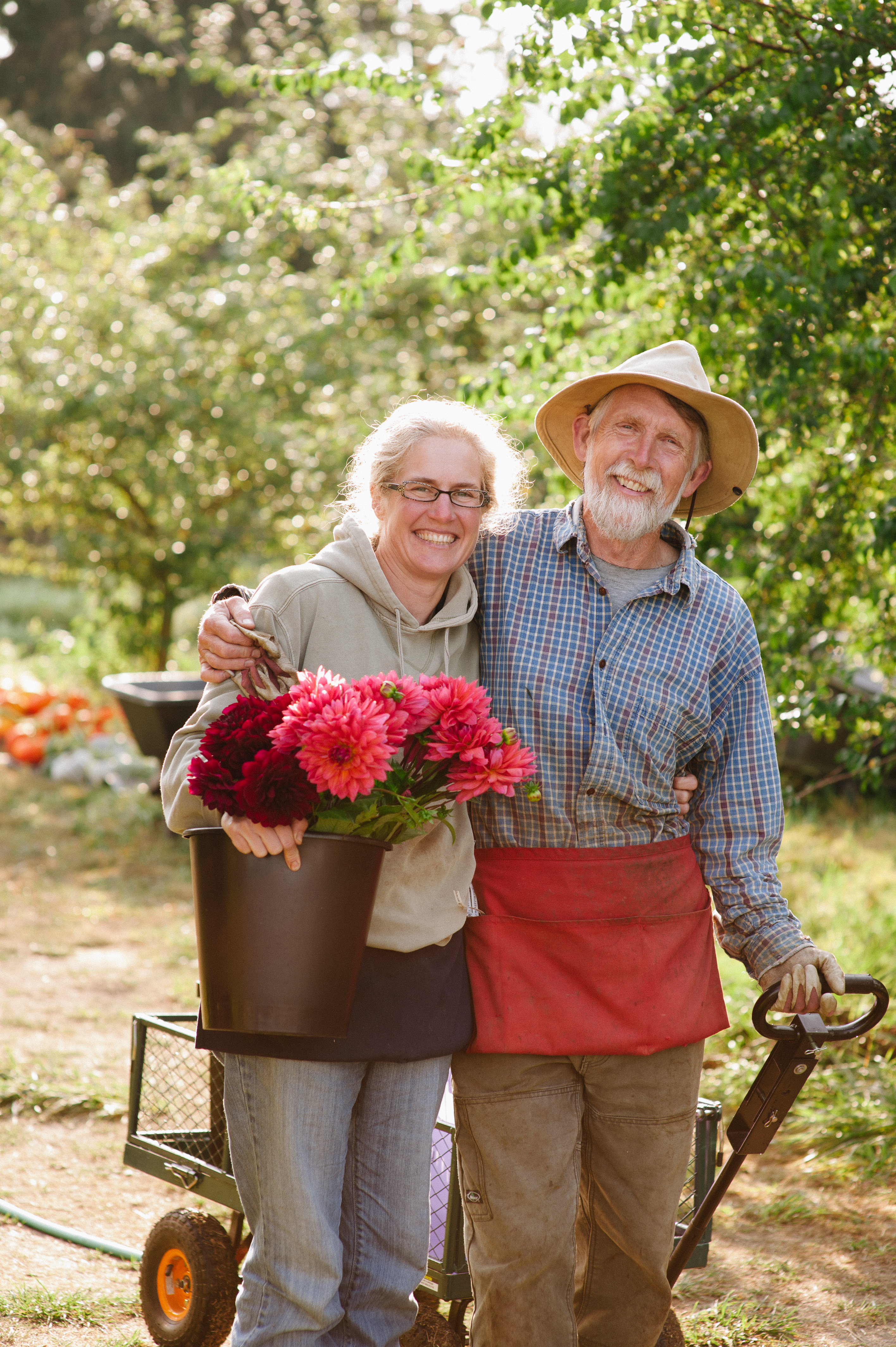
Diane Szukovathy and Dennis Westphall, photographed by Mary Grace Long (c) September 2012 at Jello Mold Farm in Mt. Vernon, Washington.
In this week’s podcast you’ll meet flower farmer Diane Szukovathy, the “cover girl” (along with floral designer Stacie Sutliff) of The 50 Mile Bouquet.
More than anyone I have met in the past five years, I credit Diane and Dennis Westphall, her husband and co-owner of Jello Mold Farm, with inspiring me and enhancing my understanding of what it means to be an American flower farmer.
I’ve interviewed and written about Diane and Dennis many times, but in today’s episode, I wanted to zero in on some of the exciting news taking place at the Seattle Wholesale Growers Market. This is an innovative, farmer-owned cooperative that Dennis, Diane and several other pioneering flower farmers launched two years ago. Their tagline is: Farmer to Florist.
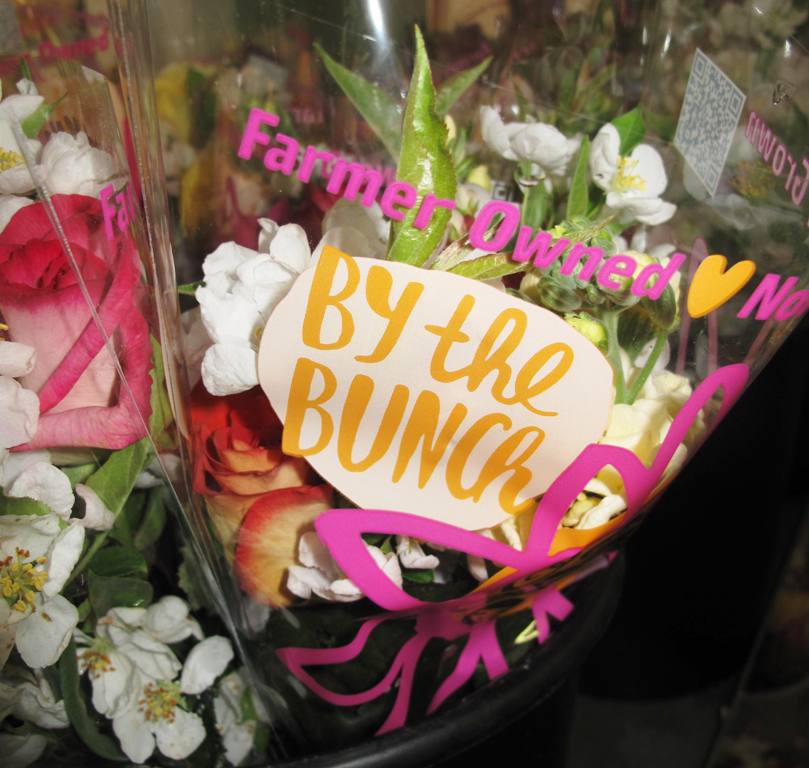
Listen to my conversation with Diane as we discuss the new supermarket/mass merchandising program called “By the Bunch.”

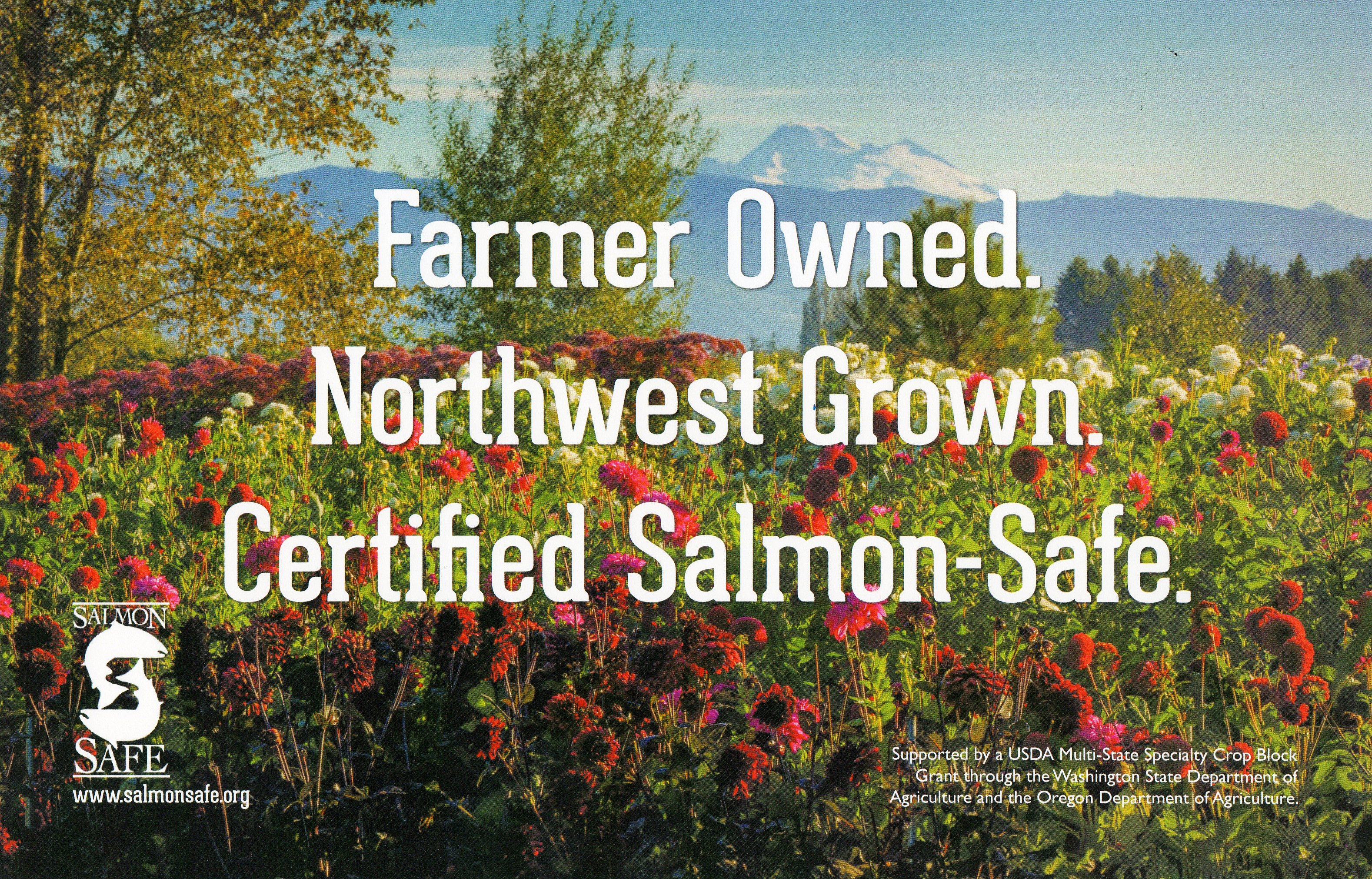
The flower-growers’ co-op provides great messaging and branding to educate customers at point of purchase.

Remember this cool logo: By the Bunch. It means these gorgeous bouquets are possible because their ingredients were grown by a bunch of awesome NW flower farmers
This is a cooperative-driven model that was designed to connect local flower farms with volume market opportunties like grocery store floral departments. Diane explains how this new program came to be and why it has so much potential to increase the income stream for people growing cut flowers.
Click here for more background on Diane and Dennis of Jello Mold Farm.
Click here for news about the 2011 launch of the Seattle Wholesale Growers Market.
Click here for an October 2012 report about the grant funding that was used to launch the new mass market program.
Click here for the post I wrote this past spring when the By the Bunch bouquet program launched.

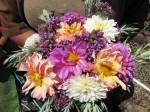
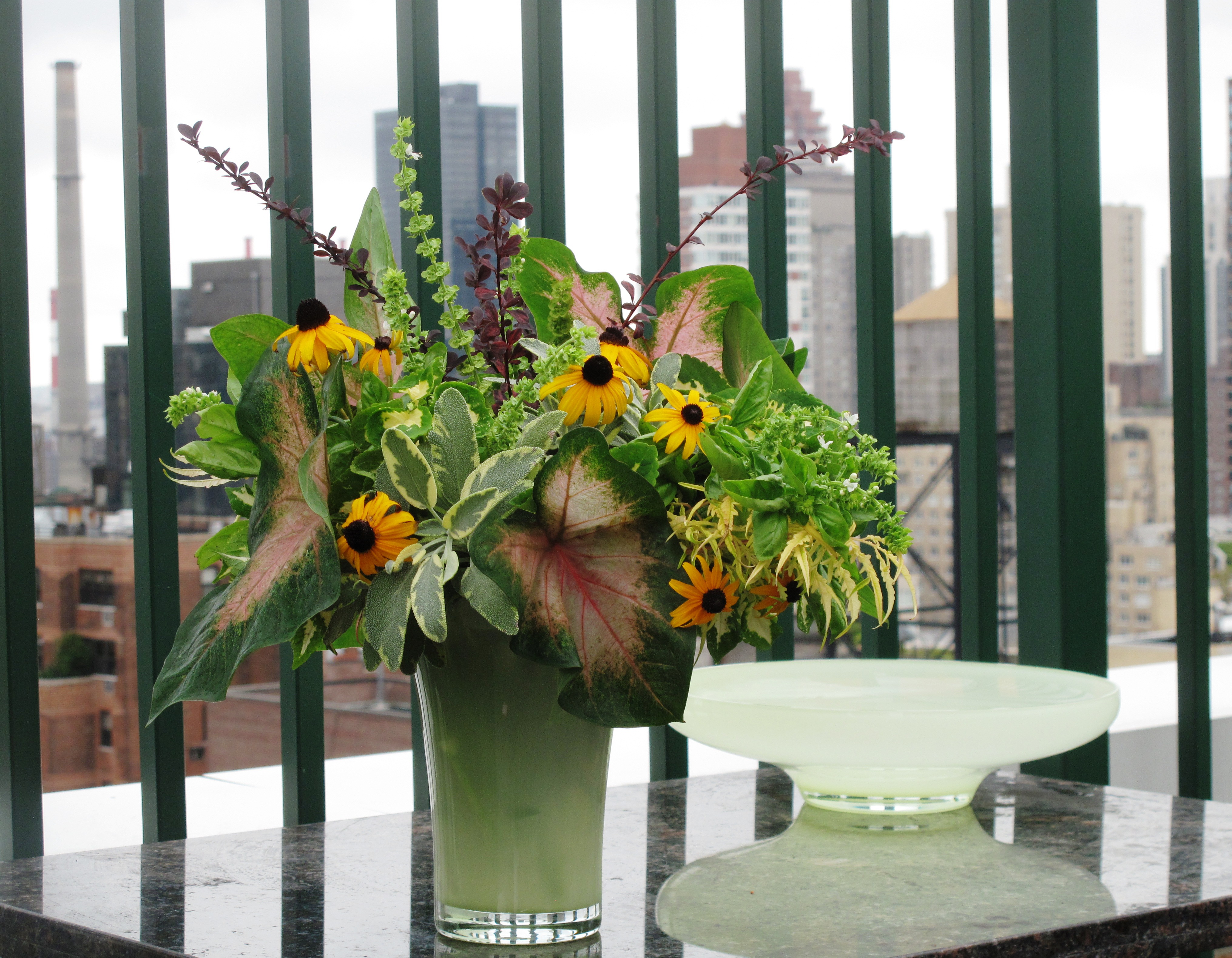
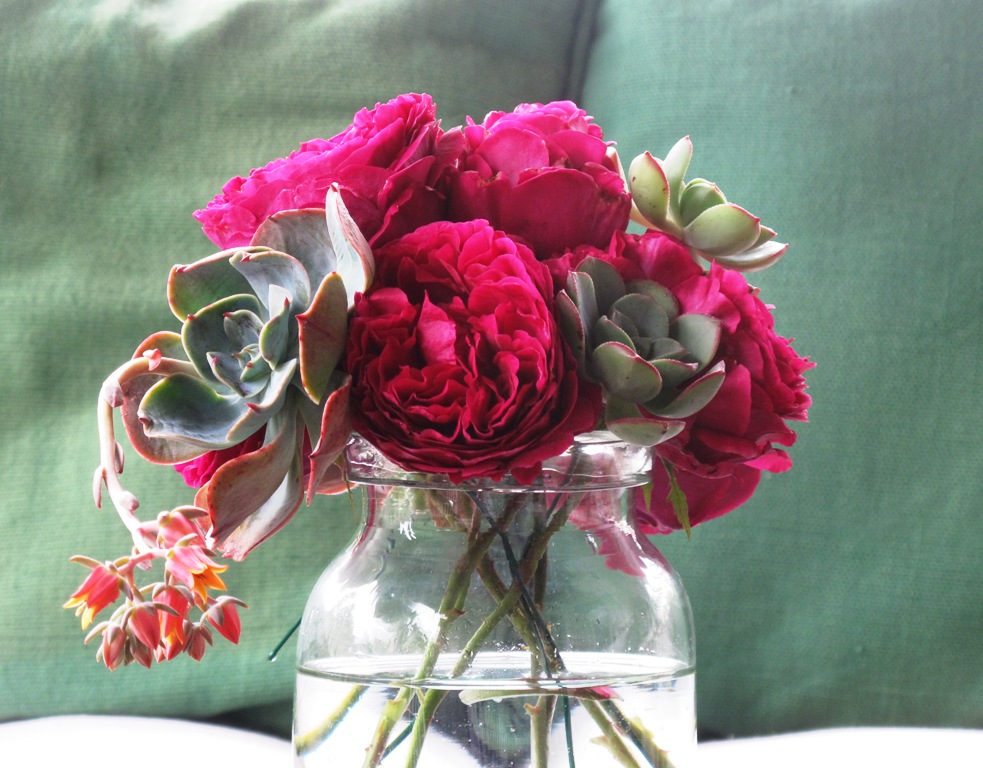
I made this bouquet at the invitation of Ellen Spector Platt, a fellow garden writer who shared her NYC rooftop bounty with me
Ingredients:

Long after I left Manhattan, Ellen redesigned the longest-lasting floral elements, using several bud vases to each display a single Caladium leaf (c) Ellen Spector Platt

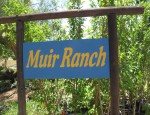
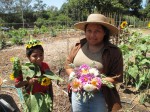
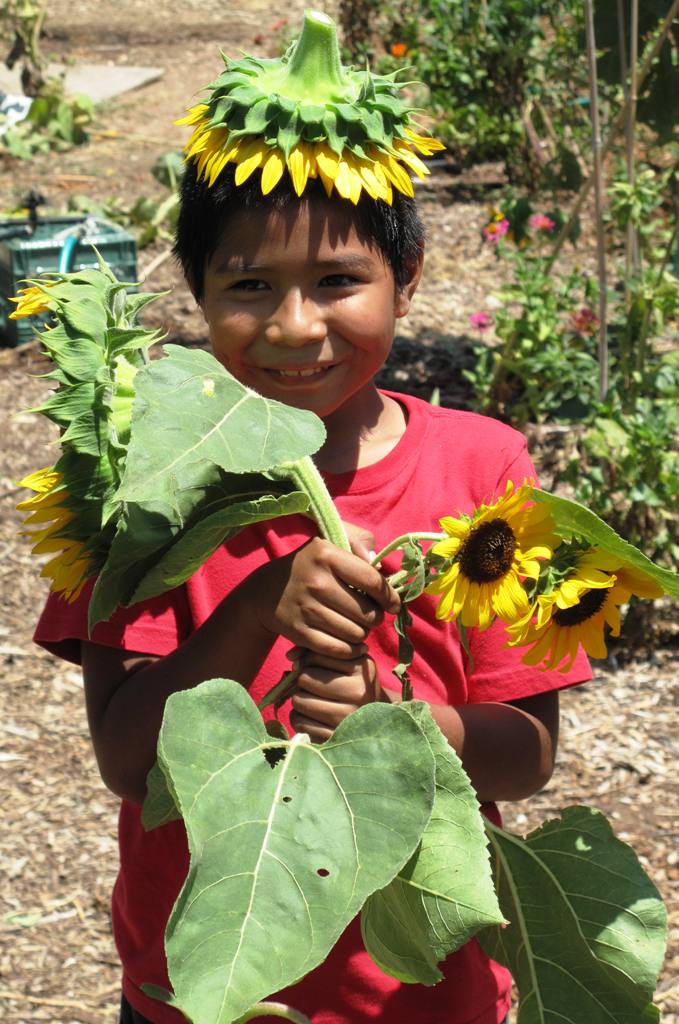
The little brother of a summer teen farmer donned a sunflower hat that Mud Baron gave him at Muir Ranch. Adorable~!
Here’s some more great news about the Urban Farming Movement.
In 2011, a dedicated team of volunteer teachers and students began converting 1.5 acres of Pasadena, California’s John Muir High School campus into a school-based farm.
Today, Muir Ranch grows a variety of flowers, vegetables and fruits that are included in weekly CSA boxes as well as school cafeteria lunches. Students can complete community service or internship graduation requirements by enrolling in classes at the Ranch. Muir Ranch also provides paid internships to students, which are funded by private donations, special events, farmer’s market sales, and subscriptions to the produce box program (CSA). Every week, Muir Ranch CSA subscribers get a box or bag of about 7-10 different types of fruit and vegetables grown without the use of pesticides or chemical fertilizers. Customers pick their shares up at central distribution sites throughout Pasadena. Muir Ranch CSA partners with several local farms for seasonal fruit and vegetables to supplement what they can produce, providing tax-deductible weekly boxes to over 100 subscribers. It is the CSA program that generates much of the income that keeps this place operating.
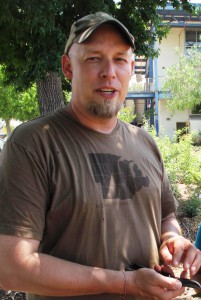
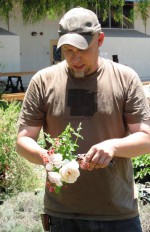
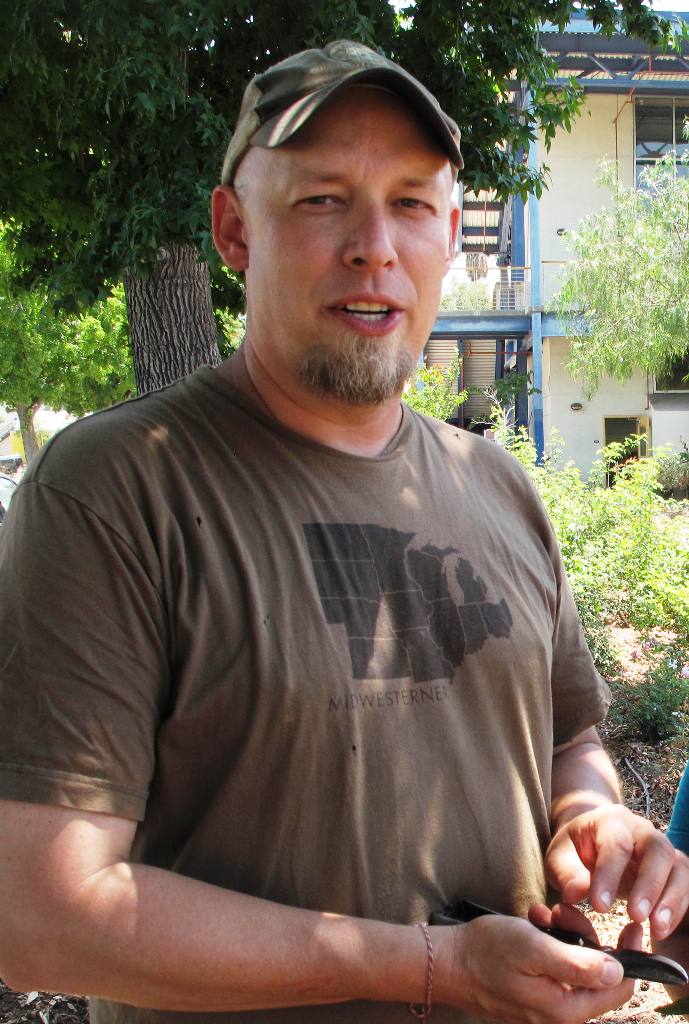
“Mud” Baron, Executive Director of Muir Ranch, is an urban farming activist and proud bouquet-maker.
One of the people at the hub of this fast-rolling wheel is Mud Baron, a passionate school garden advocate who serves as the Executive Director of Muir Ranch. That sounds like a high-falutin’ title, but in all reality, he is true to his nickname. Mud gets down and dirty – and REAL – with his kids, teenagers whose horizons are much brighter after they’ve learned to grow and sell food and flowers to local customers.
How did this former design-build contractor end up teaching gardening and farming skills to urban youth? I’m still trying to figure out the exact path of Mud’s career, but suffice it to say he’s in his element growing food and flowers. He totally lights up whether he’s shooting the breeze with one of the teen-CSA interns or sharing drinks with me and a board member (Mud ordered the Stone IPA, brewed with dandelion greens).
Board member Leelee Clement Doughty discovered Muir Ranch through the Pasadena Garden Club, which brought expert Rosarians to the farm to teach students about rose growing and rose care. She got hooked and started volunteering. “The best sales pitch is the Ranch itself,” she told me. A lifelong gardener and corporate finance escapee, Leelee digs the lessons she sees young people learning: Cooking and Catering, Marketing, Nutrition, Math and Business, Science and more. Right now, Muir Ranch is a “fiscally sponsored proeject of the Pasadena Education Foundation,” but if Leelee and Mud’s vision is realized, it will soon be a standalone nonprofit.
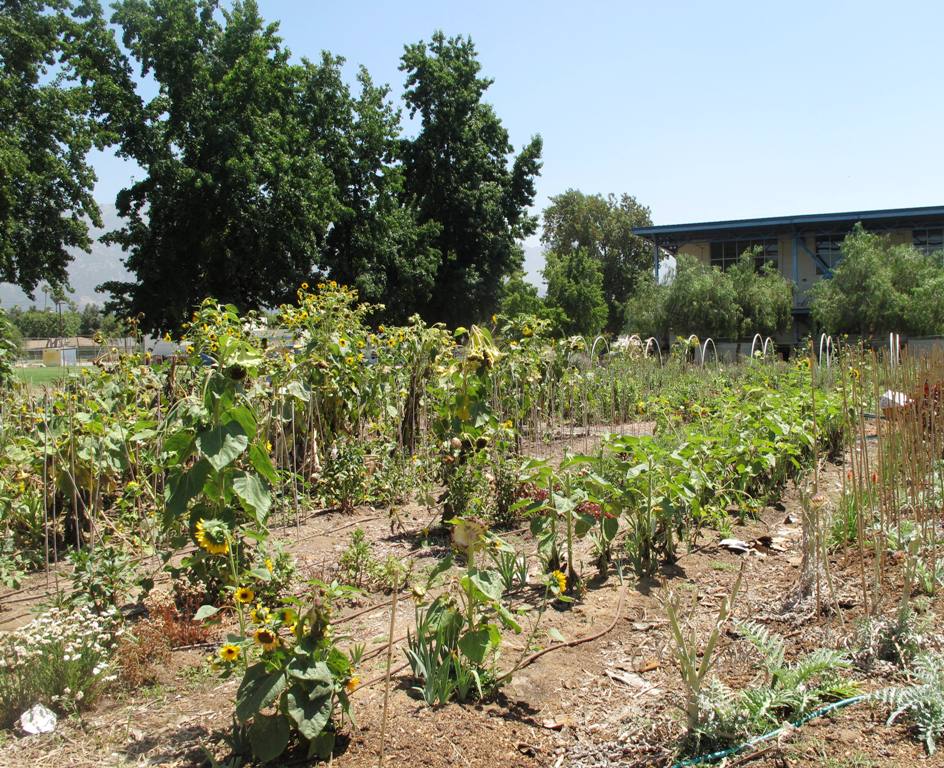
Many programs besides the CSA are supported under the umbrella of Muir Ranch, such as partnerships CSAs run by with other local schools and learning gardens. Muir Ranch also and hosts monthly “Plug Mobs” to help the community start their own gardens. In Mud’s mind, no Southern California-based teacher should go wanting for school garden supplies. “The Plug Mob program means that finding seeds and plants is no longer a factor for 2,000 schools,” he says. Muir Ranch operates like a plant nursery, helping source and distribute seeds, bulbs and flats of plant starts. Like modern day Johnny Appleseeds, Mud and his supporters share what they have and spread around the love.
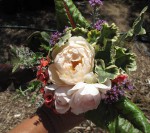
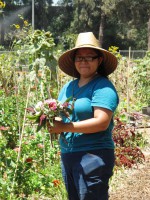
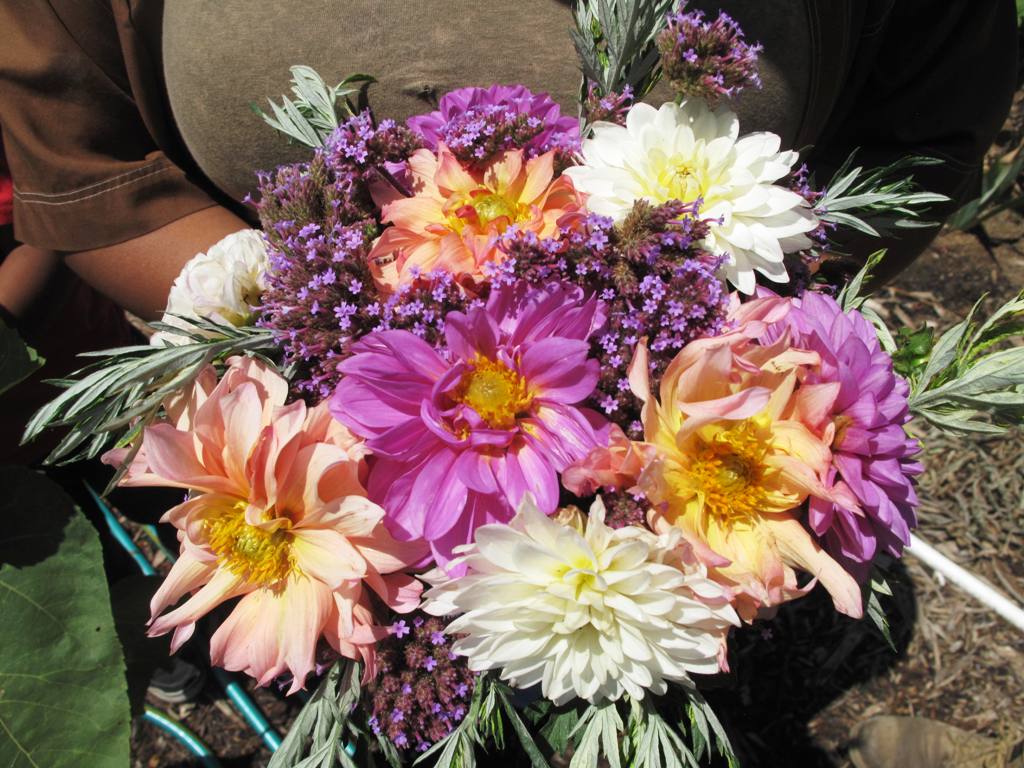
Muir Ranch hopes to add a culinary program that will connect students more closely to food systems. As young people “connect the dots,” they become involved in how food it is grown, distributed, and finally cooked into healthy meals. Besides being a center for education, Muir Ranch hosts a variety of ongoing and special events. The program is known for its floral arrangements, and I love that Mud has taught his interns and student workers how to harvest and assemble bouquets. When I visited last month, he gave two young women a challenge to create a bouquet for me. I loved the ease and confidence with which each gather flowers – mostly annuals and summer dahlias — into a custom-made bunch.
And the word is getting out about Muir Ranch’s flowers. One of Mud’s interns just earned $400 selling wedding flowers to a market customer. According to Mud, that experience has opened her eyes to possibilites for a bright future.
Volunteers are welcome (and needed) at this innovative program, especially to weed, prepare beds, turn compost, plant seeds and plugs, move worm “tractors,” maintain irrigation systems, water nursery plants and harvest crops. If you’d like to stop by and help, the regular Muir Ranch Workdays take place Monday-Friday from 8 to 11:00 a.m.
If you want to feast your eyes on more beauty from this place, follow Mud’s Instagram posts here: http://instagram.com/cocoxochitl
And follow his Twitter feed, here: @muirranch or @muirranchcsa

Podcast: Play in new window | Download
Subscribe: Apple Podcasts | Podcast Index | RSS | More

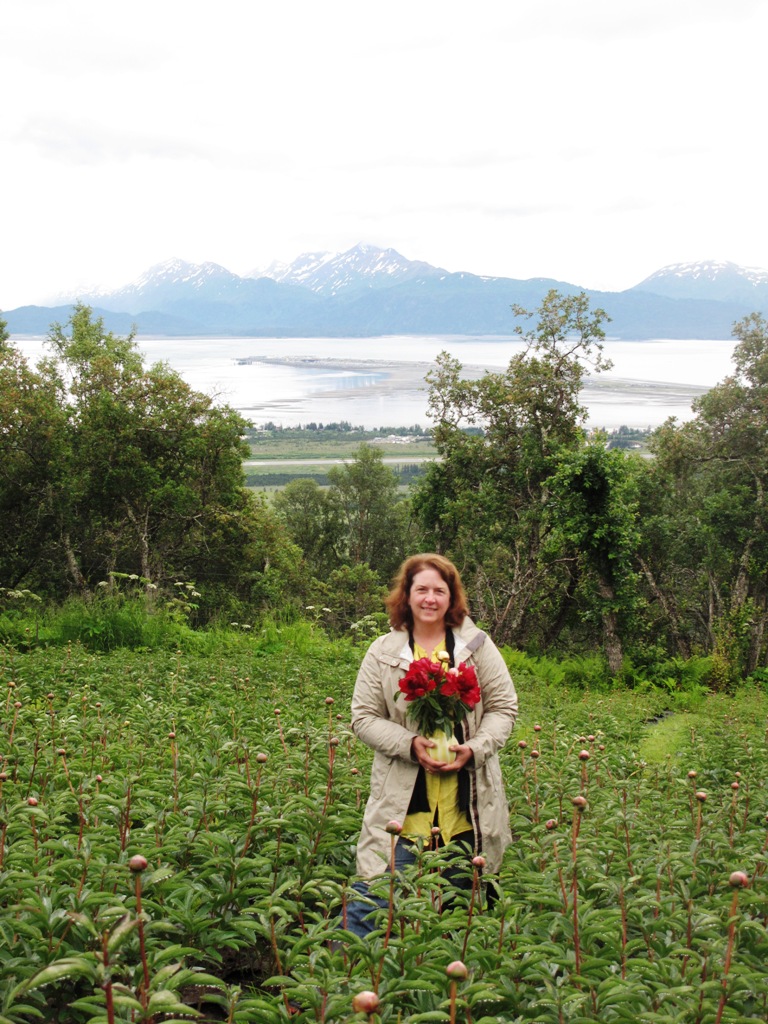
I’m standing in a Homer, Alaska, peony field at Scenic Place Peonies. It’s owned by Beth Van Sandt and Kurt Weichhand – check out the views!!!
Last summer I visited Alaska and toured about 12 cut peony farms from Fairbanks to Homer – in one week! It was a wonderful trip, made all the more special because of the many cool, welcoming flower farmers I met along the way. They hosted me for meals, spent quality time walking and talking with me along the rows of robust and beautiful plants, lent me a bed for the night, and generally adopted me into their Alaska Peony Tribe! If you want to learn more about the Peony Growers of Alaska and how to order cut flowers from some of them directly, visit the Alaska Peony Growers’ web site.
It was a thoroughly freeing time for me as a journalist because I was my own client. No editor gave me the assignment. No publication had their dibs on how the story would be reported. I used my Alaska Airlines’ frequent flier miles to book my flight into Anchorage and then rented a car with another set of airline miles.
I made reservations to tour Denali National Park on the first day – mainly because Dr. Pat Holloway, my trip advisor, insisted that I couldn’t just drive past the majestic national park while seeking peony farms! After that first day, I spent the following seven preoccupied with peonies, their cultivation, harvest, post-harvest care and ultimate journey to the hands of satisfied customers. It was pretty sweet – and I can’t wait to get back. I wrote a fun post about the week in Alaska here.
Other than selling a *tiny* story about Alaska peonies to Sunset magazine, I am happy to announce that my first big editorial placement appears in the current issue of Alaska Airlines magazine. How fitting! You can read the feature here [PDF].
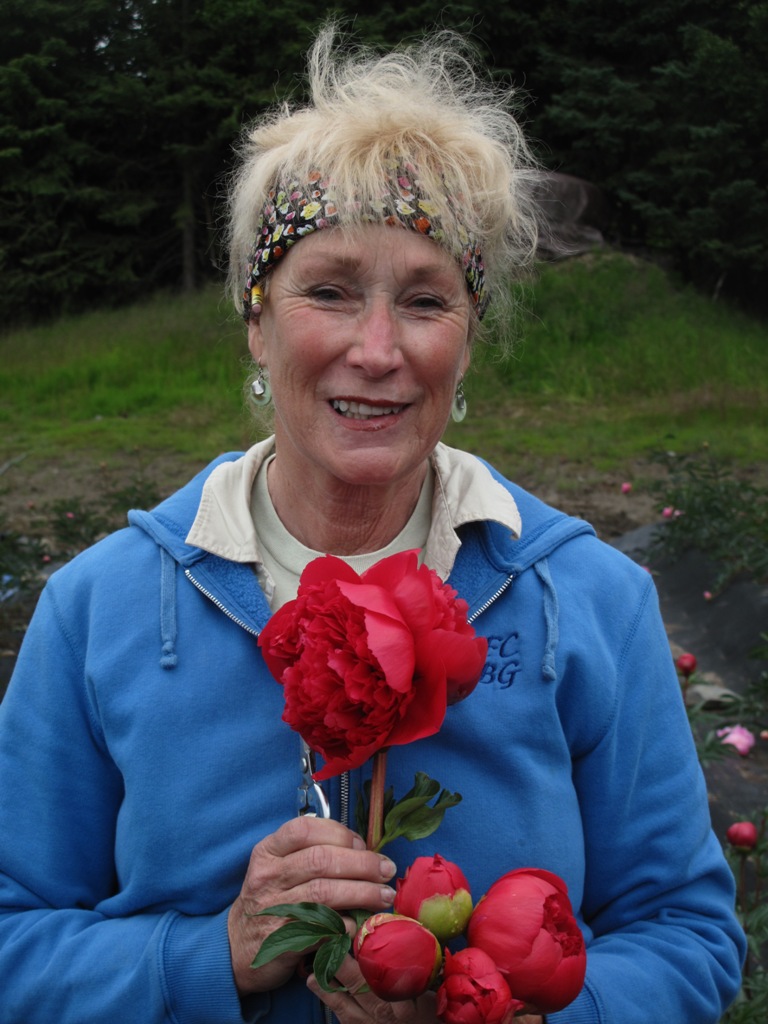
This week’s podcast features interviews with the owners of two farms I visited during my tour. First, you’ll hear my conversation with Rita Jo Shoultz of Alaska Perfect Peony in Fritz Creek on the Kenai Peninsula, one of the first growers to jump in feet first to plant peony roots. You will hear the sounds of nature around us, as we sat in her garden near the pond to talk. For some crazy reason, Nicco, her cat, was fascinated with the audio recorder’s microphone. You’ll hear a few bumps in the audio, thanks to the curious cat!
Here are some photos from Alaska Perfect Peonies:
READ MORE…

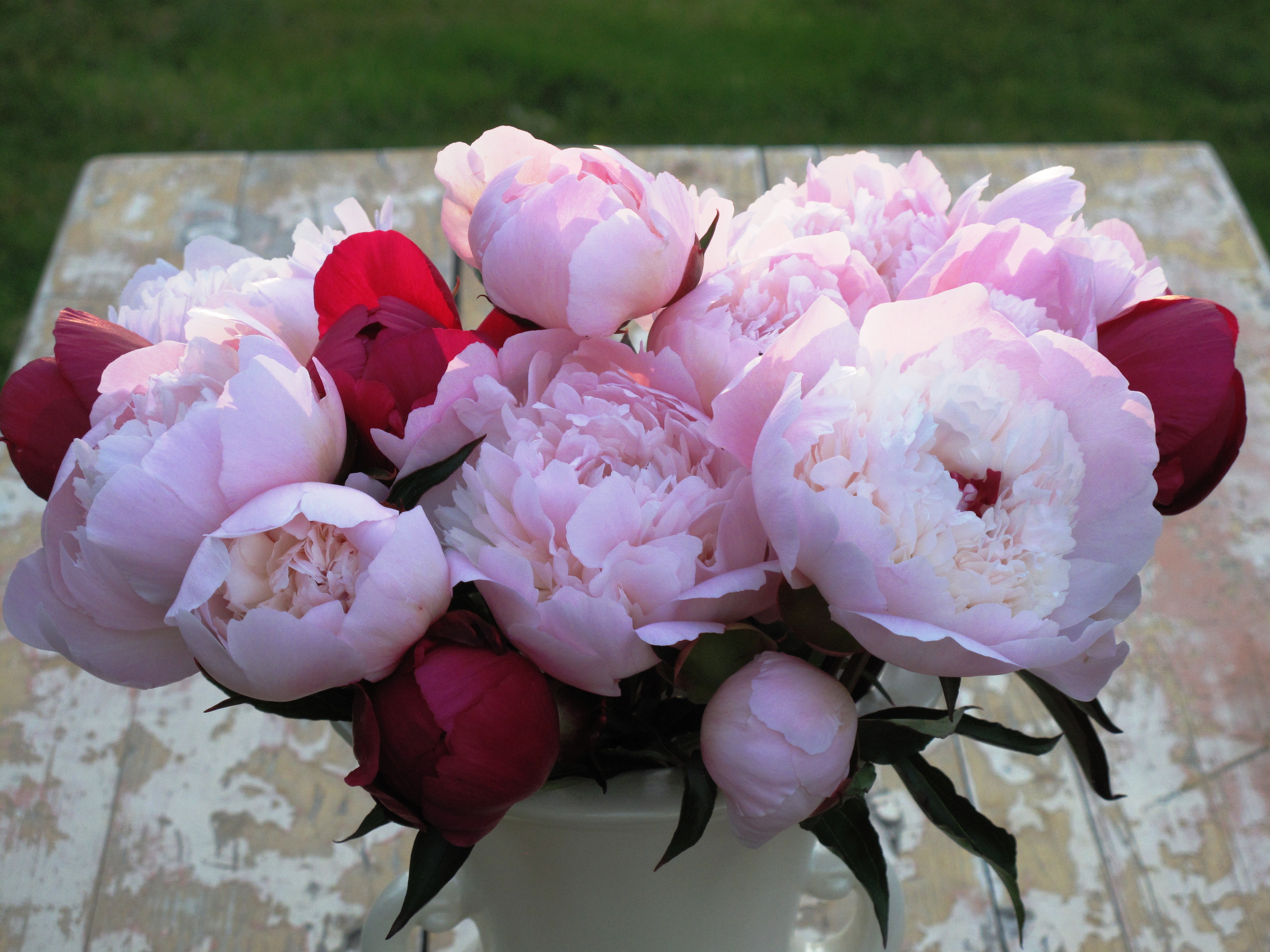
I came home from Alaska with these luscious peonies – and it seemed as if no other flower could compete for room in the vase.

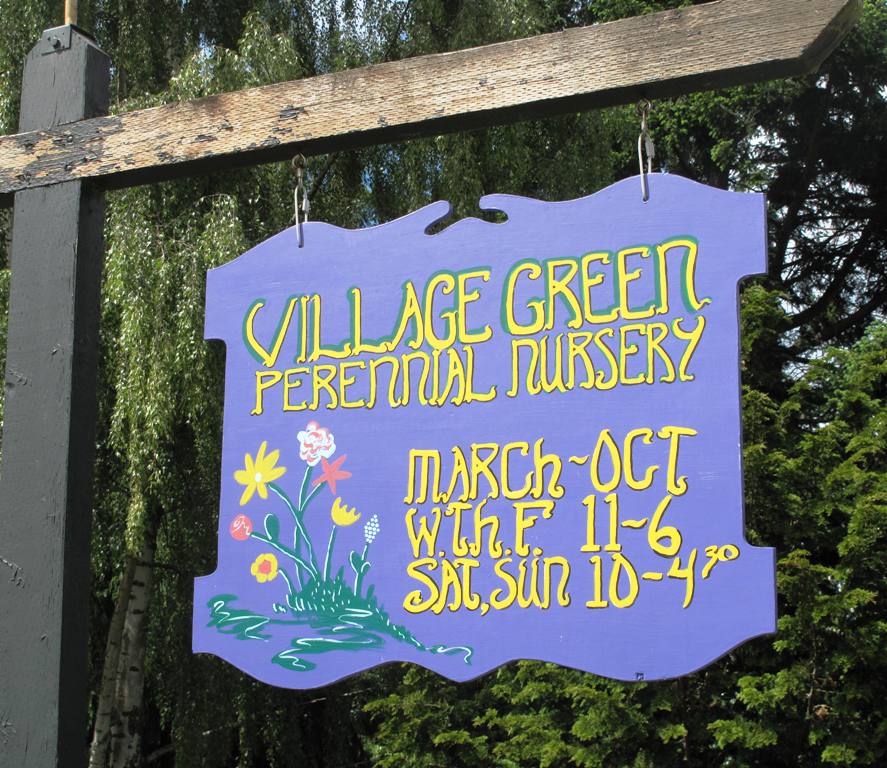
Just look for the hand-painted lavender sign when you’re driving down 26th Avenue Southwest in Seattle. There’s plenty of places to park on the street . . . and then you’ll wander down the long drive to the nursery.
Earlier this spring, I had the delightful experience of giving a floral-design workshop at Village Green Perennial Nursery in West Seattle’s White Center neighborhood. This place is like a secret garden, although there are many, many customers who have been in on the secret for years. This is a plant-centric business, one neighbor to the next.
Village Green Perennial Nursery was founded by Teresa Romedo over 30 years ago. In 2003, she passed the torch to Vera Johnson, who has owned and operated the nursery ever since.
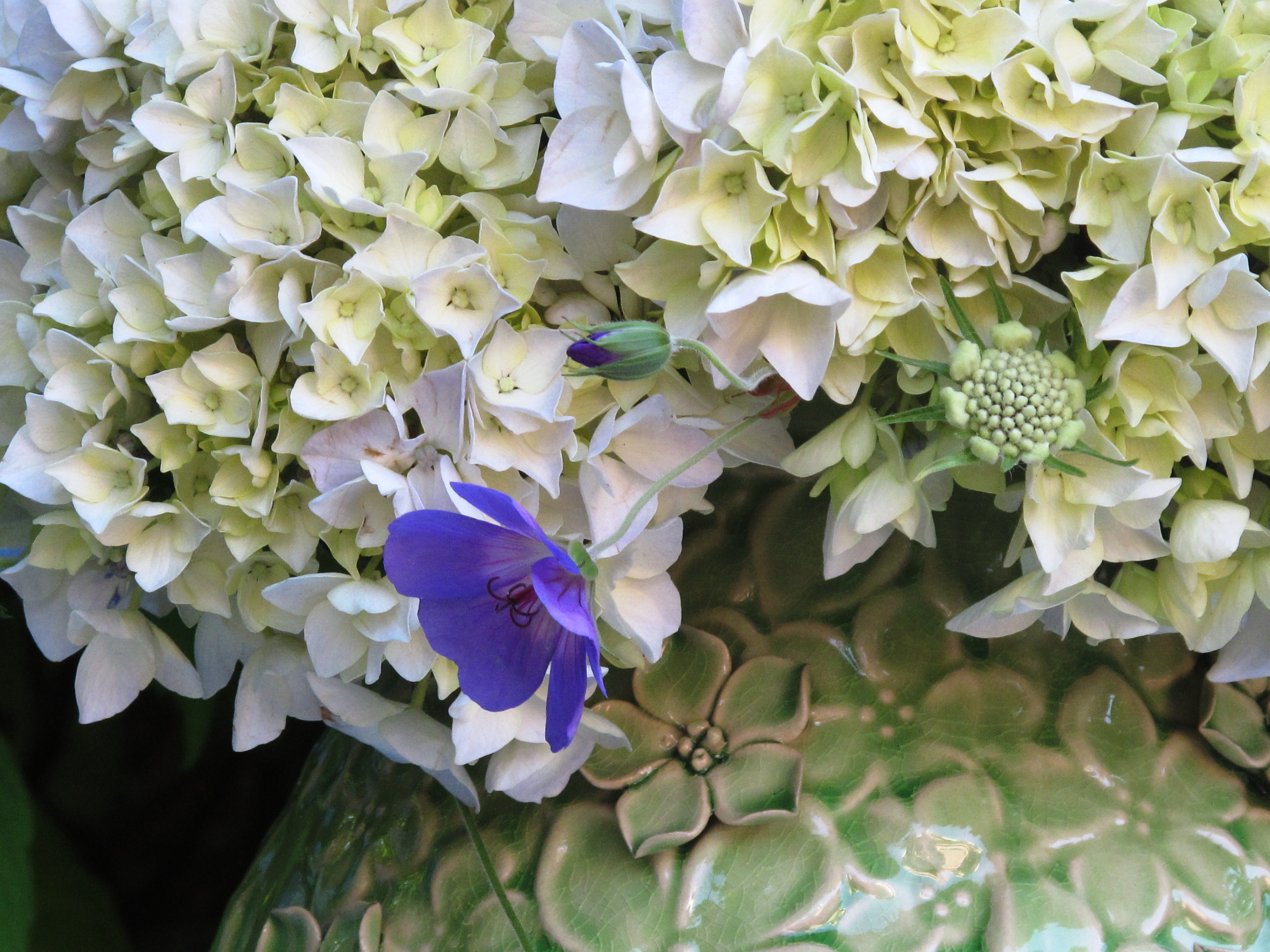
Vera Johnson, plantswoman, horticulturist, designer, educator and artist, presides at the helm of this magical destination. Her mission is to inspire the neighborhoods of White Center and West Seattle by providing the very best resources available to create sustainable outdoor living spaces, one block at a time. As a little garden center with big ambitions, Village Green is known for high-quality customer service and healthy plants. It has evolved as a community center that showcases local artists, musicians, and events.
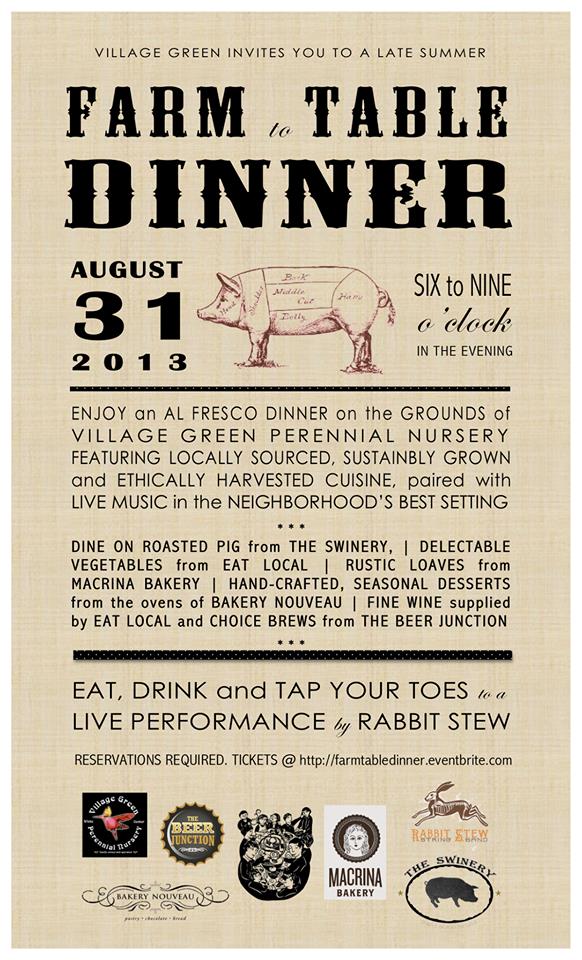
Vera has just announced her first farm-to-table event, scheduled for August 31st. This has the potential to be an unforgettable moment in time, an experience that celebrates food, wine, plants and flowers. Tickets are $100 per person. Order yours here.
Take a virtual tour of the beauty at Village Green Perennial Nursery – and save the date for a fabulous event! I hope to see you there!
READ MORE…

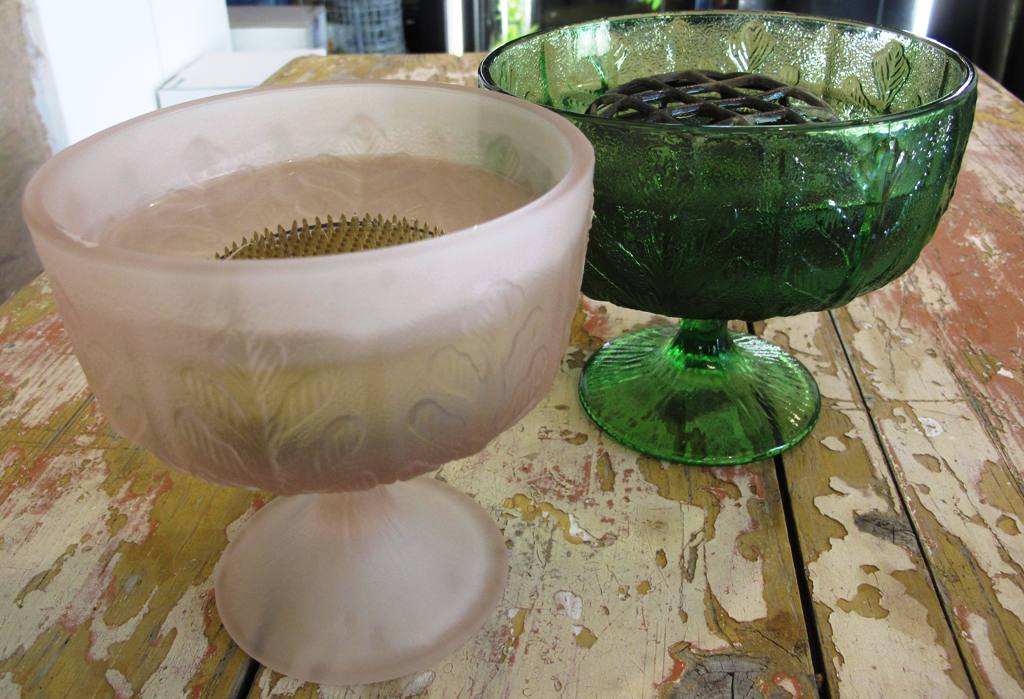
It’s easy to find these not-quite-vintage and not quite-retro, but definitely collectible footed glass vases. I snagged the frosted pink one on eBay for $4.99 and found the green embossed one at my local Goodwill store for even less!
These vases have been identified as FTD florist vases, dated to 1978. The pattern is called “oak leaf” and I’ve found the two colors shown above as well as an amber-gold and milk-glass white, all with the raised embossed leaf pattern.
The first time I used this charming green footed bowl in a demonstration, someone guessed it was Depression glass. There is that pressed-glass quality to these containers, but they’re newer. I like to think FTD was producing them in the U.S.A. and shipping them to mom-and-pop flower shops around the country at a time when those florists were still using predominantly American-grown flowers. The vases are so much more interesting and well made than most of the (probably) made-in-China stuff you see coming out of floral wire services these days. Keep your eyes out at the thrift store or surf on eBay, where I’ve found at least six or seven listings for idential and similar vessels.
I’ve written before about how much I love footed anything for floral arranging. Here is a recent post where I wax eloquently about footed vessels. Today, it was time to play with some flowers and see what I could create. By the way, here are the dimensions on these bowls: overall height, 5-1/2 inches; diameter, 5-1/4 inches; depth of bowl, 2-1/2 inches.
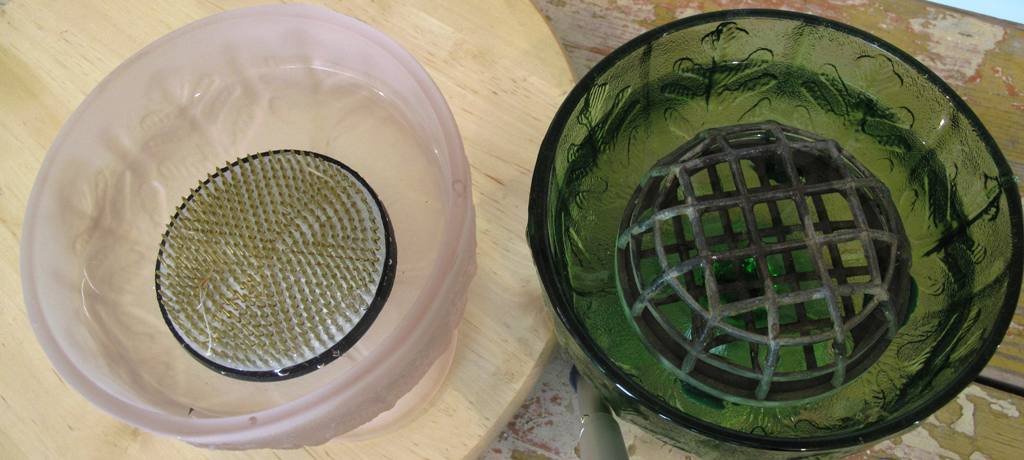
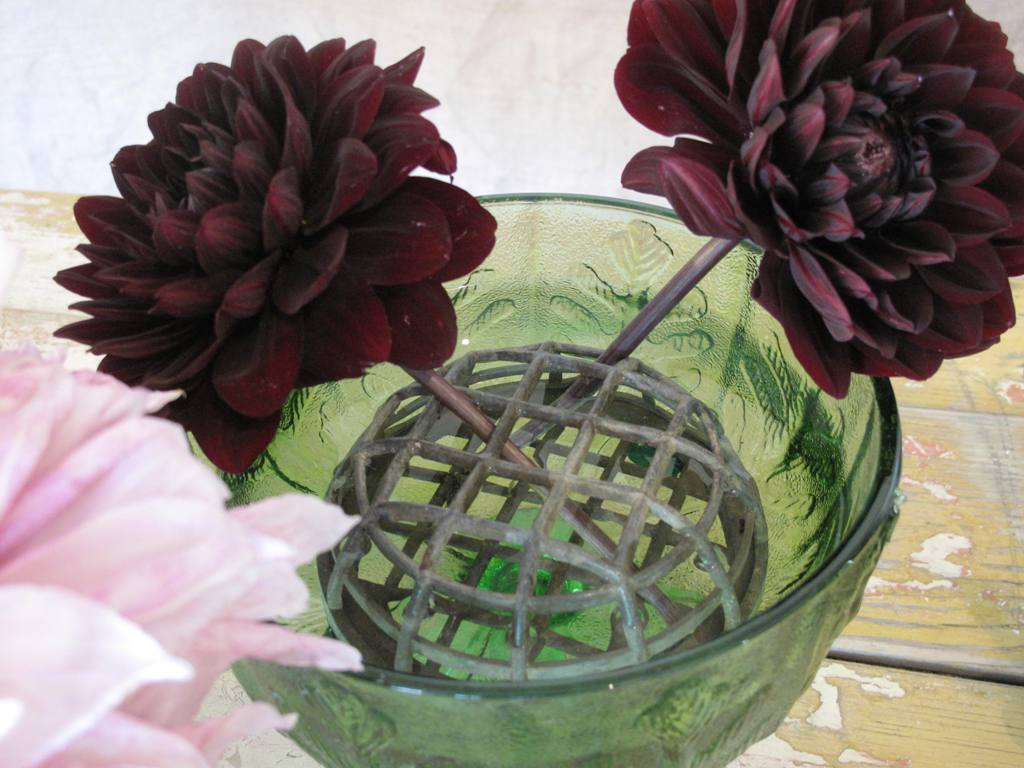
The shallow bowl does require some kind of device to stabilize stems. Back in the day, those 1978 florists were probably blithely cutting up chunks of foam to stick inside. But today we all know how unsafe it is to handle or use florist’s foam for its toxic attributes (formaldehyde being the active ingredient). So out came the metal frogs, as you can see in my bouquets below. Alternately, I could have shaped a section of chicken wire to fit inside, securing it with floral tape. Both methods are quite easy and eco!
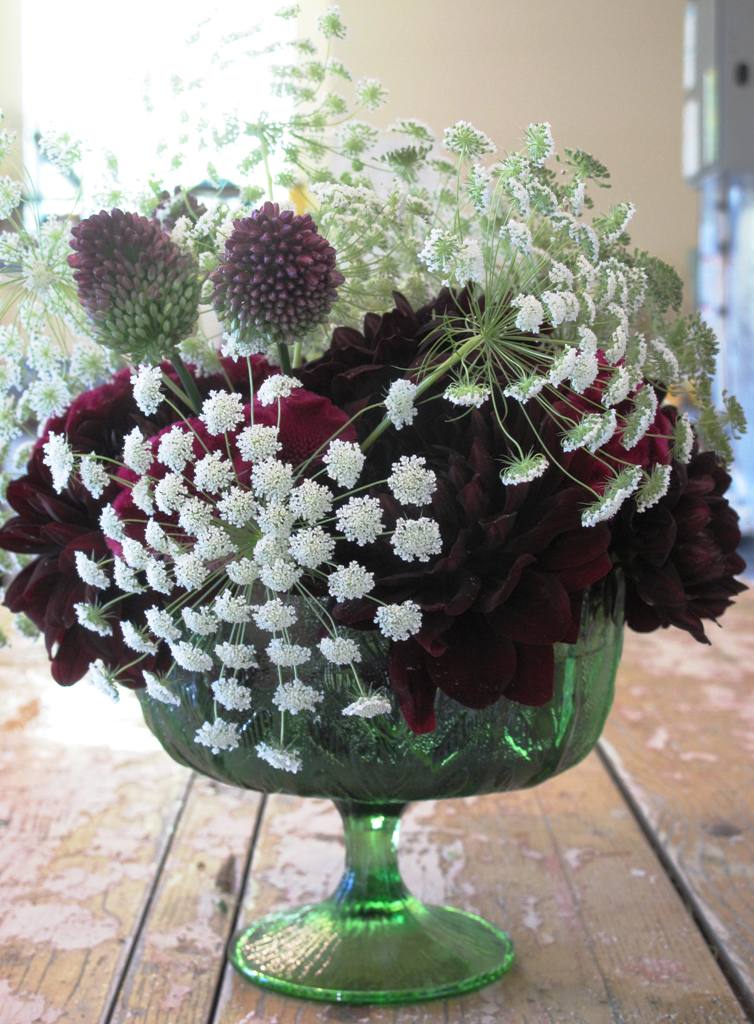
Here is my first of two arrangements, using the green vase:

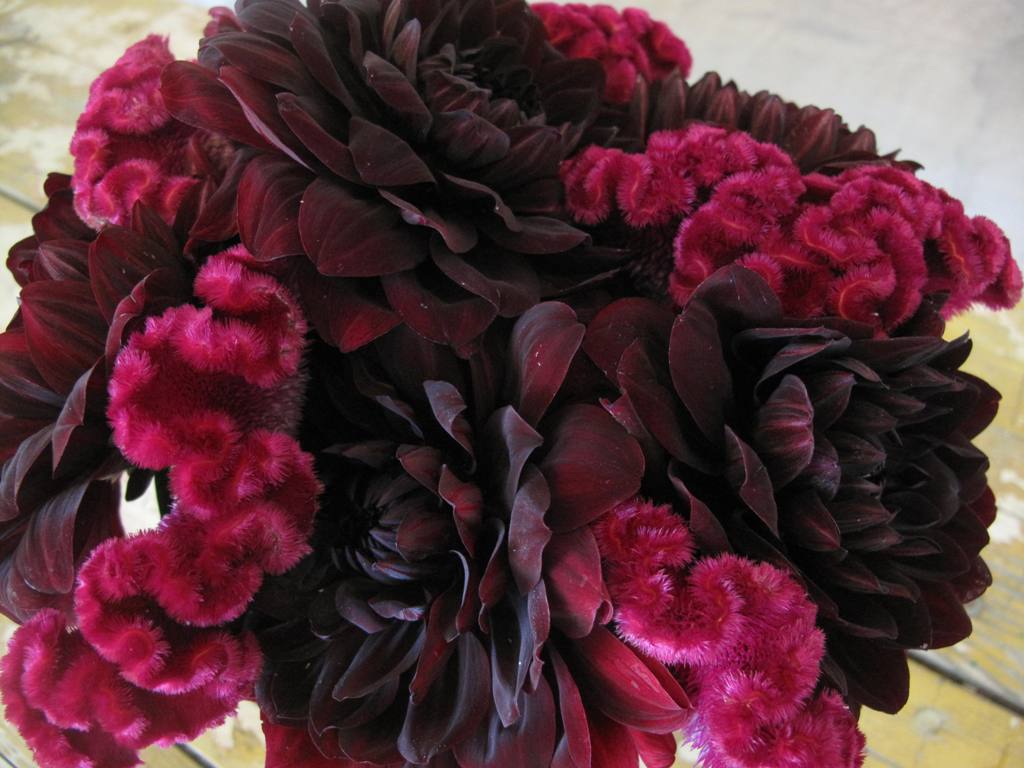
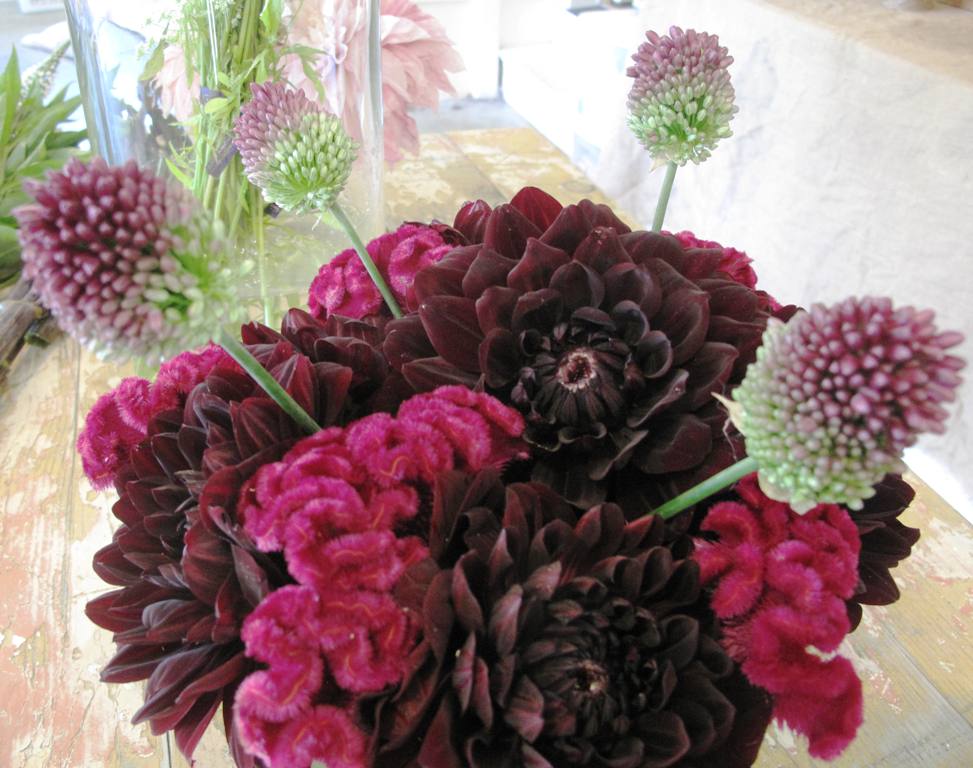
Step One: Insert maroon dahlias into metal frog. Notice how I’ve cut the stems short so that the flower head snugs close to the rim of the vase.

Step Two: After seven dahlias are arranged evenly throughout the opening, I added five lush fuchsia cockscomb celosias inbetween the darker flowers.

Step Five: Finish off the bouquet with a few stems of gooseneck loosestrife (Lysimachia clethroides), a quirky accent that repeats the white from the QA Lace and brings a new texture into the design.
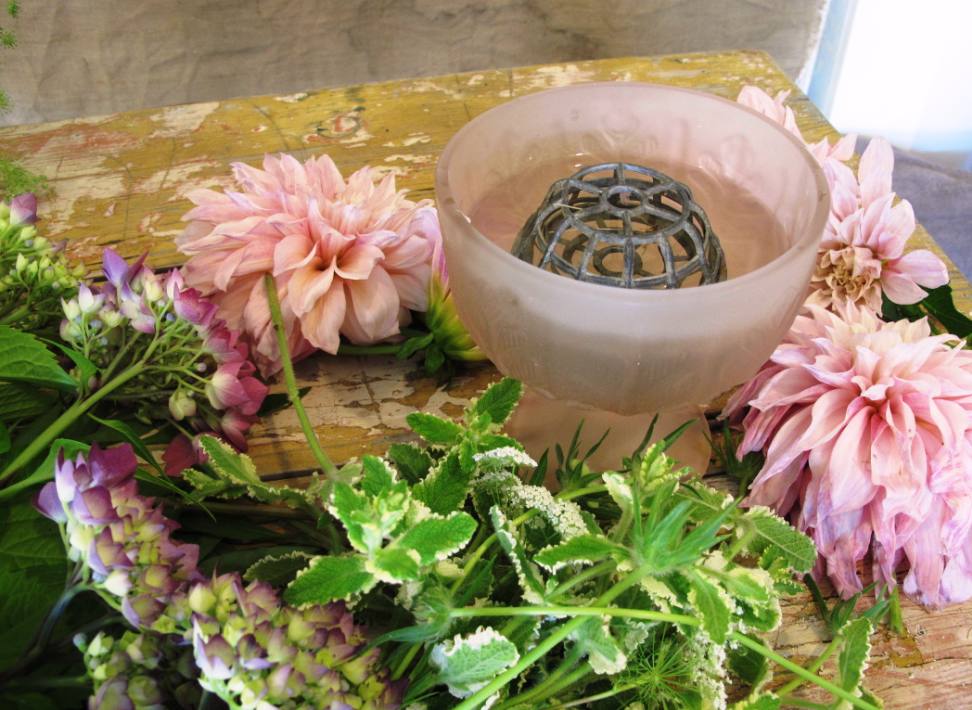
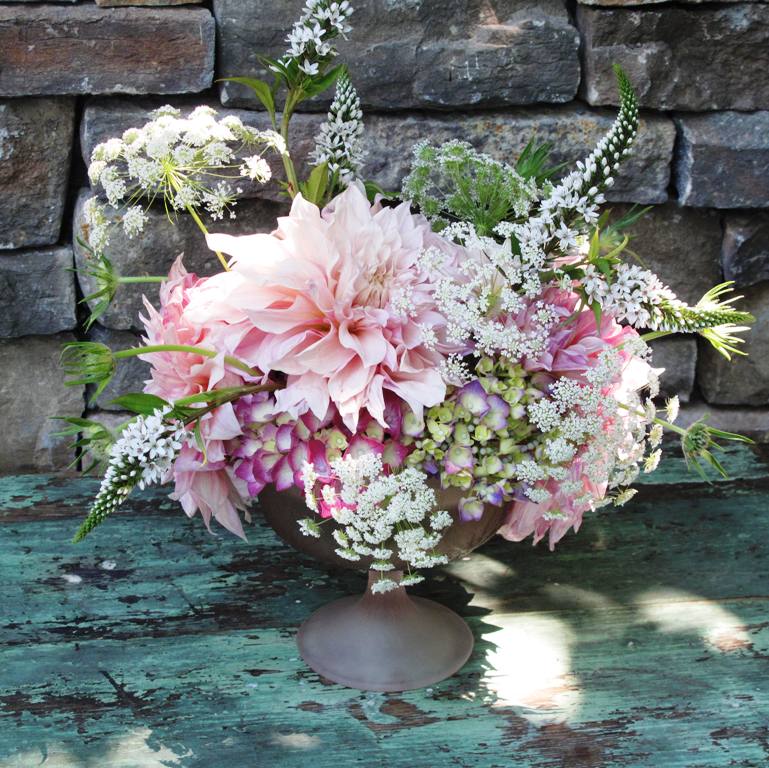
Here how I filled the pale pink frosted vase:

Getting started. If you compare this photo with the one at the top of this post you’ll see that I switched the frog. The original pin frog I planned on using wasn’t allowing me to insert stems at an angle or sideways, so I replaced it with a metal cage-style frog.

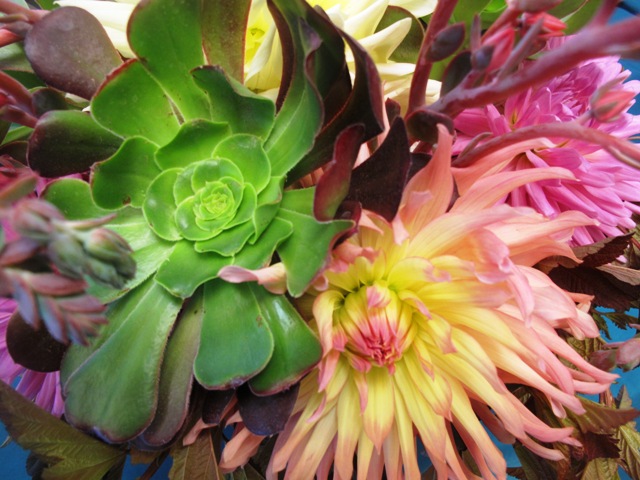
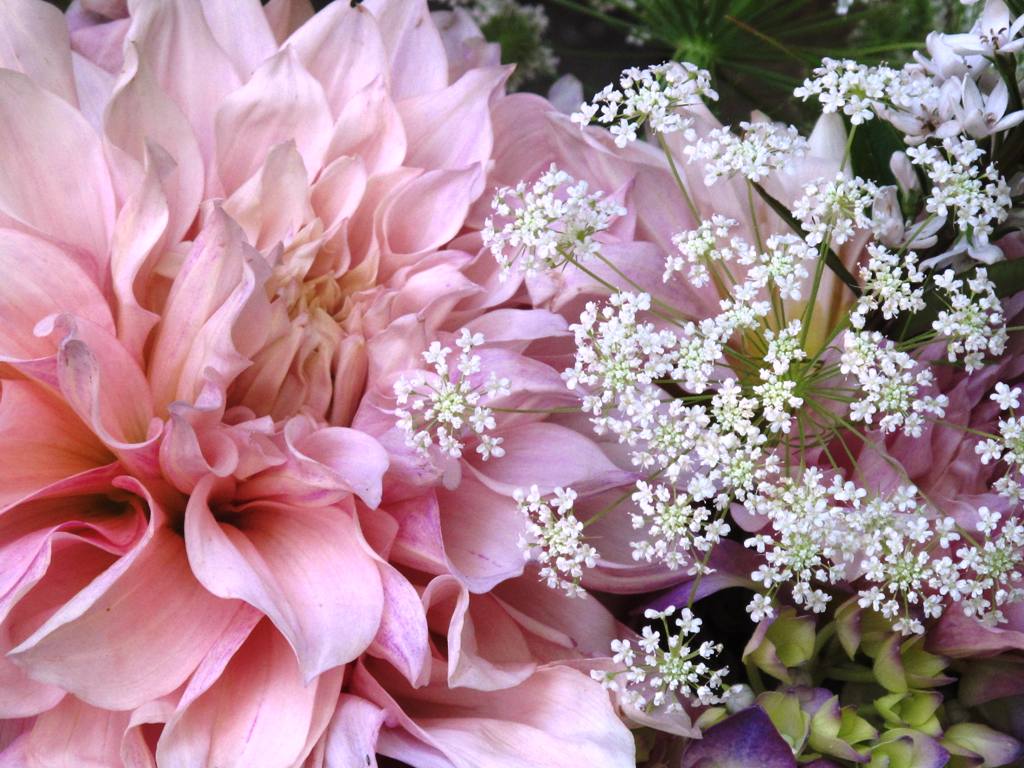
This bouquet came together in much the same way as the first one, so I didn’t photograph all the steps in detail. Notice that I started with a cluster of unopened hydrangea heads, which created a “base” that supports the three ‘Cafe au Lait’ dahlias, making them more prominent. Other ingredients include Queen Anne’s Lace, Scabiosa buds, and the gooseneck loosetrife. Even though similar ingredients are repeated from the first bouquet, this color palette gives it a totally different look and feel.
© Debra Prinzing, all written and photographic content. Website design/development by Willo Bellwood/Metric Media