Debra Prinzing

Get the Email Newsletter!

Author Archive

Bee Movie – can Hollywood really get people excited about pollinators?

Tuesday, November 6th, 2007

bee movie

Inspired that my friend Erin was going to take her 2 youngsters to see “Bee Movie,” and presented with a rare unscheduled afterschool block of time (no soccer practice, no carpooling), I asked Alex if he wanted to see “Bee Movie” yesterday afternoon. The media exposure has been HUGE on this Jerry Seinfeld and Renee Zellweger vehicle, although one reviewer on NPR warned listeners that even though the kids would like it, and Seinfeld fans like me would love the adult puns, there were too many far-reaching elements to the storyline to put this full-length cartoon on the best-movie list.

My son 10-year-old son Alex thought the movie was “intriguing and very interesting,” although, he said, and I quote: “it could have had more storyline and less stupid puns.” (I think he is referring here to the girl-meets-bee romance.)

But a movie is a movie. And off we went. The narrative is filled with lots of bumblebee humor, if there is such a thing. The main character “Barry” (rhymes with Jerry) wears a black-and-yellow striped turtleneck (natch). Barry and his pal Adam (voiced by the adorable man-child Matthew Broderick), are facing adult beehood and the prospect of working at the same job for the rest of their lives in a honey plant.

barry the bee

But Barry yearns to escape from the hive and get a taste of the real world, so he cons his way onto team of elite “nectar collectors,” studly bee-guys with big chests and the real world responsibilities of gathering “pollen power.” Once he follows them out to a floriferous Central Park (where else but New York City for Jerry/Barry?), where the animation portrays crayon-hued perennials and flowering trees from every continent and bloom-season all together in fantastical springtime glory, Barry soon understands that these pollen-patrol guys get all the action. As Barry puts it: “Fla-Ow-Ers!”

Then Barry lands on the windowsill of Vanessa, a HUMAN floral designer, voiced by Renee Zellweger. She saves his life by slapping a waterglass over Barry just when her doofus boyfriend is about to swat the irritating bee with the sole of a boot. The animation art highlights fancy-leaf geraniums spilling out of Vanessa’s windowboxes…a notable attempt at botanical accuracy.

Bees are not supposed to speak with humans, but Barry wants to thank Vanessa for saving him….and soon they’re pals (Barry has a little bee-like crush on Vanessa). When he goes to the grocery store perched on Vanessa’s shoulder, Barry discovers shelves filled with jars of honey. And he is shocked to learn that humans are “stealing” the golden fruits of bee labor, so to speak.

With all of the righteous indignation you’d see in Jerry, George, Kramer and Elaine (and even Newman) over the Soup Nazi’s rules, Barry decides to “sue” the human race (actually the five mega-honeymaking corporations). It all unfolds rather like a classic Seinfeld episode. As Jerry would say: yada, yada, yada. I don’t want to spoil the rest of the plot for you.

But in the end, the bees wrest control of honey-making from corporate demons (represented by a diabolical John Goodman-voiced defense lawyer) and Barry and Vanessa end up together, in a kind of platonic-romantic partnership where she sells cut flowers and he dispenses legal advice to the animal kingdom.

I kind of like the fact that the film’s big climax is the point at which Barry educates Vanessa about the essential role bees play in the plant world. When the bees at Honex (the fictitious company where generations of bees spend their lives making gobs of honey) decide to stop pollinating and instead take an early retirement, all the plants start to shrivel and die. The movie makes this point: plants live because pollinators help them reproduce.

Wow. Okay. so then I come home from the movies and I am sorting through piles of magazines and newspapers (we subscribe to more than a dozen monthly magazines, plus the NYT and LATimes – we are a reading household that never catches up with all the words available to us!) , and I came across the October issue of Puget Consumer Co-op’s Sound Consumer newspaper. The cover story: “Colony Collapse Disorder: Revisiting the Hive.”

How timely to read that organic beekeepers and small diverse organic farms are “living solutions” to the threat of Colony Collapse Disorder. The article, by Debra Daniels-Zeller, explains that honeybees are disappearing, plagued with parasites, diseases, and the threat of pesticides. She quotes Todd Hardie from Honey Gardens Apiaries in Vermont: “Bees are the canary in the coal mine,”….the loss of pollinators is a sign that agriculture is out of balance due to pesticides.

So Jerry Seinfeld’s “Bee Movie” doesn’t tell the WHOLE story, but I urge you to support local, organic honeymakers who encourage bees and other pollinators to thrive and do their bee-worthy jobs in this world. In organic honey-solidarity, I think I’ll have a dollop of my Pender’s Honey Farm (Camarillo, CA) pure honey, straight from the Thousand Oaks Farmer’s Market, with my yogurt and strawberries tomorrow for breakfast.

P.S. Hat’s off to Dreamworks for entering into a joint-marketing deal with The National Honey Board (it beats those crappy Happy Meals). You can download six honey-themed recipes from the web-site, including:

Stuffed sweet peppers

Pacific rim grilled fish

Mango chicken

A honey of a chili

Honey gingerbread

Honeyglazed roast lamb

A Northwest celebration

Sunday, November 4th, 2007

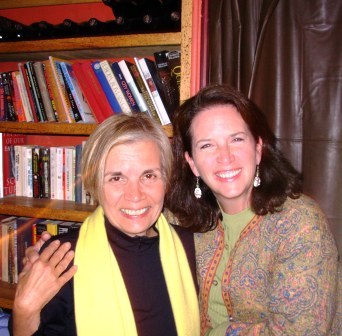
deb and braiden

[Spencer Johnson photograph]

Celebrating Braiden Rex-Johnson’s book launch at Pike Place Market’s Steelhead Diner

I’m still high from a completely indulgent trip to Seattle for a 24-hour visit on November 1st. The somewhat skeptical guys in my household are not convinced it was a “necessity,” but of course the best things in life – friendship – are indeed a necessity… as they feed our spirits and souls and remind us of all that is good in the face of less-than-good forces in the world.

book coverThe purpose for my trip was to help food-goddess and dear friend Braiden Rex-Johnson celebrate the launch of her newest (6th? 7th? – I’ve lost count!) cookbook, “Pacific Northwest Wining and Dining” (John Wiley & Sons). The book’s subtitle: “The People, Places, Food, and Drink of Washington, Oregon, Idaho, and British Columbia,”may be a mouthful, but what a savory and mouth-watering mouthful it is. Braiden spent the better part of two years traveling the PNW to meet pioneering winemakers and innovative chefs. With her talent for storytelling and her savvy knowledge for wine-and-food pairings, Braiden’s 270-page tome is delectable (as are Jackie Johnston’s lovely photographs that transport me to each special spot on the NW map).

I feel like Braiden has escorted me far off of “the-beaten-path” to some of my favorite places on earth; but with her as my guide, I see it with new eyes, savor it with an eager palate and embrace her profound appreciation for all things local and seasonal.

In her essay, “What is Northwest Cuisine?” Braiden speaks of food and wine in a manner that will resonate with many gardeners (who also understand the importance of terroir, of place):

“The Northwest’s enticing indigenous ingredients — morels and chanterelles, clams and mussels, crab, salmon, lamb, berries, apples, pears, lettuces, and greens — help define the region’s cuisine. There’s a profound connection between Northwest Cuisine and the varied terrain that inspires it. But the starting point is always fresh ingredients — natural bounty of the Northwest. It is a very seasonal cuisine, a cuisine solidly grounded in the local provender.”

I love this woman, her passion, her intensity, her focus, her professionalism, her sense of irony and her way with words. Braiden delivers up a full menu of delicious stories, personal insights, intimate profiles, and inspiring, but achievable recipes. I can’t wait to prepare some of the exciting recipes in this book, including Sea Scallops with Spiced Carrot-Dill Sauce (to be enjoyed with Riesling) or Walla Walla Sweet Onion Frittata (with Chardonnay as a companion). UPDATE: Click here to read a wonderful review (and get a great recipe to try) about Braiden and PNW Wining & Dining in the December 5, 2008 issue of Seattle Post-Intelligencer; story by Rebekah Denn.

view from airplaneHonestly, flying to Seattle from Burbank (2-1/4 hours) is no harder than driving to LA sometimes. And so the journey was easy. And the reward was rich: to walk into the book party and see Braiden’s expression of surprise and laughter (and a few tears) in response. If I can ever write about gardens, plants, and flowers the way she writes about food ingredients and wine-as-food, I will be a happy woman.

A landscape in the sky

Friday, November 2nd, 2007

green roof

Debra Prinzing photos

Designed by Pamela Berstler and Marilee Kuhlmann for a client in LA’s Sherman Oaks community, this green roof is a spectacular example of how overhead plantings enhance a garden

Wouldn’t it be great if succulents could transform the residential rooftops of the West? Well, it’s happening…one roof at a time. I want to share the great news that “The Art of the Living Roof,” my first piece for the Los Angeles Times “Home” section, ran yesterday, Nov. 1st, and it’s all about planted roofs.

Thanks to the sage insights of LA designer Pamela Berstler of Flower to the People (isn’t that a very cool name for a design firm?), I received a crash course in greening-up rooftops. She partnered with fellow landscape designer Marilee Kuhlmann of Comfort Zones Garden Design, also in LA, to plant two small-but-elegant overhead gardens that shelter and hide pool equipment and the utility area for Marilee’s Sherman Oaks clients.

green roof detail

The use of crassula, echeveria, aeonium and sedums adds up to a lush, textural canvas in every shade of green….plus touches of burgundy, red, gold and cream. Kudos to these talented women.

Marilee is the dynamo responsible for the Santa Monica Green Gardens Tour, otherwise known as the “Attainable-Sustainable Tour,” which showcases local LA and Santa Monica backyards each spring (April 26, 2008 is the scheduled date). I can’t wait to get in on that event because it promises to inspire those of us who have the desire to use organic, sustainable and environmentally safe practices to design with the earth as our “client.”

Another great geen roof resouce is Green Roofs for Healthy Cities, a Toronto-based nonprofit membership association for companies and advocates for green roofs (and walls!). Steven Peck is the founder and president and shared his insights in my piece, as well.

Rockin’ in Oklahoma

Monday, October 29th, 2007

About a month ago, I gathered with 500 or so of my closest friends to attend the annual Garden Writers Association symposium in Oklahoma City. We were treated to some amazing experiences, including a Country Western jam session under the stars, tours of private and public gardens, great speakers and workshops, lots of new plants, design inspiration and story ideas. And good friends, many of whom I see only once a year. For me, that’s the best part.

There were lots of goodies in our complimentary backpack, a multi-zippered number that sports the logo of Garden Writers Association and Total Environment, an Oklahoma City landscaping firm that sponsored many of our events.

rose rocks

Oklahoma rose rocks, resting on a gravel-lined tray. Nature, elevated to a higher art form.

Tucked inside was the very coolest gift of all. A rock. Yup, an earthy chunk of Oklahoma’s geological history. Round, reddish-brown, and measuring about 2 inches across, the rock was naturally formed and resembles a rose with a swirl of petals around the edges. I am fascinated by this little chip of stone.

“Rose rocks,” we soon learned, are an Oklahoma specialty. I’m so impressed that Oklahoma members of GWA’s host committee hand-collected hundreds of rose rocks to share with us, their visitors. I will cherish this special piece of their world and I can’t resist holding it in my hand and looking at this beautiful natural phenomenon. I just mentioned my fascination with the souvenir rock to a fellow GWA member who clearly wasn’t as excited about it as me. She said, “Oh, when I saw that, I wondered if it was an animal, vegetable or mineral. I thought it was edible.”

Well, my dear, uninitiated, rose rock-ambivalent friend, let me I quote here from the Oklahoma Geological Society brochure that came with our 2-inch specimen:

oklahoma map

“Rose rocks, the reddish-brown sandy crystals of barite that resemble a rose in full bloom, are more abundant in Oklahoma than anywhere else in the world. They have been reported in small quantities in California, Kansas, and Egypt, but are in greatest concentration in the Permian Garber Sandstone in a narrow belt that extends 80 miles through the central part of Oklahoma between Pauls Valley and Guthrie.

“The rose-like appearance of the rock’s petal-shaped clusters is due to the intergrowth of crystals of barite (a mineral compound of barium sulphate, BaSO4) as a cluster of divergent blades. Barite was precipitated in interconnected voids in the rock, probably from barium-rich marine waters that covered the Permian Garber Sandstone during or shortly after its deposition about 250 million years ago.”

So, in other words: a quirk of nature, 250-million years ago, started this geological oddity that surprises us today. Awesome to think about.

Here are some other nifty rose-rock facts:

Most rose rocks are 1/2 to 4 inches in diameter and consist of 5 to 20 radiating plates.

The largest known single rosette is 17 inches across and 10 inches high and weighs 125 pounds.

Clusters of rosettes 38 inches tall and weighing more than 1,000 pounds have been discovered.

Gov. Dewey F. Bartlett declared the rose rock the official Oklahoma state rock in 1968.

We saw some larger rose rocks specimens on display in a few gardens, arranged on trays or in a curio cabinet like a Natural History Museum exhibit. Wow, these are cool. What’s a rock-lovin’ girl to do once she’s back home in LA? Hmmm. You bet. I checked eBay and typed in a search request: “Oklahoma Rose Rocks.” Lucky me, I found someone selling five batches of 2 rocks each and I was able to snap them up (and no, MA, you cannot have them. get your own rocks).

my tray of rose rocks

My little gathering of rose rocks, which for some reason make me very happy. Note the tiny, joined rosette pairs in the lower right

While awaiting my box of of rose rocks to arrive from Susan, the Oklahoma gal who sold them to me over the Internet, we swapped a few emails. I told her how fascinated I was with these perfectly-formed geological specimens. And she shared this funny recollection:

“…by the way, in my younger days, my grandfather used to curse these rose rocks, because they came up all over the place, especially in his rose beds! now people want them! i even have one that is 2 feet around and weighs 28 pounds! in my rose bed!!! thanks so much & God bless you!”

closeup of rose rock

Upon closer inspection, they really do look like roses!

I’m eager to learn lots more about gardening in Oklahoma, especially after spending five days there in late September and early October. Luckily, I have a new guide in Dee Nash, a fellow GWA who shares her experiences living in a log house, gardening in Oklahoma and writing about it at www.reddirtramblings.com.

Plant excursion extraordinaire

Sunday, October 28th, 2007

For weeks I’ve been anticipating my big “field trip” to San Marcos Growers with fellow garden writer and landscape designer Joan Bolton. Joan divides her time between designing residential gardens (Santa Barbara Gardens) and writing a column called “In the Garden” for several Central California daily newspapers, including Santa Maria Times, Santa Ynez Valley News, Lompoc Record and Times-Press-Recorder. Follow the link to her web site to read her articles.

Joan offered to escort me on a plant-shopping excursion to the legendary San Marcos Growers, a wholesale nursery in Santa Barbara. What a great way for me to meet new plants and bring them home to my own backyard.

After making the 1-hour drive north up Hwy. 101 (with long stretches of Pacific Ocean to my left – a welcome sight after spending much of the week under the haze of wildfire smoke), I turned off of the freeway and followed Joan’s directions to the nursery. An unassuming sign hanging from a chain-link fence greeted me. One glimpse at the endless sea of plants in one- and five-gallon pots, arranged like color blocks by species or cultivars…and I was in seventh heaven.

joan behind the wheel

Joan Bolton, my horticultural angel and guide

First you have to check in with the office and obtain a key to the electric cart. Like a golf cart for two, with plenty of space in the back for loading plants, this is the vehicle of choice for savvy landscapers who buy in volume. Joan shared her shopping tips with me, including the advice to peruse the enormous “availability” list on San Marcos’s web site and come prepared, knowing what I want.

plants on cart

We filled the cart with gorgeous plants, including Salvia ‘Purple Majesty’ at upper right

Since my yard is one enormous blank slate, I preferred to shop the Debra Prinzing “let-the-plant-speak-to-me” method. It’s an organic, rather than organized, plant-shopping experience, which involves allowing my eyes to wander up and down the rows of black plastic pots with delicious foliage, stems and blossoms peeking out of them…until I zero in on something very intriguing and am lured to it. “What’s this?” “Oh, it’s not the best cultivar,” says Joan. “Try this one – you’ll like its habit better.” Or, “This is a pretty flower, but wait until you see this one.” She is a fount of knowledge, having designed gardens for more than a decade. I felt like I had my own personal horticultural angel who helped me hand-select just the right plants.

Of course, we were a bit limited by the size of the cart – and the space in my Subaru Outback. I can always come back for more, I told myself. I allowed myself one little Salvia victory, and Joan was gracious enough to chuckle over it.

Joan introduced me to an AMAZING variety called Salvia mexicana ‘Limelight’, which has chartreuse and blue flowers. Of course, if one is good; two are better. They will be gorgeous in the new mixed perennial-grass-shrub bed I’m planning.

Then another Salvia caught my eye – with an almost iridescent deep purple-blue flower. It’s called Salvia ‘Purple Majesty’ (S. guaranitica x S. gesneriflora). Yeah! There’s gotta be room for her somewhere in my new design scheme.

About 30 minutes later, Joan said: “You know, I think I want that ‘Purple Majesty’, too.” So we turn around the cart and start driving up and down the rows, looking for the dazzling purple-blue block of about 50 pots where I originally pulled my specimen. But every time we found a purple patch, it wasn’t the right salvia, or it was an agapanthus, or some other impostor. Finally, we asked some workers where we could find the ‘Purple Majesty’ – and they told us where to look. We drive up to a sorry-looking collection of black pots with green leaves – and NO BLOOMS. Hmmm. Turns out that during the previous 30 minutes when we were chasing around after other plants, the industrious crew had dead-headed all the ‘Purple Majesty’ salvias.

salvia in compost pile

Yup. Those gorgeous blooms were piled into the bucket of cuttings, destined for the compost pile. Joan was a pretty good sport about it. She still took home the plant, but now she’ll have to wait until 2008 to enjoy the bloom.

joan photographing a heuchera

Joan, up close and personal with a Heuchera maxima, which she’s profiling in her next column

Here’s a list of what I brought home; comments to follow as I watch them grow:

Agave gypsophila (please pronounce after me: Jipp-soff-fil-a. Not, Jip-so Fill-A). I stand corrected. This is the wonderful Agave with the pointed wavy leaves that curl – A week ago, I admired it at Lotusland. Now I can have my very own, although Joan warns me that it will grow very large and thus requires some elbow room. Also known as Gypsum Century Plant.

Prostanthera ovalifolia ‘Variegated’ (white variegated leaves with purple flowers)

Boronia crenulata ‘Rosy Splendor’

Agastache barberi ‘Tutti Frutti’ (lavender-pink flowers)

Pennisetum ‘Eaton Canyon’ (Now I can grow purple fountain grass, including this cultivar – a dwarf red fountain grass – as a perennial and not an annual!)

Polygala fruticosa ‘Petite Butterfly’ – new to me – a Sweet Pea shrub. This one has a compact form (Joan’s favorite) with purple flowers.

Lavenders, miscanthus, nepeta, campanula, euphorbia and phygelius also found their way into my heart. Luckily, I know these plants, and I take comfort in the idea that the spirit of my beloved Seattle garden will also grow here in SoCal.

Post-script: San Diego

Tuesday, October 23rd, 2007

The telephone, email messages, television and radio reports are bombarding us. Good wishes from friends wondering if my household is safe from fires. The answer is YES.

Worrying about our dear San Diego gardening friends, their homes, gardens, entire lives. So far, I’ve heard from several who are okay, including Kathy Lafleur, who emailed from Rancho Santa Fe today to report:

We left the house at Sunset last night and were back by sunrise. We have been cutting broken tree limbs and dragging them off to the back driveway all morning .

We called a tree service and they said they are not allowed to do any work in the Ranch until further notice. We also ordered three more diptsy dumpsters to be delivered ASAP.  The problem with Santa Ana winds is the unpredictability.

We are ready to leave again on a moments notice. Hopefully the winds will end and they can get control of this situation.

Sending prayers to San Diego

Monday, October 22nd, 2007

I spent Saturday and Sunday visiting some incredible gardens in San Diego County, while attending the October board meeting of Pacific Horticulture Foundation.

7xeriscape

The Water Conservation Garden’s engaging signage both educates and inspires homeowners to consider low-water landscape design

With my friends and fellow board members, I enjoyed touring innovative public gardens and inspiring private gardens, including the Water Conservation Garden at Cuyamaca College in El Cajon and the private gardens of Judy Bradley & David Mitchell (in Del Mar) and Lani & Larry Freymiller (in Rancho Santa Fe).

freymillerumbrellapatio.JPG

A charming seating area at Lani and Larry Freymiller’s

lafleurshed

A view of Kathy Lafleur’s new art studio – through the arbor

Lorene Edwards Forkner and I had the added bonus of staying for two nights at the guest house of avid gardener Kathy Lafleur and her husband Tom, who have turned an aging garden and neglected parcel of land in Rancho Santa Fe into a highly personal, artistic, soulful oasis.

Now, twenty-four hours after we left San Diego to drive north (dropping Lorene at Burbank Airport around 3:30 p.m. on Sunday), we have learned the horrifying news that the wildfires have forced our friends to evacuate their properties.

tomlafleur

Tom wrote: Remember what it looked like at 9am Sunday when you were here?? this is 9am Monday…winds are >40mph, we are on a mandatory evacuation all the way to hy 5…  250,000 people are asked to move out of their homes, 125,000 ac of fires burning!!

This morning, Tom Lafleur sent me a few photos of their garden (including the rose pergola, above), illustrating the devastation of the Santa Ana winds sweeping through the county, toppling trees, sending branches falling, and knocking over garden furniture. I worry that the fires will do even further damage – as Rancho Santa Fe is in the path of fast-moving flames.

Please keep these gardeners – and everyone in San Diego County whose homes are in the line of spreading wildfires – in your prayers. I heard from San Diego garden writer Nan Sterman tonight, a huge relief after no word since she sent out a very brief “I’m about to be evacuated” email this morning. She and her family (and dog) are safe, staying with friends in north San Diego County.

As for my family and home in Thousand Oaks, the good news is that so far, we’re only worried about the smoke and poor air quality. Fires are still raging to the north, west and south – about 10 to 15 miles in each direction. This is our introduction to yet another one of the vagaries of living in Southern California!

Garden field trip: Lotusland

Sunday, October 21st, 2007

debralorene

Debra and Lorene – in front of the Euphorbia ingens

Friday, October 19th was not only a gorgeous, sunny, blue-skied, 72-degree Southern California day, it was the birthday of my dear friend Lorene Edwards Forkner. And we celebrated our mutual love of gardening by taking in a morning at the famed Lotusland in Montecito, outside Santa Barbara. The day was the first of a whirlwind, three-day extravaganza that involved too much driving (I logged 600 miles on my Subaru odometer), but treated us to rare hours of time to talk with one another. We also met with old and new gardening acquaintances in San Diego, but more on that in my next entry.

Lorene and I go way back – to the late 1970s when we were both undergraduates at Seattle Pacific University; she, a talented fine arts major; me, a fabric-obsessed textiles-and-clothing major. Who would have guessed that we would both end up in horticulture? (but in some strange way, painting and textile design both influenced our lifelong interest in plants and gardens).

We reconnected in the late 1990s at none other than the Northwest Flower & Garden Show, the year when Lorene was one of the gold-medal designers of a garden for the Washington Park Arboretum (she went on to win another gold medal and “best in show” a few years later for a display garden representing Fremont Gardens, the specialty nursery Lorene ran for 13 years).

lotusland house

The Mediterranean style architecture of the 1920s is a backdrop to massed planings of mature cactus, including golden barrel cactus.

I so miss my Seattle girlfriends, so having Lorene in town made this a special day. As she had never before been to Lotusland, we simply had to go. It is on the list of Gardening Meccas that one must visit in life. Even if the spectacle of outrageous plantings is not your thing, there is a lot one can learn from the free-spirited garden style expressed by the late Madame Ganna Walska, who spent more than four decades creating this extraterrestial landscape and who died in 1984.

golden barrel

A pleasing juxtaposition of form, color and texture

opuntia

Opuntia gosseliniana v. santa-rita

agave

Agave gypsophila

Today, the 37-acre botanical garden is a place to study subtropical and tropical plant collections including rare cycads, cacti, palms and euphorbias.

pond

The pool, lined with shells, in the Aloe Garden

A favorite quote from our docent sums up Madame’s approach to gardening: “She always wanted more of everything.”

You need to plan ahead for a visit to Lotusland, including reserving a place in a docent-led group tour that takes about 90 minutes. The fee is $35 per person and there are AM and PM tours. Being with a docent is a little bit frustrating, although Lorene and I were lucky to be with a pretty patient guide (I had the unfortunate experience last year getting stuck with the Docent Nazi who rushed me when I wanted to take photos and stood there pontificating about Madame Walska when I was ready to move on). But by and large, the docents at Lotusland are really smart and passionate about this rare botanical treasure.

The secret to seeing Lotusland at your own pace, though, is to join as a member. For a $75 annual membership, you can schedule a self-guided visit up to six times a year, plus participate in members only events.

The Garden Library: book reviews

Wednesday, October 17th, 2007

PacHortReading great garden writing is one of life’s joys. And one of my favorite pastimes is to spend time savoring the words written by friends and fellow garden writers.

Here are two books I recently reviewed for Pacific Horticulture magazine (an important resource for anyone who gardens in the West).

BBGbook

The Bellevue Botanical Garden: Celebrating the First 15 Years, by Marty Wingate (2007, The Bellevue Botanical Garden Society), 9×12 inches, 112 pages, $19.95. To order: Bellevue Botanical Garden.

“The moment you enter the garden, you will sense that the BBG is as personal as a beloved private garden,” writes Nancy Davidson Short in her back-cover tribute to this book. Indeed, in author Marty Wingate’s colorful narrative of this relatively young garden, the passion of its supporters’ “ownership” influences all aspects of the Bellevue Botanical Garden’s inception and evolution.

To celebrate the garden’s first 15 years, the BBG Society asked Wingate and book designer Virginia Hand to sift through decades of archival material dating back to the 1940s, conduct first-person interviews, and edit hundreds of images contributed by volunteer and professional horticultural photographers. The result is a timely and timeless document that captures the roots of BBG – from the gift of land by benefactors Cal and Harriet Shorts to the partnership between the BBG Society and the City of Bellevue’s Parks Department.

Revealing her talents as a garden tour guide and garden writer, Wingate escorts her readers through BBG’s multilayered narrative, stopping at important venues to recount a small historical detail, or focusing closely on noteworthy plant specimens. She enthusiastically retells the story of this “living jewel” and its influence on regional, national and international audiences who number 300,000 visitors each year.

The book’s most inspiring section covers “The Gardens” — including the Entrance Garden, Northwest Perennial Alliance Borders, Yao Japanese Garden, Shorts Ground Cover Garden, Waterwise Garden, Alpine Rock Garden, Fuchsia Garden, Native Discovery Garden and Lost Meadow/Loop Trail.

Illustrated with exquisite photographs of plant combinations and garden portraits, the history of these specialty gardens is also shared through interviews with key volunteers who helped design, install, tend to and nurture their creation.

And ultimately, that’s the heart and soul of this book: How members of the gardening community – from avid lay gardeners to professional landscape designers and horticultural educators – turned the dream of a botanical garden into a beautiful reality for the public.

CAGG

California Gardener’s Guide, Volume II, by Nan Sterman (2007, Cool Springs Press) 7×10 inches, 271 pages, $24.95. To order: Plant Soup.

In the interest of full disclosure, I admit to being more than a little familiar with the format of Nan Sterman’s excellent new book, California Gardener’s Guide, Volume II. In 2005, Mary Robson and I coauthored the Washington and Oregon Gardener’s Guide, its Northwest cousin.

I am a newcomer to California, having relocated to Ventura County in August 2006. And I’ve been waiting for this book ever since. Having given up my Seattle garden, along with plants like hostas and hellebores that loved shade and moist growing conditions, I’m faced with a new backyard, a tabula rasa for a novice to California gardening. Like many gardeners, I want to grow and nurture plants that are appropriate for my surroundings, including ornamental natives.

Sterman, a California gardening expert who embraces sustainable practices such as designing with drought-tolerant plants, serves up her top recommendations: 186 plants for California’s diverse growing areas.

This is no small task, as Sterman notes in her introduction: “From north to south and east to west, there are dramatic differences in vegetation, geology, topography and climate.”

Before revealing her recommendations for the “best of the best” — annuals/biennials, bulbs, fruits, groundcovers, herbs, ornamental grasses, perennials, shrubs, succulents, trees and vines — Sterman introduces the beginning gardener (or California newbies like me) to the state’s five primary growing regions. She includes useful charts that outline average annual rainfall, maximum and minimum temperatures for each region, including: the coast, inland valleys, the Central Valley, low deserts and high deserts.

With Mediterranean conditions accounting for much of the state’s geogrpahy, Sterman zeroes in on native plants and those from other Mediterranean regions adapted to California’s low-water conditions. She also covers “thirstier” plants, edibles and ornamentals that are noteworthy for their “return on investment” (fruit, berries or fragrance). In the one-page plant profiles, Sterman makes note of species with low water, moderate water and high water needs. Useful icons also indicate whether the plant attracts butterflies or hummingbirds, supports bees, is edible, fragrant, produces fruits, is long-blooming or appropriate as a cut flower, provides food or shelter for wildlife, has colorful foliage, is drought tolerant, a good container plant, grows well in Mediterranean conditions, adds a tropical look to the garden, tolerates coastal conditions and is a California native.

I really appreciate the “zone” graphic which shows a tiny map of California on each page (this is a clever feature that I wish Mary and I had used in our version of the state plant guide). The map is shaded to allow readers to tell at-a-glance whether a plant is hardy for the region in which they live; Sterman also includes the estimated minimum temperature for the plant.

Now I can take the California Gardener’s Guide along on plant-shopping excursions and use it to find something other than the ubiquitous agapanthus (okay, we thought that was a “rare” plant in Seattle: now I see it growing in clumps at the corner gas station!).


Destination: plant sale

Sunday, October 14th, 2007

ben alex

Benjamin and Alexander – my reluctant plant sale companions

It’s a sunny, 72-degree Sunday in Southern California and I needed to persuade my children to join me for a plant-shopping adventure. How to do it? My destination was the Huntington Botanical Garden’s fall plant sale in Pasadena, only 48 miles away to the east. Living here requires superhuman strategies such as figuring out which of about 200 different freeway routes one can take – and whether the route one chooses is indeed the best (what I really mean is whether the route one chooses allows me to drive more than 30 mph).

Somehow, the promise of shopping at an Apple store, the Gap, and lunch on Pasadena’s hip Colorado Blvd. was adequate enticement. Luckily, we have the essentials for surviving LA’s freeways: snacks, sunglasses, a portable DVD player, iPod, Game Boy (plus NPR and Garrison Keillor for mom).

Then….my children indulged me with 30 minutes at the end of this expedition to swing through the plant sale. I wasn’t too worried about showing up late on a Sunday. In my previous existence, in Seattle, arriving at a plant sale on a Sunday afternoon would only be for the uninitiated. By then, the very BEST plants have all been snatched up by early-bird fanatics on Saturday. I learned years ago about the wisdom of volunteering at plants sales such as Master Gardeners or Northwest Horticultural Society in order to be there in time for first-dibs.

But now, honestly, my “garden” has so far to go that I can’t indulge in panicking about whether or not I’m going to miss out on rare specimens. To put a positive spin on the situation, this garden has incredible potential. We’ve already lived here a year during which I was only able to get my patio containers planted and spend about $500 paying a great worker named Nelson to wheelbarrow away layers and layers of softball-sized red lava rock “mulch” that covered our infertile soil.

While I’m trying to pick out the remaining pieces of lava rock imbedded in the planting beds, and fantasizing about a lavish – dare I say Abundant – garden that will grow here some day (and arguing with the boys who would rather have me yield space to a much-desired trampoline), I’ll be satisfied with a few pots of this and that. Today, I bought a fabulous variegated blue sage (Salvia guaranitica ‘Omaha’), a Euphorbia lambii (Zones 9-11), a silvery spiked cactus-like creature from the Andes named Abromeitiella lorentziana, another cool crassula (‘Coralita’) that I planted in an old green enamel tea kettle previously punctured on the bottom, and two aromatic mint plants — a peppermint (Mentha x piperita ‘Swiss Ricola’) and a spearmint (Mentha spicata var. ‘Mint the Best’).
Here’s what I had in mind for the mints:

wateringcans

A backyard still-life with spearmint and two vintage watering cans (garden bench designed by Jean Zaputil)

The retro-era galvanized watering cans were given to me by my nongardening friend Stacey Winnick. Stacey is a vintage textiles dealer in New York. She’s the type of loyal, longtime friend willing to take me to the New York Botanic Garden to see the Chihuly exhibit a year ago, even though she’s not really into horticulture.  Stacey’s excellent eye for design saw these cool watering cans at a tag sale or an antique show and she snagged them and later gave them to me. Both cans have traveled home to the West Coast in carry-on bags (on two different trips). When I saw the July 07 issue of Martha Stewart Living magazine, featuring a fantastic just-cut arrangement of flowers spilling out of a rustic watering can, I called Stacey and told her how truly savvy she was – she knew there was something special about those castoff containers!

These cans have been on display in the backyard, but it took a chance encounter to inspire their upgrade into eye-catching containers.  A few weeks ago, I interviewed Bonnie Manion, a San Diego area gardener and antique/collectibles dealer, about her organic vegetable garden. The story will appear in the summer 08 issue of  “Nature’s Garden,” a Better Homes & Gardens publication. Whether scouring her many domestic sources or traveling to the French flea markets, Bonnie is always on the lookout for interesting salvage, antiques and collectibles for the garden. Her company is called “Mon Petit Chou” and you can find her garden bed frames, gates, baskets, vintage containers and more at Chicweed, Cedros Design District, 240 S. Cedros Ave., Solana Beach, California (858) 205-8083.

In looking through the photos that will accompany the story, I noticed bright green leaves of spearmint spilling out of an old watering can. Assuming they were cut herbs, I asked Bonnie how long the mint lasts in water. Oh, she said, that’s a leaky watering can, so I use it as a container and just plant the mint inside. Yeah. Great idea. After  finishing our phone call, I ran outdoors and filled both of Stacey’s watering cans with water. I knew they were weathered and a bit wobbly (the bottoms of each are now convex, as if they were partially filled with water when temperatures hit freezing, which turned to ice, popping out the base). Once filled, the cans both seeped water from the lower edge. Instant drainage!

Home from the plant sale, with my two new mint plants in hand, I planted up Stacey’s watering cans, inspired by Bonnie’s craftiness. I’ll have even more enjoyment from this cheerful composition knowing that I can pinch off bunches of mint for lemonade or ice tea.