November 20th, 2008
 The month of November seems to generate an abundance of magazine articles about being “thankful.” For many of us, the notion of giving thanks is top of mind this season. Not only am I hugely grateful for my family, friends, home, garden and writing career, I’m so often reminded how rare these gifts truly are.
When it was time to write my “In the Garden” column for the November issue of my local magazine, 805 Living, my editor Lynne Andujar mentioned choosing Volunteerism as the month’s theme. You can see how nicely this idea is communicated on the cover, which reads: “Give Thanks, Give Back.”
The assignment made me think of Master Gardeners, some of the most volunteer-minded souls in the gardening world. I first learned about the MG program in the early 1990s, when my friend Jean Zaputil trained as a Master Gardener in King County, the local Seattle area program. I was always so impressed that Jean did this, especially when she managed the herb department for the local MG plant sales. That experience, combined with her BFA in Interior Design, soon led Jean to start her successful landscape design business.
Wanting to expand my own horticultural knowledge about the time I was trying to switch from business writing to home and garden feature writing, I applied to enroll in the 1998 Master Gardener class (also in King County). I spent many enjoyable years actively involved with the organization, including three years as PR chair for our annual plant sale.
When I moved to Southern California, I thought I’d re-apply and get in on the excellent training that comes directly from local horticultural experts. That’s when I discovered the Ventura County MGs require trainees to volunteer (“give back”) 80 hours of community service in their first year. The math just didn’t add up for me, at least at this time in my life. But the application and interview process introduced me to my local MG group, and piqued my interest in learning more.
What better way to get to know the Master Gardeners in my own back yard than by writing about them? (I always say that “I write in order to learn,” so it makes sense!).
READ MORE…
Posted in Creativity, Gardening, General, Plants, Writing | 1 Comment »
November 17th, 2008
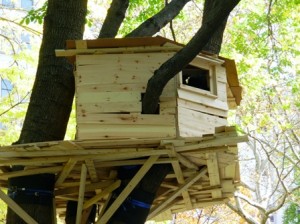
Alerted by my British shed-pal Alex Johnson, of www.shedworking.co.uk, to news that a village of tree houses had sprung up in Manhattan’s Madison Square Park, I was determined to see the spectacle with my own eyes. While in NYC for a brief 48 hour visit last weekend, I added a stop at this midtown Manhattan public exhibit of sheds-in-trees.
My son, Ben, and I spent 2 days in New York, en route home from a not-so-happy occasion (my mother-in-law’s funeral). The exposure to theater and art was a welcome respite. Last Sunday, before departing to take the train out to JFK Airport, we squeezed in a subway ride on the Downtown R train to 23rd Street & Fifth Avenue.
Emerging from underground into the beautiful autumn weather, we crossed the street and entered a verdant, 6.2-acre patch in the heart of urban hustle. Looking up, built around the trunks and suspended amid branches of six or seven tall shade trees, we spied the underneath sides of the Tree Huts. While quite humble, constructed with an apparent lack of precision from 2-by-4s and nails, each little hut seems perfect in its imperfection. The mere essentials of shelter are provided: roof overhead; floor beneath; walls to protect; window or doorway for access and light. All that is missing is a rope ladder or steps made by pieces of lumber nailed up the tree trunks. I was eager to scramble the heights and enter one of these engaging structures!
READ MORE…
Posted in Architecture, Creativity, Playfulness, Shed Glossary, Spiritual Practices | 9 Comments »
November 14th, 2008
Welcome to my 101st post on Shed Style. I guess it’s a bit of a milestone, and I have been wanting to do something special to mark the accomplishment. For bloggers who post constantly, finally passing the one hundredth installment may not be that significant (some of my pals could do that in a month or two!). But for me, a relative newbie to blogging, reaching Number 101 is an exciting benchmark.
By moving into the triple digits as I document my little corner of the blogosphere, I realize how much I enjoy this writing venue. There’s a lot of freedom when a writer can sit down and compose her thoughts unhindered by another’s deadlines, tone, or style. No editor, no word-count restrictions. Sure, there’s no pay, and the circulation (readership) is certainly a lot smaller than the traditional print media that usually publishes my words. But even still, the presence of this blog in my life fills a personal and creative need that my other outlets don’t always satisfy.
A BIT OF BACKGROUND
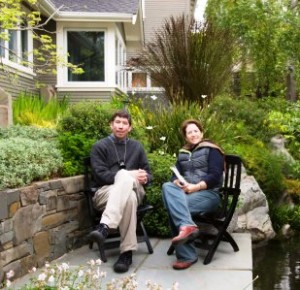 I originally started this blog in March 2007 to document the creation of Stylish Sheds and Elegant Hideaways, the book that photographer Bill Wright and I produced and published this past April. The early morning, “on-location” photo at right is from our year-long odyssey to discover and document the stories of the most creative and inspiring shed designs around the country (not to mention their inspiring owners).
[As an aside, the idea of writing a book-in-progress blog didn’t really take off until AFTER the photography and manuscript finished in the fall of 2007 . . . best-laid plans, and all that!]
Bill and I talked about this book for a long time (we’ve worked together since 2000). But by the summer of 2005, we got serious. Bill had just started to taste the sweet and satisfying flavors of the book world by collaborating with interior design writer Brian Coleman on a book called “Window Dressings” (Gibbs-Smith Publishers). I had worked on four previous books and in June 2005 I traveled to NYC to meet Sarah Jane Freymann, with whom we signed on to represent us as agent.
We began with a fairly decent catalog of shed photography, images Bill and I produced earlier for my articles in Seattle Homes & Lifestyles and Romantic Homes magazines. We created a book outline, gathering up bits and pieces of ideas, including some concepts I played around with in 2002 when Gary Luke at Sasquatch Books and I briefly toyed with ideas for a shed book.
Bill and I sat at the island in the kitchen of our (former) Seattle home, joined by our friend Marcy Stamper. A talented writer, editor, and photographer in her own right, Marcy introduced the two of us when she was art director at Seattle Homes and assigned Bill to photograph my first shed design piece for the magazine in 2001. Now freelancing and living in eastern Washington, Marcy was back in Seattle for a few days. We asked her to meet with us and come up with a design concept that we could use to “sell” our book to a publisher. We called our project “Shed Style.” The resulting 12-page mini-book she designed was called a BLAD (which stands for: book-layout-and-design).
 Our meeting took place mid-day in early August. The conversation was punctuated (interrupted) with the screaming, ear-splitting, sounds of the Blue Angels flying overhead. It was a few days before Seattle’s popular Seafair Festival and the Navy jets were in town to perform. Their practice runs and actual performances occur over Lake Washington in Seattle.
Um, yes, right over the rooftops of my former neighborhood in Seward Park. We could barely hear ourselves speak and eventually, we gave up and went out front to witness the spectacle. (Well, Bill and I did. I think Marcy was hiding under the table, reminding herself that it was noise like this that drove her over the Cascades to the solitude of the town of Twisp.) Bill took a great photo of the jets flying by (seen at left).
ON THE ROAD WITH BILL AND DEBRA
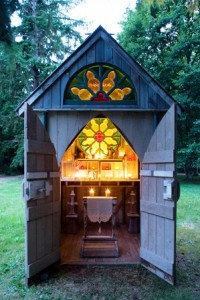 With the book successfully sold to Clarkson Potter/Random House, we began this journey. Although we had a few sheds “in the can” when we started this project a summer later, in July 2006, Bill and I had no idea what kind of momentum we’d soon experience. That same month, even before the contract was actually signed, we photographed five chapters (five shed locations) all around Washington state.
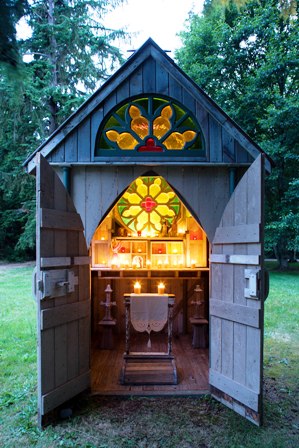
I still remember the euphoria I felt on July 5, 2006 when we came back to Seattle on the last ferry from Vashon Island where we’d photographed Edgar Lee’s magical little chapel-shed, fully lit with votive candles from his former business Votivo (see Bill’s photo, right).
I laid awake half the night replaying the thrill of the setting and the joy I felt looking through the lens of Bill’s camera as it framed the scene we’d created.
The following month, in August 2006, I moved with my children and dog to join my husband in Southern California (he preceded us by a few months). A week or so later, Bill and his wife Pauline welcomed their brand new baby Ella into the world. How many more life-altering things could we manage in such a short period of time?
We got back on the road by November ’06 when Bill flew down to Burbank to spend a few days before Thanksgiving photographing San Diego area locations with me. After the holidays, we started on an intense marathon of travel to scout and photograph sheds, sheds and more sheds.
FAST FORWARD
Stylish Sheds and Elegant Hideaways was published in late April. Since then, Bill and I have pursued our own projects, but we continued to scheme about how/when we could again collaborate.
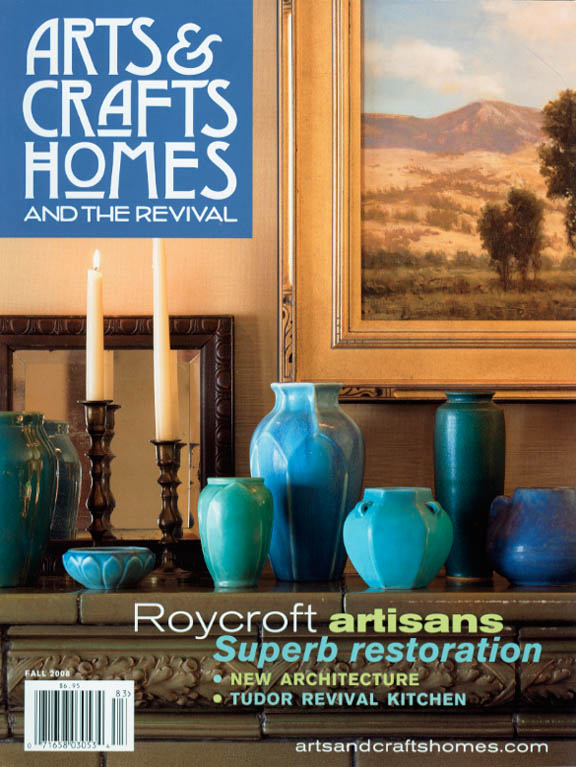
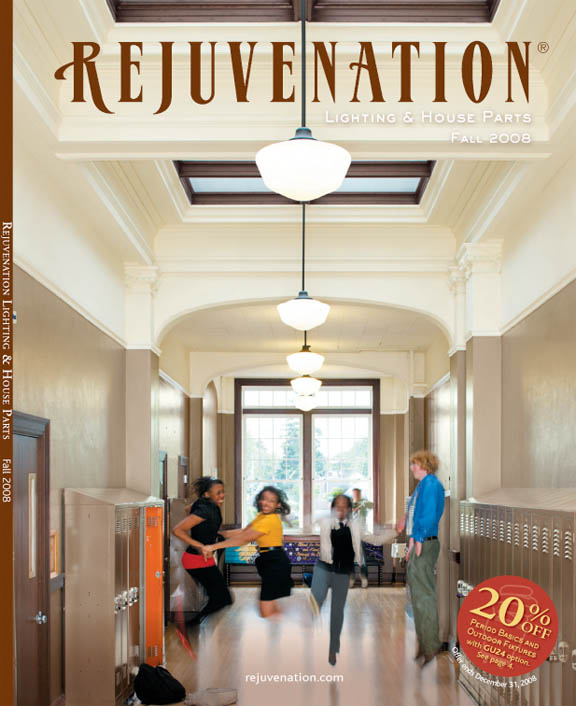
In the six months since our book’s release, we’ve had some great adventures – together and individually. Bill continues to photograph GREAT projects and I continue to write design pieces for national and regional magazines and Southern California newspapers, including the Los Angeles Times and the San Diego Union-Tribune. Recently, Bill nailed two great covers, which I want to share here:


Left: Fall 2008 cover of Arts & Crafts Homes (for a Brian Coleman story); Right: Cover of Rejuvenation Lighting’s Fall catalogue. [William Wright photography]
LAST WEEK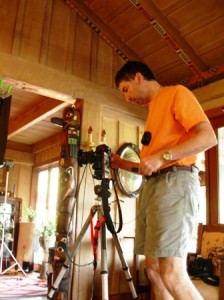
Our work has appeared together in several recent magazines, including stories for the October 08 issue of Alaska Airlines/Horizon Air magazines, the November 08 issue of Seattle Homes & Lifestyles, and others, but since completing the G-R-I-N-D of our “year of the book,” Bill and I had not been able to find the time to create any new stories together.
That opportunity finally came last week, when Bill flew from Seattle to Southern California. We drove up to Ojai, the historically famous town located east of Santa Barbara near the Topatopa Bluff, to photograph a 1908 bungalow, its grounds and interiors, for Arts & Crafts Homes. See Bill at work, right.
We enjoyed two days of hard but gratifying work, thanks to owner Kathy Couterie (an ace stylist in her own right!).
The article about the home she owns with her husband, Emmy-winning director and Oscar-winning documentary filmmaker Bill Couterie, will appear in 2009, but until then, here is a preview of our photo shoot:
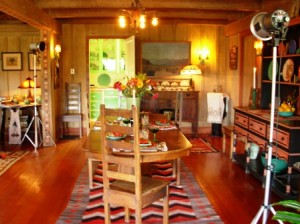
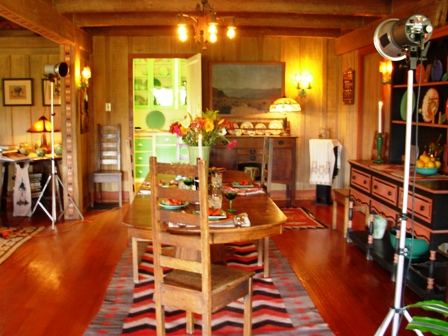
Lights, camera, action….the Couterie dining room, styled, lit, and ready to photograph.
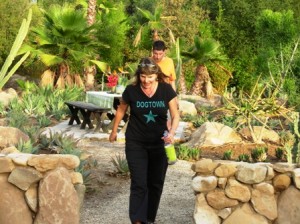
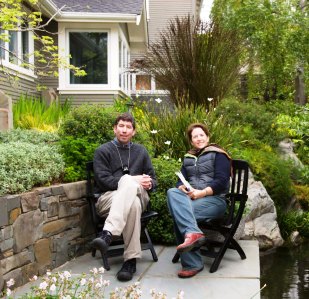
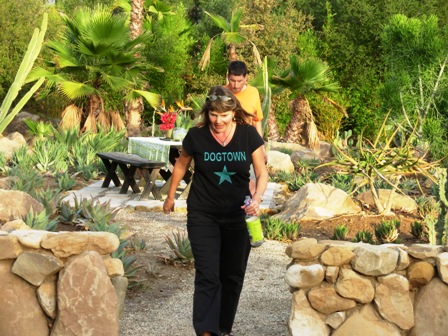
Kathy Couterie (foreground), followed by Bill Wright, as we finalize the garden shot for Arts & Crafts Homes.
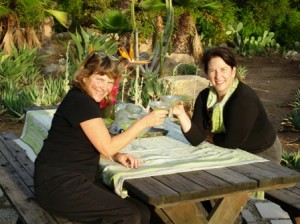
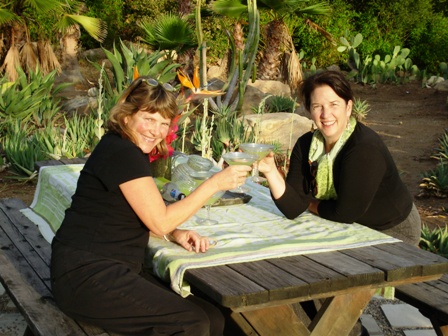
The sun is about to set, we’ve photographed the garden, and we’re ready to call it a day.
Posted in Creativity, Writing | 4 Comments »
October 27th, 2008
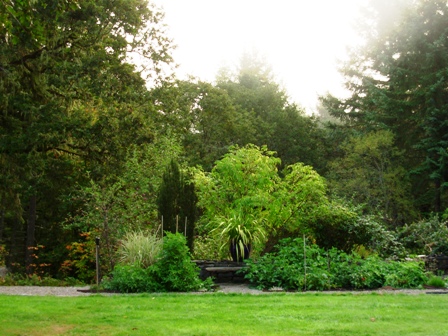
An early morning scene outside the guest room window at Mary-Kate Mackey’s in Eugene
October in Oregon – you can’t beat it. Earlier this month, I traveled there to lecture to the Hardy Plant Group of Willamette Valley.
Returning to my beloved roots, in the Pacific Northwest, was such a treat, especially since it is still wickedly hot down here in LA and I am desperate for some moist, cool autumnal weather.
And oh, the gardens!
 Mary-Kate Mackey, fellow garden writer and a gifted journalism educator, met me at the airport. It was fun to fly into this sleek, modern, small airport and arrive via Horizon Airlines (they serve complimentary Pacific Northwest ale on board and, oh, by the way, one of my articles appears in the October issue of Horizon/Alaska’s in-flight magazine, so I was able to grab lots of extra copies from the seat-pocket in front of me, etc.!).
Upon disembarking in Eugene, I was impressed by the changing autumn light and saturated foliage palette. Oh, it’s autumn in Oregon! It took away my breath and captured my heart.
The evening began with drinks at a nifty bistro with Mary-Kate, followed by dinner with my dear friend Jennifer (we were editors together at “Seattle Woman” magazine in the 80s).
On Tuesday, after a restful overnight in Jenny and her husband Tim’s comfortable home, I met up again with Mary-Kate.
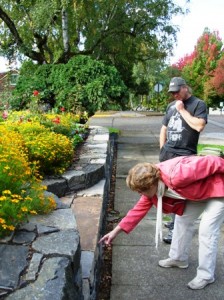
Since I missed out on the one-day garden tour in Eugene that followed last month’s Garden Writers Association’s annual symposium, I had a special request for Mary-Kate: Can I have my own mini-tour of the best of the best Eugene has to offer? [Above: Mary-Kate inspects the craftsmanship of a stunning stone wall hand-built by Allen Bosworth (right) of Bosworth Landscaping.]
READ MORE…
Posted in Creativity, Gardening, Landscape Design, Plants, Shed Glossary, Writing | 5 Comments »



 The month of November seems to generate an abundance of magazine articles about being “thankful.” For many of us, the notion of giving thanks is top of mind this season. Not only am I hugely grateful for my family, friends, home, garden and writing career, I’m so often reminded how rare these gifts truly are.