The Slow Flowers Podcast is the award-winning show known as the “Voice of the Slow Flowers Movement.” Launched in 2013 as the original flower podcast, we’ve devoted more than 10 years to covering the business of flower farming, floral design, and the Slow Flowers sustainability ethos. Listen to a new episode each Wednesday, available for free download here at slowflowerspodcast.com or on iTunes, Spotify, and other podcast platforms.
December 19th, 2008
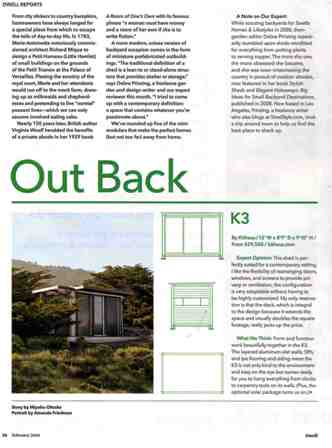
 I’m honored to be the featured “expert” on prefabricated sheds in Dwell magazine’s upcoming February 2009 issue. How cool is that? (In September I wrote about the photo shoot with the very talented Los Angeles-based photographer, Amanda Friedman. . . now it’s finally appearing in print).
I received a sneak preview of the article when associate editor Miyoko Ohtake mailed me a few complimentary copies, which arrived in yesterday’s post. The article is also available online; not on Dwell.com, but on the very cool digital magazine site, Zinio. Even though the hip “prefab issue” isn’t out on the newsstand yet (because the December-January issue is still for sale), you can order it for the $5.99 cover price at Zinio. Check it out.
I love what Miyoko wrote in the Dwell Reports feature titled “Out Back.”
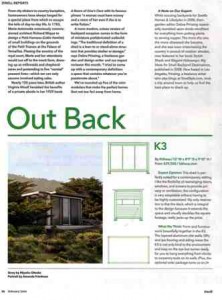 From city slickers to country bumpkins, homeowners have always longed for a special place from which to escape the toils of day-to-day life. In 1783, Marie-Antoinette notoriously commissioned architect Richard Mique to design a Petit Hameau (Little Hamlet) of small buildings on the grounds of Versailles. Feeling the scrutiny of the royal court, Marie and her attendants would run off to the mock farm, dressing up as milkmaids and shepherdesses and pretending to live “normal” peasant lives – which we can only assume involved eating cake.
Nearly 150 years later, British author Virginia Woolf heralded the benefits of a private abode in her 1929 book A Room of One’s Own with its famous phrase “a woman must have money and a room of her own if she is to write fiction.”
A more modern, unisex version of backyard escapism comes in the form of miniature prefabricated outbuildings. “The traditional definition of a shed is a lean-to or stand-alone structure that provides shelter or storage,” says Debra Prinzing, a freelance garden and design writer and our expert reviewer this month. “I tried to come up with a contemporary definition: a space that contains whatever you’re passionate about.”
READ MORE…
Posted in Architecture, Creativity, Sheds & Havens | 11 Comments »
December 17th, 2008
Those of us who attended the September 2008 Garden Writers Association annual symposium in Portland were in for a big treat when we boarded the coach buses (seven or eight in all) and took a ride to Boring, Oregon, home of Iseli Nursery.
 We were introduced to a world of ornamental conifers, in every shape and size. Even though Washington is called the “Evergreen State,” in the nursery trade, it seems, the folks in Oregon claim the title.
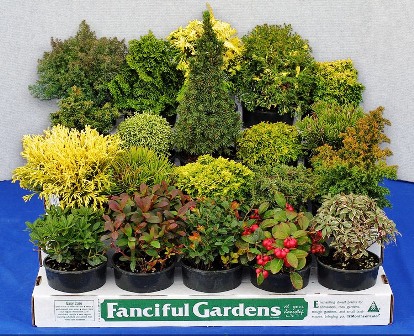
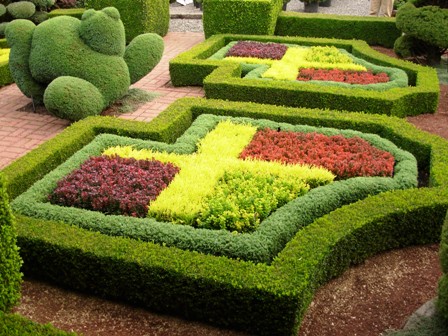
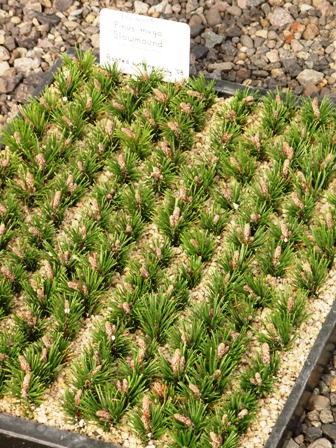
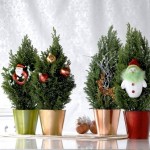
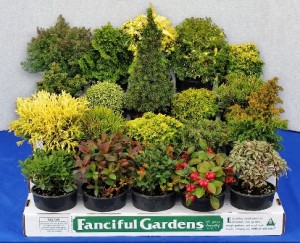
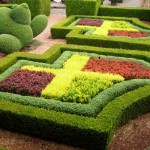
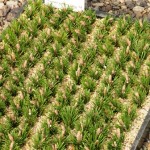
Iseli Nursery grows all sorts of amazing woody plant specimens – trees, shrubs and more. They sent us home with a gift bag packed with five delightful little conifer specimens – perfect for a container planting, rock garden or tablescape. You can see the incredible variety in Iseli’s “Fanciful Gardens” collection depicted above (including some dwarf broadleaf evergreens in the front row). My photos, from left: A colorful “knot garden” of mostly dwarf conifers mixed with barberry, Iseli entrance; tiny, just-propagated woody cuttings of mugo pine.
The next day, I found myself sitting on yet another the bus ride/garden tour with with Sandy Dittmar, a horticulturist at Iseli. We talked about how many gardeners are only now discovering conifers, and how dwarf conifers are so versatile for smaller landscapes. She planted a seed of insight and got me thinking.
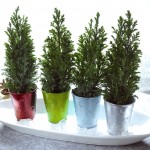
So when I saw my local Trader Joe’s stocked with miniature Leyland cypress and Lawson cypress (we’re talking 4-inch pots for $4.29 or so), I called Sandy and said: Remember when we talked about dwarf conifers? Are those Trader Joe’s mini-trees yours?
It turns out, the tiny live trees in shiny pots are supplied by BloomRite Nursery, a wholesale grower in Half Moon Bay, California. But Iseli’s tiny Alberta spruces, mugo pines, and blue-star junipers, and countless other dwarf conifers are showing up in specialty nurseries and retail florists around the country. Cute, they are. Versatile, too. And perfect for a scaled-back Christmas!
In this cost-conscious holiday season, it was a fitting “tiny tree story” for the Los Angeles Times’ Home section, page F2 (December 13th).
Here is the piece I wrote under the “Seen” heading, in its entirety:
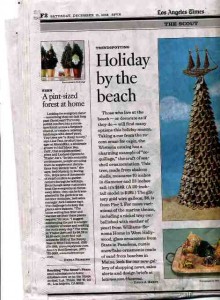 A pint-sized forest at home
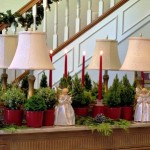
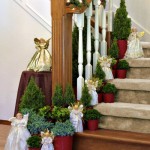
Looking for evergreen decor – something that can last long past Christmas? Turn tiny potted conifers into a miniature forest across a fireplace mantle, or create a tabletop landscape with dwarf pines. Tiny trees are “a cheap luxury,” says Lisa Tsui, a product manager at BloomRite, a wholesale grower in Half Moon Bay, Calif., that supplies potted pines and Leyland cypress to Trader Joe’s. “In this economic environment, people are using them to supplement decorations they already have,” she says.
Iseli Nursery in Boring, Ore., ships tens of thousands of dwarf conifers to garden centers during the holidays. Even though some customers treat the evergreens as throwaway décor, they can be transplanted in the garden or an outdoor container, Iseli sales manager Jock Demme says. The challenge is to keep the plants alive indoors. “The home setting has drier and warmer air than these plants require,” he says. “I suggest submerging the pot in a larger container of water and soaking the roots every day.” The trees at Trader Joe’s sell for $4.29 to $5.99 each; you’ll find variations for $9.95 at the Empty Vase in West Hollywood, (310) 278-1988, www.emptyvase.com. Also try Red Envelope, (877) 733-3683, www.redenvelope.com.
Here’s a little gallery of dwarf and miniature tree photographs, shared by Iseli and Nurserymen’s Exchange (which is the company behind BloomRite).
Posted in Creativity, Entertainment, Plants, Playfulness | 8 Comments »
December 15th, 2008
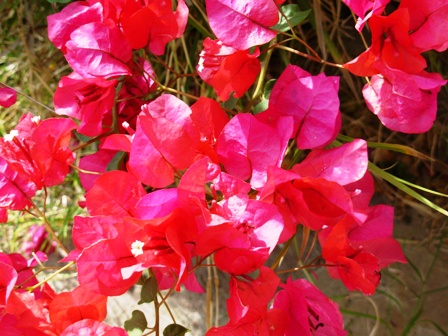
My bougainvillea’s lipstick-pink bracts look almost iridescent in Southern California’s December sunshine
Dateline: Thousand Oaks, California
USDA Zone: 10
The journalist-observer in me couldn’t help but notice that when the 15th of each month rolled around, many of my favorite fellow bloggers wrote about this phenom called “Garden Bloggers Bloom Day.” They even included images of that day’s blooms in their own garden.
The instigator behind this movement is Carol of May Dreams Gardens, and somehow I thought I had to be invited by that select inner circle of garden bloggers to participate. Kathy Purdy of Cold Climate Gardening recently set me straight on that assumption and assured me that all I have to do is post photos of my flowers. She sent me an email with “No Rules for Bloom Day” in the subject line and a link to May Dreams Gardens with the “rules,” of which there really are none:
All you need to do to participate in Garden Bloggers’ Bloom Day is post about what is blooming in your garden on the 15th of the month, or thereabouts, depending on your personal schedule. Then leave a comment on my bloom day post so we can find your blog and check out what is blooming in your garden.
I sort of cheated because I took these photos yesterday, Dec. 14th. I’m glad I did, though because today, Dec. 15th, we experienced a rare occurrence: RAINFALL. Don’t worry – I managed to spend plenty of time outside soaking up the raindrops while letting my dog, Zanny, run around and play catch with her favorite (now muddy) yellow tennis ball. It was a glorious day and everything is refreshed – in the garden and in our spirits. All the air pollution and dust has been washed off of the foliage and the soil looks wet and dark brown. We’ll see how long that lasts!
Here’s what I have to contribute:
 Bougainvillea, seen here and above. It was inherited from the previous owner when we moved here in 2006. The first time I really noticed a bougainvillea was in 1999, when my sweet husband took me to Palm Springs for a surprise 40th birthday weekend. We were staying at the former Merv Griffin Resort and Givenchy Spa (how mid-century!) and there was an entire wall covered with the raspberry-colored display of bougainvillea. Little did I know then that I’d live in Southern California some day and actually have one in my garden. I’m trying to train it up to the the patio-covering arbor.
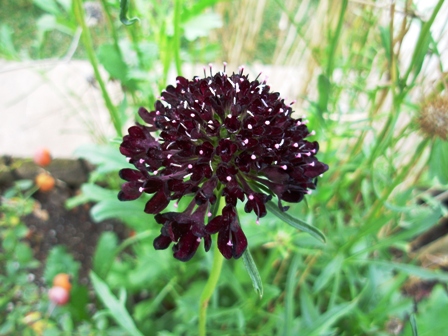
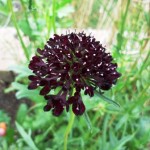 Scabiosa atropurpurea ‘Black’, also called pincushion flower – and also called ‘Ace of Spades’. This perennial (for me) has a delicious, dark-plum bloom. It’s a favorite of butterflies because they can use it as a landing pad while doing their thing. I purchased this plant in 2007 on a “garden gals’ field trip” to Annie’s Annuals (we actually took a road trip from SoCal to the Bay Area for the San Francisco Flower & Garden Show and Annie’s was a side trip). The scabiosa thrives and re-blooms so often I can’t keep up with the job of cutting back the old growth. So pretty as a cut flower, especially when combined with anything chartreuse.
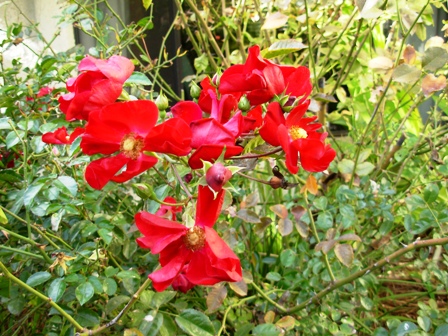
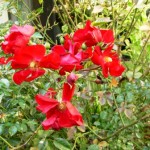 Mystery rose, another “gift” from the former owner of our property.
I really like the delicate form of its single flowers, the crimson petals and the yellow centers. This rose, which is taller than me, has thrived despite little or no water in the area outside my dining room window. I have plans to renovate this bed, but first I have to hand-dig and remove the red lava rock “mulch” out of the bed, which may explain why this to-do remains on my list!
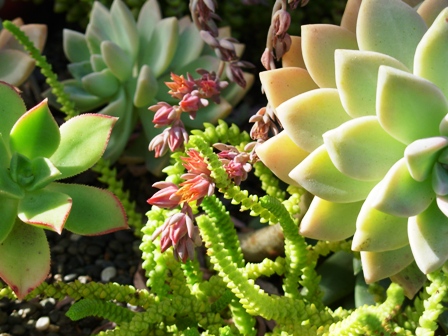
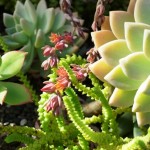 Echeveria hybrid in bloom. This is a close-up of the beautiful, costume-jewelry-like flowers, the stem of which emerges from the center of an echeveria. I have a wonderful display of echeverias, crassulas, sedums and other succulents in my kids’ old red wagon. It was once planted with spring bulbs or summer annuals (back in Seattle), but here, it is a perfect, low-maintenance container for a wagon-full of succulents. According to Lorraine Schulz and Attila Kapitany in “Echeveria Cultivars” (Schulz Publishing, Australia) the cut blooms of echeverias alway outlast more conventional flowers when brought indoors for an arrangement.
Well, that was fun! I’m happy I could join the Bloom Day party!
Posted in Creativity, Plants | 9 Comments »
December 14th, 2008
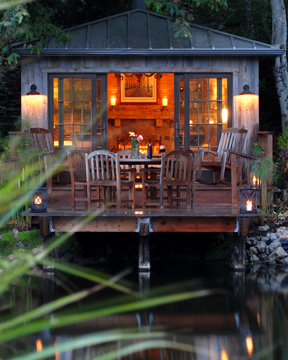
Last Friday, I enjoyed a wonderful “field trip” to Church Estates Vineyard in Malibu, owned by Robert Church Haggstrom. This was one of those magical behind-the-gates visits that reminds me how very fortunate I am to be a writer in this town.
I was invited by publicist Dienna D’Olimpio, with whom I’ve been corresponding for a few months. She originally contacted me to share photographs and background info about Church Estates Vineyard, its chateau and garden settings. I haven’t even tasted the wine yet (the winery’s first Chardonnay will be bottled soon and its Pinot will be ready this fall), but the beauty of the setting appealed to me immediately.
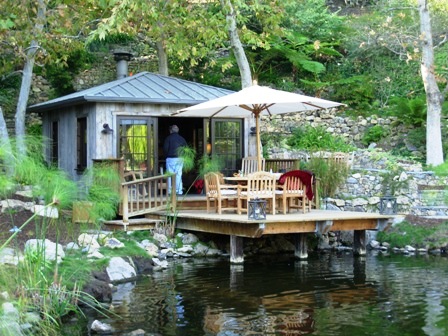
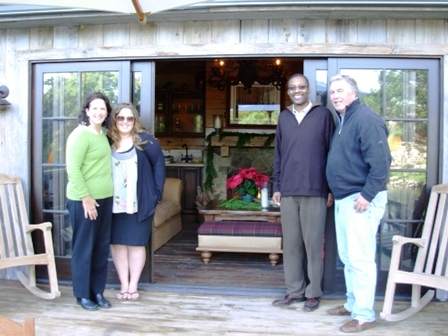
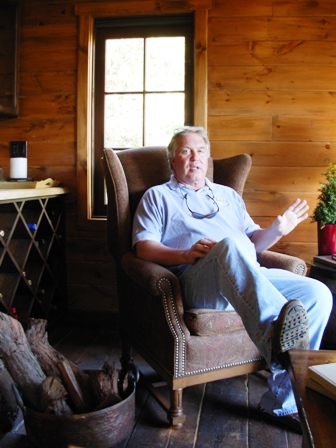
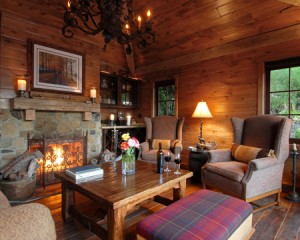 A tiny building, situated at the edge of a pond, captured my imagination. I later learned that Bob calls it his “boathouse,” and to me, it is the most beautiful, romantic boathouse I’d ever seen. Truly an elegant hideaway. (see interior, right).
Once I saw photographs of the gardens (not to mention the boathouse), all of which share the nine acres with 3,000 grapevines, I knew I wanted to visit and develop a story.
The estate is available for weddings, corporate events, and other private parties. Robert Church Haggstrom’s personable daughter, Maja, is the go-to gal for brides, corporate event planners, and anyone else who wants to rent the lovely haven for an unforgettable day.
As impressive as are the vineyards and well-appointed chateau, I couldn’t take my eyes off of Bob’s little getaway by a pond. The boathouse photos – seen above – are courtesy of Church Estate Vineyards.
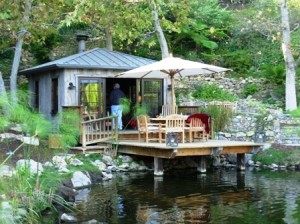 Dienna arranged for me to visit and I managed to persuade my husband, Bruce, to come along for the tour. He’s not really into gardens, but he is into real estate. We drove to Malibu, about 30 minutes from home, and arrived at Church Estates in time to meet Maja just inside the entrance. Thank goodness she was driving a golf cart because the elevation change from the parking area (near a sunken clay tennis court and horse stables) to the upper gardens and chateau would have required sturdy shoes and perhaps a walking stick to navigate on foot.
We hopped onto her golf cart and made our way up the winding drive, through the garden, to the grand French-style chateau. Out of the corner of my eye, I spied the pond and boathouse. The table on the dock was set for lunch! Oh, goodie, we were going to end up there at the water’s edge for our meal.
Maja narrated our tour: She grew up in Malibu and knows the ins and outs of every square inch of Church Estate Vineyards. To listen to Maja describe the gardens here, you can tell she still has that childlike wonder and curiosity about nature’s beauty. It is infectious.
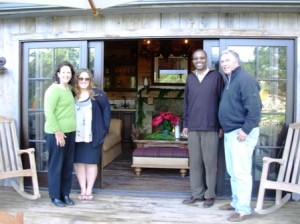 The story of Church Estate Vineyards is one that I will tell in a future article, after I spend a proper amount of time with “Malibu Bob,” as Mr. Haggstrom is affectionately called around here.
But in the meantime, I will touch on highlights of his boathouse.
- It was the first thing he built here after purchasing the property five years ago
- Bob wisely situated the structure at the bottom of the hill, nestled under a stand of mature sycamore trees – facing the man-made pond, which he has since landscaped and stocked with swans.
- The boathouse measures about 20-by-20 feet in size; the exterior is finished in weathered wood and the standing-seam metal roof is aging nicely.
- The interior features a lovely fireplace and comfy furniture (but not a bed, darn it! Bob said he figured if there was a bed, all of his guests would argue over who would get to sleep here)
- The floor is made from antique boards, and when one of Bob’s friends accidentally knocked over a container of oil (after a fondue party), Bob decided to have the entire floor rubbed with oil – which adds a soft, aged patina to the space.
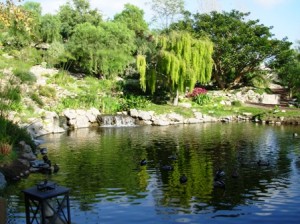
Thank you Bob, Maja, Marie and Dienna – we had a wonderful visit, enjoyable conversation, delicious food — and were thoroughly enchanted with the magical setting you’ve created at Church Estate Vineyards. I can’t wait to return!
[photo above, from left: me, Maja, my husband Bruce Brooks, and Robert Church Haggstrom].
Posted in Architecture, Creativity, Entertainment, Shed Glossary, Sheds & Havens | 5 Comments »
December 13th, 2008
About a month ago, while reading Alex Johnson’s wonderful blog, Shedworking, I saw his post about an artist named Sarah Lynch. She has spent 2008 posting an original painting EVERY DAY on her blog.

Alex had discovered one of Sarah’s posts from July, featuring a charming garden shed entitled “Shed with Hollyhocks.” It was enchanting and I immediately went to her blog and subscribed to receive her daily artwork. Sarah is an English-Canadian woman living in Southern Ontario. You can find her work for sale via her blog (where there are links to some online galleries also selling her art).
I don’t know her at all, but Sarah has brought me a small dose of happiness every morning. Opening the link to see her next piece is one of the very first things I do after making my cup of tea and sitting down to read email at the start of the day.
I think Sarah may love sheds as much as I do, because today she offers a charming piece entitled: The Lonely Shed (7″X5″ WC pencil on paper):
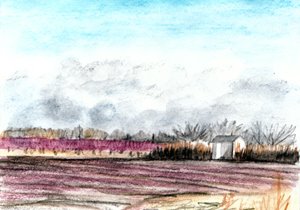
The year is almost over and I’m worried that Sarah may stop posting her artwork. I like reading her brief, personal artist statements that accompany each drawing, illustration or painting. She has alluded to her readiness for a slower pace, perhaps creating three paintings a week instead of seven. Get in on the last few weeks of the year and subscribe to this little piece of joy that will arrive in your in-box each morning. I, for one, am hoping for MORE SHEDS!
IN OTHER NEWS. . .
On Sunday (12/7) we received a mention in Irene Virag’s column in Newsday. She included Stylish Sheds and Elegant Hideaways in her “Gift List,” featured at the end of her longer piece on Ken Druse.
Stylish Sheds and Elegant Hideaways (Clarkson Potter, $30): Author Debra Prinzing and photographer William Wright showcase 28 sheds from Southampton to Seattle. From clematis-covered potting sheds to writers’ retreats, these structures enhance lifestyles and landscapes.
READ MORE…
Posted in Architecture, Book reviews, Creativity, Shed Glossary, Sheds & Havens, Spiritual Practices, Writing | 1 Comment »
December 11th, 2008
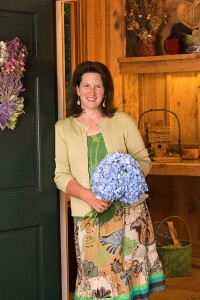 If you, like me, are enchanted with sublime and soulful backyard destinations once merely called “sheds,” consider yourself a Shedista.
According to some Internet searches, the term Shedista has been appropriated (originated?) by the boutique wine industry. In France, these clever folks are called “Garagistes,” because they make incredible wine in their garages. Kind of an underground movement!
To quote Wordspy.com: “Shedista: A professional, low budget wine maker, particularly one who processes grapes in a shed-like building.”
I first discovered this term in Jay McInerney’s “Uncorked” column for (now defunct) House & Garden magazine: It was titled “The Shedistas.”
He wrote about a “warehouse gang” of Santa Barbara winemakers who “maxed out credit cards to rent a shed, buy a few tanks and a few tons of Syrah grapes, design a label, and make [their] own wine.”
Those who know me well know I have no desire to steal a moniker from winemakers. However, if you do an Internet search of the word, I bet you’ll find nearly three-quarters of the Shedista entries appearing are ones that I’ve generated. Yup, I’m out to change the meaning of this alluring term.
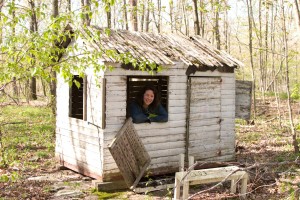 Here’s my definition: “Shedista: A person who creates and occupies a small-scale shelter in the garden for personal enjoyment and the pursuit of any creative passion.”
My UK shed friend, Uncle Wilco, who publishes a blog at his We [heart] Sheds site, calls himself a “Sheddie.” It’s a close cousin to “Shedista,” and we can all feel free to use both terms! Another friend coined the word Shedquarters to describe his backyard office. In other words, shedistas find shelter in their shedquarters. I like it!
If you wish to see some of the very best examples of personal escapes, aka “sheds,” check out my book: Stylish Sheds and Elegant Hideaways. Welcome to all Shedistas!
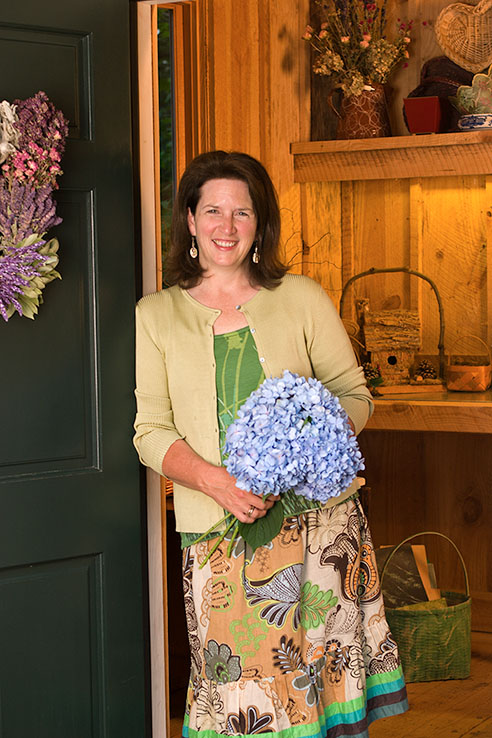
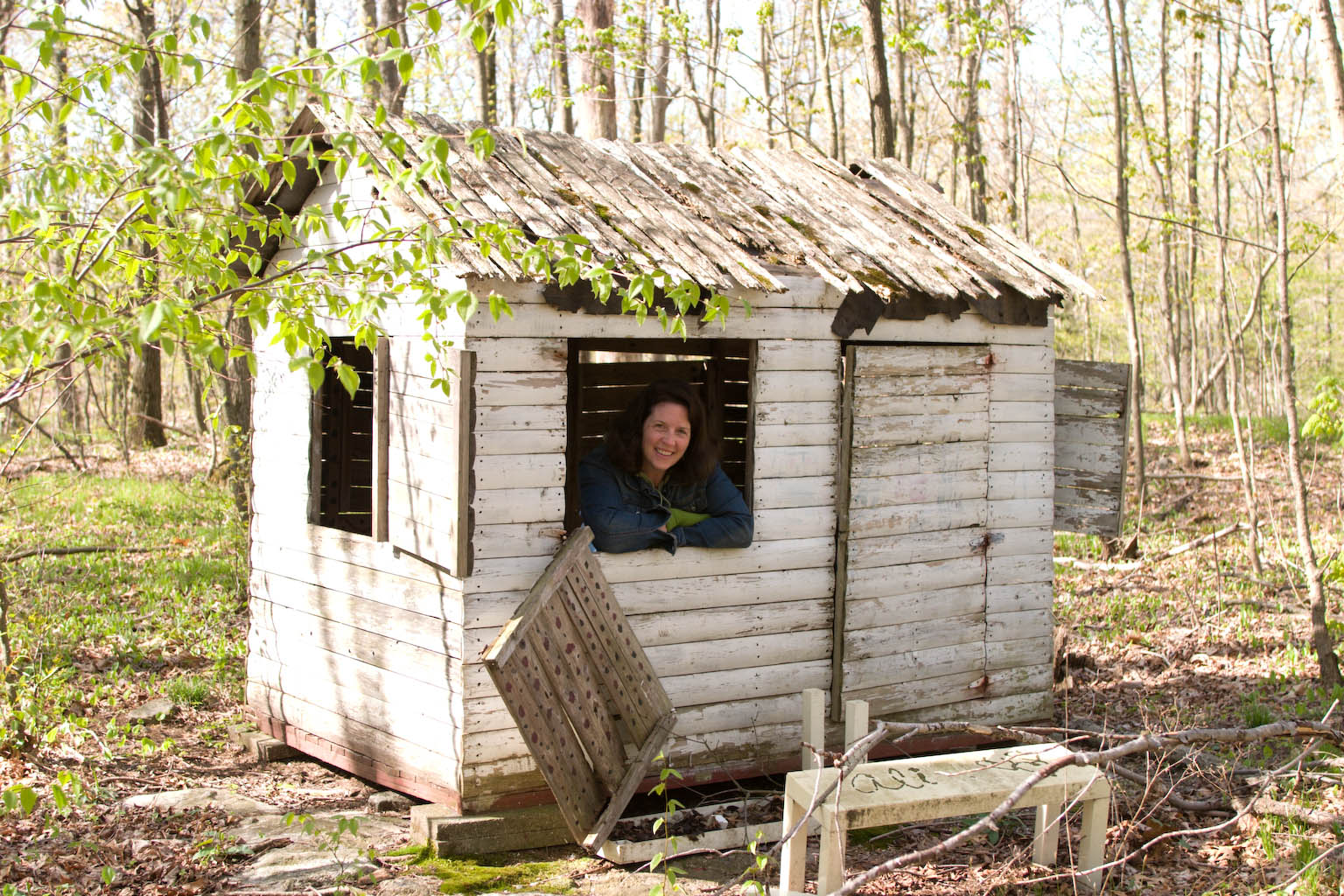
Photos: (c) William Wright; top left: taken in July 2007 in Atlanta – in the doorway of Betsy Hansen’s beautiful potting shed. Lower right: taken in May 2007 (as a joke) at an abandoned child’s playhouse in Connecticut. We were on location at author Amy Bloom’s property and noticed this “shack” on a hill near her property. We couldn’t resist!
A Post-Script, Uncle Wilco just tipped me off to his December 14, 2006 post “What is a Shedista?” in which he quoted the same Wordspy definition I’ve used. I like what he wrote after that:
sounds great, but who is someone who brew beer in their sheds, maybe a shedbrewhaha
As I wrote in a reply to him: Of course, while I was running around the country trying to find sheds to photograph and write about, there he was . . . steps ahead of me! Thanks Uncle Wilco!
Posted in Architecture, Creativity, General, Shed Glossary, Sheds & Havens | 9 Comments »
© Debra Prinzing, all written and photographic content. Website design/development by Willo Bellwood/Metric Media



 I’m honored to be the featured “expert” on prefabricated sheds in Dwell magazine’s upcoming February 2009 issue. How cool is that? (In September I wrote about the photo shoot with the very talented Los Angeles-based photographer, Amanda Friedman. . . now it’s finally appearing in print).