The Slow Flowers Podcast is the award-winning show known as the “Voice of the Slow Flowers Movement.” Launched in 2013 as the original flower podcast, we’ve devoted more than 10 years to covering the business of flower farming, floral design, and the Slow Flowers sustainability ethos. Listen to a new episode each Wednesday, available for free download here at slowflowerspodcast.com or on iTunes, Spotify, and other podcast platforms.
January 9th, 2009
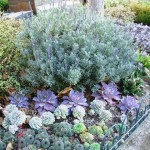
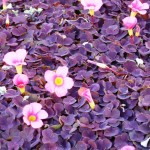
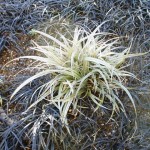
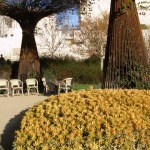
This post aspires to nothing more than sharing with you my garden-gal outing two days ago to the Getty Center in LA. I had a lovely “New Year’s” lunch with garden designers Linda McKendry (of Linda McKendry Design) and Laura Morton (of Laura Morton Garden Design).
We toasted the New Year and talked about our goals, our wishes, our dreams, our *resolutions* and a bit of reality. After lunch, the three of us took an afternoon stroll through the Getty’s Robert Irwin-designed garden.
The light was beautiful. The plantings were surreal. Enjoy!
Posted in Creativity, Gardening, General, Landscape Design, Plants, Shed Glossary | 4 Comments »
January 5th, 2009
 Here’s my January 2009 “In the Garden” column for 805 Living magazine, featuring artist and designer Jennifer Gilbert Asher and her beautiful sculpture.
GARDENS AS GALLERIES: Choose and place ornamentation with a thoughtful eye toward your garden’s overall design.
Why do artful objects – such as sculpture, salvaged architectural fragments or even a birdbath – make such an impression in the garden?
Like adding jewelry to a little black dress, or a few bright pillows to a tired sofa, artwork, sculpture and ornamentation can take any garden from ordinary to extraordinary. Well-placed art adds to, rather than detracts from, the overall composition. In the winter, when the garden is quieter, artwork often takes center stage.
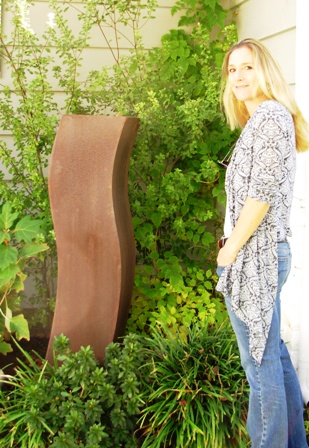
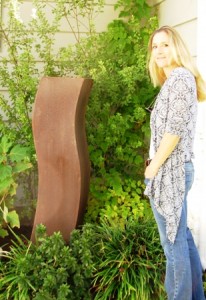 “Even though sculpture is a four-season element in the landscape, it becomes the star of the show when everything else is going dormant,” says Jennifer Gilbert Asher, principal of Woodland Hills-based Chilmark Gardens. [see Jennifer, right, with “Curvas,” placed in her own garden.]
Precious objects, displayed side-by-side with foliage and flower – or partially hidden among the stems and branches of a favorite plant – give a garden its personality. They also communicate volumes about its owner’s taste and style.
“I place sculpture not just to complement the garden, but to transform it,” Asher says. “A captivating sculpture can spike curiosity and provoke thought. It can be playful or energetic; meditative or even sensual.”
Asher was inspired to design a collection of bold, modern pieces after she had trouble finding affordable artwork for her client’s landscapes. “I was shocked at the lack of accessible fine art for the garden. I heard the same thing from other designers, all over the country. You shouldn’t have to be a millionaire to transform your landscape into an outdoor art gallery,” she says.
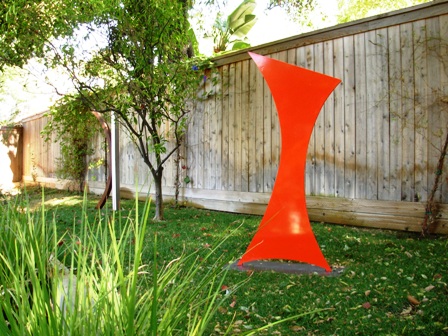
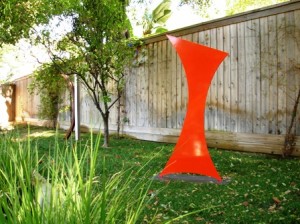 She teamed up with Los Angeles entrepreneur Karen Neill Tarnowski last fall to launch TerraSculpture, an online art gallery and sculpture studio. Asher design and create abstract, graphic forms in stainless, weathered and powder-coated steel. TerraSculpture uses durable, outdoor-friendly material such as 11-gauge steel; finishes vary from brushed stainless to eye-popping primary colors. [at left: “Leap”]
With names like “Embrace” and “Closer,” many of the pieces evoke human emotions. And unlike the type of sculpture you’d see in public parks or museums, which is far too large for the domestic landscape, TerraSculpture’s designs range from 4-1/2-feet-tall to 6-1/2-feet-tall. (For customers whose homeowner-association covenants restrict anything that appears above backyard fences or walls, these dimensions offer added benefits.)
READ MORE…
Posted in Architecture, Creativity, Landscape Design | 7 Comments »
January 3rd, 2009
 You spy a weathered castoff, a tarnished this or a timeworn that. What is the first thing that comes to mind? “Don’t throw that away! I can find a good use for it.”
The designer’s mind will recycle, reinvent or re-imagine the piece of “junk,” giving it a new purpose as an object of style. Read on for the first installment of a new column that features local designers and resources for transforming otherwise unusable objects into home décor.
Today’s HOME section of the Los Angeles Times introduces a new feature about recycling old objects for home and garden decor. It’s the brainchild of editor Craig Nakano and we hope this is just the beginning of the “hunt” for cool ideas that give new life to elderly castoffs.
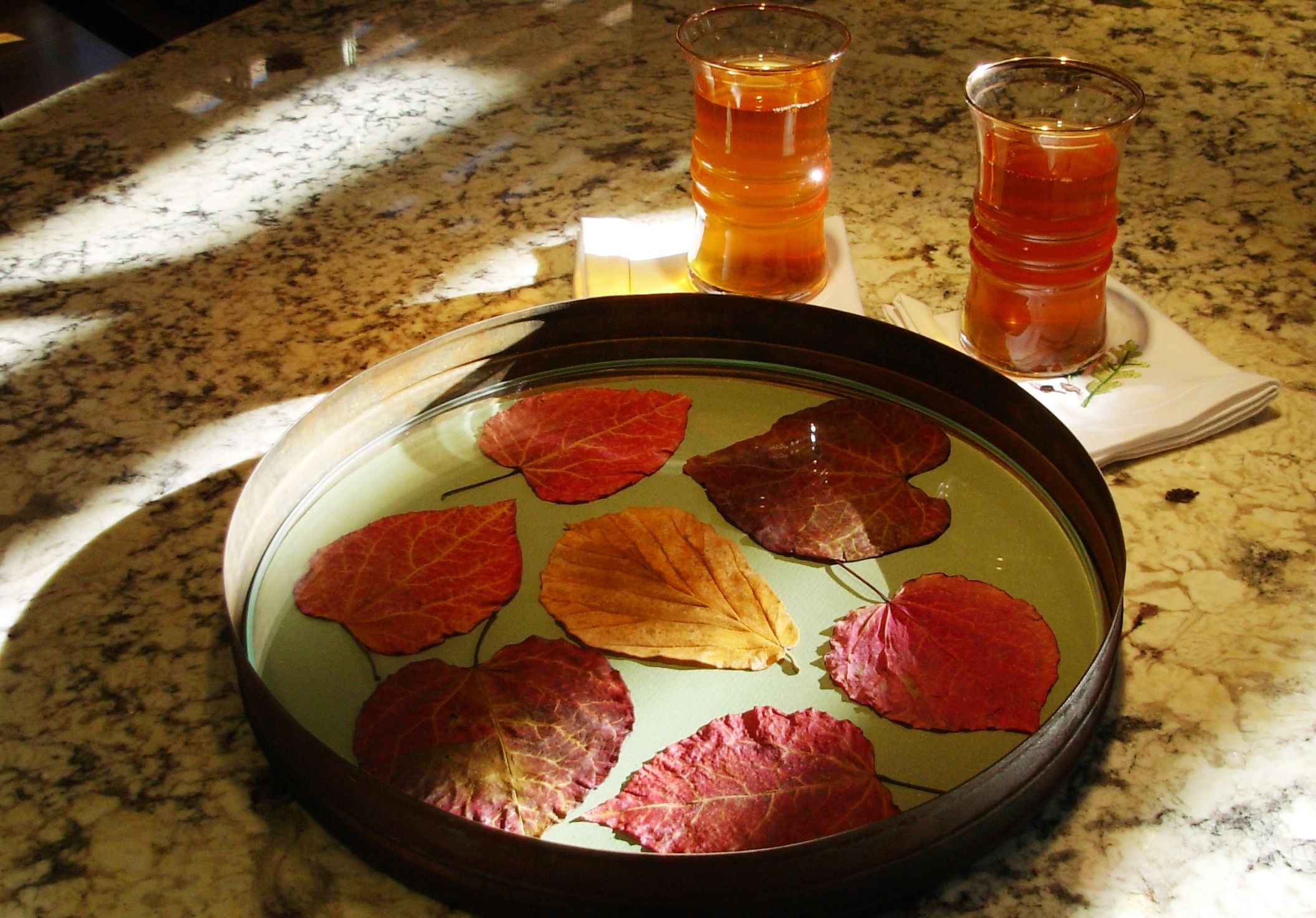
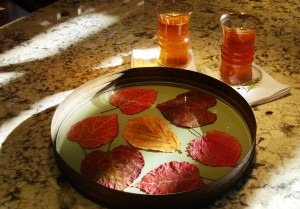
To get things going, I created the first product – a cocktail tray made from a vintage feature-film canister. I found the 14-inch diameter tins at Pasadena Architectural Salvage, a store filled with carefully salvaged columns, doors, windows, corbels, gates, hardware and more. Most everything there is pricey (we’re not talking junk-shop rates) but worth it if you want to factor in the “value added” of someone else seeking, securing, and transporting rare or hard-to-find objects.
When I visited Pasadena Architectural Salvage, I got lucky. The tins (bottom and lid as a set) were $5 each. I found similar ones for $15 to $25 each on eBay, so I know I got a steal. My Recycled story, “A second serving,” gives readers the background of these vintage 35 mm film tins and step-by-step instructions for making their own. My finished photo appears above, with two heirloom ridged and gold-rimmed juice glasses that were my grandmother Helen Winslow Ford’s (thanks, mom!).
P.S., I used “a lust for rust” in my lede sentence. Credit must be given here to my friends Beth, Lisa and Amy of the Salvage Studio. It’s one of their favorites and I’m sure they coined the phrase!
Posted in Creativity, Entertainment, Playfulness, Writing | 4 Comments »
January 1st, 2009
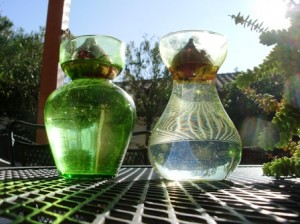
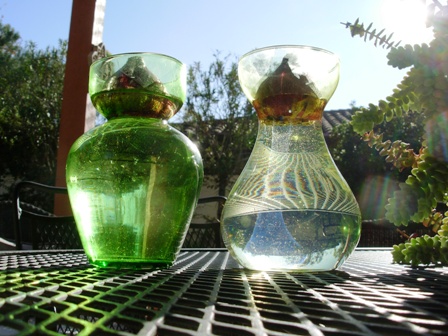
Enjoy this photo gallery of some of my New Year’s gardening projects, accomplished today. I’ll add a few comments with each image to explain what I did. Above: Two hyacinth bulbs from Brent and Becky Heath’s care package – I saved them to grow in these glass bulb vases in my kitchen windowsill.
 The blogosphere and Twitter world have been busy today, with my friends and those whose work I admire/read writing about resolutions, garden mission statements, and more. I have really tried to tear myself away from the keyboard and screen. It’s ironic that I spend more time here at my desk – looking through the open shutters to the backyard – than I do actually touching, breathing and engaging with said yard.
So today I decided to spend time on gardening projects. I am stiff and tired. Six hours straight – pruning and deadheading, digging up, wheeling the barrow to and fro – is not my typical schedule these days. And I am determined to return to this routine (or an edited version of it) in 2009.
Because you know what? I’m feeling very happy.
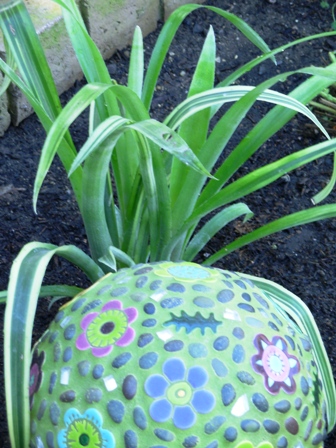
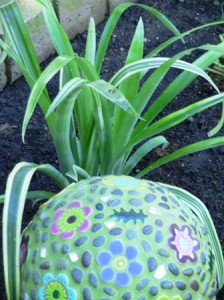
At left: I finally planted this beautiful Billbergia nutans ‘Variegata’, which I am embarrassed to say I purchased in March 2008 at Western Hills Nursery in Occidental, Calif., during our post-SF Flower & Garden Show garden-gals’ field trip. Miraculously, this plant has not only endured, but seemingly thrived in a 6-inch pot all these months. It is a beautiful, strappy, striped plant and doesn’t it look nice with the Clare Dohna mosaic orb?
What’s been holding me back anyway?
Since leaving behind my cherished garden in Seattle in August 2006, and moving to what many people think is heaven on earth – Southern California – I have been fairly disengaged with my new yard. As I’ve said before, I can’t really call it a garden. It’s really just a yard filled with plants I don’t understand or particularly like. I’ve had bursts of energy now and then to try and tackle things, including hiring someone a year ago to dig up and haul to a landscaping dumpster a yard’s worth of big red lava-rock mulch that covered every surface of soil.
 But my heart hasn’t been in it. My heart is so torn between my past life and my present life. Surely, I am a lucky woman. I have my family who I cherish. I have so many wonderful friendships that continue, regardless of whether I’m in Washington State, California or other places around the globe. I manage to keep writing articles about gardens and design topics that really get published by tangible publications (that’s a shocker) and so what’s the problem?
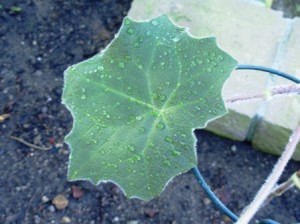
At right: Senecio cristobalensis is another survivor from the Western Hills plant-shopping excursion in March, now given a special place in my front border. What pretty leaves! It’s supposed to reach 6-ft x 6-ft so I will eventually have to relocate this fuzzy-leafed beauty. This is one of those plants I once purchased from Heronswood (I just found the original plant tag from 2001!) that never wintered over in Seattle. See? I already have a new reason to be grateful for living in Zone 10~
I don’t have all the answers, but I’ve been pondering on how to get out of my rut. And the answer is staring me right in the eye. I need to return to the garden. The one that I see if I lift my eyes away from the computer screen and look through the slats of the shutters. Sometimes we have to start moving forward even before we know the path. “Putting wheels on it,” is how my friend Stephanie would describe it. Moving anywhere is better than staying put. There’s a lot of safety at this keyboard. But I don’t want to be just an observer of other people’s gardens, homes, plants and collections. I need to have my own relationship with the land, the plants, and the wildlife that occupy my suburban backyard. I’ll say it again: I need to return to the garden.
 Today, I did just that. And while I’m in no position to write a garden mission statement, I do have a simple goal (dare I say Resolution?) for myself. And that is to spend 1 hour a day, at least 5 days a week, in the garden. Lord knows, I waste that much time reading emails each day. I think there’s a much better use of my physical and mental energy – and that’s to get outdoors and garden.
I don’t have money to hire a landscaper to do all the things I dream of accomplishing here, but my investment of time and attention is bound to improve my environment. It’s bound to improve my emotional attitude about this place. I’ll try and use this blog to document my progress.
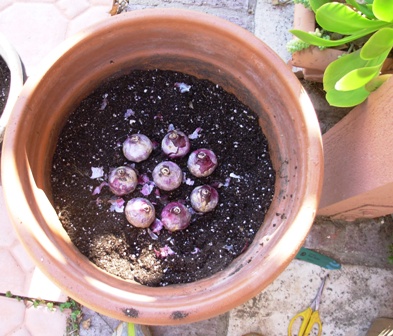
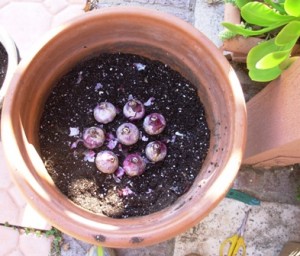
Above: I guess any month of the year is bulb-season here in LA. It’s just that my bulbs will have to be annuals. That’s something I will have to get used to, after investing in and planting hundreds of spring flowering bulbs back in Seattle. The hyacinths, narcissus, tulips and muscari I planted today were a surprise gift from Brent and Becky Heath. The box filled with 70 bulbs arrived a few weeks ago ~ what a treat! I planted layers of bulbs in 2 terracotta pots this afternoon. Then I sprinkled annual seeds on top of each (dwarf cosmos on one; nigella on the other). Who knows if you can pair annuals with bulbs? It’s worth a try! This is my chance to experiment, so stay tuned!
And Happy New Year to all of you. Let’s cherish what we have!
Posted in Creativity, Gardening, General, Plants, Spiritual Practices, Writing | 6 Comments »
December 30th, 2008
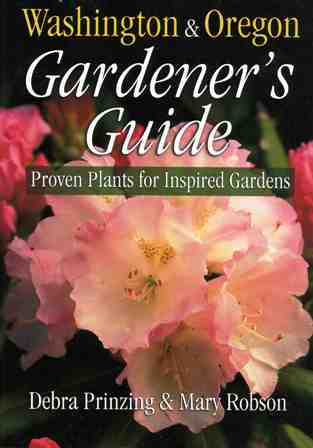
 In early 2005, Cool Springs Press published the Washington & Oregon Gardener’s Guide, a book I co-authored with the wise and gifted garden writer Mary Robson. We combined our talents to share years of garden experience to help readers plan, plant, and maintain a beautiful and healthy garden.
The book is filled with our personal recommendations of plants that thrive in the Northwest, presented in a concise, helpful format. The major challenge of writing WOGG, as we called it, was to limit ourselves to 186 individual plant selections, from annuals to vines. No gardener wants to be told she has to “choose” a finite plant list!
 Our fabulous publicist, Lola Honeybone, who now runs Media Workshop, a Nashville-based book PR shop, suggested that Mary (shown at left) and I develop a lecture to accompany our book-signings and appearances. She dreamed up the title “Seven Habits of a Highly Successful Gardener.” Lola’s clever angle brought Mary and me together for a 2005 lecture at the Northwest Flower & Garden Show in Seattle. It was so much fun to plan this talk knowing Mary and I would have a friendly give-and-take as we walked the audience through our Seven Tips.
Later, our friend Richard Turner, editor of Pacific Horticulture, asked us to turn the lecture into an article. Here is the article, from the journal’s Winter 2006 issue. It seems appropriate to share this as we approach 2009 – and I encourage you to adapt these tips for your own New Year in the Garden:
Seven Habits of a Highly Successful Gardener
 Gardeners in the west enjoy the unique luxury of living with few rules about what’s right or wrong in the way we grow our plants. We appreciate and adapt to our garden’s cultural conditions. We are overwhelmed with a seemingly endless selection of excellent, healthy and suitable trees, shrubs, perennials, annuals, vines, bulbs and ground covers from which to choose for our landscapes.
In the Pacific Northwest [my former home], we’re particularly lucky to have temperate conditions where it’s not too hot – and not too cold. This welcoming, plant-friendly climate bestows added blessings. Imagine how hard it was for us to compile a regional gardening book and limit ourselves to only 186 great plants!
Perhaps the horticultural excesses in our lives call for a little discipline. Certainly, we want to be good stewards of our gardens, both to ensure our immediate enjoyment and the long-term health of the plants and places we tend.
So, with apologies to the original “7 Habits” author Steven R. Covey, we offer the following Seven Habits of a Highly Successful Gardener:
READ MORE…
Posted in Creativity, Gardening, Plants, Playfulness, Spiritual Practices, Writing | 9 Comments »
December 21st, 2008
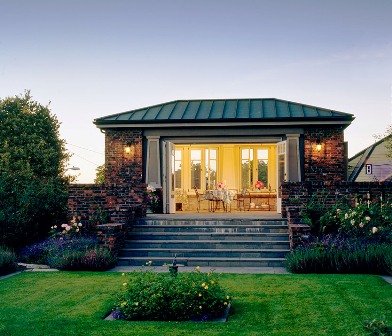
A modern-day dining pavilion, rooted in history [William Wright photograph]
This stately dining pavilion is the setting for the best garden parties. Start with impromptu dinner invitations for a few friends, add a bottle of wine, ripe tomatoes and bunches of basil harvested fresh from the garden. Joan Enticknap’s al fresco destination infuses her events with a carefree spirit. After dinner, guests usually wander off and enjoy her garden.
Bill Wright and I were fortunate enough to discover, write about and photograph Joan’s dining pavilion in 2002. She also owns the charming potting shed that graces the cover of our book, Stylish Sheds and Elegant Hideaways, photographed by Bill.
For Joan, a rare double city lot accommodated the construction of a two-car garage at street level. Above it sits her 12-by-22 foot, freestanding dining pavilion.
Designed by Seattle-based Bader Architecture, the inviting structure is connected to her restored 1914 home by a stone terrace. The architects incorporated accordion-fold glass doors across the pavilion’s width, linking it to an herb- and rose-filled garden beyond.
“The open doors allow Joan’s parties to spill out into the garden,” says principal Gregory Bader. Shutters cover 16 pair of windows, each of which opens via tilting or swinging hinges. The windows reinforce the perspective that overlooks the street-scape below and territorial views to the north. In fact, the building is situated perfectly to shelter Joan’s garden from northern winds.
 Project architects Dan Umbach and Andy Salkin drew from local carriage houses and English conservatory influences to create the pavilion. “We loved the orangery at Kensington Palace in England and this really comes from that tradition,” Bader says.
Wanting her garage and pavilion to echo the home’s origins, Joan instigated an extensive search for vintage clinker brick.
“I placed ads in (local) newspapers and eventually found a fellow who had saved clinker brick from a Craftsman bungalow.” Seven thousand bricks, combined with the passion of a talented stonemason, constructed the carriage house-inspired pavilion.
When the weather is warm, Joan slides open the pavilion doors and encourages her guests to enjoy seating on the blue stone patio. A wide staircase descends into the fragrant garden below. And that’s when a wonderful meal and beautiful landscape conspire with the senses to lure the party outdoors, any time of day.
A version of this story originally appeared in Seattle Homes and Lifestyles, with text by me and photographs by Bill.
Read further to learn more about The Orangery or L’Orangerie, a new addition to the Shed Glossary.
Posted in Architecture, Creativity, Shed Glossary, Sheds & Havens | 5 Comments »
© Debra Prinzing, all written and photographic content. Website design/development by Willo Bellwood/Metric Media