The Slow Flowers Podcast is the award-winning show known as the “Voice of the Slow Flowers Movement.” Launched in 2013 as the original flower podcast, we’ve devoted more than 10 years to covering the business of flower farming, floral design, and the Slow Flowers sustainability ethos. Listen to a new episode each Wednesday, available for free download here at slowflowerspodcast.com or on iTunes, Spotify, and other podcast platforms.
June 4th, 2009

hydrangeas and roses - straight from my garden in 2006
Here’s what you need to know when ordering flowers online or over the telephone.
Earlier today, I joined Jennifer Litwin, host of “The Shop Cop,” a national consumer advocacy program that airs live every Thursday at 10 a.m. Pacific on Voice America Radio.
We discussed ways that consumers can make the most of their long-distance flower purchases, including my tips on avoiding ripoffs, poor-quality product and bad service.
Here’s a link to the 15-minute segment.
Some of the recommendations I shared with Jennifer’s listeners include:
Check local rants and raves on Yelp, the consumer review site (search “flower shops” by city). Find a certified floral designer in your city or in the city where you wish to send flowers at the American Institute of Floral Designers.
Posted in Creativity, floral design | 1 Comment »
June 2nd, 2009
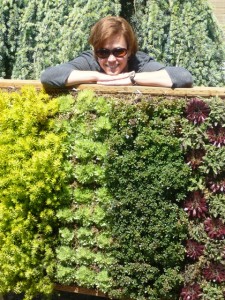
Carina Langstraat's delicious planted wall
Green walls are the hot, new, must-have landscape design element. The Europeans were the first to figure out how to engineer large-scale planted walls, inspiring some innovative American designers to follow with their own twist. From my research, most are here on the West Coast, natch.
My friend Flora Grubb in San Francisco has received quite a bit of press for her avant-garde planted wall tapestries that incorporate everything from succulents to air plants (Tillandsias).
And recently, the Los Angeles Times featured green wall designs using edibles (by Go Green Gardeners’ Anne Phillips) and California native plants + succulents embedded with LED lighting (by L.A. artist Michel Horvat).
HOW DID THIS TREND GET STARTED?
Garden writers have been describing “vertical elements” in the landscape for years. Traditionally, this idea involved arbors, trellises, fences and other structures upon which vines and climbing plants are trained. An explosion of interest in “green” planted roofs – including here in Los Angeles – followed. Pamela Berstler and Marliee Kuhlmann, two cool LA designers, create planted succulent “sky-scapes” for their clients’ garden roofs. I’ve seen, touched, and admired their work – and I can tell you, a lush, foliage-strewn roof is a lot more snazzy (and eco-smart) than tile, composite or tar!
But privately, some designers have confided to me their concern about liability issues involved in engineering green roofs. Even when I wrote on this topic for the Los Angeles Times in 2007, the experts I quoted cautioned that roof structures should be designed with load-bearing supports to manage soil/planting medium, handling moisture, and just the sheer weight of plants.
So, it’s only natural that the planted wall is the next installment of “plants-as-architecture” – a trend that seems more achievable than a green roof. I love seeing how designers are “going vertical” with a planted foliage palette.
THE WALL AS A PLANTING CANVAS
One of my favorite designers, Seattle-based Carina Langstraat (who runs Langstraat-Wood Landscape Architecture & Design with her landscape architect partner Erik Wood), has recently engineered a 4-foot by 5-foot green wall prototype at her Ballard studio. She shared with me photos and tips on how she created the system. It’s exciting to think about the possibilities, whether you’re willing to play around with this concept on your own or if you want to hire a professional.
READ MORE…
Posted in Architecture, Creativity, Gardening, Landscape Design, Plants | 4 Comments »
May 29th, 2009
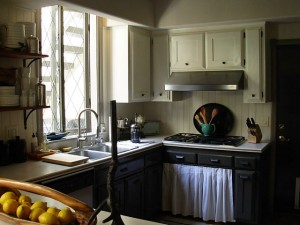
A peek at Scott and Kristan's $1000 kitchen renovation
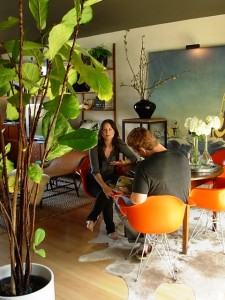
- Kristan Cunningham and her boyfriend Scott Jarrell hang out in their hip living room
For the full story about DIY star Kristan Cunningham’s clever re-do of her Venice canal district rental, read my profile in Saturday’s Los Angeles Times’ HOME section.
Kristan and her longtime boyfriend Scott Jarrell transformed a frumpy 1980s “faux French Chateau” into a cozy, lighthearted setting filled with a mix of DIY projects, vintage accessories and furnishings from big-box retailers. They use savvy and common-sense ideas to conjure a very livable – and affordable – design.
Posted in Architecture, Creativity, Furniture design, interior design | 2 Comments »
May 24th, 2009
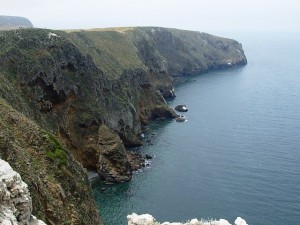
A view down the rocky coast of Santa Cruz Island
This won’t be a long post because it has been a long day. But I have some images to share from today’s field trip to Santa Cruz Island, which is part of a string of eight small islands forming the Channel Islands off the California coast (between Santa Barbara and Long Beach). Perhaps the most famous is the glamorous Catalina Island. But since I wanted to see nature and take a break from the freeways and noise, the remoteness of Santa Cruz was appealing.
My companion Paula Panich has ventured to Santa Cruz twice before by herself. She suggested a day trip over the holiday weekend and we both arranged to be away from our families for a good part of the day. It started by booking our passage through a commercial boating company called Island Packers. We each spent $48 for the round-trip journey. The boat left the Oxnard Harbor at 9 a.m. We boarded and sat up on the top deck, along with other pleasure-seekers, cameras and small video recorders around their necks. No one was disappointed by the 90-minute crossing, thanks to a playful performance from dolphins, including several that seemed to want to “surf” in the boat’s wake.
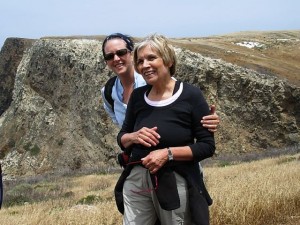
With my friend Paula, on the trail
Paula had prepped me for this trip, helping dictate a list of what I should bring: 2 bottles of water; 2 bottles of Gatorade; a fanny pack and a backpack; nuts and dried fruit; a hat and sunscreen; polar fleece and a rain jacket; hiking shoes. I added my fav hiking food – hard cheddar cheese and salami, along with crackers.
The thing is, Santa Cruz is one of four northern islands that make up the Channel Islands National Park. The only amenities on this rocky, isolated destination are a few port-a-potties and potable water. You can plan ahead to camp or kayak here but everything you bring in . . . you must pack out.
We got off the boat at 10:30 a.m. and checked our watches: Four Hours. Before hiking, we wandered through the historic displays that covered Santa Cruz’s background dating to the first indication of human life there 2,000 years ago. Those humans were probably the ancestors of our local Chumash Indian tribe. European settlers had their moment in time here, too, unfortunately. This island was home to sheep, cattle and pig ranching over the years. Paula and I kept asking ourselves: Who would transport livestock to this island to “farm” when there was still a ton of good, undeveloped property on the mainland a century ago? Ridiculous.
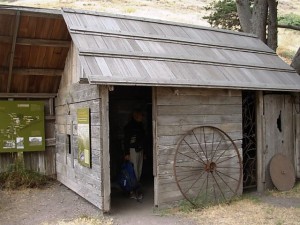
The restored black smith shed
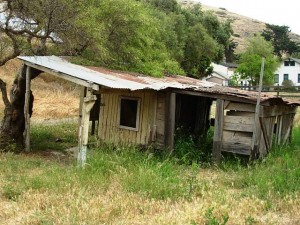
A relic of undetermined provenance
But, of course, we were tickled to see the remains of a few “sheds.”
There you go. Sheds are everywhere.
The natural beauty of Santa Cruz, though, made everything man made look uninspired. The terrain blew our minds. I kept saying: “It’s otherworldly.” Finally, Paula said it reminded her of Iceland, an otherworldly place she visited last October. When we hiked up to a bluff overlooking the Pacific Ocean to the southwest and the Santa Barbara Channel to the northeast, I was struck by how varied the geography is here.
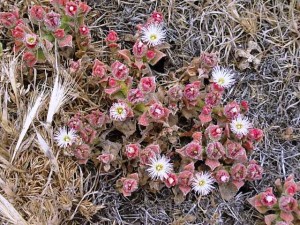
This blooming pinkish succulent carpeted the earth
On land, it’s desolate, dry and hilly (the livestock ate most of the native vegetation, but there are efforts to reintroduce native plant species). On the perimeter, it’s rugged, weather beaten and dramatic, where the sheer face of the island exposes itself to the sea.
Here’s a paragraph from the National Parks brochure we picked up:
Santa Cruz Island: Here are pristine beaches, rugged mountains, lonely canyons, grass-covered hills, and some animals and plants that you have never seen before. This paradise is Santa Cruz Island, a miniature of what southern California looked like more than 100 years ago. The largest island in the national park, with 61,972 acres, Santa Cruz is 22 miles long and from two to six miles wide. A central valley splits the island along the Santa Cruz Island fault, with volcanic rock on the north and older sedimentary rock on the south. Today, the Nature Conservancy and National Park Service preserve and protect the island.
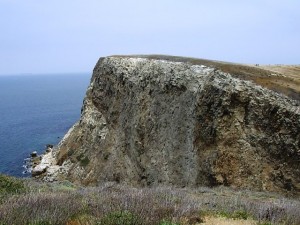
Rocky outcroppings, perhaps formed in an earlier millennia
We spent most of our time just staring at the rock formations and speculating about what force of nature had shaped them in which millennium. The trails were narrow, single-file style, and perilously close to the edge of cliffs and bluffs. But we felt more exhilarated than frightened.
Our clock wound down to 2:30 p.m. and we had to make our way back to the pier to re-board the return boat. This morning, I worried about what on earth we would do to fill 4 hours on an island, one with no tree cover, few places to sit but on the ground, and lonely views of water and rock all around us. But breathtaking scenery, good conversation with a close friend, a zip-lock bag filled with nuts and dried fruit, a few cheese-and-salami bites and – wow – time flies.
I can’t wait to schedule a return visit. Just think, only 30 minutes away from home is the boat that will bring me back to the wild place called Santa Cruz.
Posted in Creativity, General, Plants, Shed Glossary, Sheds & Havens | 3 Comments »
May 23rd, 2009
In preparing for a phone interview with prolific, bestselling author Amy Stewart to discuss her new book, Wicked Plants: The Weed that Killed Lincoln’s Mother & Other Botanical Atrocities, I came across a dog-eared manila folder in my office file drawer. Its label read “Emery’s Garden Monkshood.”
”]
![Autumn Monkshood - beautiful and poisonous [photo from Valleybrook Gardens Ltd.]](https://www.slowflowerspodcast.com/wp-content/uploads/2009/05/aconitum-150x150.jpg "aconitum")
And immediately, I recalled my own brush with a “Wicked Plant.” Before sharing my Q&A with Amy, I will indulge in the tale of Autumn Monkshood, aka
Aconitum carmichaelii ‘Arendsii’.
In the late 1990s, I worked for a wonderful specialty nursery in Lynnwood, Washington, called Emery’s Garden. I had recently left business writing and a nonprofit communications gig to embark on my “garden writer” journey. Lucky for me, the people at Emery’s took me in and our relationship there flourished. I wrote and edited “The Weedy Reader,” our quarterly newsletter. I planned and produced our educational program and special events. I basically learned the horticulture business, thanks to Emery Rhodes, Marlis Korber and Amy Tullis.
After I left Emery’s in 2000 (that’s when I joined the team of The Herald’s “Home & Garden” section in nearby Everett), I stayed in close touch with my Emery’s pals. One day, in April 2001, I received a panicked phone call from Marlis, the nursery’s general manager.
Turns out, a customer purchasing perennials pointed out some odd tags on the 6-inch containers of Monkshood (Aconitum). The tag read: “All parts of this plant are tasty in soup.” The shopper had filled one of Emery’s carts with her two toddlers and three pots of the mislabeled (and wicked) perennial. “I thought this stuff was poisonous,” she said to our sales associate. “But this label says it’s edible.”

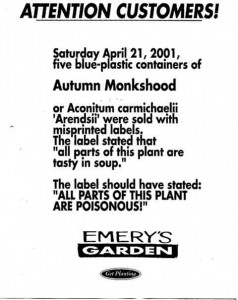 Needless to say, a check in Sunset Western Garden Book revealed the exact opposite to be true. Under “Aconitum,” Sunset warns: “All parts are poisonous if ingested.”
What resulted was a mini-international scandal and media frenzy. The common Monkshood, which is a beautiful, tall violet-blue ingredient in the cottage border, is NOT a tasty ingredient for soup or stews. Instead, it’s lethal.
The ensuing drama played out as you might expect. I got to play the role of Crisis-PR consultant while Emery’s pulled all the mislabeled plants, contacted the grower (a Canadian nursery), and soon discovered that the label mishap had been a stupid prank pulled by one of the grower’s employees! Within 48 hours, we were visited by the FDA; the Canadian authorities got involved; the plant recall went out over the wires; television, radio and print outlets picked up on the story and came to report on the scare.
In the end, it was a bit of a wake up call for Emery’s (and possibly other local nurseries) about the importance of using proper signage and labeling of toxic ornamental and landscaping plants. But I wonder, did anything really change? It certainly elevated consciousness at one nursery, at least for one season.
 Now, however, with the advent of Wicked Plants, the evils of ingesting the flowers, stems or leaves of Aconitum are coming back to haunt me. The perennial is, in fact, the very first entry of Amy Stewart’s charming and horrifying new effort, published earlier this month. Amy writes:
In 1856 a dinner party in the Scottish village of Dingwall came to a horrible end. A servant had been sent outside to dig up horseradish, but instead he uprooted aconinte, also called monkshood. The cook, failing to recognize that she had been handed the wrong ingredient, grated it into a sauce for the roast and promptly killed two priests who were guests at the dinner. Other guests were sickened but survived.
Her scary narrative explains where the perennial grows and what to look out for (gardeners should wear gloves anytime they go near aconitum, Amy advises). The page is labeled “Deadly.”
Wicked Plants, is a compendium of horrifying stories and historical facts of the botanical world. If you have any question as to the deadly, illegal, intoxicating, dangerous, destructive, painful and offensive traits of the trees, shrubs, perennials and herbs growing on our planet, you’ll want to peruse this powerful little volume.
Between the pages of Amy’s 5-3/4 x 7-1/4 inch, 235-page book, which is bound in the same sickly green worn on the face of the witch Elphaba in the musical “Wicked,” are tales of death, destruction, war and more. I recently had a chance to chat by phone with Amy, and here is part of our conversation:
READ MORE…
Posted in Book reviews, Creativity, Gardening, General, Plants, Writing | 3 Comments »
May 18th, 2009
-

-
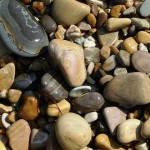
pebbles fill my shoes
-
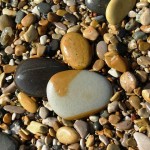
-
more patterns
-
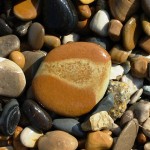
-
nature’s patterns
-
-
more pebbles and stones
-

-
pebbles and stones
-
-
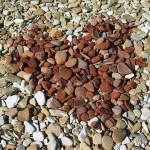
tumbled and worn, a red stone heart
For those of you who have known me for a l-o-n-g time, or even for ones who only occasionally stumble upon Shedstyle.com, it may be evident that I am torn between desperately missing Seattle, my home for most of the past 30 years, and embracing life in Southern California, where I’ve been living nearly 3 years now.
I’m learning that there is incredible beauty here in SoCal, especially if one gets off of the freeways and out into the raw, rugged nature. The same attributes that make me love the Pacific Northwest – the mountains, the ocean, the amazing plant life – are some of the ones that have made me begin to appreciate, value and (possibly) love my new home.
Yesterday was no exception. I slogged through 70 miles of freeway traffic on a mid-Sunday (which took 1 hour and 45 minutes, thank goodness for Prairie Home Companion or it would have been a lot worse!) to a place high above the ocean called Rancho Palos Verdes. When it comes to offering endless views of the Pacific shoreline, coastal beaches and blue ocean, it’s as breathtakingly gorgeous of a place as the more popular Malibu. Except, it seemed to me yesterday, with way less traffic and commercial development.
I met up with architect Ron Radziner of Marmol-Radziner, a Venice, Calif.-based architectural firm (which also has landscape architecture, interior design, furniture design and prefabricated design in its portfolio) to tour one of his projects. The property is called Altamira Ranch and the American Society of Landscape Architects recognized it with a residential design honor award in 2008. My interview with Ron about the project will appear in a future issue of Landscape Architecture magazine. Suffice it to say that the approximately three sweeping acres of California native plants, surrounding a contemporary residence (also designed by Marmol-Radziner) is a study in excellent design. It is lesson that Bud Merrill, my former garden design instructor, would have so loved. He preached the gospel of “environmentally responsive design” – and I tell you, this project – home and landscape – makes huge strides in that practice of only “lightly touching” the earth. Stay tuned for the full story.
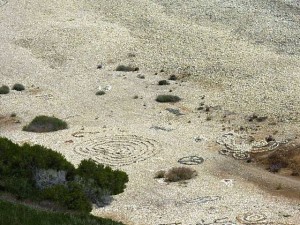
The alluring labyrinth patterns are visible from high above the beach
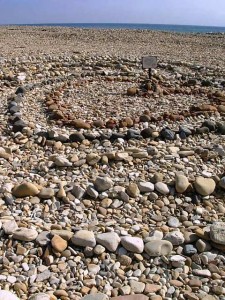
The stone design, made by unknown hands
After Ron and I finished the interview, Julie, the owners’ personal assistant, offered to walk the property with me.
She is a wealth of knowledge about native plants and how they perform in a residential setting – especially this tricky coastal site that is exposed to high winds, intense sun, frequent blankets of fog, and saltwater.
We paused at the edge of the bluff and looked down at the beach, which was probably 200 feet below us.
Julie pointed out the stone labyrinths that beachcombers have placed on the shore and she told me where to park so I could walk down to see them (she also suggested where I could grab some lunch; ironically, it was at the grill where golfers eat when they’re finished playing the greens at the Trump International Golf Club).
I hiked down to the beach and made my way across the uneven, rocky surface. It isn’t one of those “take off your shoes and stroll barefoot” kind of beaches. My shoes kept filling up with pebbles, but I couldn’t imagine going bare. The wind was brisk, which you’ll notice in the poor sound of the two short movies I shot. How else do you show the experience of a labyrinth without a moving picture?
At the Beach with Deb:
httpv://www.youtube.com/watch?v=BKYt9OW2iQE
Walking the Heart-shaped Labyrinth:
httpv://www.youtube.com/watch?v=HSxQm4iv_GA
Here’s my takeaway from yesterday’s unexpected hour on the beach: I was given yet another gift of California’s natural beauty. It was a vivid reminder that I am here for a reason. I am still discovering the reason(s), but isn’t having a chance to drink in this beach, collect a few of these stones and witness the creative way artistic humans have responded to them reason enough?
Posted in Creativity, General, Landscape Design, Playfulness, Shed Glossary, Spiritual Practices | 6 Comments »
© Debra Prinzing, all written and photographic content. Website design/development by Willo Bellwood/Metric Media