May 12th, 2011
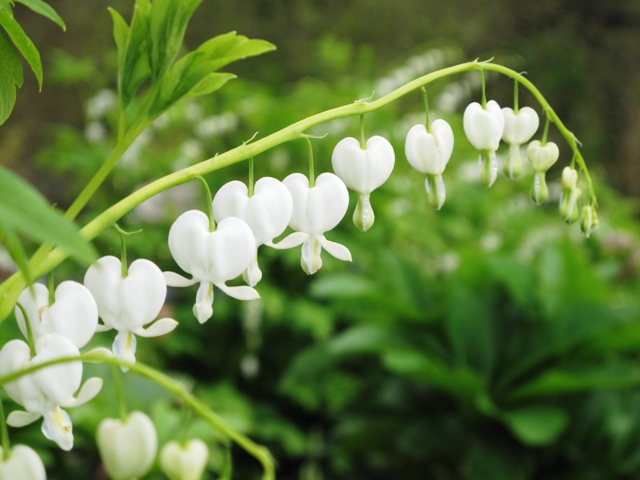
Sigh. What else can you say in response to these gorgeous, white bleeding hearts?
Well, this field trip was LAST Friday, but you’ll enjoy my photos all the same. If you don’t know about the July 22-25th Garden Bloggers Seattle Fling, then check it out here.
My pals Lorene, Marty and Mary Ann and I were persuaded to “host” this horticultural free-for-all that can be best decribed as a weekend of garden touring and networking for bloggers around the globe.
Lorene and I headed out last Friday to scout a couple amazing residential gardens that we want to include on the tour, as well as the Bellevue Botanical Garden. It’s truly still spring here in Seattle; I’ve been away for four years, living and gardening in Zone 10-+, but I don’t remember this persistent rain, wet, gray, chilliness as late as mid-May. So when you see the photos I took on May 6th, you might be surprised! They look very April-ish, don’t they?
Even still, it was exhilarating to have a glimpse of the soon-to-arrive “season” of blooming and unfurling. Please enjoy along with me:
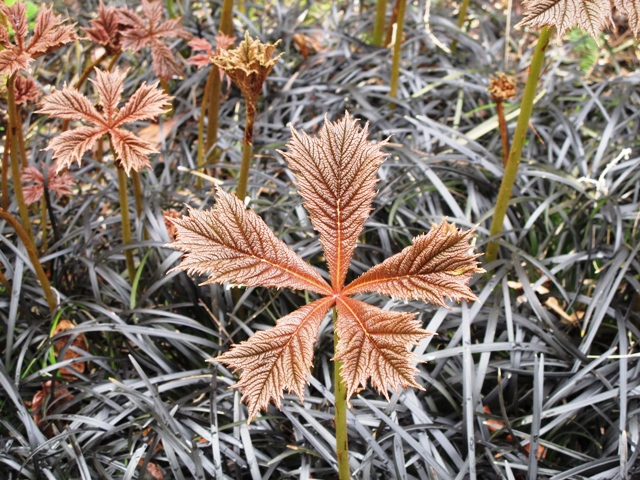
What a sultry combo, spotted at Michelle and Christopher Epping's garden in Newcastle. This will be a stop on the Bloggers' Fling. Yummy Rodgersia + sooty-black Mondo grass.
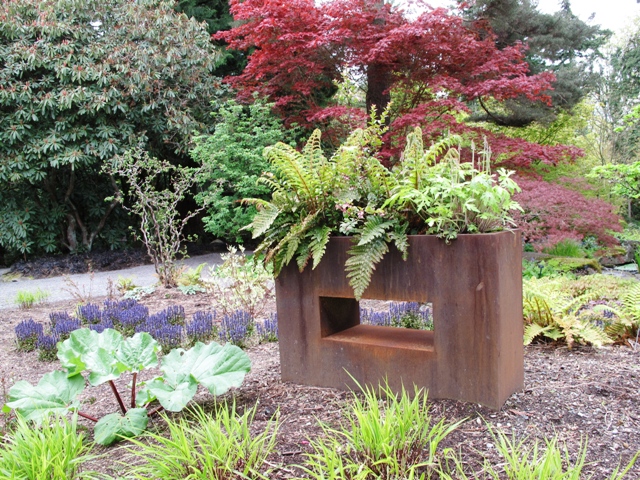
I love this modern, see-through, cube-planter at BBG. I want one, preferably in this gorgeous weathered steel.

More steel, this time in an orb, suitably displayed in a bed of tumbled riverrock.

Stone totems paired with grasses create a lovely entrance at the Bellevue Botanical Garden.
Posted in Creativity, Gardening, General, Landscape Design, Plants | 4 Comments »
May 7th, 2011
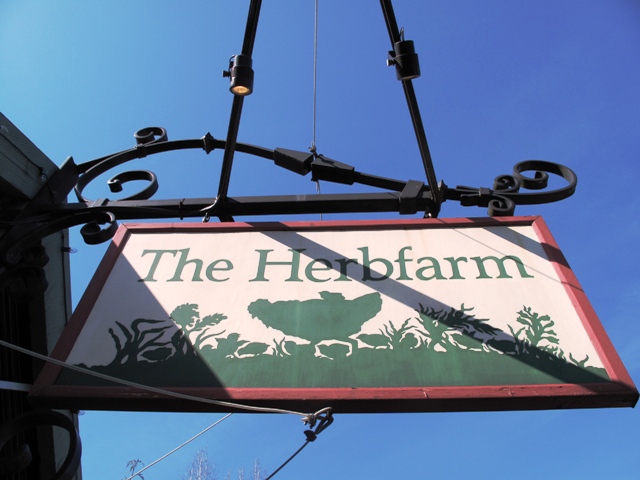
The Herbfarm Restaurant
Last weekend I was a guest at The Herbfarm, the only AAA 5-Diamond restaurant west of Chicago and north of San Francisco, rated number 1 in the Pacific Northwest for both food and service by the Zagat Guide.
Dining there is a true “culinary experience” that draws food aficionados from around the world. I’ve been fortunate enough to eat at The Herbfarm Restaurant on three prior occasions dating back to 1995 when I dragged Bruce there to celebrate his appointment as Seattle’s deputy mayor. Our friends Jenny Ulum and Tim Gleason actually flew to Seattle from Eugene, Oregon, in order to join us at that meal.
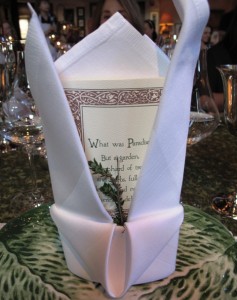
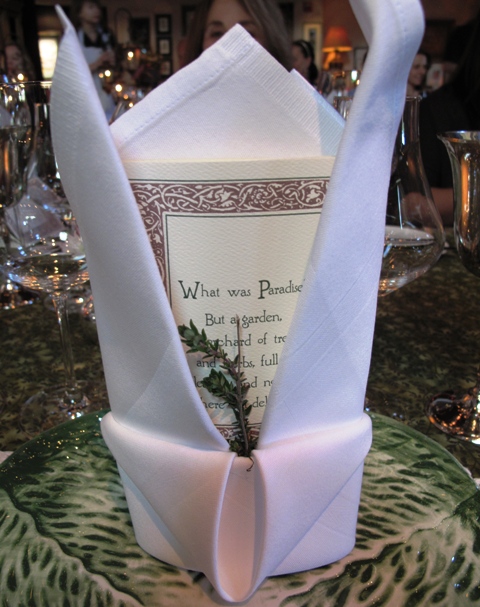
The menu cover reads: "What was Paradise? But a garden. . . "
The Herbfarm Restaurant proprietors Carrie Van Dyck and Ron Zimmerman hosted fellow writer Robyn Cannon and me for an unforgettable meal last Sunday evening. We’re talking a four-and-a-half-hour, nine-course extravaganza that celebrates locally grown ingredients prepared with innovation and ingenuity. I say unforgettable, in that years after an evening at The Herbfarm, one can instantly recall tasting (perhaps for the very first time) a specific dish or uncommon ingredient. Oh, and did I mention that each course is paired with a Northwest libation selected by Sommelier Tysan Dutta? The wines are chosen to complement and enhance every bite.
The Herbfarm’s history is long and not without drama (including a fire that destroyed the original Herbfarm location in Fall City, Washington, that was started by Ron’s parents in 1974 as a small nursery, followed by challenges trying to gain permission to rebuild).
I have such fond memories of the old-timey Herbfarm. When my oldest son Benjamin was little, I used to take him out there to see the herb garden and a few farm animals. We still have the lavender-filled stuffed bunny rabbit, which we found in the gift shop. Those expeditions usually involved bringing along another mom and child to have a picnic in the herb garden.
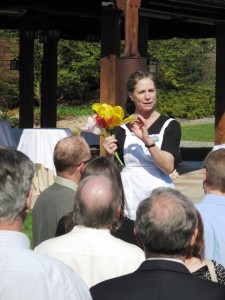
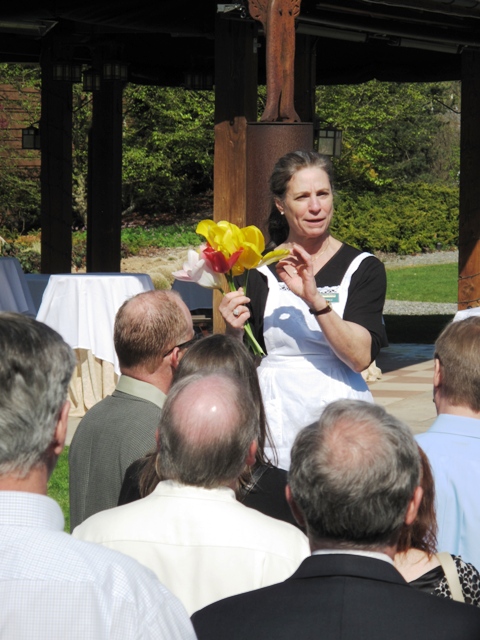
Carrie Van Dyck begins each meal with a tour of the garden.
The Herbfarm Restaurant’s current location in Woodinville dates back to 2001 when Ron and Carrie had to pick up and move the entire restaurant. They constructed a charming English-Tudor style cottage that houses antiques, a vintage fireplace, and tables that overlook the kitchen-as-theatre all night long.
Robyn and I were staying at the adjacent Willows Lodge where we attended the Pacific Northwest Travel Writers Conference. And that’s how we ended up sneaking out of the proceedings late Sunday afternoon to join Carrie as she hosted the pre-dinner tour. The Herbfarm and Willows Lodge share a vegetable and herb garden where raised beds and clipped boxwood balls are interconnected by crunchy hazelnut shelled pathways.
Carrie picked and passed around some of the edible ingredients that diners might expect to taste that evening — tulip petals, sweet cicely, sorrell, lovage, thyme, fennel and lemon verbena. We stopped to visit the resident pair of Vietnamese potbelly pigs named Basil and Borage, who reside in a pen next to the composting area. That seems appropriate, doesn’t it?
Once we followed Carrie indoors and were seated for dinner, Ron took the stage to explain a bit more about the menu development. The Herbfarm creates 26 different themed menus each year, based on the seasonal availability of ingredients and the culinary whims of the chef Chris Weber and his team. By the way, Chef Chris is one of the youngest 5-star chefs in the country. Possibly THE youngest. What a talent!
READ MORE…
Posted in Creativity, Entertainment, Gardening, General, Playfulness, Writing | 2 Comments »
April 29th, 2011
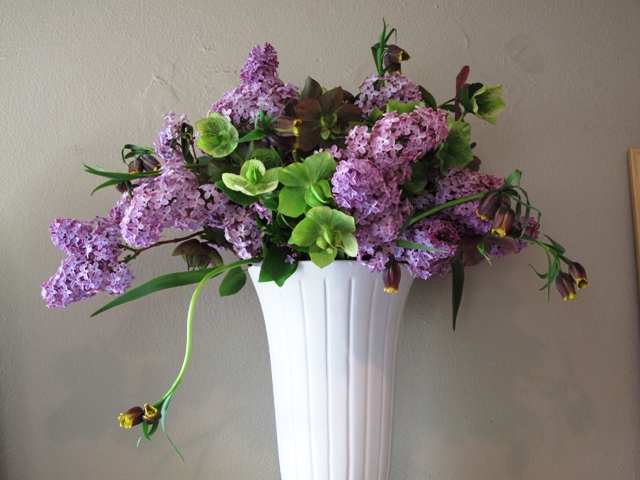
A yummy spring bouquet - straight from local farms and fields
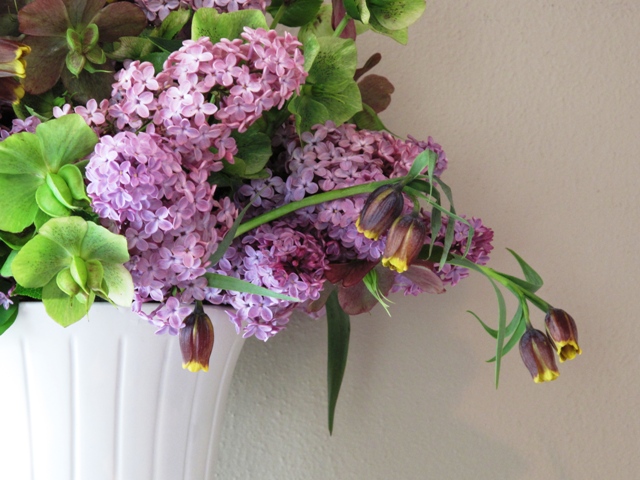
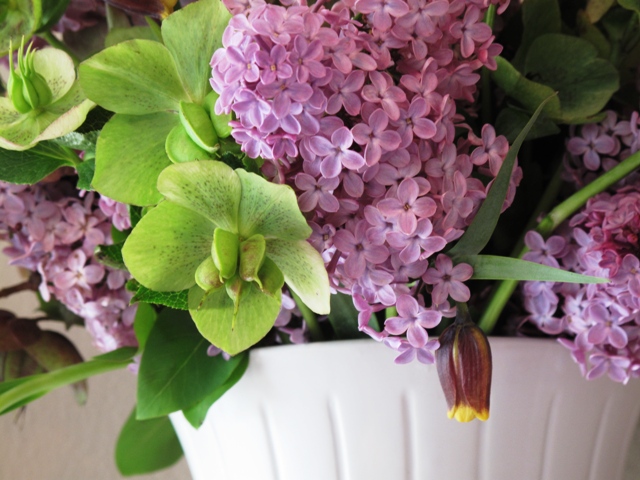
Springtime is embodied in this vase, isn’t it?
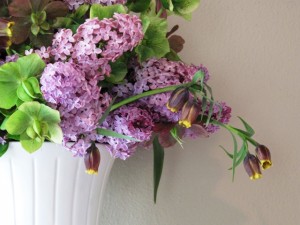
Take a visual "whiff" and enjoy this combination of three lovely flowers.
You can almost smell that heady perfume associated with Syringa vulgaris, or the common lilac. To me, the fragrance is associated with my lifelong relationship with flowers.
We lived in rental house in Connecticut when I was in elementary school; the backyard was home to an overgrown lilac that drew me to its blossoms (we loved playing underneath the flower-laden branches and smelling spring).
Later, when I was a teenager, I remember secretly harvesting armloads at a city park and carrying them to school in May, as if I was in a pageant!
When we planted our former Seattle garden in the late 1990s, I asked my friend Karen to select a lilac for the border. She chose one called ‘Sensation’ – it has deep purple florets and each petal is rimmed in white. That shrub never disappointed. . . and I waited for its blooms each year until we moved away.
And most recently, while living in Southern California, I nearly fainted when I happened upon a lilac farmer at my local market. I was so fascinated to learn lilacs can grow there at a high elevations, such as in Lancaster, Calif., north of LA. I even had to run back to my car for my camera so I could interview her about those unforgettable flowers.
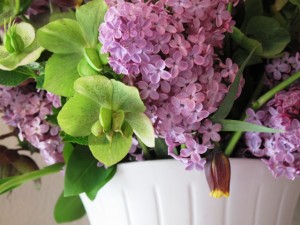
Another closeup - I can't resist!
Today’s bouquet features the addition of several Jadeite-green garden hellebores and a few sultry plum-and-yellow Fritillaria assyriaca. These companions turn two bunches of just-cut lilacs into a sweet bouquet for my fireplace mantel.
And the best thing about these blooms? They’re from local Northwest flower farmers – yeah!
The lilacs were grown by Oregon Coastal Flowers in Tillamook, Ore.
The hellebores were grown by Jello Mold Farm in Mt. Vernon, Wash.
The fritillarias were grown by Choice Bulb Farms in Mt. Vernon, Wash. Check out David Perry’s gorgeous still life of this unusual flower at our blog, A Fresh Bouquet.
If you’re a floral, event or wedding designer, be sure to meet these fabulous farmers at Seattle Wholesale Growers Market. If you’re a customer, be sure to ask your designer to patronize this amazing cooperative of local growers. Their motto is awesome: From Farm to Florist.
Here’s a link to a little post and gallery from my visit earlier this week.
Posted in Creativity, floral design, General, Plants | 4 Comments »
April 3rd, 2011
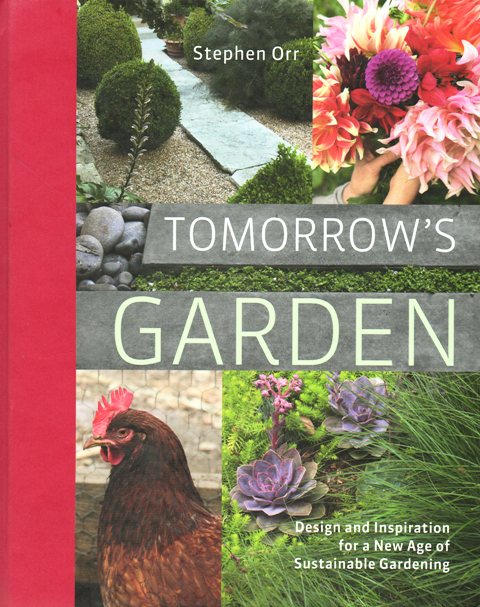
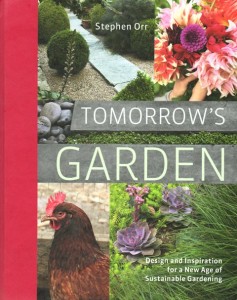 A few weeks ago I had a phone date with Stephen Orr, the guy who has held all the jobs I’d love to have: Garden Editor for House & Garden magazine; Garden Editor for Domino magazine . . . and now, garden editorial director for Martha Stewart Living magazine.
He is one of the friendliest and most genuine individuals I’ve ever had the pleasure to meet in the magazine world. It was a treat for me to interview Stephen about the publication of Tomorrow’s Garden, his first book. I’ve met Stephen in person a few times, both in Los Angeles at a Garden Conservancy symposium, and in San Francisco when I spoke at Flora Grubb Nursery after Stylish Sheds and Elegant Hideaways, my own book, was published. We garden writers really do live in a small world!
Thanks to Craig Nakano, my editor at the Los Angeles Times HOME section, for agreeing to feature my Q&A with Stephen.
You can click here for the full story. And click here for a web gallery of Stephen’s photography that accompanies his book. Here is an excerpt of my interview with Stephen:
“People don’t think much about where gravel comes from as a resource,” Orr said, yet gravel gardens are becoming increasingly popular. His book features gravel landscapes from Venice and Ojai to Austin, Texas, to Nantucket, Mass. We asked him to discuss gravel as a sustainable design material:
What appeals to you about the use of gravel?
It is such a great base for many styles, from traditional to modern. There are plenty of people in Los Angeles and San Francisco who have jumped on the bandwagon wanting to make low-water gardens, but I’m happy to see it catching on in other parts of the country. The California lifestyle is so amazing, with outdoor rooms, and they can be “floored” differently. One room could be floored with grass, another with stone pavers or gravel.
Designers praise gravel gardens as permeable and an alternative to lawns. How has your view of the material changed?
I was visiting nursery owner Flora Grubb in San Francisco, and she told me she often recommends gravel to customers. And then the question “Where does it come from?” came up. Our conversation opened my eyes to begin viewing gravel as a finite resource.
Where does it come from?
As with so many environmental choices, the decisions we make trying to do the right thing are complex and often somewhat overwhelming. In many cases, gravel does indeed come from local quarries. The Austin gardens in my book used local gravel. Those gardeners like how it matches the colors of the natural geology around them. But in other areas, its origin is a big question mark. Even after a lot of research, I found I still have a lot of questions about how responsibly gravel is mined. The EPA monitors gravel production, which is a huge industry mainly for construction and highway building. In comparison, gravel for gardening use is minor, but it’s still something to be conscious of.
What questions should homeowners be asking about the gravel they buy?
I suggest you approach it like having a local consciousness of food. Don’t buy bags of gravel if you don’t know where it comes from. It may be shipped longer distances than is environmentally responsible. Try instead to source the material close to home.
What type of gravel do you recommend?
There is a difference between “crushed stone,” which has sharper edges, and “pea gravel,” which is rounded. Some people prefer walking on the rounded pea gravel, but consider the environmental impact it takes to extract it from ancient stream-beds formed by alluvial processes over millennia. Pea gravel isn’t a manufactured product. It’s not even a renewable resource. Many forward-thinking designers are switching to more jagged, crushed limestone or granite instead.
Any tips on how gravel should be installed?
One major thing I learned is that the depth of gravel is important. If it’s laid too deep, it’s like trudging through deep snow. Most of the designers I interviewed recommend you first put down a layer of “road base,” bigger pieces of crushed stone — an inch or two in length. Lay it very flat with a compactor and then place just a few inches of crushed gravel or pea gravel on top. This approach makes a very stable surface.
What are some of the interesting ways people use gravel?
I love the modern look of some of the gardens in my book. But I also really love gravel gardens with a more traditional influence where plants are encouraged to self-sow. I’m a plant nut. I come at gardening because I love plants. So to me, the space that contains the plant — the garden — is a frame to show them off. I love seeing volunteers like verbena or a spire of silver verbascum in the gravel. Or, I like to see gravel as the flooring for a spare space containing just a water feature.
Do you see gravel as the anti-lawn?
I like to see gravel and lawn used in combination. Just as a lot of us live without wall-to-wall carpet and instead have rugs with wood floors, I encourage people to think of their lawn as an area rug. Think about using it with an element of crushed rock, such as a flat area under a tree or where you need better drainage.
Posted in Book reviews, Creativity, Gardening, Landscape Design, Plants, Writing | 2 Comments »
March 30th, 2011
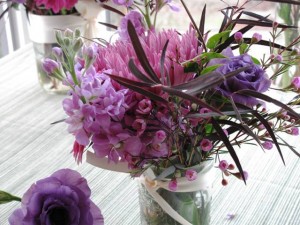
A spring bouquet in a Mason Jar inspires . . .
The other day, while talking with my friend Lorene (one of the most creative people I have known since we were college classmates together), I described some of the cool design ideas I’ve spotted in the past few weeks. My own enthusiasm for all this visual stimulation made me realize my “list” could be a blog post here.
After seeing these ideas in Seattle, Los Angeles and New York, my own idea-bank has been rekindled. Witnessing the talent of others doesn’t ever make me envious. No, it makes me want to up my own game and push myself further to do something wonderfully better as a writer, a gardener, a designer.
The type of inspiration I’ve seen lately has been truly exquisite. Great design is great design, whether in the garden, the home, or the restaurant. When you see it, you know it!
There may be no other response than to gaze in awe and say – WOW. But if your muse can be stirred or awakened by these ideas, by all means, use them as a starting point for your own artistic expression. I hope you enjoy where all this beauty takes you!
A TEENAGER WINS
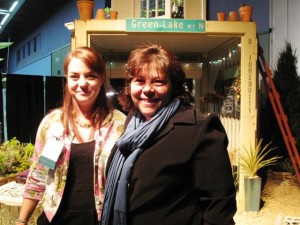
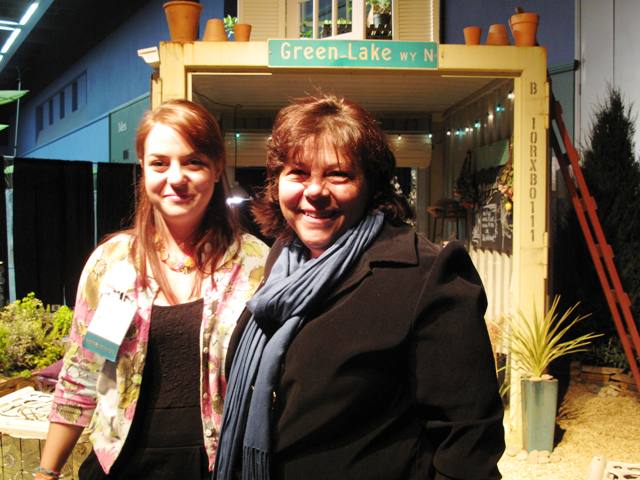
17-year-old garden designer Courtney Goetz won a Gold Medal at the Northwest Flower & Garden Show. Her mom, designer and writer Sue Goetz, is one of her influences.
At last month’s Northwest Flower & Garden Show, one of my most favorite annual events, I was invited by Julie Chai of Sunset Magazine to help “judge” the Sunset Outdoor Living Award.
We were smitten by a small but extremely innovative garden called “Paradise (to be) Regained . . . borrowing Thoreau,” which we honored with the Sunset award.
The critera recognizes a garden that exemplifies “fresh, useful and achievable ideas.” In this instance, the designer was 17-year-old Courtney Goetz.
Courtney, the daughter of garden designer and writer Sue Goetz, grew up in the garden-making business. In 2005, when she was 11, Courtney helped mom Sue design a display garden named “A Child of the Garden Grows . . . .” for this same show. Now, she has made a garden herself – and guess what? In addition to the Sunset Award, the show judges honored Courtney with a Gold Medal.
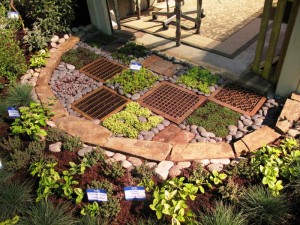
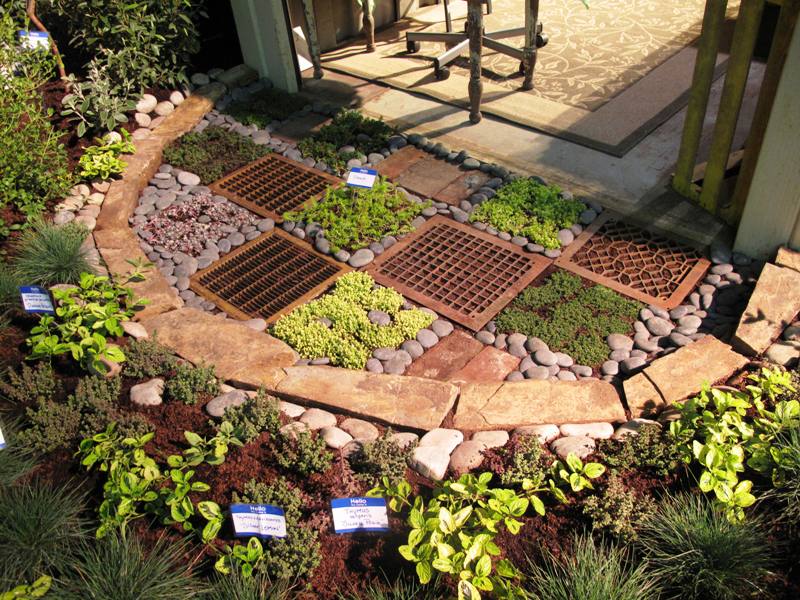
This half-circle garden floor treatment by Courtney Goetz shows how to pair salvaged metal grates with colorful groundcovers to create a "welcome mat" at the entry to a garden shelter.
As her Senior Thesis Project for Gig Harbor High School, Courtney wanted her design to be all about “recycling, re-purposing, and ‘re-characterizing’ used materials for use in the garden,” she says. “My goal and intent for this garden is to have green ideas for everyone to instill in their lives. I want the message to get out that not everyone can buy solar panels or hybrid cars, but anyone can and will make a difference by using a little bit less and utilizing what we already have.”
One of the many wonderful – and really clever — details of Courtney’s display garden was the checkerboard “floor” treatment, combining recycled metal grates with ground covers and rocks.
We loved this idea as a modern twist on a “welcome mat.” Courtney selected varieties of sedum and sempervivums in gold and dark green, as well as smooth rocks and the metal grates. It all adds up to a really gorgeous detail in the garden.
Look for exciting things to come from this young talent. We can’t wait to see more!
ROUGH AND SMOOTH TEXTURES
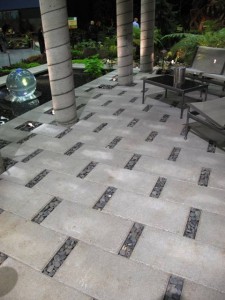
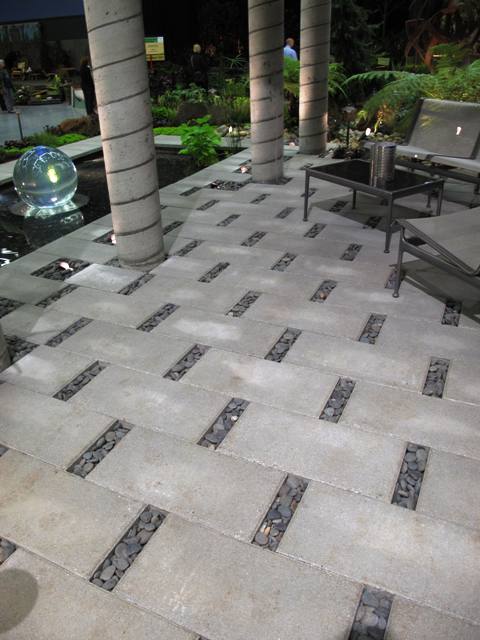
Openings between each paver makes room for a permeable detail of smoth stones.

Design detail
Another wonderful “floor” treatment appeared in a garden called “Wrinkle in Time,” designed by Karen Stefonick of Karen Stefonick Design. Her garden won the Best in Show Award, also called the “Founder’s Cup.”
Since I was able to tour it up close during the judging, I realized how truly creative Karen is when it comes to working with landscaping materials. She devised a patio using two simple ingredients: Concrete Pavers and Tumbled Stone.
Look closely at this pattern created by the slightly offset 1-by-2 foot concrete pavers. By staggering their placement and filling a 2-inch gap at either end of each paver with small rocks, Karen has accomplished two things.
First, she uses the texture of stone to contrast with the smooth concrete, which results in an attractive pattern. Second, this treatment turns a patio into a permeable surface for collecting rainwater into the ground rather than allowing it to stream down to the curb and disappear. Very cool!
BIRTHDAY BOUQUET
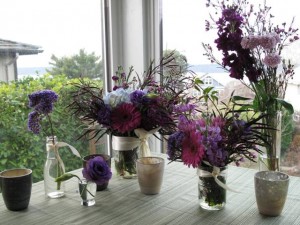
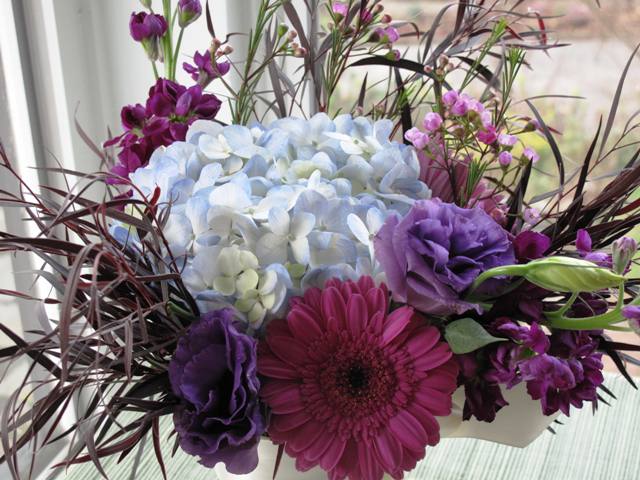
What a gorgeous grouping of flowers and vases!
During all the Flower Show activity, including giving three talks in two days, I almost forgot to celebrate my birthday. But thankfully, my friends and family didn’t forget.

Flower detail
One of the best surprises was the delivery of flowers from a local West Seattle shop called Fleurt Studio.
The gift-giver was my sister-in-law Sandra B. Henriquez. Her touching gesture of sending flowers was made more amazing because instead of resorting to the generic, 1-800 route, Sandi did her homework to find a local flower shop that offers unique, one-of-a-kind gift bouquets. She called (long-distance from Washington, DC) and spoke with Samantha, the owner, and discussed exactly what would be included in the delivery.
And here’s what arrived: A “floralscape,” an eclectic grouping of five differently-sized vases holding mostly purple and plum ingredients. I loved the whimsical inclusion of two canning jars, a bud vase, a vintage bottle and a miniature glass cup. Together, they created a floral display that no single bunch could equal. Magical, huh?
LOS ANGELES VIBE
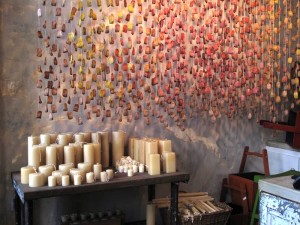
Stunning!
After February’s Flower Show madness, March welcomed a trip to Los Angeles, my former home town. Living there for the past four years was an amazing adventure, especially when it comes to learning about design with new eyes. The city, and in fact all of Southern California, was for me a big design graduate school – with lessons in architecture, industrial design, sculpture and history.
While living in LA, I spent a lot of time scouting homes and gardens for the Los Angeles Times HOME section, as well as visiting retail sources for plants, furniture, gardening accents and more.
Rolling Greens Nursery in Hollywood is one of my favorite haunts. It was the site of our Garden Design magazine Hollywood Issue party last April – one of those exciting moments when I said to myself: I can’t believe I’m living here and doing this type of work I love!
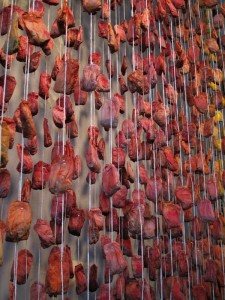
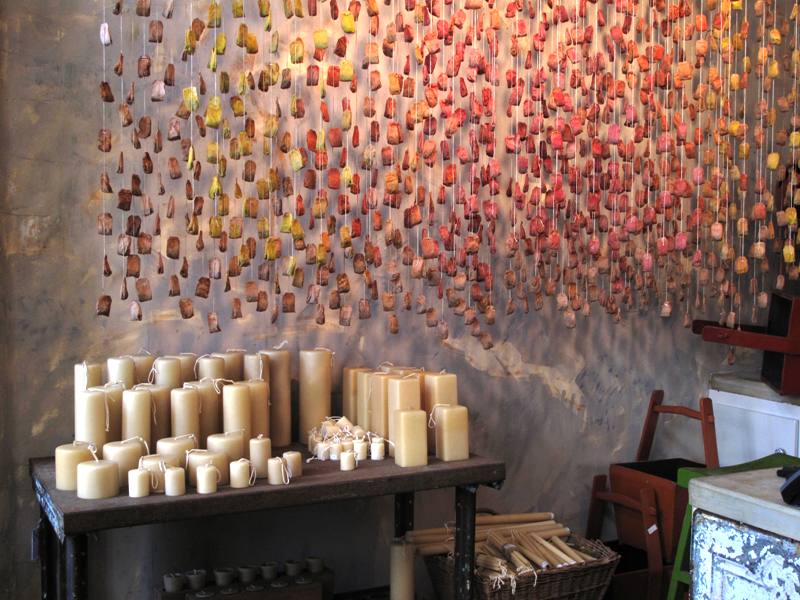
Teabags, thousands of them!
When I returned to LA last week to work on a photo shoot for Better Homes & Gardens, I took our art director Scott Johnson to visit Rolling Greens. I wanted him to see several of the area’s cool nurseries. We stocked up on some plants for the next day’s shoot, and poked around buying ourselves tiny agaves to bring home to our colder climes (Seattle for me; Des Moines, Iowa, for Scott – yes, I know. It’s really futile, but we try).
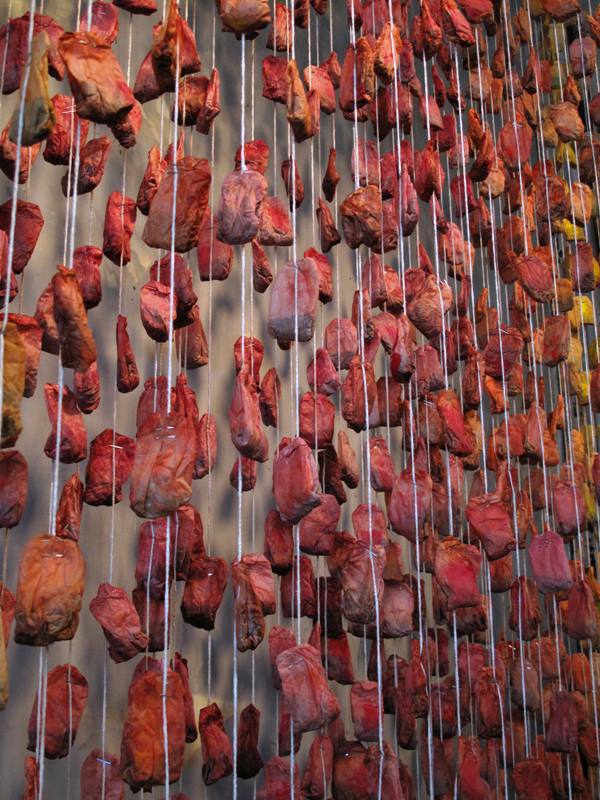
But the wow-factor occurred when I walked into the large space where cookbooks and culinary/gourmet products are typically sold. There along the far wall hung a new installation that I can only describe as a Tea Bag Curtain. One of the staffers told me that the artful treatment had just been hung by Rolling Greens creative director Angela Hicks and her crew.
Hundreds (maybe thousands!) of hand-dyed tea bags, attached to long strings create a beautiful semitransparent cascade, suspended from rods attached at the ceiling. I can only imagine how much time and care was taken to create this rosy-melon masterpiece.
Organic and delicate, this “curtain” is so charming. I am eager to figure out how to replicate it somehow. Simple ingredients paired with masterful execution . . . it adds up to something truly remarkable. This Tea Bag Curtain isn’t “selling product,” but who cares? It goes miles at saying to Rolling Greens customers: we care about design and we’re a place where you can be inspired.
ON TO NEW YORK CITY

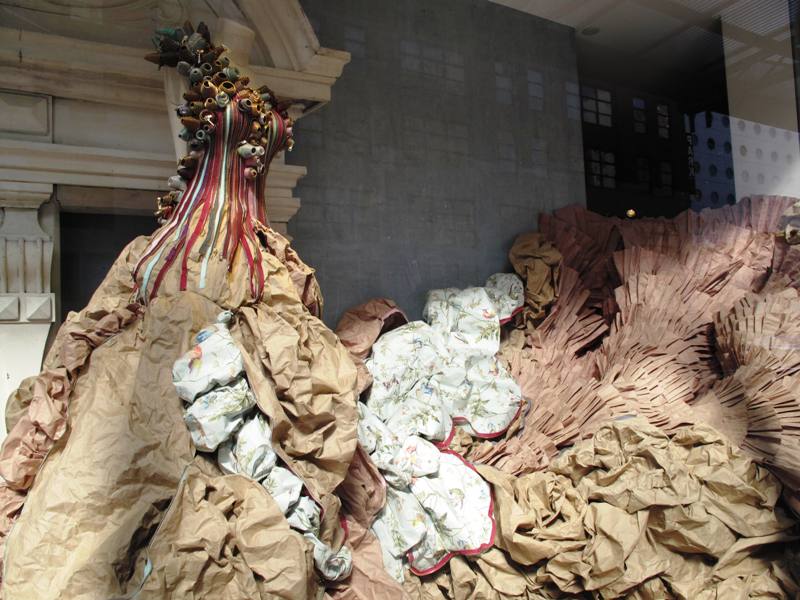
Anthropologie's lavish zipper gown - look close and see how it was made with straight pins!

Here's how the crushed paper skirt emerges from the tight, pastel-colored bodice....
Only days after spending 48 hours in Los Angeles, I flew to New York City. I’ve previously written about visiting the awesome High Line Park, but here’s another visual treat, shown purely for its beauty and innovation.
I turned the corner on my way to the Chelsea Market, a huge warehouse-turned-hipster food mall, and there on the corner was a gorgeous Anthropologie window display.
Some super-creative designer turned a dressmaker’s form, yards of zippers, straight pins and crushed butcher paper into a fanciful ball gown. The way the separated zippers form the bodice so the gold and silver metallic zipper teeth sparkle in the light . . . dazzling. But at the top of each zipper, the “end” has been spiraled into a little rosette.
Just take a look and feast your eyes on the charming way a few simple ingredients become Cinderella’s new gown!
Now, go out and do something uninhibited and artistic today. I dare you! I’m going to try it myself.
Posted in Architecture, Creativity, floral design, Gardening, General, interior design, Plants, Writing | 9 Comments »