
Debra Prinzing

Get the Email Newsletter!

Archive for the ‘Landscape Design’ Category

Gardens under glass

Wednesday, January 6th, 2010

In a setting of snow on the last day of 2009, the Phipps Conservatory makes a grand statement

In a setting of snow on the last day of 2009, the Phipps Conservatory makes a grand statement

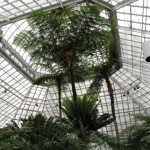
An amazing garden under glass, The Phipps Conservatory is a delightful destination in the heart of urban Pittsburgh.

I visited last week when the outdoor daytime weather averaged 20-degrees Fahrenheit.

But once we walked indoors, of course, the “season” changed. Blooms more likely to be seen in my Los Angeles backyard were thriving in the conservatory’s dozen-plus “rooms,” including the tropical-like Palm Court, Fern Room, Orchid room and Sunken Garden.

The Desert Room looked oh-so-familiar to me, with agaves, aoeniums, aloes and opuntias poking through the sand-colored gravel floor.
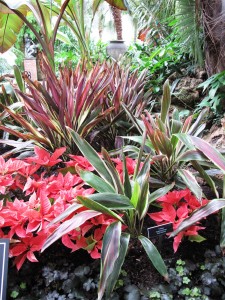
This was a new combination to me: Ti plants (Cordyline sp.) with Poinsettia

This was a new combination to me: Ti plants (Cordyline sp.) with Poinsettia

I visited on New Year’s Eve day and was delighted to learn that the Phipps actually remains open until 10 p.m. on New Year’s Eve, welcoming those more interested in a serene, candlelit celebration than louder festivities.

Right now, many of the plant displays here are dotted with glass sculptures by an artist named Hans Godo Frabel, who is know for his “realistic and otherworldly glass figures.”
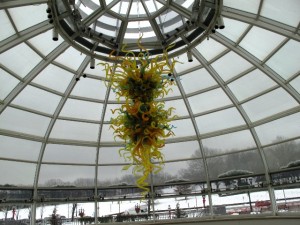
Chihuly's brilliant chandelier in mimosa yellow hangs from the ceiling of the new entry

Chihuly's brilliant chandelier in mimosa yellow hangs from the ceiling of the new entry

Glass of a different sort was presented here in the past – the Dale Chihuly sort – and a few of his pieces remain in the permanent collection, which my photos show here.

My son Alex, who is 12, was very intrigued by Frabel’s alienlike glass creatures, as well as by his realistic glass flowers and salamanders. We took lots of “alien” photos.
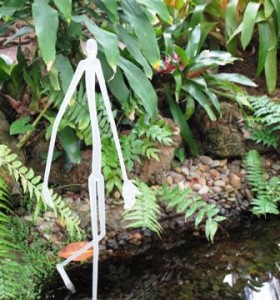
One of the eery glass aliens by Hans Godo Frabel

One of the eery glass aliens by Hans Godo Frabel

Fortunately, these disparate works of art were grouped together to present little stories in distinct wings of the conservatory. Otherwise I would have been completely confused.

In the 2000 book Crystal Palaces: Garden Conservatories of the United States, Anne S. Cunningham profiled the remaining major glass gardens. She wrote:

“Phipps Conservatory is a reminder of Pittsburg’s greatness in the time when Andrew Carnegie and Henry Phipps helped transform the American landscape with steel, steam engines, and civic philanthropy. Among his many contributions, Phipps (1839-1930) gave the city a conservatory “for public instruction and pleasure” in the newly developed Schenley Park.

When it was built, the Phipps Conservatory was the largest of its kind in the country. The shimmering Romanesque-style edifice made of steel, cypress, stone and glass reached 64 ft. tall and covered more than 43,000 square feet. It was originally filled with plants chosen at the World’s Colombian Exposition in Chicago. Writes Cunningham: “. . . the entire tropical plant display was shipped by train across the Midwest in time for the debut of the conservatory.”

From the height of fame to unfortunate neglect, this place barely survived subsequent decades. Sadly, the glorious conservatory fell into disrepair during the Depression. According to Cunningham: “by the 1930s, rats and weeds competed for space; a savage storm in 1937 damaged the big glasshouse and destroyed the greenhouses in back. By 1940, WPA crews had reconstructed the production houses, but the conservatory continued to suffer from natural deterioration and inconsistent community support.”

The Phipps’s renaissance  came in 1993 when a private foundation purchased it and began to restore and revive the grand garden under glass. The Phipps seems to have come full circle with the 2009 highlight of hosting President and Mrs. Obama and the G-20 summit last September. The conservatory was the site of the opening dinner and reception for the world’s leaders. How wonderful that a garden was the backdrop for this powerful gathering.

The rebirth of this grand conservatory is indeed cause for celebration. Here are some impressions from our visit last Thursday:

Garden Field Trip: Descanso Gardens, Los Angeles

Sunday, January 3rd, 2010
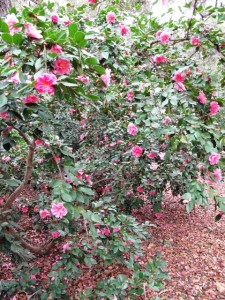
An unlabeled dark pink Camellia in winter at Descanso Gardens

An unlabeled dark pink Camellia in winter at Descanso Gardens

Camellias are oh-so-beautiful, delicate and almost porcelain-like in their perfection.

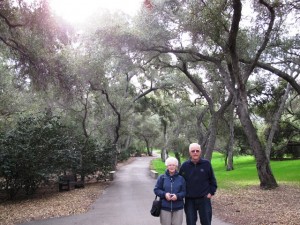
Deb and Anita (Mom) in Japanese garden

Deb and Anita (Mom) in Japanese garden

On the day after Christmas, my parents and I visited Los Angeles’s most established camellia collection at Descanso Gardens

The mature camellia shrubs (many of which are tree-like in their proportions) are protected from Southern California’s harsh heat and sunlight because they’re planted in the understory of even more mature sycamore and live oak trees. They are happiest in the cooler months of the year.

Here, you really do feel like the paths lead through an established woodland. It’s actually an urban woodland, just off of the junction of two freeways. But that’s LA for you.

When we moved to Los Angeles in August, 2006, we got off the plane at Burbank Airport and while waiting for luggage, I noticed a huge DESCANSO GARDENS billboard above the luggage claim area. I remember thinking, “what kind of garden could exist among all this concrete?” 

Anita (Mom) and Fred (Dad) at entrance to Oak-and-Camellia Forest

Anita (Mom) and Fred (Dad) at entrance to Oak-and-Camellia Forest

Later, I was lucky enough to visit. Descanso Gardens is a 160-acre natural woodland and botanical garden located just north of Burbank in a community called La Canada-Flintridge. It’s about a one-hour drive east of where I live in Thousand Oaks and about 20 minutes west of Pasadena. If you plan a visit to the Huntington Botanical Garden, you can easily add a side trip to Descanso. 

I was invited to give a talk at Descanso a few summers ago and was blown away by its immense scale, as urban gardens go. But until last week, I had never visited during the winter Camellia season.

Descanso’s founder, E. Manchester Boddy, publisher and owner of the Los Angeles Daily News, preserved the land (gardens, woodland and chaparral) to share Southern California’s natural beauty with future generations. This is where he lived, building a home in 1938 with views of the San Gabriel mountains. The Boddy family left the house in 1953 when they sold Descanso to Los Angeles County.   

A beautiful pink camellia display

A beautiful pink camellia display

About the Camellia Forest:


Thousands of camellias grow in the understory of a 20-acre oak forest. Boddy began planting camellias in the late 1930s, originally to supply the florist trade.
Many plants were purchased from F.M. Uyematsu, a Japanese-American nurseryman whose camellias were well known to the trade.   Other plants came directly from china, including Camellia reticulata cultivars, imported by Boddy in 1948.  Camellias bloom here from October through May, so you can actually enjoy them most of the year except for summer.

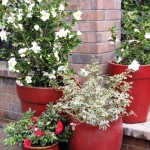
Here are some more of the flowers and garden features that we enjoyed on our winter visit. I especially love the glossy red container plantings of Camellia sasanqua ‘Setsugekka’ because they remind me of the same ones growing in my former Seattle garden, espaliered against the fence for a beautiful winter floral display.

Keeyla Meadows colors her garden world

Sunday, December 20th, 2009

Note: A version of this Q&A appeared earlier this week in “LA At Home,” the Los Angeles Times’ daily home and garden blog.

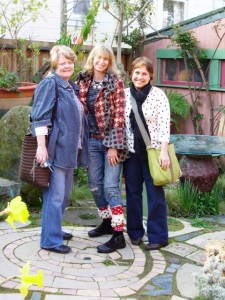
Mary Ann caught one glimpse of the awesome coat and matching socks . . . and said - Hey, that's Keeyla Meadows!

Mary Ann caught one glimpse of the awesome coat and matching socks . . . and said - Hey, that's Keeyla Meadows!

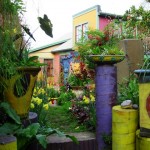
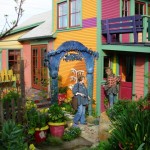
Los Angeles native Keeyla Meadows lives in Berkeley where she makes art and designs gardens. Her cheerful, 50-by-100 foot city lot is a living canvas packed with life-sized female figures and not-so-perfect vessels, hand-built in clay and glazed in a palette of turquoise, apricot and lavender.

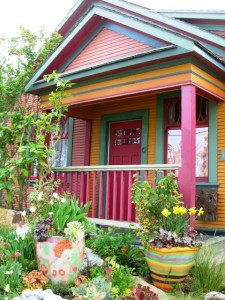
An exuberant color palette that few would dare to use - here's Keeyla's Berkeley bungalow and street-side "sunset" garden

An exuberant color palette that few would dare to use - here's Keeyla's Berkeley bungalow and street-side "sunset" garden

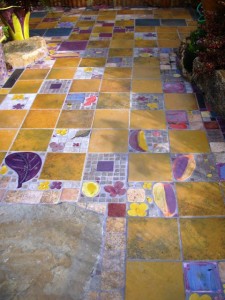
No surface here is left unadorned. Whether it’s her swirly ceramic paving, custom metal benches or sculpted walls, Keeyla artistically places favorite objects and plants with a carefree confidence that few of us can master.

Fans of Keeyla have long admired her award-winning gardens, including a ‘Best in Show’ at the San Francisco Flower & Garden Show a few years back. Her beautiful first book, Making Gardens a Work of Art, was published in 2004 by Sasquatch Books, a Seattle imprint that also published my first book, The Northwest Gardener’s Resource Directory.

Lorene and me ~ gal pals in Keeyla's garden

Lorene and me ~ gal pals in Keeyla's garden

In 2008, I lucked into an impromptu visit to Keeyla’s personal wonderland when my girlfriend Mary Ann Newcomer boldly followed her into Café Fanny’s in Berkeley, an Alice Waters bistro, and snagged an invite for our group of breakfasting garden writers.

Lorene Edwards Forkner, Mary Ann and I hopped in the car and followed Keeyla to her bungalow, a few blocks away. It is fair to say we were hyperventilating!

“You can take photos, but don’t publish them until my book is out,” Keeyla requested. It was the least we could do, having feasted our eyes on her botanical paint box, imagining how we might try her playful ideas in our own backyards.

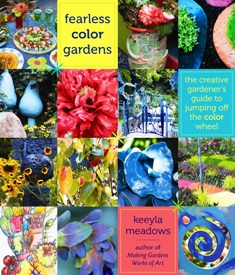
9780881929409_CMYKHer new book, Fearless Color Gardens: The creative gardener’s guide to jumping off the color wheel (Timber Press, $27.95), has just been published. Filled with Keeyla’s photography of design projects, as well as her doodles and sketches, it reads like a colorist’s memoir, complete with a muse named Emerald.
Strong on fantasy, it’s also a useful workbook for garden owners who need a nudge toward the more vibrant end of the color spectrum. I recently asked Keeyla about the book.

Q: How do you teach students to feel confident as garden designers?

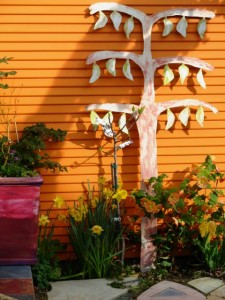
Keeyla's color sensibility is in her DNA as evidenced by the orange side of her house punctuated by a tree-inspird sculpture

Keeyla's color sensibility is in her DNA as evidenced by the orange side of her house punctuated by a tree-inspird sculpture

A: A lot of people have this mantra that says, “I’m not a creative person. I’m not an artist.” Our lives are built around the practicality of what we have to do everyday so many people shut those doors to creativity a long time ago. I suggest you treat garden design like something you do all the time. The physical activity of placing plants in a space can be as easy as folding laundry and putting it away, or setting the table, or baking a cake.

Q. How can I make a landscape project feel less overwhelming?

Mary Anne Newcomer, Keeyla Meadows and Lorene Edwards Forkner

Mary Anne Newcomer, Keeyla Meadows and Lorene Edwards Forkner

A. I suggest you divide your space up like a series of photographs or like windows.

Decide what “picture” you’re working with, where it starts and ends. Start with looking out the kitchen window and use plants and art to fill the frame.

Q. Where does your color inspiration come from?

A. A lot of my color sense comes from growing up in Los Angeles and living with its “colorfulness” – the light, tile work and Catalina Island all inspired me. Right now, I’m designing a new garden for the San Francisco Flower & Garden Show in March. It’s a habitat garden and the colors I’m using come from the red-headed garter snake, an endangered snake from the San Mateo coastline. It has a read head with a turquoise and red stripe down the back, so it’s providing my design motif, my imagery and my color combination.

Jump off the conventional Color Wheel and play with Keeyla's Color Triangle

Jump off the conventional Color Wheel and play with Keeyla's Color Triangle

Q. How do you suggest people “jump off” the color wheel?

A. The traditional color wheel makes my head spin. I use a color triangle, which is so stabilizing. I put blue at the top of the pyramid – it represents the sky. The other two points are red and yellow. Between the three primary colors are the secondary colors. On either side of any point is a harmonic chord of color. You’ll never go wrong if you take one of the points – red, yellow or blue – and use one of those chords of color on either side of it.

 Q. How do you balance artwork with the plants in your garden? 

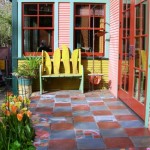
A checkerboard of color in a patio installation

A checkerboard of color in a patio installation

A. Art gives me a constant relationship to plant against, a very stable feature to move through the seasons with.

Art creates so much focus and orients the whole space so one is not always reinventing. It is like a stage setting.

The artwork and hardscape set the stage for your plants to really become the stars.

Here’s a quote from Keeyla’s book that seems apropos:

“In my gardens, color refers to everything – absolutely everything. I don’t just make a bland holder, a neutral vase, for colorful plants. Color includes the rocks, the pavings, and the artwork. It also connects up with the color of the house and the sky above. So it’s really like bringing the camera to your eye. When you take a photo, you are looking at everything in the frame. In creating color gardens we will look at everything that is part of the garden picture. . . “

More photos to share from our visit to Keeyla’s magical garden:

Rolling Greens nursery and garden emporium comes to Hollywood

Wednesday, December 16th, 2009
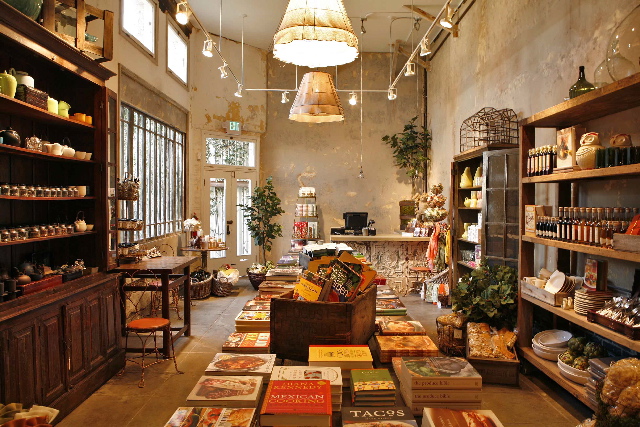
Gourmet food, exotic tea blends and a library of design books fill the new Rolling Greens in Hollywood

Gourmet food, exotic tea blends and a library of design books fill the new Rolling Greens in Hollywood

rolling greensLast Thursday, a vintage tire shop in the heart of Hollywood was the setting for a festive pre-opening bash thrown by Rolling Greens, its new tenant.

Designers, landscapers and horticulture fans gathered to sip, graze, explore (and shop!) at the hottest new garden emporium in Los Angeles. My editors at Garden Design magazine asked me to attend and check out the happenin’s.

Rolling Greens’ second location is the brainchild of owner Greg Salmeri and his colleague and creative director Angela Hicks. The original store in L.A.’s Culver City is a distinctive nursery, home and garden destination, formerly only for the trade, that opened to the public in 2004.

Tire dealer-turned-garden emporium, in a historic, weathered building that's full of character

Tire dealer-turned-garden emporium, in a historic, weathered building that's full of character

For his new outlet, Salmeri snagged the lease on Town Tire Company, a weathered brick building that has been a Hollywood landmark at the corner of Beverly Blvd. and Gardner Ave. Built in 1930, the iconic structure was originally a food market and then in 1963 became a tire store.

“I’ve had my eye on the Town Tire Co. building for years and dreamed of opening Rolling Greens in this incredible space,” Salmeri says. “In this new location, we’ve expanded our offerings into home categories beyond what we offer at our Culver City location.”

Greg Salmeri

Greg Salmeri

Salmeri and Hicks turned the tire shop’s unpolished attributes into appealing design elements for Rolling Greens. There are big metal garage doors that roll up to connect the indoor spaces with the fresh-air ones. The original concrete floor has been cleaned up and the exposed brick walls sandblasted. Once covered over, several huge glass doorways topped with half-circle transom windows have been exposed to invite sunshine into the 1,000-square-foot bed and bath department. The cash-wrap counters are clad in 19th century pressed-tin ceiling tiles. The “color greenhouse” is a glass-and-steel dividing wall that encloses an area for indoor plants, including orchids and ferns. Panes of amethyst and bottle green glass replaced broken sections, creating a vintage greenhouse backdrop at the center of the store.

READ MORE…

A tree obsession, or should I say a two-tree obsession?

Friday, November 20th, 2009
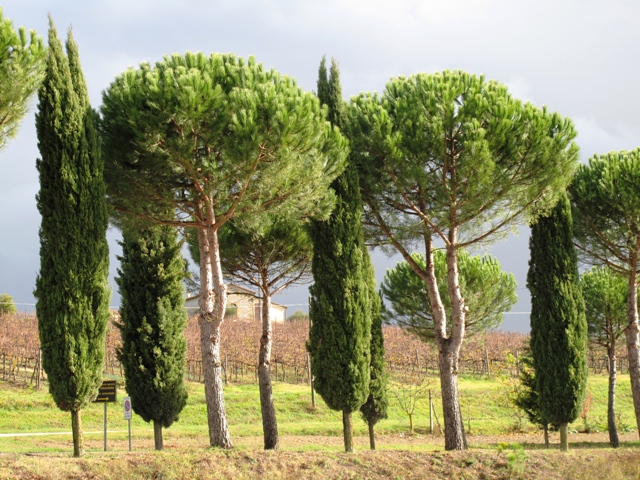
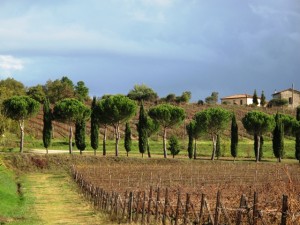
Italian cypresses are so companionable with Italian stone pines

Italian cypresses are so companionable with Italian stone pines

I did a lot of driving in Tuscany. More than I would have liked, just ask my girlfriends. Lots of to-ing and fro-ing between our remote villa and the train station in Chiusi about 45 minutes away. But there was one scene on the road between Trequanda and Sinalunga that caught my breath every time I drove past it and made the driving worth while.

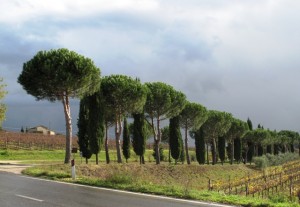
Someone planted two lovely rows of trees on either side of a long driveway that ran perpendicular into the strada. And as I approached it, the classic, Renaissance-inspired pattern emerged, filling my line of vision with its elegance and storybook perfection.

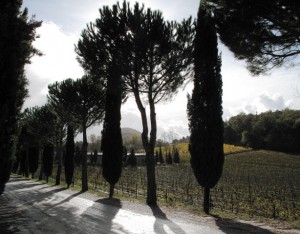
When backlit, the tree shapes are even more distinctive

When backlit, the tree shapes are even more distinctive

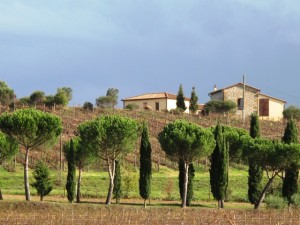
Silhouetted against the Tuscan sky, or back-lit by the sun, stood the contrasting shapes of tall, slender Italian cypress trees (Cupressus sempervirens) and upward-sweeping, umbrella-like forms of Italian stone pines (Pinus pinea).  The iconic forms alternate up one side of the drive and back down the other, ensuring a perfect display of two quintessentially Italian trees.

Thanks to the genius plantsman or woman who decided that these two trees – one, a spire; the other, a classic ovoid — should be grown together.

If ever I have enough land and live in the right climate, I’m going to replicate this gorgeous, satisfying, perfectly ordered pattern of trees. For now, I will share more photos. I stopped one morning and snapped oh-so-many views.

Another view of my favorite tree scene

Another view of my favorite tree scene

Beautiful and orderly, an intentional planting scheme

Beautiful and orderly, an intentional planting scheme

Each time that I approached the pine-and-cypress-edged drive, a smile covered my face

Each time that I approached the pine-and-cypress-edged drive, a smile covered my face


P.S., this is the pine tree from which those delicious pine nuts come from.

Creating and capturing movement in the landscape

Monday, November 16th, 2009

AGnucov1AA version of this piece originally appeared in my 2005 book, The Abundant Garden (Cool Springs Press), photographed by Barbara J. Denk, a gifted Bainbridge Island-based photographer. 
I recently updated the text as an article that appears in the current Southern California Horticultural Society newsletter.

RHYTHM AND MOTION

In landscape design, you can create a visual flow through the garden with the dynamic element of rhythm.

As a beat is to music, as choreographed steps are to a dance, rhythm animates a garden. Even if the wind doesn’t blow, your garden can look and feel infused with energy.

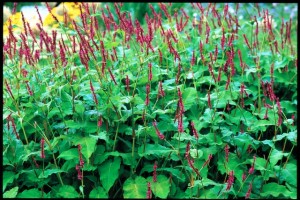
Raspberry-red spikes of aptly named Persicaria amplexicaulis 'Firetail' erupt in this singular performance of color and form. (Barbara J. Denk photograph)

Raspberry-red spikes of aptly named Persicaria amplexicaulis 'Firetail' erupt in this singular performance of color and form. (Barbara J. Denk photograph)

MOTION:  We experience a physical sensation when something rustles or sways in the garden. We pause to appreciate movements, subtle or dramatic – flowing water, rippling leaves, a billowing banner, or clanging chimes – because they signal life’s evanescent qualities. Such movements resonate as the garden responds to the earth’s vital elements.

By the very act of creating a garden, we embrace the external forces of nature, most of which are out of our control. In addition to rays of sunlight and rain showers, the kinetic presence of wind and breeze in our landscapes is important to channel – as movement – in a planting scheme.

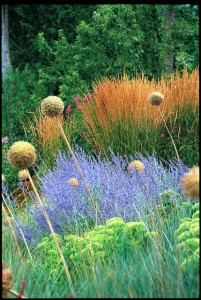
The ball-shaped seed heads of Allium 'Globemaster' are showcased against a rhythmic display of Calamagrostis x acutiflora 'Karl Foerster', velvety Russian sage (Perovskia atriplicifolia) and Sedum 'Autumn Joy' (Barbara J. Denk photograph)

The ball-shaped seed heads of Allium 'Globemaster' are showcased against a rhythmic display of Calamagrostis x acutiflora 'Karl Foerster', velvety Russian sage (Perovskia atriplicifolia) and Sedum 'Autumn Joy' (Barbara J. Denk photograph)

It’s rewarding to see how climatic changes affect the garden, something we can’t help but notice, whether there are extreme gusts or light flurries flowing through branches and stems. When we intentionally design the garden to capture these movements, we infuse an otherwise commonplace landscape with vitality.

The choices of plants that can catch the airflow, gently dance, or furiously shake are endless. Perennials with tall, slender stems ripple like the fringe on a canopy (think of a vibrant stand of daylilies or a swath of lavender).

Fluffy inflorescences of maiden grass undulate above its finely-textured blades – and the overall effect is a seductive rhythm. The leaves of a California pepper tree shimmer like sequins on an evening gown. Agapanthus seedpods rattle and whisper as autumn arrives. The natural symphony energizes any landscape.

RHYTHM:  Beyond individual plants, the visual suggestion of animation or motion can also be incorporated into the overall template of a garden. The repetition of organic forms, the course of a sinuous path, or the sensual outlines of beds and borders suggest movement. Alternating shapes – the gradual widening or narrowing of a space, the regular spacing of trees – do as well.

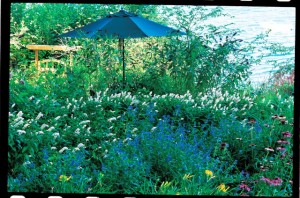
Calm white and intense blue join for a duet of gentle movement. A border of creamy white Lysimachia clethroides relates well with a stand of blue-flowering Caryopteris x clandonensis.

Calm white and intense blue join for a duet of gentle movement. A border of creamy white Lysimachia clethroides relates well with a stand of blue-flowering Caryopteris x clandonensis (Barbara J. Denk photograph)

When the tiny stones in a Zen garden are raked into concentric circles, movement appears. When a “stream” of large, smooth, river rocks fills a gully or trench, the sense of running water is implied. The sequence of stepping stones spaced through a cushioned ground cover of fragrant thyme invigorates the scene and helps direct the viewer’s eye through the garden. The scene is emotionally alive and visually pleasing.

Movement in a garden is essential. It’s the organic rhythm, the fluid characteristic that every garden needs in order to come to life for those who enjoy it.

Here are some tips for “animating” your garden:

  • Develop a repertoire of plants:
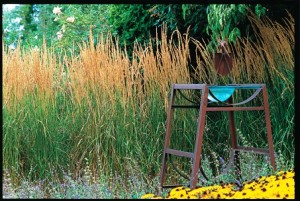
A glass bowl - a modern birdbath - is showcased against a coppery stand of Karl Foerster grass - an exquisite choice for "motion" in the garden (Barbara J. Denk photograph)

A glass bowl - a modern birdbath - is showcased against a coppery stand of Karl Foerster grass - an exquisite choice for "motion" in the garden (Barbara J. Denk photograph)

Base your plant selection on the scale of your house and the natural setting around it. Once you’ve selected the primary plants – those that provide structure and have multiseason interest, such as ornamental grasses – you can choose a second wave of plants to “star” in specific seasons.

  • Create a basic framework for design:

Choose a template and follow it consistently throughout the garden. One method is to mirror dominant lines of your house, such as repeating key architectural shapes in the landscape. Use these as a guide for shaping pathways and planting beds. For example, a home’s arched windows and doorways might be echoed in the contour of a border or patio. Alternately, you can borrow a framework for design from nature, such as the irregular rhythm of distant hills. 

  • Consider the vertical dimension:
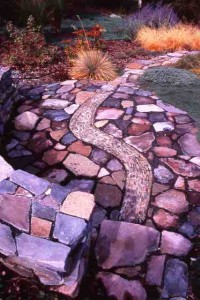
Hardscape, such as this fabulous pebble "river" running through a flagstone patio, can animate and energize the landscape. This was designed and installed by my Yakima friends Linda Knutson and Ron Sell (Debra Prinzing photograph)

Hardscape, such as this fabulous pebble "river" running through a flagstone patio, can animate and energize the landscape. This was designed and installed by my Yakima friends Linda Knutson and Ron Sell (Debra Prinzing photograph)

Backlighting is magical, even in my own backyard. I love the morning sun as it illuminates and highlights the various blades, stems and leaves (Debra Prinzing photo).

Backlighting is magical, even in my own backyard. I love the morning sun as it illuminates and highlights the various blades, stems and leaves (Debra Prinzing photo).

Select plants that bring height, energy, and motion into the garden, and vary their placement for impact.

Even if surrounded by buildings on every side, your garden will respond to daily and seasonal climate changes. Watch how breezes move through the garden, and capture that energy by placing fluid plants where currents flow. Notice where the sun rises and sets in relation to your landscape, and choose trees, shrubs, grasses, and other perennials that will reflect the morning light or absorb sunset’s glow. Red and purple foliage turns flame-like when backlit. As the sun’s rays shine through fringed tassels of fountain grass or pampas grass, the garden will shimmer in response.

Gray concrete goes “green”

Saturday, November 14th, 2009

Here’s a story that ran in the Los Angeles Times last month. It’s about a few of Stephanie Bartron’s projects to remake her clients’ ugly concrete patios into more attractive – and sustainable – backyard features. The best part of the story is learning how easy it is to turn this technique into a DIY project of your own. The LA Times also features an awesome in this photo gallery. Read on . . .

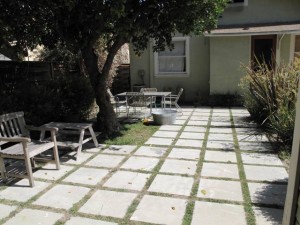
The basketball-court like patio has been repurposed by scoring and slicing 4-inch bands to create a grid pattern

The basketball-court like patio has been repurposed by scoring and slicing 4-inch bands to create a grid pattern

If landscape designer Stephanie Bartron has her way, California’s sea of patio concrete is going to start shrinking.

When the Los Angeles landscape designer eyed her clients’ slab behind a 1940s Atwater Village bungalow, she knew the concrete had to go. New hardscape and plants would have done the trick, sure, but digging out all that paving was costly and, the the waste would just end up in the landfill.

So, Bartron took a different approach. She hired a professional industrial saw operator to slice up the 20-by-20 foot patio into a grid of 18-inch squares.

The result is a new focal point for the garden, resembling evenly-spaced pavers divided by 4-inch bands of grass. When it rains, the storm water percolates into the ground rather than streaming down the driveway and into the street. Little material was thrown away. But the biggest effect was aesthetic. The repurposed patio no longer resembles a basketball court, nor does it dominate the tiny lot.

A power saw with a diamond blade slices up a sea of concrete

A power saw with a diamond blade slices up a sea of concrete

“By cutting it up, I changed the scale of the concrete from a big slab into an attractive backyard feature,” the designer says.

While his two children play nearby, owner Caleb Dewart, a television producer, likes to lounge beneath the mature orange tree that Bartron saved.

“We’re really happy we didn’t have to tear this up and start over,” he says of the patio. “And we like using what we have rather than being wasteful.”

Bartron’s approach solves myriad design challenges, and the designer has artfully sliced up several ugly patios and driveways for clients. Environmentally conscious homeowners like reducing the waste associated with redesigning a landscape. Budget-conscious clients like getting a lot of bang for their buck.

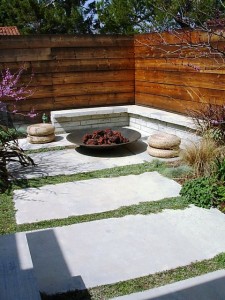
The once-ugly carport slab is reinterpreted as a lovely courtyard and seating area designed by Stephanie Bartron

The once-ugly carport slab is reinterpreted as a lovely courtyard and seating area designed by Stephanie Bartron

According to Kenny Grimm, sales manager for Oxnard-based Independent Concrete Cutting Inc., this kind of project requires an experienced operator to cut concrete with a diamond blade, 37-horsepower saw. Cost: $140 per hour, plus travel charges.

“We’re seeing more people re-use their existing material because recycling your paving is an affordable alternative to hauling it away,” he says. “You can get a lot of cutting done for around $1,000.”

For yoga instructor Lucy Bivins and cinematographer Eric Schmidt, Bartron recycled front-yard concrete into useful elements, including garden benches and a prominent water feature.

The couple inherited a gray slab when they purchased a Mt. Washington house designed by architect Barbara Bestor. The concrete had been installed by a previous owner as part of a carport, Bivins says. “It was very bleak and unattractive,” she says. “A real eyesore.”

At Bestor’s suggestion, she and Schmidt contacted Bartron for design help.

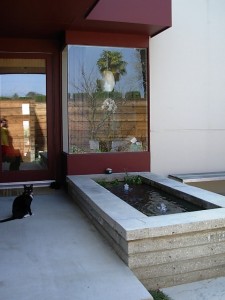
Narrow bands of concrete now form the edges of a modern koi pond and fountain

Narrow bands of concrete now form the edges of a modern koi pond and fountain

“We asked for shade trees, an outdoor gas fireplace and some type of fountain,” Schmidt says. “Stephanie turned the unused space into our outdoor living room, which in just a few years has been filled by a canopy of shade trees. It’s a favorite place to sit with our newborn son, Hugo, listen to the fountain and watch the trees move in the wind. It calms him down every night before bedtime.”

Used to working with old, cracked paving, Bartron was fascinated with the newer concrete. Four-inches thick and embedded with rebar, it covered 400 square feet between the street and her clients’ front door.

Coming up with a savvy design that created little waste was “like solving a big jigsaw puzzle,” the designer says. “This material was in great shape, but we wanted to turn one giant slab into many smaller elements for a bold and inviting garden space.”

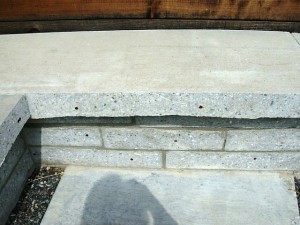
Bartron chose a rectilinear motif to echo the architecture’s lines, slicing the patio into 1-1/2-by-4-foot sections. She layered the cut-out concrete in the form of an L-shaped seating area, the bench backed by a new, horizontal-plank fence. Narrower slices of concrete stacked four levels high form the edges of a contemporary fountain and koi pond. Cross sections reveal aggregate-like detailing when sanded smooth.

You can see the interesting texture in the cross-sections of cut concrete

You can see the interesting texture in the cross-sections of cut concrete

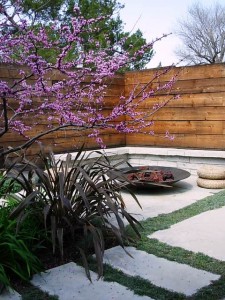
Bartron left some of the concrete in place but carved away planting strips to accommodate low-growing, drought-tolerant dymondia, a silver groundcover. She also removed enough patio to create two large beds for Eastern redbud trees (Cercis canadensis), carex and fescue grasses, and New Zealand flax. Evenly-spaced concrete bands serve as a walkway from the front door and adjacent bubbling fountain to the L-shaped seating, which has a gas-piped steel fire bowl designed by New York artist Elena Colombo .

“It’s a very sexy entertaining space,” Bivins says. “Whenever we have people over, we end up around the fire bowl. There can be 10 of us here and it still feels intimate.”

She praises Bartron for coming up with a money-saving design that also enhances the architecture.

“It was very crafty of her,” she says. “She took our lemon and made lemonade.”

Cutting up the patio

Another view of the lush transformation of this garden

Another view of the lush transformation of this garden

Want to slice up your patio? Landscape designer Stephanie Bartron says it’s not for the faint of heart. It’s possible to make small cuts using a power hand saw with a diamond blade, but you should take safety precautions such as wearing safety goggles and heavy gloves. Large-scale projects, such as the ones shown here, are best left to professional contractors.

Draw a map of your patio and think about where you want to place furniture. Table and chair legs need to be placed on an even surface, not in the spaces between concrete.

Dig along your patio to determine the concrete’s depth and the edge type (uniform or jagged). Newer concrete may be even, but old patios tend to be rough-edged. The type of edge may determine if or how the cut pieces may be repurposed.

While marking your pattern with chalk, note of any cracks, chips or score lines. If possible, tweak your design to eliminate these blemishes.

If the concrete is prone to cracking, Bartron suggests cutting it so the remaining pads are standard paver sizes (18- or 20-inch squares). “That way you can pull out a cracked section and install a replacement paver,” she says.

Here’s how her garden influences one textile designer

Thursday, November 12th, 2009
Sina Pearson relies on regular visits to her island garden in Washington state to inspire her teextile designs.

Sina Pearson relies on regular visits to her island garden in Washington state to inspire her teextile designs.

I met Sina Pearson in 2006 when her publicist Susan Harkavy arranged a visit to the textile designer’s aerie (aka studio, atelier, loft) in SoHo.

I was in New York City with Bill Wright to photograph an amazing glass-and-steel West Village “shed” for Stylish Sheds and Elegant Hideaways, but I took a side trip for an hour to meet Sina and see her work.

She grew up in Washington State and studied art and textiles at the University of Washington. Our common Pacific Northwest roots gave us an easy, mutual language, designer-to-writer, as we talked about her interests, influences and passions.

Recently, Garden Design magazine invited me to profile Sina as “One to Watch,” with a short Q-and-A that appears in the November-December 2009 issue. Due to space, a portion of my interview did not make it into the print edition. So here it is in full, along with some photos that Sina shared from her garden in Washington’s Fidalgo Island (Skagit Valley).

Garden Design NovDec001ONE TO WATCH:

Textile designer Sina Pearson may live and work in SoHo but trips outside the city inspire her saturated stripes and vibrant abstracts.

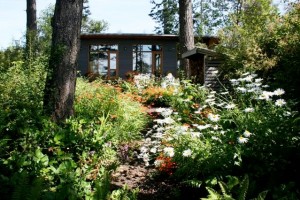
She spends one week each month at a remote island cabin in Washington State, surrounded by a semi-wild garden, just steps away from the 1950s A-frame where she played each summer as a child. Sojourns abroad include idea-gathering places like Scandinavia, France, Mexico and the Caribbean. Collectively, these design “threads” are woven into finished cloth: confident, evocative – and high performance – textiles for residences, hotels, restaurants, offices and outdoor settings.

sina-pearsonThe designer, manufacturer and entrepreneur trained in fine arts and textiles at the University of Washington before earning a MFA in textiles from Cranbrook and studying at the Royal Academy of Arts, Crafts and Design in Stockholm. She launched Sina Pearson Textiles in 1990.

Pearson reinterprets outdoor fabric that looks as if it belongs inside, including terrycloth, chenille and boucle cloth made with Sunbrella® yarns for sunfast, stain-, rain- and mildew resistance. Her newest collection, out next spring, is called Colores de Mexico. Her influence? The orange-striped, hand-woven Mexican curtains that Pearson’s mother hung in the family’s beach cabin. “It has an ethnic, modernist vibe with a serape-like texture,” she says.

 Q. Tell me about your Fidalgo Island garden and how it informs your textiles:

 A. I could not be doing what I’m doing if I didn’t have my garden. It frees my soul and lets me experiment with weaving colors and textures together. The way I work in my garden is very much how I work in textiles. I’ve always maintained that you have to listen to what the fabric wants to be – it’s a wonderfully slow process. Similarly, I have to let my garden design itself. I observe how each plant color works together, how each season is revealed in flower, foliage and blade.  

Q. What influences you as a designer?

A. I can’t separate how I’ve grown up from what I am now. My parents were so visual – my mother was a landscape designer and my father was a photographer. We had Jack Lenor Larson’s textiles in our house. I cannot remember a time when I was not playing with fabric. Family legend recalls me cutting textiles into small pieces and arranging them on the sofa when I was two. At 12, I learned weaving from a Swedish woman and batik design from Ruth Pennington, a very fine metal artist. I created a huge, abstract piece of batik silk with fuchsia pink, bright orange and red colors. We hung it up in the sun and it looked like a stained glass window. Ruth turned to my mom and said: “Sina has a career in textiles.”

Q. How is your Scandinavian heritage reflected in your work?

A. I grew up with Danish modern furniture and I double-majored in Swedish language and literature in college. I also lived and studied in Sweden. When I design, I am looking for “emotion” – the feeling conveyed by yarns, colors and textures in my fabrics. After my last trip to Scandinavia, I created a collection evocative of what my ancestors would have woven to wrap themselves in for warmth: soft, heathery “comfort” fabrics that are hand-crafted, quiet, simple and dignified.

cote d azur_03Q. How have you re-imagined outdoor fabric as something more than utilitarian?

A. When I first started in the contract fabric industry in the late 70s and 1980s, everything was rather plain. That all changed when I went to Unika Vaev as president and design director. We introduced the first tapestry for contract interiors. Herman Miller put our tapestries on its new paneling system and broke open the whole concept of patterned fabrics.

The same thing has happened now that I’m designing outdoor fabric with Sunbrella® yarns. I wanted to invigorate outdoor fabrics with modern designs. I’m a big proponent of mixing cool and warm colors together. I also like to use neutrals – sage, taupe, mid-tone brown – with brighter colors to give a reference to nature.

Q. What is the ideal exterior setting for Sina Pearson’s textiles?

IMG_3265A. A space where the interiors blend with nature as occupants move from indoors through a covered area to the outdoors. I love to see complementary fabrics and colors in all three environments. I don’t design my outdoor fabrics separate from my interiors collection. My outdoor fabrics look and feel just like indoor textiles, yet they are made with high-performance fibers for resistance to sun, mold and mildew.

Q. What is on your drafting table right now?

A. I have little piles of yarn sitting on my desk. I’m playing with brighter palettes to create fabrics with clean, crisp colors of summer. I’m also playing with simple shapes, hand-cutting paper into geometric forms – stripes and flowers. I find it very satisfying. I look like a second-grader, sitting on the floor cutting out bits and pieces.

–Debra Prinzing

What can we learn from a classic Tuscan garden?

Tuesday, November 10th, 2009
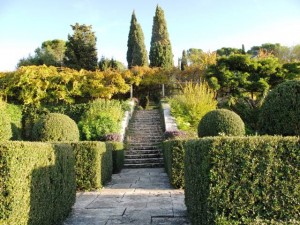
The stone steps of La Foce's terraced garden draw the eye upward, towards two large Italian cypresses

The stone steps of La Foce's terraced garden draw the eye upward, towards two large Italian cypresses

I’ve barely been home from Italy for 24 hours and despite jet lag, I am still alert enough to post my first report about the two week trip to Tuscany.

One of the most memorable days was our tour of La Foce, a Tuscan estate and garden with influences dating to the 15th century when the property was built as an Inn (“Osteria”) by the Hospital of S. Maria della Scala.  It is located in the town of Chianciano, about 30 minutes southeast of where we stayed in Montisi.

“Foce” (pronounced Foe-CHAY) means “opening” or “meeting place,” and its origins are traced to the Etruscans. The name refers to the osteria’s location as a stopping place where two prominent roads intersect. The roads were traveled by pilgrims, merchants and travelers who sought rest from their journeys at La Foce.

READ MORE…

More gardens, even more plants

Wednesday, October 7th, 2009
Shopping and playing at Plant Delights Nursery

Shopping and playing at Plant Delights Nursery

“All the world’s a nursery. And all the men and women merely gardeners.”

— William Shakeshovel (aka Tony Avent)

Garden Writers Annual symposium, Part IV

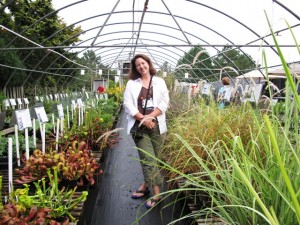
On Friday, Sept. 26th, the climate started cooling off, but with that came some lightish showers. Luckily, the rain held off until later in the morning, but we started out boarding buses at 7 a.m. (!) to visit to the famous Juniper Level Botanic Gardens at Plant Delights Nursery – a gardener’s mecca, nursery and botanical garden all in one.
 
Consider: A five-acre display garden that contains 17,000 different plant specimens. The nursery has 1,600 different plants available at any given time. Talk about over-stim!  
Wow - a chance to meet Tony Avent, genius plantsman

Wow - a chance to meet Tony Avent, genius plantsman

I have been a fan of plantsman Tony Avent ever since I inherited the late Stephanie Feeney’s working files from her book, The Northwest Gardener’s Resource Directory. I picked up where Stephanie left off to edit the 9th edition in 2002. That was when Internet plant-ordering was in its infancy and thousands of plant fanatics on both coasts looked forward to receiving the entertaining Plant Delights catalog from this Raleigh nursery. I got a kick out of the “price” that Tony printed on the front cover. It hasn’t changed in the ensuing years: “10 stamps or a box of chocolates.”  

Here’s what I wrote about Plant Delights Nursery in 2002 (of course, never having been there, this was based on the catalog and web site):

 Among the Plant Delights here is an engagingly humorous catalog, its gentle joshing bordering occasionally on the sarcastic. Earlier issues have been subtitled along the lines of “Raiders of the Lost Park” and “It’s not easy being variegated,” as this nursery boldly announces its mission to sell unusual perennials. You’ll find an online catalog of 1,000-plus offerings, including arisaema, asarum, cannas, crinum lilies, epimediums, ferns, hardy palms, hardy ginger lilies, hellebores, heuchera, hosta, lobelia, ornamental grasses, pulmonaria, Solomon’s seal, tiarella, verbena . . . and more.

When we arrived Friday morning, Plant Delights was everything I hoped it would be – and more. The crew at Plant Delights were all-hands-on-deck. Hundreds of garden writers wandered (raced?) around the property, little red or green wagons in tow, seeking unusual must-have plants in the hoop houses and absorbing design ideas in the display gardens that surround Tony and Michelle Avent’s home. The mood was at first festive, followed by a quiet sense of awe.

READ MORE…