Debra Prinzing

Get the Email Newsletter!

Archive for the ‘floral design’ Category

SLOW FLOWERS Podcast: East Coast-West Coast, meet Jennie Love and Erin Benzakein, creators of The Seasonal Bouquet Project (Episode 114)

Wednesday, November 6th, 2013
bouquet poster

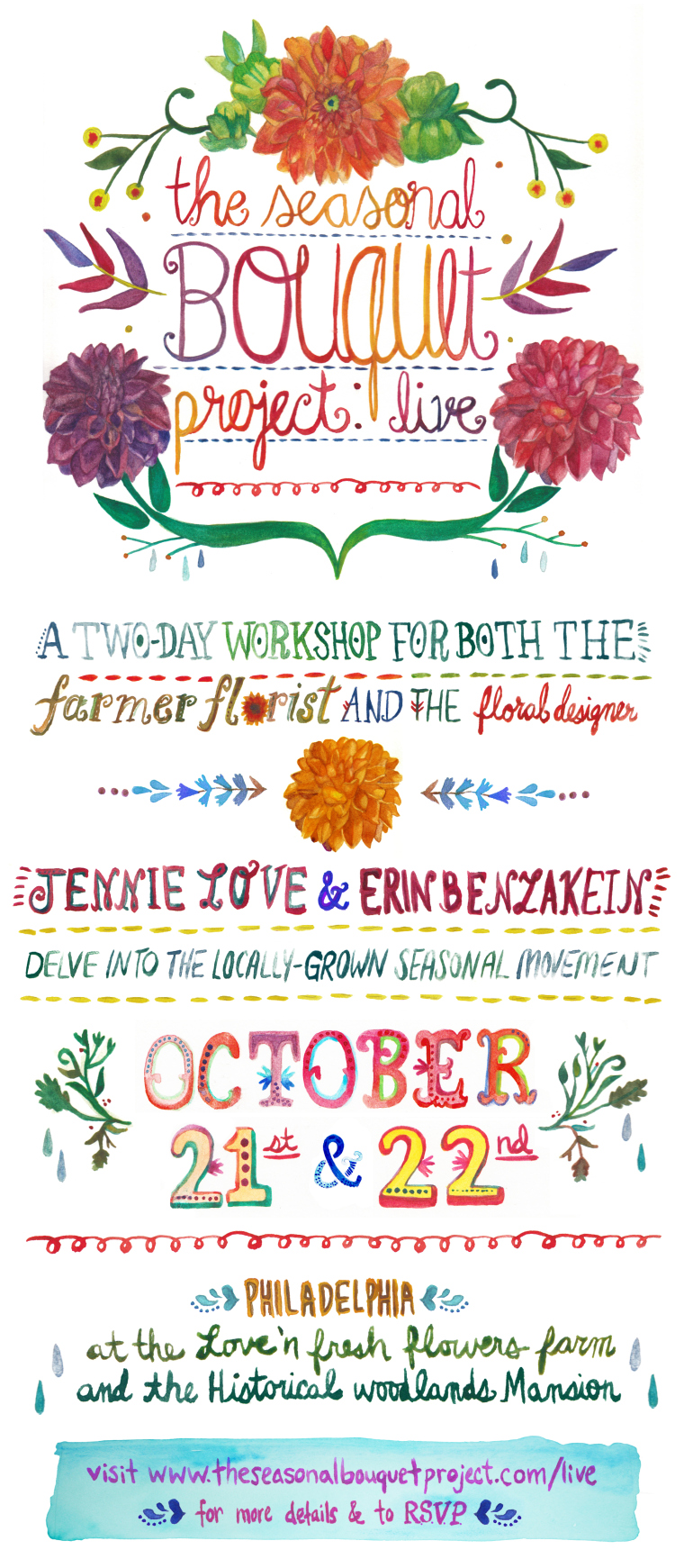
Jennie Love and Erin Benzakein are the dynamic east-west floral duo behind The Seasonal Bouquet Project. This lovely poster was hand-illustrated by Shannon Collins 


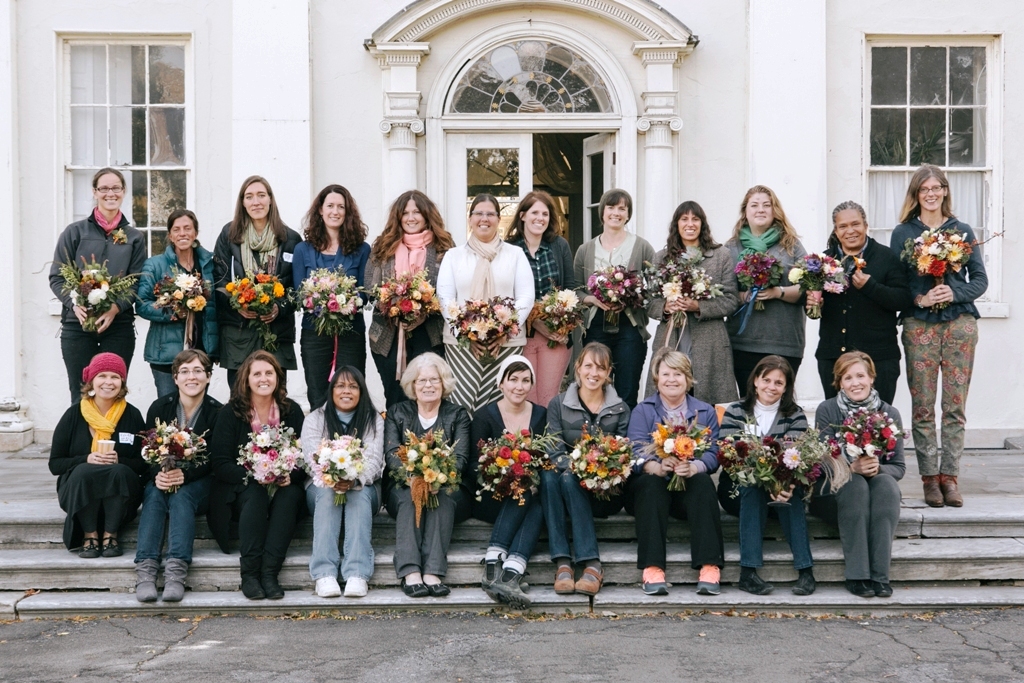
group

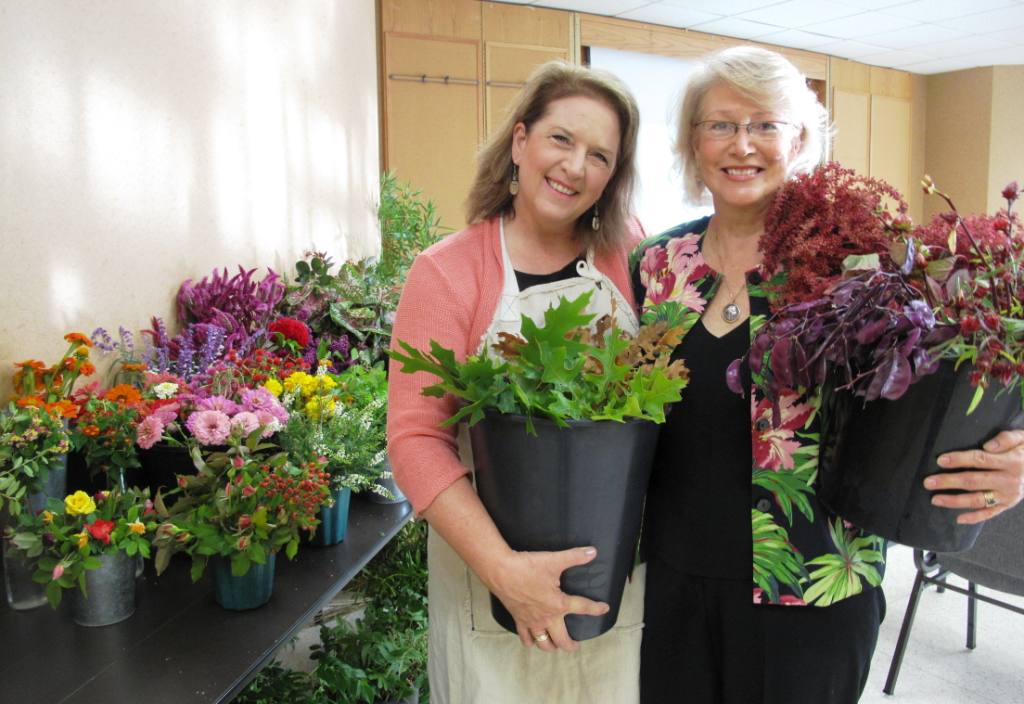
Courtesy of The Seasonal Bouquet Project, a photo from one of Jennie and Erin’s workshops in October. Erin Benzakein is seen 3rd from left, back row; Jennie Love is seen 6th from left, back row. 

For the past few years, I’ve been interviewing and writing about a category of designer who I dub the “farmer-florist.”

These include a rare group of individuals in the flower world who are equally talented in the science of growing flowers and the art of designing them. 

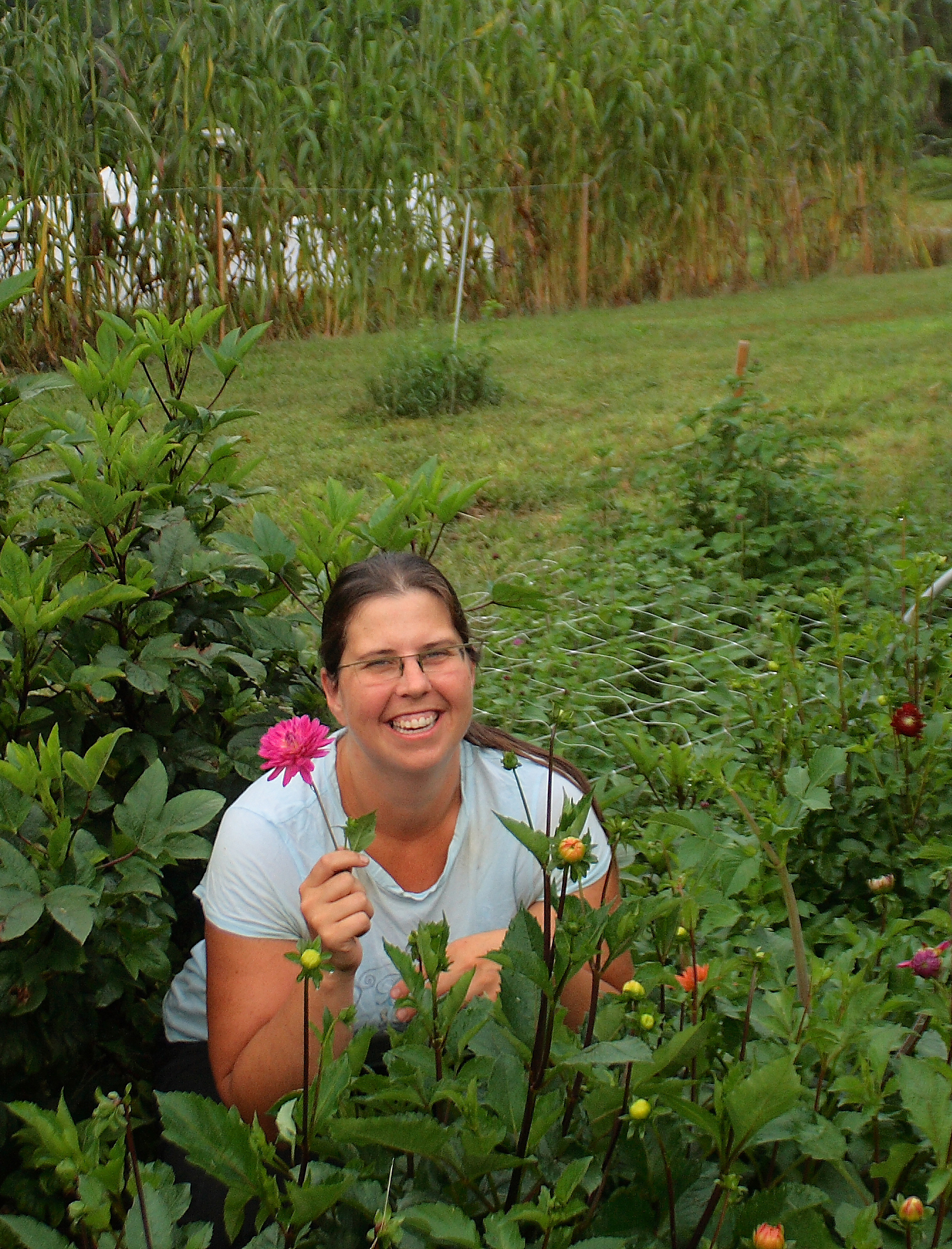
Jennie

Jennie Love, farmer-florist, and owner of Love ‘N Fresh Flowers, of Philadelphia

You’ll meet two of those talented people on today’s podcast, Jennie Love of Love ‘N Fresh Flowers in the Philadelphia area and Erin Benzakein of floret flowers in Washington’s Skagit Valley. 

Both Erin and Jennie have been in the business of creating stunning floral art with locally grown materials for several years now. Their west coast/east coast friendship prompted these flower friends to create THE SEASONAL BOUQUET PROJECT in early 2013. Their first post featured yummy, early spring flowers, posted on March 5th.

The Seasonal Bouquet Project emerged from a winter brainstorming session about “how to feed our souls’ fires during the hectic months of the growing season and how to further demonstrate the beauty of locally grown flowers to a wider audience.  And, to be completely candid, it’s a bit of a competitive double dog dare between two people who like to have some fun,” according to their website. 

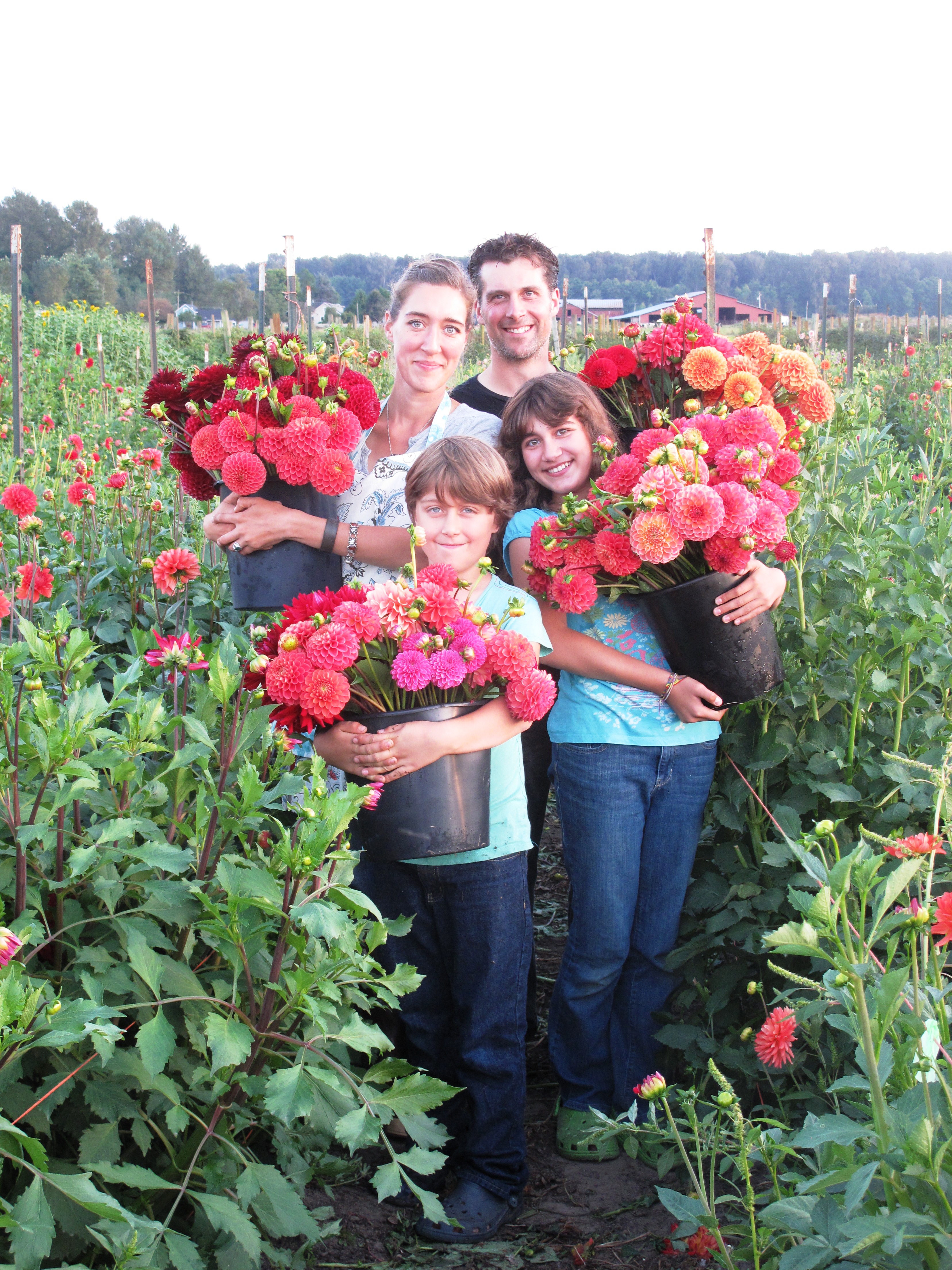
Benzakein family

Erin Benzakein, with her husband Chris and children Elora and Jasper. I took this photo last summer at floret flowers, their farm in Washington’s Skagit Valley.

All the materials used in the bouquets were grown within a 25 mile radius of the respective designer, the vast majority coming straight from their own flower fields.  

As they wrote on their website: “Since  we’re on opposite coasts growing in very different climates, this project is a showcase for what’s available through the seasons across the country.” People all across the country and around the globe, for that matter, followed along on the gorgeous journey. Erin and Jennie also invited readers to post photos of their own bouquets, as long as the ingredients were within that 25-mile radius. 

As you will hear in this interview with Jennie and Erin, which took place on October 25th via Skype, the friends cooked up a 2-day workshop to celebrate the “end” of their season. They planned “The Seasonal Bouquet Project LIVE” and scheduled the event to take place on Jennie’s flower farm in Philadelphia. Listen along to hear what happened next – and gain inspiration and insights into the life of a farmer-florist.
Photos to enjoy from Jennie Love and her farm:

Jennie

Jennie farms on agricultural land that dates back to William Penn. Photo by Maria Mack Photography ©2012 http://mariamackphotography.com


A beautiful summer bouquet, grown & designed by Jennie Love Maria Mack Photography ©2012  http://mariamackphotography.com

A beautiful summer bouquet, grown & designed by Jennie Love Maria Mack Photography ©2012 http://mariamackphotography.com


zinnias in July

Zinnias in July, designed by Jennie Love.

Photos to enjoy from Erin Benzakein and her farm:

floret roses

Garden roses at floret flowers, August 2012. I took this shot during our photo shoot for Country Gardens magazine. 


Floret Bouquet

Erin’s bouquet, designed for Country Gardens magazine.

Thanks for joining me in this episode of SLOW FLOWERS. Because of your support as a listener, we’ve had more than 2,200 downloads since July – and I thank you for taking the time to join to my conversations with flower farmers, florists and other notable floral experts.

If you like what you hear, please consider logging onto Itunes and posting a listener review.

Until next week please join me in putting more American grown flowers on the table, one vase at a time. 

The Slow Flowers Podcast is engineered and edited by Hannah Holtgeerts. Learn more about her work at hhcreates.net. 
SLOW FLOWERS: Week 44

Sunday, November 3rd, 2013

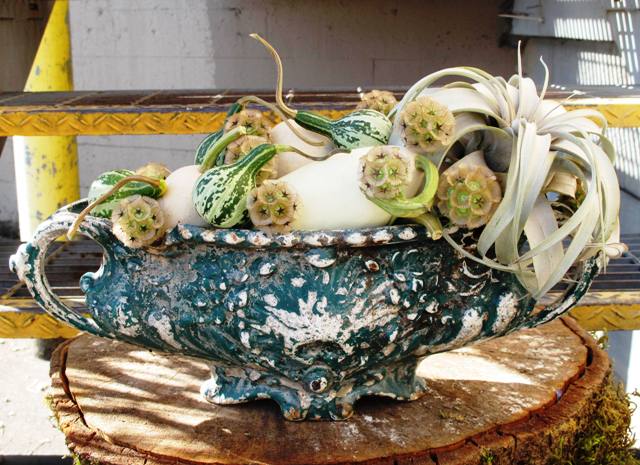
TARNISHED AND TEXTURED

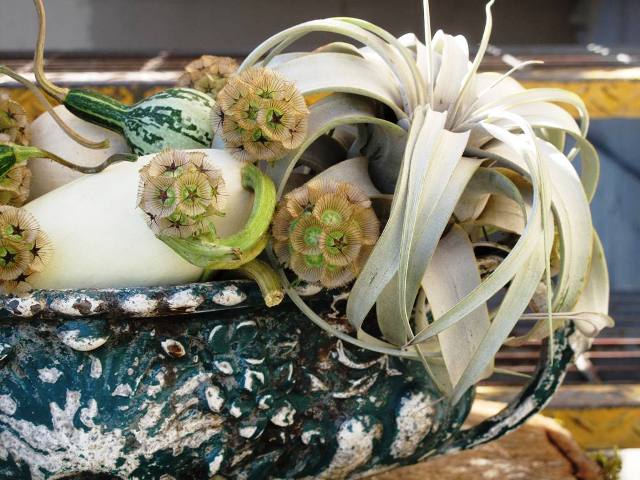
Tillandsia detail

Super-popular tillandsias, especially this ghostly-white species, makes for an interesting fall centerpiece.
Ingredients:
1 Tillandsia xerographica plant, a gift from Nan Sterman (Tillandsias benefit from a light spritzing of water every week or so) 
3 Japanese nest egg gourds, grown by Jello Mold Farm
5 Tennessee dancing gourds, grown by Jello Mold Farm
9 stems Scabiosa stellata ‘Paper Moon’, grown by J. Foss Garden Flowers
Vase:
5½-inch tall x 16-inch long x 6-inch wide, vintage cast-iron planter, found at the Long Beach Flea Market
 
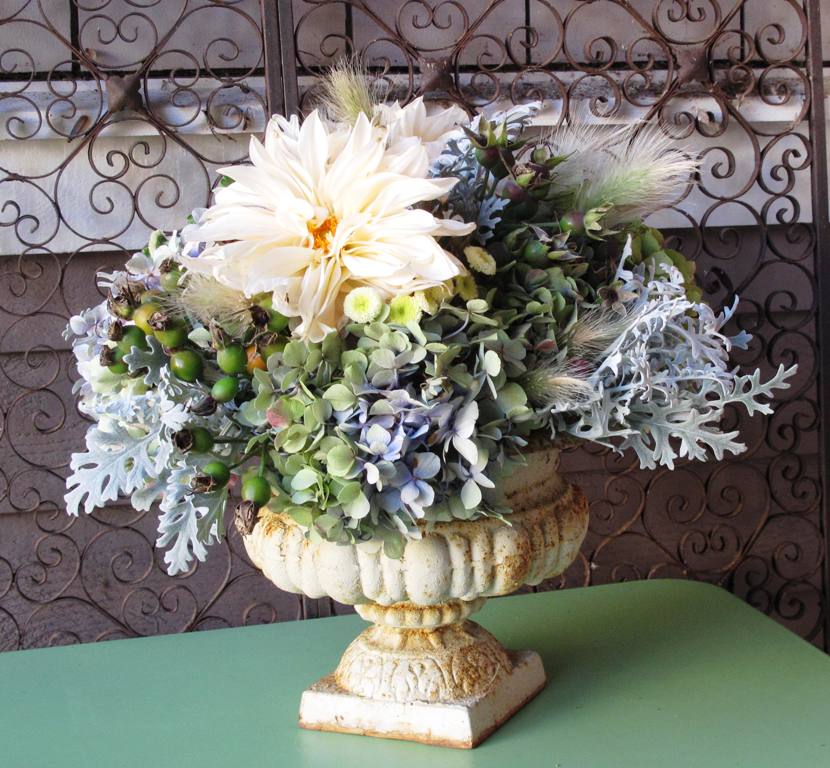
Tillandsia in a tarnished urn.

There’s a pleasing asymmetrical balance created by using this tillandsia on the right side of the design, as it echoes the urn’s curved handle on the left.

 
Design 101
Balance, a design principle: Balance is deeply ingrained in our psyches. In the garden or in a vase, a visuallybalanced design feels pleasing to the eye; when something feels out of balance, it can be agitating to look at. Balance is divided into three categories: Asymmetrical (seen here), in which both halves of a composition may express similar visual weight but are unevenly positioned.
 
Balance is created by a shift in weight on either side of a central fulcrum. Here, you see that the left side of the arrangement reveals the decorative handle of my urn, while the right side of the arrangement offsets it with the curved leaves of the tillandsia. Symmetrical or bilateral balance means that both sides of a composition are equal, one side essentially mirroring the opposite side. Formal flower arrangements are often symmetrical. Radial balance emanates from a central core, like the rays of a sunflower or spokes of a wheel. This dynamic approach appears in perfectly-domed bridal bouquets or centerpieces designed for 360-degree viewing.


SLOW FLOWERS Podcast: Cynthia Alexander left behind her Texas law practice to become a flower farmer (Episode 113)

Wednesday, October 30th, 2013
Cynthia and Debra

My visit to Ft. Worth this month gave me a wonderful chance to reconnect with flower farmer Cynthia Alexander.


Cynthia Alexander

Cynthia Alexander, flower farmer and owner of Quarry Flower Farm.

You could call Cynthia Alexander, a “chapter two” flower farmer. A passionate gardener, Cynthia has spent the past several years reinventing herself from a real estate attorney into someone whose relationship with land is exemplified in a completely different way! 

Over the past few years, Cynthia and her husband Bob have been transitioning from the city to the land. Quarry Flower Farm, their 120-acre farm, is located in Celina, Texas, about 40 minutes outside of the Dallas-Ft. Worth urban center. 

Earlier this month, I traveled to the Ft. Worth Garden Club to lecture about the “Slow Flowers” movement and to lead a workshop for members of the Garden Club’s floral design group. This was my second visit to the Dallas Ft-Worth area to talk about LOCAL flowers and in both cases, my “credibility” was enhanced thanks to Cynthia.

She is a native Texan whose goal is spreading beauty through organic agriculture and the practice of good land stewardship.  Her repertoire of ingredients is impressive!

At Quarry Flower Farm, Cynthia grows native Texas shrubs and trees, as well as perennials, annuals, grasses, bulbs, vines and herbs. Her fascination with botanical elements means she has an incredibly diverse list of ingredients for floral fans, everyone from hot floral designers to farm-to-table caterers.

Cynthia's Flowers

The botanical bounty that came from Cynthia’s harvest was mind-boggling!

Here is the extensive list of flowers, foliage, herbs, branches and ornamental grasses she provided for the Ft. Worth workshop: 

Amaranthus ‘Red Hopi’
Artemisia 
Aster
Beautyberry
Black Bamboo
Bois D’Arc apples
Broomcorn
Cardoon
Celosia 
Chinaberry foliage, yellow berry
Cotinus
Cotton Bolls
Crepe Myrtle
Dianthus
Elm Winged branches
Garden Roses
Geranium scented
Gomphrena ‘Fireworks’
Hibiscus ‘Jamaican Red’
Juniper silver berry
Lambs ears
Lantana 
Liatris
Love In A Puff vine, pod
Magnolia
Marigold
Myrtle branches
Peppers
Perilla green
Persimmon branches
Pittosporum 
Poke
Privet 
Purple Hyacinth Bean pods
Pyracantha orange berry
Rattanvine
Rosehips
Rush
Sage
Salvia Leucantha
Sansieveria 
Sedum 
Sunflower Maximillian
Tritonia
Vinca 
Yellow wildflower
Zinnia 
 
Cynthia Alexander

Cynthia’s design talents were evident when we met in 2012 at a field-to-vase workshop I taught at the Dallas Arboretum.

Cynthia first came to my rescue in February 2012 when I taught an eco-floral design course at the Dallas Arboretum. I had contacted her through the ASCFG directory, asking for help. Cynthia showed up with a bevy of flowering bulb varieties and spring branches – much to the delight of the Dallas floral design students. After all, it was FEBRUARY, for goodness sake’s. She saved the day!

The same thing happened when I encouraged the Ft. Worth Garden Club to source LOCAL Texas leaves, branches and flowers from a real flower farmer. Cynthia is a gem. And you’ll find her personal story fascinating.

I mean really….how many people leave a successful, 30-year career as an attorney in order to dig in the dirt and grow cut flowers? For that reason alone, I adore this gifted woman. Enjoy our conversation and listen for all of Cynthia’s advice about her second career – as a cut flower farmer. 

In addition to the flower fields at Quarry Flower Farm, Cynthia and Bob cherish their unique location and beautiful pond (a former gravel quarry). They nurture a native habitat that attracts many birds, butterflies and critters.  They have used green-building practices, sourcing materials from an English-style oak timber-frame barn (circa 1835), from the Mohawk Valley in New York, which they have re-erected beside the quarry pond. 
 
Quarry Flower Farm

The farmhouse at Quarry Flower Farm.

Cynthia hosts garden club tours, bridal parties and U-pick guests by appointment during the spring growing season. Check her web site for details.

Other Resources mentioned in our interview:

The Flower Farmer: An Organic Grower’s Guide to Raising and Selling Cut Flowers (Chelsea Green Publishing, 2008), by Lynn Byczynski 

Cynthia mentioned that her inspiration began by spending time with Pamela and Frank Arnosky, owners of Texas Specialty Cut Flowers. The Arnoskys have also written an important resource, as well, Local Color: Growing Specialty Cut Flowers.

Association of Specialty Cut Flower Growers is a membership association of flower farmers in every state. The ASCFG has many wonderful resources for beginning and established flower farmers. 


Thanks for joining me in this episode of SLOW FLOWERS. Because of your support as a listener, we’ve reached nearly 2,000 downloads since July – and I thank you for taking the time to join to my conversations with flower farmers, florists and other notable floral experts.

If you like what you hear, please consider logging onto Itunes and posting a listener review.

Until next week please join me in putting more American grown flowers on the table, one vase at a time. 

The Slow Flowers Podcast is engineered and edited by Hannah Holtgeerts. Learn more about her work at hhcreates.net.


SLOW FLOWERS: Week 43

Sunday, October 27th, 2013

HAPPY HALLOWEEN

Orange McCoy

Orange-glazed vintage McCoy sets the color palette for this autumn arrangement.

ladder with 2 vases

Two vases, same vintage; different styles. Ready for the festive autumn holidays.

Ingredients:


I used a combination of these floral ingredients in the two bouquets:
Culinary mint (Mentha sp.), grown by J. Foss Garden Flowers
Marigolds (Tagetes erecta), grown by J. Foss Garden Flowers
Crocosmia x crocosmiiflora ‘Emily McKenzie’, grown by J. Foss Garden Flowers
Fountain grass (Miscanthus sinensis ‘Rotsilber’), grown by Jello Mold Farm
Feverfew (Tanacetum parthenium ‘Vegmo Lime’), grown by Everyday Flowers

Vase:
6-inch tall x 4-inch diameter vintage McCoy bud vase

Flower pot:
5¼-inch tall x 5-inch diameter vintage McCoy flower pot

Grow This
Ornamental grasses: Autumn is the best time of year to harvest ornamental grasses and grains for inclusion in bouquets. Right after the fountain grass, foxtail grass and millet bloom, when the heads are still ripe, cut the slender grass stems and place in fresh water until used in an arrangement. If you harvest grasses after the seed heads have begun to dry, they tend to shatter, leaving little seeds all over your tablecloth.


SLOW FLOWERS Podcast: American Flower Farming Update with Lane DeVries (Episode 112)

Tuesday, October 22nd, 2013
Lane DeVries

Meet Lane DeVries, CEO of The Sun Valley Group, America’s largest cut flower farm, and Chairman of the California Cut Flower Commission.

American Flower Farming Update with Lane DeVries, Chairman of the California Cut Flower Commission (Episode 112)

Today’s interview is with Lane DeVries, a fourth generation flower farmer who grew up in his family’s business in Holland until he came to the US in 1983, at the age of 23.

I’ve gotten to know Lane in the past few years while partnering with him on projects for the California Cut Flower Commission, the advocacy agency that promotes that state’s 225 flower farms. His farm, The Sun Valley Group, based in Arcata and Oxnard, is the state’s largest (in fact, it’s the country’s largest).

Lane and I recently met in Portland, at the Field-to-Vase Dinner, a very special gathering of flower farmers, florists, flower retailers and wholesalers and the media, held on October 8th.

I co-hosted the event with the CCFC and our goal was to convene floral industry leaders to discuss new initiatives in the American Grown Flower Movement.

The underlying message: partnering with your would-be competitors is a good idea when it comes to changing how consumers connect with domestic flowers.

New Seasons Market

Lane takes time to meet flower consumers as often as possible. He recently made an appearance at New Seasons Market in Portland, Oregon.

My podcast interview with Lane took place via Skype, a few days after that dinner. Please enjoy our conversation and meet a man who lives and breathes cut flowers. I love that Lane, in spite of all of his professional success, continues to eagerly seek out the next new thing. He sees old flowers in a new way and improves on customer favorites with new hybridizing methods.

He is a visionary and I credit Lane with his amazing leadership moving his own flower farming community into an important dialogue about American grown flowers.

The next time you see a blue-and-yellow license plate-style CA-Grown label on a bouquet of flowers at the supermarket, you’ll have people like Lane DeVries to thank.

cover_flower_confidentialHighlights of Lane’s long career in the U.S. cut flower industry are chronicled in Amy Stewart’s 2007 book, Flower Confidential: The Good, The Bad, and the Beautiful – and you can read an excerpt of that story here, courtesy of Amy and Algonquin Books of Chapel Hill (c) 2007 and 2008. All Rights Reserved. 

(Photos (c) Linda Blue, courtesy of the California Cut Flower Commission)

Local Flower Growers Say: “Pick Me” – The Field-to-Vase Dinner Recap

Sunday, October 20th, 2013

Note: This article originally appeared in the online edition of The Oregonian, October 17, 2013. Click here to read the online version where you can comment and Tweet the link. I want to acknowledge up front that the Field-to-Vase Dinner concept and format began in June 2013 at the Monterey Bay Greenhouse Growers Dinner, created by my friend Kathleen Williford of the California Cut Flower Commission. The Portland event earlier this month was based on her model and she was there in spirit! Follow Kathleen at @kathinated.

The Table is Set.

The table was set with American-Grown flowers, the vases containing stems from Oregon, Washington & California cut flower farms.

10194582873_b2cfe7e857_o

Menu

A shared meal, local food, local flowers and an important dialogue about American Grown Flowers.

A coalition of California cut flower farmers recently arrived in Portland, extending their hands of friendship to the local floral industry. They weren’t exactly holding olive branches, although those botanical elements would likely be found in a vase of California-grown blooms.

No, the reason was self-preservation, not just for the seven California farms in attendance, but for their counterparts in Oregon and Washington.

Their Field-to-Vase gathering took place on Oct. 8 at Leach Botanical Garden in southeast Portland, where a local caterer served a decidedly local menu to about 40 flower farmers, floral retailers and wholesalers, and designers.

Part flower summit, part floral showcase, the event brought together people who might otherwise view themselves as competitors. 
 
Collaboration is the best way to save American cut flower farms, maintained Lane DeVries of The Sun Valley Group based in Arcata, Calif., the largest cut flower farm in the United States.  
Lane DeVries

Meet Lane DeVries, CEO of The Sun Valley Group, America’s largest cut flower farm, and Chairman of the California Cut Flower Commission.

DeVries is also the current chairman of the California Cut Flower Commission, the organization that hosted the event.

U.S. flower farms once produced nearly 65 percent of the nation’s cut flowers, but over the past two decades, imports from South America have caused that figure to shrink to around 20 percent, DeVries said.

“We’ve actually seen cut flower operations go out of business in a lot of states,” he said. “The reason we are reaching out to (Northwest) flower farms is to work together as an American-grown domestic flower movement.”

Flower farming cooperatives are well established in the Northwest, dating to 1942 when the Oregon Flower Growers Association was founded. The wholesale farmer-to-florist market operates from a warehouse in Portland’s Swan Island industrial district with about 30 vendors.

In 2011, inspired by Portland’s home-grown floral business model, the Seattle Wholesale Growers Market opened on behalf of 16 Oregon and Washington flower farms.

Diane and Molly

Diane Szukovathy and Molly Sadowsky of the Seattle Wholesale Growers Market

According to Diane Szukovathy, a Mount Vernon, Wash.-based farmer and the Seattle growers’ market president, the emerging market’s locally grown efforts gained momentum last fall when it received $138,000 in USDA Specialty Crop Block Grant funds, administered in partnership with the Washington State Department of Agriculture and the Oregon Department of Agriculture.

“The grant money helps us open more distribution channels for local farms to sell their flowers,” Szukovathy said. “Together, we can all shed light on major shifts in how people buy flowers.”

A wide variety of Northwest-grown flowers and foliage is found in the floral departments of New Seasons Markets.

bouquets

These Farm Bouquets represent the participating flower farms from California, Oregon and Washington – a veritable bounty of botanical excess!

Katie McConahay, the chain store’s floral merchandiser, said she’s starting to expand her definition of what is local and seasonal to include California-grown flowers, especially during the winter months when production on Northwest flower farms is lower.

“When I buy for our stores, my focus is definitely on Oregon- and Washington-grown flowers,” McConahay said. “For many of our customers, California was not considered ‘local,’ but in order to sustain an American-grown floral product consistently throughout the year, California is a good year-round option for us.”

She hopes better product information and education at stores will help consumers see that domestic flowers, even from one state away, offer an alternative to imported ones.

Dinner

The gathering was held in a quintessential Northwest venue: Portland’s Leach Botanic Garden.


fall bouquet

Seasonal, local and sustainable flowers – beautiful and of the moment.

For Christopher Papst, a manager-buyer with Greenleaf Wholesale Florist, based at the Portland Flower Market, bringing California flowers to the Northwest is a logical next step after sourcing locally, especially in the off-season when production is limited on Oregon and Washington flower farms.

“For one thing, the transportation costs are better,” he explained. “Ninety percent of imported flowers come through Miami, followed by three to four days on a truck. Even under ideal conditions, it’s still four days. For the freshness factor alone, I want California flowers.”

Increasingly, florists are coming to Greenleaf with specific requests for local and seasonal flowers, Papst added. “I just had a florist asking where our flowers originated from because she had a customer insisting on local flowers.”

Elizabeth Artis

Elizabeth Artis of Espe Floral + Foliage, a Portland designer with a commitment to local and seasonal flowers.

Elizabeth Artis, owner of Espe Floral + Foliage, a flower shop inside the Food Front Cooperative Grocery in northwest Portland, was encouraged by the connections she made at the gathering. Her studio’s tagline is “local, seasonal, sustainable, lovely,” a sentiment that resonates with her eco-minded customers.

“I’ve always considered California ‘local,’ and now I have a new vocabulary to communicate that idea to my clients,” she said. “As winter is coming, having flowers from California – just across the border – will give me more options.”

Local flower farmers
If you prefer domestic flowers:

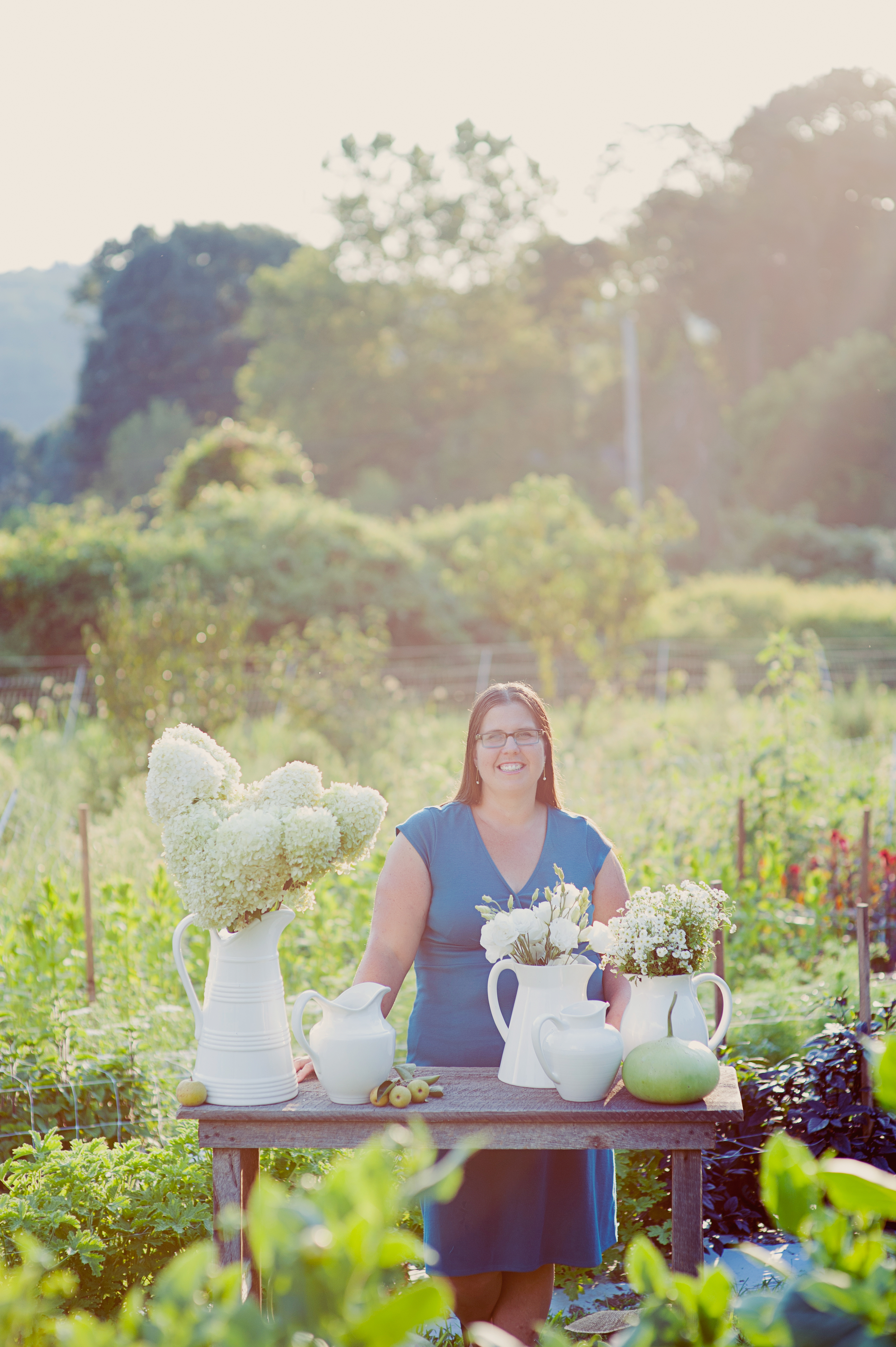
Debra Prinzing is a Seattle-based design writer, author of “The 50 Mile Bouquet” and “Slow Flowers: Four Seasons of Locally Grown Bouquets from the Garden, Meadow and Farm” and creator of Slow Flowers, a new, free online directory to help consumers find florists who use American-grown flowers. 

READ MORE…

SLOW FLOWERS: Week 42

Sunday, October 20th, 2013

MARKET FRESH

Todays Dahlias

The season for dahlias is almost over, but these vivid selections are a reminder of how much we LOVE this amazing flower.

Ingredients:
20 stems Dahlia ‘Audrey Grace’, ‘Keith H’ and ‘Pearson’s Patrick’, grown by Dan’s Dahlias
5 stems fountain grass (Miscanthus sinensis), grown by Jello Mold Farm
5 stems yellow crocosmia (Crocosmia sp.), grown by J. Foss Garden Flowers
6 stems millet (Setaria italica ‘Red Jewel’), grown by Charles Little & Co.
 
version1Vase:
13-inch tall x 7-inch diameter galvanized metal flower bucket
 
Grow This 
Dazzled by dahlias: Perhaps it’s because of their amazing diversity in color, form, petal shape and size, but the dahlia is no longer just an old-fashioned cottage flower.
 
It’s an in-demand ingredient for brides, hosts and floral designers who can’t seem to get enough of this plant that originated in the highland areas of Mexico and Central America. “They vary in size from less than two inches to ten inches,” Dan Pearson points out.
 
“People are drawn to those dinner-plate-sized flowers for the wow factor, but soon they realize that the smaller to medium-sized flowers are useful for bouquets.” You can learn a lot more about growing and harvesting dahlias at www.dansdahlias.com.


SLOW FLOWERS: Week 41

Sunday, October 13th, 2013

CLUSTERS OF PINK

small bouquet in pink

Autumn hydrangeas, pink snowberries, luscious dahlias harvested just before late October frost and ball-shaped gomphrena add up to something quite charming. 

Ingredients:
 
4 stems hydrangea (Hydrangea macrophylla), harvested from my garden
9 stems pink snowberry (Symphoricarpos x doorenbosii ‘Amethyst’), grown by Charles Little & Co.
5 stems Dahlia ‘Nijinsky’, grown by Everyday Flowers
15 stems globe amaranth (Gomphrena globosa), grown by Charles Little & Co.
 
Vase:
 
6-inch tall x 7-inch wide x 4-inch deep vintage Floraline florist’s vase
 
Design 101
 
sm_three_pink_gomphrena_4895Group for impact: Tiny flowers can disappear when they are added to a bouquet with mostly larger blooms. One of the ways to give them more impact is to group three or five into a mini-bouquet, tied with bind wire or string. When added to the bouquet, the small cluster reads as a color block that’s more noticeable in the overall composition. Here, I wired together several sets of the clover-like globe amaranth flowers and inserted them between the much-larger hydrangea and dahlia blooms.


SLOW FLOWERS Podcast: Sarah Ryhanen of Saipua – a Brooklyn floral designer plants her own flower farm (Episode 110)

Wednesday, October 9th, 2013

CORRECTED AUDIO INCLUDED HERE~

Sarah Ryhanen of Saipua, is a Brooklyn floral designer who has planted her own flower farm (Episode 110)

Saipua means "soap" in Finnish, reflecting Sarah's family heritage.

Saipua means “soap” in Finnish, reflecting Sarah’s family heritage.


Nicolette and Sarah

Nicolette Owen (left) and Sarah Ryhanen (right), collaborators in The Little Flower School of Brooklyn.

I first learned about Sarah Ryhanen when I read an article about The Little Flower School of Brooklyn, a venture she had created with fellow floral designer Nicolette Owen of Nicolette Camille Floral. The article was in none other than the New York Times, in which the writer proclaimed the renaissance of old-fashioned floral design for modern-era crafters. 

Reading that article was like a huge floral flag being waved in front of my eyes.

Right on! The floral world I was so fascinated with documenting for The 50 Mile Bouquet was in good hands with these young, passionate, talented, urban designers. 

bowls and shears

All the supplies, beautiful, simple and ready for the flower arranging students at The Little Flower School of Brooklyn.

So like probably everyone else in the country, I started stalking Sarah through her web site and blog, and following Nicolette’s work through her web site and the lovely floral arrangements she created for Bringing Nature Home (Rizzoli, 2012), a book by photographer Ngoc Minh Ngo.

Welcome to Saipua

Welcome to Saipua + Flower School.

When I spent a few days in New York City last August, I contacted them to ask whether I could sit in on one of their workshops. The class was sold-out, of course, so I was just an observer. It was amazing to me that 12 persons (11 women and 1 man) gathered on a sweltering Saturday morning to create bowls of flowers in an un-airconditioned warehouse-studio in Brooklyn. There was so much excitement in the room, with a combination of newcomers and repeat students. People soaked up every word, concept and idea Sarah and Nicolette offered – and they were unabashedly proud of their own creations. 

Every detail was attended to in advance, as you can see by the photos I took that day. Sarah and Nicolette shared about their own design processes, about the way they select floral ingredients, and how they prefer to use materials like pin frogs and chicken wire (rather than foam). 

floral ingredients

Seasonal, locally-grown late summer flowers.

As the designs took shape, I had a bird’s eye view, perched in the tiny loft above the workshop. After students finished their arrangements, the women served them champagne and appetizers, like a fancy party. It’s no wonder these creative gatherings are so popular! It’s like going on an art retreat in the midst of your crazy, busy life. A moment in time that prompts anyone to feel more creative, more experimental, more artisitc.

When we met, one of the things Nicolette and Sarah and I discussed was the challenge of finding the flowers and botanicals they wanted and needed for special events, from weddings to workshops. Sarah told me that she and her partner Eric Famisan had recently purchased farmland in upstate New York, where they were in the early stages of planting a flower farm. 

students at work

A creative explosion of floral expression – enjoy this bird’s eye view.


Final bouquets

A still-life of the beautiful arrangements created by students of The Little Flower School of Brooklyn, August 2012.

Since then, I’ve watched as The Farm at World’s End has evolved, through Sarah and Eric’s wonderfully-photographed blog and honest, heartfelt text. 

Under a heading called “The Idea,” here’s what Sarah writes:

When the economy took a dive in 2008 we started to see a major loss in the NYC flower market. Loss of interesting product. The unusual, weedy, wild stuff that I was so into and that made my work unique. The trouble was that wholesalers had to be safe – the floral industry is one of the first to feel the blow of a weak economy. So wholesalers on the flower block of 28th street stuck to what they knew would sell; your South American hot house roses, ranunculus, lilies, peonies. Here’s a perfect example  — pre 2008 you could buy Garden Valley Roses (fragile, exquisite but expensive heirloom roses) on the block. 

Around that time I was starting to explore other outlets for material. We found local farms to supplement our market purchases (River Garden, Lebak, Added Value), and also started ordering product direct from the west coast – the promised land of flowers. 

Still there was always something I could not locate. Auricula, campanula “pantaloons”, black hellebores, unusual bearded iris…at Saipua we now spend hours and hours searching for the highest quality, most unusual flowers. Visiting flower farms and talking to growers is the best part of my job. You meet these crazy, passionate people and let me tell you – it’s contagious. Eventually you got to try growing yourself. So here we are.

On the flower block back in the city, the guys joke – when are you going to start selling us flowers? I try to explain to them (and to everyone who has not yet been to Worlds End) that it’s a slow process. That we’re years away from producing the opulent abundance that people envision when they hear “Flower Farm”. But I’ve come to realize that it’s not about quantity. I’m not in the business of hustling anymore. None of our work at Saipua will ever require thousands of stems.  It will however require a brown iris. And by god, I’m going to grow it.

Fortunately for listeners of The Slow Flowers Podcast, I had a quick 36-hour layover in New York a few weeks ago, en route to my Italian writing retreat. It coincided with a late afternoon opportunity to sit at the kitchen table in Sarah’s Brooklyn apartment, just around the corner from Saipua’s studio. We talked about farming, flowers and collaboration. Please enjoy the conversation.

SLOW FLOWERS: Week 40

Sunday, October 6th, 2013

OLD WORLD MEETS NEW FLOWERS

Vintage green vase

This evocative palette of green and dark maroon expresses complementary colors in a surprising new way.

Ingredients:
 
9 stems Sedum ‘Autumn Joy’, grown by J. Foss Garden Flowers
7 stems bells of Ireland (Moluccella laevis), grown by J. Foss Garden Flowers
7 stems chocolate sunflowers (Helianthus annuus ‘Moulin Rouge’), grown by J. Foss Garden Flowers
3 branches fruiting crab apple (Malus ‘Professor Sprenger’), harvested by Jello Mold Farm
 
Green Jar with flowers

Welcome~ the dramatic scale of my glass jar looks just right at the front door!

Vase:

13-inch tall x 9-inch diameter with 5½-inch opening, vintage Portuguese oil jar
 
Eco-technique
Botanical elements as flower frogs: I often start an arrangement using soft, fluffy foliage or dense flowers like the Sedum ‘Autumn Joy’ as the “base” that peeks out over the top of the rim. Once the stabilizing element is in place, all the other stems can be inserted through it and they will remain just where you want them. The foliage and flowers are integral to the overall composition and there’s no need for florist’s foam.