The Slow Flowers Podcast is the award-winning show known as the “Voice of the Slow Flowers Movement.” Launched in 2013 as the original flower podcast, we’ve devoted more than 10 years to covering the business of flower farming, floral design, and the Slow Flowers sustainability ethos. Listen to a new episode each Wednesday, available for free download here at slowflowerspodcast.com or on iTunes, Spotify, and other podcast platforms.
November 15th, 2007
 In recent weeks I’ve been at loose ends, trying to find my voice and my “inner muse,” as I recover from a marathon book production schedule that has pretty much occupied the past 12 months of my life.
Lately, the big question just simmering beneath the surface of my consciousness has been: “What next?”
I just don’t know.
Having poured so much intense focus and passion into Stylish Sheds and Elegant Hideaways, I now feel a bit of sadness because the process has ended. It was such an intimate, joyous experience of just two people sharing their individual gifts to create a book. It was glorious, exhilarating and painful (good pain) process. 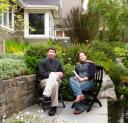 Bill Wright, my partner and photographer, has been the best collaborator I could have asked for. He has been exceedingly gracious, patient and a good traveling companion to boot.
This week we proofed the second “dummy” – the entire book in color photocopied form, text, images, layout in place. All 224 pages of it! To hold the book in my hands on April 29th will be a dream come true. (photo: Bill and Debra, on location in SF Bay Area, 6 a.m., March 2007)
But still… “What next?” The pressing question of the moment.
All I know right now is that I have to get my hands in the soil, literally. I planted today. Planted not just with a shovel but (unfortunately) with a pickax. I thought I would leave clay soil behind when I moved from Seattle to Southern California. NOT. There are parts of SoCal comprised of agricultural-rich soil, while other parts (the riverbeds) are sandy and still other parts seem to be compacted clay. I think one reason my garden’s soil is so horrible is that it has been suffocating under thick plastic sheeting and four-inch-thick layers of egg-sized red lava rock (the previous owners’ idea of having a low-maintenance landscape).
“Peeling away” a ton of rocks and huge sections of plastic as I begin to work organic matter into the dirt is part of the rebirth of this piece of land. That “rebirth” metaphor applies to my creative journey, as well. My dearest friend Britt, an Episcopal priest, put words to the emotions I’m feeling. I was fortunate enough to see her yesterday when she was in LA for a meeting. (photo: Deb and Britt, August 2007, Newport OR, celebrating Britt’s wedding weekend)
 “You are in the process of unearthing the soil of your own life,” she said. “You need to get to the root, the essence, of yourself.” This makes some sense to me. I am trying to dig deeper and discover (define?) what drives me creatively. And it is both confusing and compelling to examine everything from small, exciting details (an unfamiliar bloom, a backlit blade of grass, a perfectly-shaped succulent) and big macro ideas that stretch my thinking (notions of friendship, truth, fidelity, and integrity).
 So for now, all I know is that in order to understand beauty, I must strive to create it in my own life. If that means stretching my muscles to wield a pickax, so be it.
Be patient toward all that is unsolved in your heart and try to love the questions themselves. Rainer Maria Rilke
Posted in Creativity | 3 Comments »
November 13th, 2007
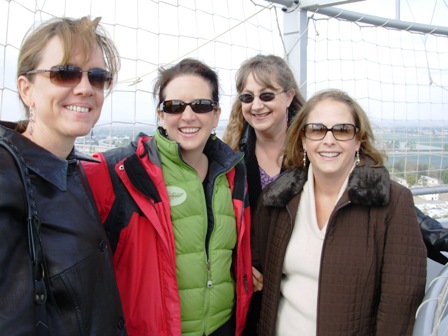
Southern California Garden Writers members convene – 150-feet in the air above Orange County’s Great Park; from left: horticulturist Heike Franzen, me, author and houseplant expert Julie Bawden-Davis, and freelance writer Katie Bloome.
Gather together 30 gardening communicators for a day of networking and idea-sharing and you are guaranteed to have fun, inspiration and even a little controversy as opinions and ideas are swapped. The date: Sunday, November 11th. The venue: Roger’s Gardens, one of the country’s preeminent independent retail nurseries located in the coastal town of Corona del Mar.
Before we settled down to hear from three fascinating speakers, the group of writers, television and radio personalities, photographers,  plant experts and horticultural vendors convened at Orange County’s Great Park in nearby Irvine. According to horticultural consultant Tom Larson, who is an advisor to this mammoth, 20-to-30 year endeavor, the Great Park is large enough to encompass Central Park, Balboa Park and Golden Gate Park in its acreage.
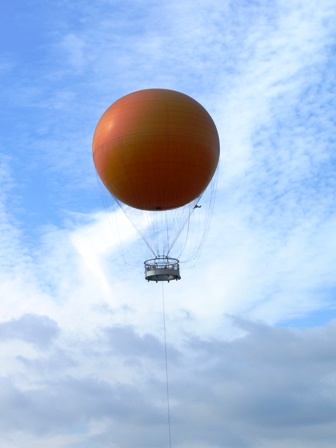
The 72-foot diameter balloon took us several hundred feet in the air and provided visibility of 20 miles.
Yes, it is a decommissioned military base, but once we boarded the bright orange hot-air balloon and ascended several hundred feet above the barren scene, we started to “get” the vision of the Irvine city fathers, environmental pioneers and community activists determined to create something very special in the midst of overdeveloped Southern California.
This ambitious endeavor will include a mind-boggling array of horticulture, sustainable agriculture and native habitat in a several hundred acre “park.” Where Marine jets once took off and landed (the base was built in 1942 on the site of what once served as growing fields for popular California crops) will soon be a living, “green” community hub.
New York-based landscape architect Ken Smith’smaster plan includes a 2.5-mile tree-lined “canyon,” a lake and botanical garden, picnic lawns, amphitheatre, sports parks and wildlife corridor for migratory terrestrial and aviary animals. A conservatory “bridge” will span the lake; 150,000 native trees are being grown for planting; conservation and sustainable design practices are in place. Eighty percent of the demolished building material (steel, aluminum, wire, sheet-rock, concrete from the military base) will be recycled. Whew.

Nan Sterman, San Diego-based gardening personality, author and designer, and national GWA Director-extraordinaire planned this amazing day for all of us.
Planners are bringing together plants and people, providing urban land for small-scale organic farmers, growing landscaping plants that support wildlife and nurture people, and recycling water for irrigation. It is truly amazing that voters several years ago rejected a proposal for yet another international airport in favor of reclaiming this land for community use. If you come to Orange County, you need to make time to visit – and return (as this will be one of those multi-decade endeavors). The investment is for future generations and I find that exciting and inspiring.
In the interim, while development is underway, the Great Park planners are turning over several acres of land to two food bank operations, Community Action Partnership and Second Harvest, with the goal of growing nutritious, wholesome produce for the community’s homeless population and others facing hunger.
Back at Roger’s we settled in for “News You Can Use: Industry & Environmental Trends for Garden Writers – All About Plants, Gardens and Garden Communications.” Three Southern California experts shared their insights:
 News from the Wholesale/Grower World: Plant trends with Nicholas Staddon (director of New Plant Introductions, Monrovia Growers)
Nicholas highlighted the following trends:
Plant “Branding”
Native plants (with a region-by-region focus)
Awareness of Invasives (see Carl Bell, below)
Waterwise plant choices
Tropicals-and-arid plants together
Minimalist gardening (doing more with less)
 News for the Environment: Invasive Plants in Southern California with Carl Bell (UC Cooperative Extension)
Claiming, “there are no good weeds; there are no bad plants,” Carl highlighted the forthcoming “PlantRight”initiative that will be rolled out statewide in February 2008. The program will encourage consumers and retail nurseries to “Keep Invasive Plants In Check,” and voluntarily stop the sale and planting of known invasives.
One of the smartest features of the program is to suggest to home gardeners non-invasive plant alternatives to the garden thugs. Carl offered these definitions to guide the discussion of “what is an invasive plant?”
EXOTIC:
to a gardener, it means “foreign, tropical, interesting, cool”
to an environmentalist, it means a “bad, foreign, invasive pest”
to a regulatory agency, it means “a foreign organism that is likely a pest (although other governmental buzzwords include “alien” and “noxious,” a legal term that requires eradication, containment or control.
NATIVE/INDIGENOUS:
“Evolved in that location, present without any influence of humans (in California environmental organizations like the California Native Plant Society, Audubon, Sierra Club, “native” is regarded as specific to a region or area of the state)
NON-NATIVE/NON-INDIGENOUS:
“Introduced by humans, either accidentally or intentionally”
NATURALIZED:
A non-native plant that has established a stable, reproducing population in an area after introduction. Naturalized plants do not necessarily invade other areas. This term is used essentially the same way for gardens or natural habitats.
INVASIVE:
A naturalized plant that is spreading out from the location where it was introduced. Rapid or slow, its spread can be aided by disturbance or not, and it can have mild to drastic impacts on the native flora/fauna.
WEED:
Any plant that is objectionable or interferes with the activities or welfare of humans; invasive plants are a special category of weeds.
Other resources:
The St. Louis Declaration on invasive plant species
Cal-HIP (California Horticultural Invasives Program)
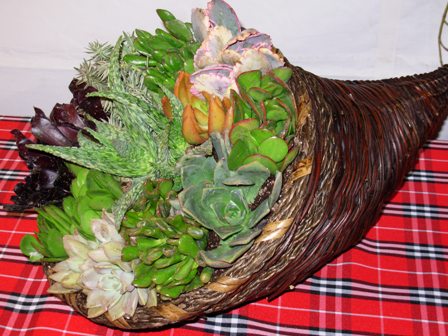
An awesome centerpiece of “Retro Succulents” from EuroAmerican Propagators — illustrates one HOT plant trend
News from the Retail Nursery World: What’s Hot and What’s Not in Home Gardening with Ron Vanderhoff (Nursery manager, Roger’s Gardens):
Ron is a veteran nurseryman and garden writer whose popular weekly column “The Coastal Gardener” appears in Orange County’s Daily Pilot newspaper. Here is his inside-scoop on the ins-and-outs of gardening trends:
NOT: “Gardening” vs. HOT: “Gardens”
According to Ron, yesterday’s definition of a garden was a place where one would “grow” and “care for” plants; a place of enjoyment and work (emphasis on “work” as a verb)
While today’s definition of a garden is a “living space” that’s also a place of enjoyment and relaxation (emphasis on “relaxation” as an experience)
Other HOT trends:
Inside-Out: The walls of our homes have come down; homeowners are now “exterior design” experts; plants only account for one-third of spending on outdoor living
Posted in Creativity, Entertainment, Gardening, Shed Glossary | 6 Comments »
November 9th, 2007
I’m always happy when the monthly Southern California Horticultural Society meetings roll around (second Thursday of each month), despite the requisite l-o-n-g drive on LA freeways to get there. Last night was a plant-lovers’ celebration, featuring ceanothus expert and nurseryman David Fross. Ceanothus includes the North American native plants known as wild lilacs, mountain lilacs, California lilacs, blue-blossoms, and buck-brushes.
 David Fross, founder of Native Sons wholesale nursery in Arroyo Grande, CA, coauthored Ceanothus (Timber Press, 2006) with Dieter Wilken, botanist at the Santa Barbara Botanic Garden. The 272-page book is a tribute to Fross’s lifelong love affair with the blue-flowering woody shrub. The seduction is evident in his text:
“Each spring, tints and shades of azure, cobalt, indigo, and cerulean surface in the chaparral of California as if to offer a new name for the Golden State. Madder blue, milk-blue, and lavender, and then there are the blues of the sea — aqua, ultramarine, and a hue found only in the Sea of Cortes. The genus includes plants with flowers of each of these colors, and more: cyanine, sky blue, and the flinty hues of slate.”
 According to Fross, who divides this plant monograph into two sections — “Ceanothus in the Garden and Landscape” and “Ceanothus in the Wild” — the English are much more creative than North American gardeners in planting ceanothus, using it as a hedge, groundcover, specimen tree, or climbing/espaliered embroidery on the face of an ancient stone building. “In London, they use ceanothus everywhere,” Fross proclaimed, saying he once counted 17 ceanothus plantings between his London hotel and the train station.
Luckily, it’s not too late to start using the hundreds of species and cultivars outlined in Ceanothus. For a guide, I’ll turn to page 125, Fross’s useful selection reference. He suggests cultivars for good garden tolerance, covering banks, groundcovers, informal hedges and screens, specimens and small trees, small garden spaces, seashore and shade. Plus, he lists eight variegated cultivars; I am a sucker for variegated foliage (I inherited an early specimen of Ceanothus thyrsiflorus var. griseus‘Diamond Heights’ from my pals at Seattle’s Elisabeth C. Miller Botanical Garden in the early 2000s, and enjoyed the awesome gold-and-green chevron-marked foliage in a glazed Chinese-red container before transferring the plant to the front slope of my Seattle garden, where I hope it still lives). Fross also lists summer flowering ceanothus, plants with large inflorescences, fast-growing cultivars and white blooms.
In Seattle, ceanothus has the reputation for being short-lived and finicky (I remember early on over watering ‘Julia Phelps’ only to watch her succumb from too much of a good thing). Now, I’m excited to try this “classic California genus” in my Zone 10 landscape. One spot on my must-visit list: Leaning Pine Arboretum, California Polytechnic University in San Luis Obispo, where there is an extensive display of California native ceanothus (Fross directed the development of the California Collection there).
MORE PLANTS
One of the other nifty features at the SoCal Hort meetings is “Plant Forum.” Like an old fashioned garden club activity, members bring in plants, cuttings, flowers, fruits and seeds to just show off the bounty of their own backyard. I love the amazing variety of samples on display – most of which are completely new to me.
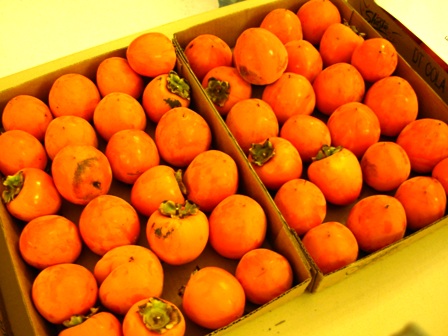
Last night, a highlight was one member’s box of just-picked Hachiya persimmons, lined up like perfectly-formed eggs in a crate. The skin color – difficult to describe, but you know the word persimmon conjures up visions of something spicy, exotic and rare….and that’s how these delightful fruits appear to me. They are as vivid as a setting sun over the Pacific Ocean. Having lived in SoCal from 1967 to 1970 when I was young, I have strong memories of my midwest Mom not knowing what on earth to do with the persimmon tree in our backyard. She found one recipe for persimmon cookies. They tasted chewy and were seasoned with cinnamon and other spices (ginger? allspice? nutmeg?)….I’ve asked Mom to find the recipe. Now I have four delicious-looking fruits in my kitchen window, awaiting the transformation with said recipe into cookies for my own children.
A few other specimens from fellow SoCal members got me excited, too:
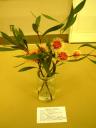
Hakea laurina (Pincushion) – Australian, large shrub to 12-feet, fall-blooming
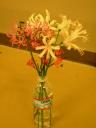
Nerine (mixed) – South African bulbs, to 2 feet, fall-blooming
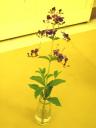
Clerodendrum ugandense (Butterfly bush) – African, to 20 ft, nearly ever-blooming
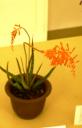
Aloe bellatula – blooms at various times, from Madagascar
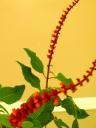
Salvia confertiflora – Brazilian, 4-6 feet tall x 4 feet wide, blooms all year (hummingbirds love it); cut back hard, sun/dry conditions
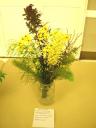
Fall bouquet – including Senna artemisioides, Adenathos sericea (Woolly bush), Acacia baileyana ‘Purpurea’, Grevillea ‘Moonlight’, and Tagetes lemmonii.
Posted in Book reviews, Gardening, General | 4 Comments »
November 6th, 2007
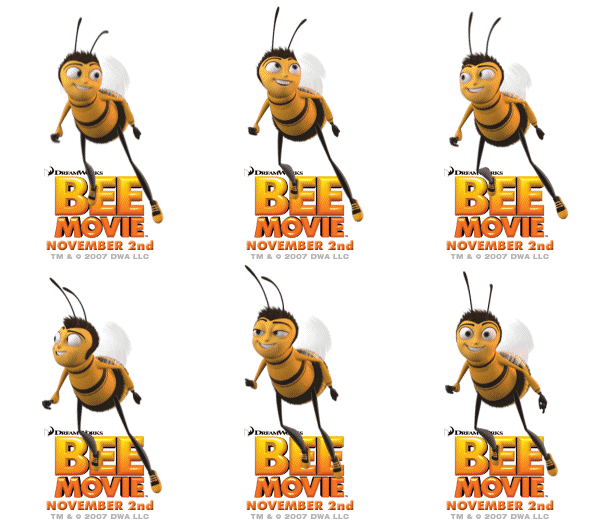
Inspired that my friend Erin was going to take her 2 youngsters to see “Bee Movie,” and presented with a rare unscheduled afterschool block of time (no soccer practice, no carpooling), I asked Alex if he wanted to see “Bee Movie” yesterday afternoon. The media exposure has been HUGE on this Jerry Seinfeld and Renee Zellweger vehicle, although one reviewer on NPR warned listeners that even though the kids would like it, and Seinfeld fans like me would love the adult puns, there were too many far-reaching elements to the storyline to put this full-length cartoon on the best-movie list.
My son 10-year-old son Alex thought the movie was “intriguing and very interesting,” although, he said, and I quote: “it could have had more storyline and less stupid puns.” (I think he is referring here to the girl-meets-bee romance.)
But a movie is a movie. And off we went. The narrative is filled with lots of bumblebee humor, if there is such a thing. The main character “Barry” (rhymes with Jerry) wears a black-and-yellow striped turtleneck (natch). Barry and his pal Adam (voiced by the adorable man-child Matthew Broderick), are facing adult beehood and the prospect of working at the same job for the rest of their lives in a honey plant.

But Barry yearns to escape from the hive and get a taste of the real world, so he cons his way onto team of elite “nectar collectors,” studly bee-guys with big chests and the real world responsibilities of gathering “pollen power.” Once he follows them out to a floriferous Central Park (where else but New York City for Jerry/Barry?), where the animation portrays crayon-hued perennials and flowering trees from every continent and bloom-season all together in fantastical springtime glory, Barry soon understands that these pollen-patrol guys get all the action. As Barry puts it: “Fla-Ow-Ers!”
Then Barry lands on the windowsill of Vanessa, a HUMAN floral designer, voiced by Renee Zellweger. She saves his life by slapping a waterglass over Barry just when her doofus boyfriend is about to swat the irritating bee with the sole of a boot. The animation art highlights fancy-leaf geraniums spilling out of Vanessa’s windowboxes…a notable attempt at botanical accuracy.
Bees are not supposed to speak with humans, but Barry wants to thank Vanessa for saving him….and soon they’re pals (Barry has a little bee-like crush on Vanessa). When he goes to the grocery store perched on Vanessa’s shoulder, Barry discovers shelves filled with jars of honey. And he is shocked to learn that humans are “stealing” the golden fruits of bee labor, so to speak.
With all of the righteous indignation you’d see in Jerry, George, Kramer and Elaine (and even Newman) over the Soup Nazi’s rules, Barry decides to “sue” the human race (actually the five mega-honeymaking corporations). It all unfolds rather like a classic Seinfeld episode. As Jerry would say: yada, yada, yada. I don’t want to spoil the rest of the plot for you.
But in the end, the bees wrest control of honey-making from corporate demons (represented by a diabolical John Goodman-voiced defense lawyer) and Barry and Vanessa end up together, in a kind of platonic-romantic partnership where she sells cut flowers and he dispenses legal advice to the animal kingdom.
I kind of like the fact that the film’s big climax is the point at which Barry educates Vanessa about the essential role bees play in the plant world. When the bees at Honex (the fictitious company where generations of bees spend their lives making gobs of honey) decide to stop pollinating and instead take an early retirement, all the plants start to shrivel and die. The movie makes this point: plants live because pollinators help them reproduce.
Wow. Okay. so then I come home from the movies and I am sorting through piles of magazines and newspapers (we subscribe to more than a dozen monthly magazines, plus the NYT and LATimes – we are a reading household that never catches up with all the words available to us!) , and I came across the October issue of Puget Consumer Co-op’s Sound Consumer newspaper. The cover story: “Colony Collapse Disorder: Revisiting the Hive.”
How timely to read that organic beekeepers and small diverse organic farms are “living solutions” to the threat of Colony Collapse Disorder. The article, by Debra Daniels-Zeller, explains that honeybees are disappearing, plagued with parasites, diseases, and the threat of pesticides. She quotes Todd Hardie from Honey Gardens Apiaries in Vermont: “Bees are the canary in the coal mine,”….the loss of pollinators is a sign that agriculture is out of balance due to pesticides.
So Jerry Seinfeld’s “Bee Movie” doesn’t tell the WHOLE story, but I urge you to support local, organic honeymakers who encourage bees and other pollinators to thrive and do their bee-worthy jobs in this world. In organic honey-solidarity, I think I’ll have a dollop of my Pender’s Honey Farm (Camarillo, CA) pure honey, straight from the Thousand Oaks Farmer’s Market, with my yogurt and strawberries tomorrow for breakfast.
P.S. Hat’s off to Dreamworks for entering into a joint-marketing deal with The National Honey Board (it beats those crappy Happy Meals). You can download six honey-themed recipes from the web-site, including:
Stuffed sweet peppers
Pacific rim grilled fish
Mango chicken
A honey of a chili
Honey gingerbread
Honeyglazed roast lamb
Posted in Creativity, Entertainment, Gardening, General, Playfulness | 6 Comments »
November 4th, 2007
[Spencer Johnson photograph]
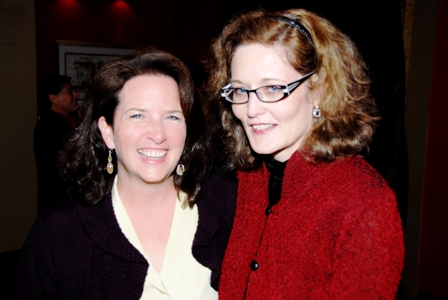
Celebrating Braiden Rex-Johnson’s book launch at Pike Place Market’s Steelhead Diner
I’m still high from a completely indulgent trip to Seattle for a 24-hour visit on November 1st. The somewhat skeptical guys in my household are not convinced it was a “necessity,” but of course the best things in life – friendship – are indeed a necessity… as they feed our spirits and souls and remind us of all that is good in the face of less-than-good forces in the world.
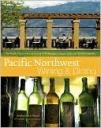 The purpose for my trip was to help food-goddess and dear friend Braiden Rex-Johnson celebrate the launch of her newest (6th? 7th? – I’ve lost count!) cookbook, “Pacific Northwest Wining and Dining” (John Wiley & Sons). The book’s subtitle: “The People, Places, Food, and Drink of Washington, Oregon, Idaho, and British Columbia,”may be a mouthful, but what a savory and mouth-watering mouthful it is. Braiden spent the better part of two years traveling the PNW to meet pioneering winemakers and innovative chefs. With her talent for storytelling and her savvy knowledge for wine-and-food pairings, Braiden’s 270-page tome is delectable (as are Jackie Johnston’s lovely photographs that transport me to each special spot on the NW map).
I feel like Braiden has escorted me far off of “the-beaten-path” to some of my favorite places on earth; but with her as my guide, I see it with new eyes, savor it with an eager palate and embrace her profound appreciation for all things local and seasonal.
In her essay, “What is Northwest Cuisine?” Braiden speaks of food and wine in a manner that will resonate with many gardeners (who also understand the importance of terroir, of place):
“The Northwest’s enticing indigenous ingredients — morels and chanterelles, clams and mussels, crab, salmon, lamb, berries, apples, pears, lettuces, and greens — help define the region’s cuisine. There’s a profound connection between Northwest Cuisine and the varied terrain that inspires it. But the starting point is always fresh ingredients — natural bounty of the Northwest. It is a very seasonal cuisine, a cuisine solidly grounded in the local provender.”
I love this woman, her passion, her intensity, her focus, her professionalism, her sense of irony and her way with words. Braiden delivers up a full menu of delicious stories, personal insights, intimate profiles, and inspiring, but achievable recipes. I can’t wait to prepare some of the exciting recipes in this book, including Sea Scallops with Spiced Carrot-Dill Sauce (to be enjoyed with Riesling) or Walla Walla Sweet Onion Frittata (with Chardonnay as a companion). UPDATE: Click here to read a wonderful review (and get a great recipe to try) about Braiden and PNW Wining & Dining in the December 5, 2008 issue of Seattle Post-Intelligencer; story by Rebekah Denn.
 Honestly, flying to Seattle from Burbank (2-1/4 hours) is no harder than driving to LA sometimes. And so the journey was easy. And the reward was rich: to walk into the book party and see Braiden’s expression of surprise and laughter (and a few tears) in response. If I can ever write about gardens, plants, and flowers the way she writes about food ingredients and wine-as-food, I will be a happy woman.
Posted in Book reviews, Creativity, Entertainment, General | 1 Comment »
November 2nd, 2007
Debra Prinzing photos
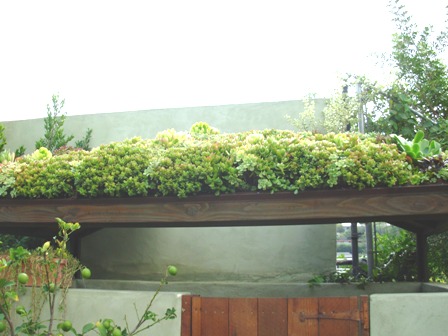
Designed by Pamela Berstler and Marilee Kuhlmann for a client in LA’s Sherman Oaks community, this green roof is a spectacular example of how overhead plantings enhance a garden
Wouldn’t it be great if succulents could transform the residential rooftops of the West? Well, it’s happening…one roof at a time. I want to share the great news that “The Art of the Living Roof,” my first piece for the Los Angeles Times “Home” section, ran yesterday, Nov. 1st, and it’s all about planted roofs.
Thanks to the sage insights of LA designer Pamela Berstler of Flower to the People (isn’t that a very cool name for a design firm?), I received a crash course in greening-up rooftops. She partnered with fellow landscape designer Marilee Kuhlmann of Comfort Zones Garden Design, also in LA, to plant two small-but-elegant overhead gardens that shelter and hide pool equipment and the utility area for Marilee’s Sherman Oaks clients.
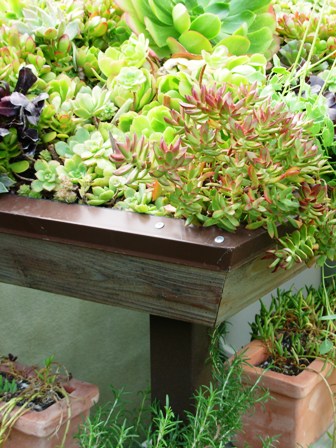
The use of crassula, echeveria, aeonium and sedums adds up to a lush, textural canvas in every shade of green….plus touches of burgundy, red, gold and cream. Kudos to these talented women.
Marilee is the dynamo responsible for the Santa Monica Green Gardens Tour, otherwise known as the “Attainable-Sustainable Tour,” which showcases local LA and Santa Monica backyards each spring (April 26, 2008 is the scheduled date). I can’t wait to get in on that event because it promises to inspire those of us who have the desire to use organic, sustainable and environmentally safe practices to design with the earth as our “client.”
Another great geen roof resouce is Green Roofs for Healthy Cities, a Toronto-based nonprofit membership association for companies and advocates for green roofs (and walls!). Steven Peck is the founder and president and shared his insights in my piece, as well.
Posted in Architecture, Creativity, Gardening | 7 Comments »
© Debra Prinzing, all written and photographic content. Website design/development by Willo Bellwood/Metric Media