The Slow Flowers Podcast is the award-winning show known as the “Voice of the Slow Flowers Movement.” Launched in 2013 as the original flower podcast, we’ve devoted more than 10 years to covering the business of flower farming, floral design, and the Slow Flowers sustainability ethos. Listen to a new episode each Wednesday, available for free download here at slowflowerspodcast.com or on iTunes, Spotify, and other podcast platforms.
June 3rd, 2008
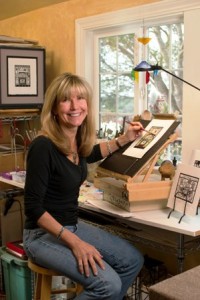
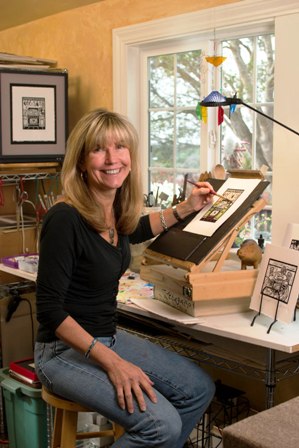
Liz Lyons Friedman, at the easel inside her studio [William Wright photo]
Liz Lyons Friedman, artist and printmaker extraordinaire, creates joy-inducing pictures in her boathouse-turned-atelier in Aptos, California (near Santa Cruz). Her vibrant artwork documents life, love, food, wine, home, garden, travel and more — all those pursuits cherished by lovers of beauty. The stuff of which memories and friendship are made. One of her recent series of prints is aptly entitled “Celebrations.”
After we discovered Liz (thanks to Christina Glynn of the Santa Cruz Tourism Bureau), Bill and I knew we would have a blast photographing her gallery-like studio. We arrived v-e-r-y early one March morning in 2007, in need of caffeine and hauling all sorts of camera equipment and lighting out of my Subaru stationwagon.
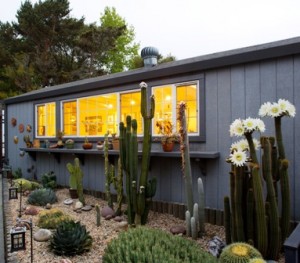
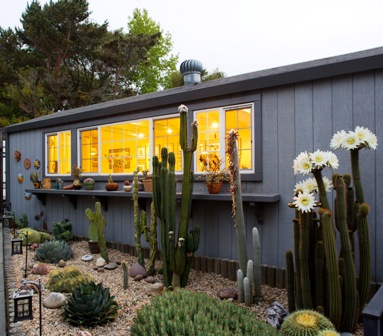
Boathouse-turned-art studio, enhanced by a cactus garden designed and planted by Liz and her partner John Gavrilis [William Wright photo]
We shot the exterior of Liz’s studio at dawn, the filtered light gracing a sculptural garden of cactus and succulents. Inside her 10-by-25 foot “shoe box,” Liz has created a gallerylike space for making and displaying her artwork. A 16-foot-long bank of windows faces the garden and ocean, drawing much-desired natural light to the interior spaces where her easel and printing press stand. Plastered walls, finished in a warm golden hue, highlight the framed prints that hang in nicely-organized groupings. French doors, worktables and a printing press finish the space.
Liz describes it this way:
“I go inside and it’s so peaceful there,” she says. “I think back to the French ateleirs, and that artists have always wanted a place to get away from everyday life and its distractions – and focus on their painting and drawing.”
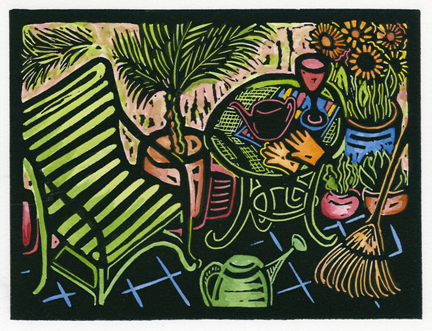
“Gardening Tools,” Hand colored linocut © Liz Lyons Friedman
Liz says that the idea for one of her more recent pieces, “Gardening Tools,” came from spending a day with Bill and me as we photographed her at work, carving a flower with U- and V-shaped knives as she sliced sections of lino tile to reveal the beautiful flower she had designed. She reminded me of the story in a recent email:
“We were chatting about pouring a glass of wine and then going out to the garden in the evening to water or putter. I always point out that the glass of wine is the most important gardening tool in the piece!”
This charming print is the result of her imagination, artistic inspiration and fond memories of time spent in the garden. It makes me very happy to look at, as I imagine Liz puttering in this garden scene. Lines from my chapter about Liz are appropriate to share here:
“In designing this studio, my motive was to make it a happy space, because I make happy art.”
Thank you, Liz! It is a joy to have you in the pages of Stylish Sheds!
Posted in Creativity, Playfulness | 2 Comments »
June 2nd, 2008
Thanks to Jane Berger of Garden Design Online for an endorsement in her blog today. The sublime shed is the new alternative to a plastic backyard storage unit, and Jane makes this point for her readers:
Once you’ve taken a quick look at this book, you’ll never again recommend a lean-to potting or tool shed or one of those abominations that they sell in the big-time lumber and hardware stores.
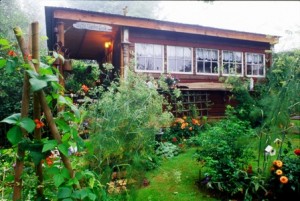
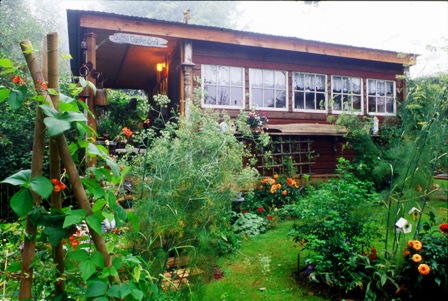
Sunni Rudd’s delightful backyard getaway
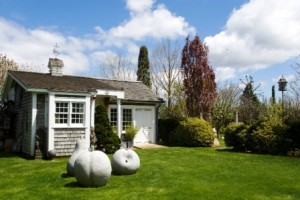
Filled with timeless character, John Barham’s potting place is at home in his sculpture garden
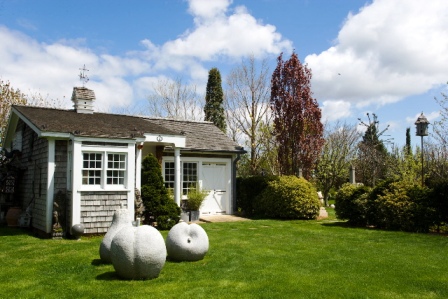
She singles out some of her favorite shed destinations featured in the pages of Stylish Sheds and Elegant Hideaways, including our friend Sunni Rudd’s rustic but feminine hideaway in Seattle and the gracious John Barham’s weathered shed in the Hamptons, inspired by a historic fisherman’s shack. Each is unique and highly personal. And that’s the point of using this tiny architecture to make a big design statement in the landscape. Adds Jane:
Prinzing paves the way for an entirely new way to think about garden structures — to make them very special places that fit the owner’s personality and add a touch in the garden that no one else can duplicate.
This book belongs on every designer’s bookshelf for inspiration … easily gained from the scores of photos by William Wright that illustrate every project.
Thank you, Jane!
Posted in Architecture, Book reviews, Creativity | 1 Comment »
May 31st, 2008
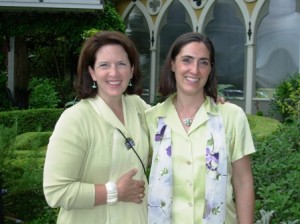
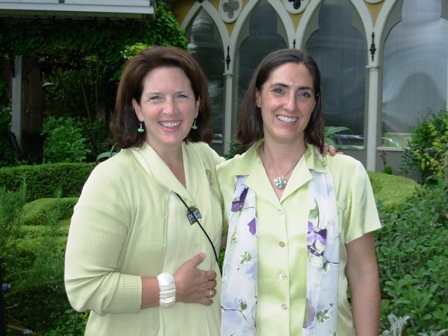
I’m joined by my friend and party hostess Kathy Fries. We’re standing in front of her rustic shack-turned-Doge’s Palace, built by John Akers
The Seattle sun was shining, perhaps a little too brightly, on Saturday, May 17th. In fact, I heard later that temperatures reached close to 90 degrees, a record high for that date in history.
Kathy Fries, aka Shed Diva (she owns four of them!) and her cast of talented gardener helpers, nannies and caterers, threw an unforgettable garden party to celebrate the launch of Stylish Sheds and Elegant Hideaways. Scheduled as an open-garden, which encouraged guests to stroll the peaceful, shady paths through the Fries property, the party paid homage to the fanciful little buildings we captured in the book. The man of the hour, shed-builder John Akers, was “missing,” but we know he likes to avoid crowds. His artistry was well received, oohed and aah-ed over, and festooned with bouquets and champagne. Good job, John! Wish you had come!
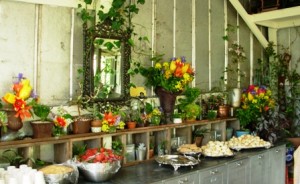
The menu included plump strawberries with brown sugar and Devonshire cream, meringue cookies, little sandwiches, iced tea, champagne . . . all served on Kathy’s potting bench-buffet
With more than 120 in attendance, the three-hour event was a bit of a whirlwind. Bill Wright and I felt like we signed books nonstop, greeted friends, hugged and thanked the owners of no fewer than 10 of the sheds featured in our book, and then signed more books. Gillian Mathews of Ravenna Gardens was our cheerful bookseller. She figured out how to get a copy of Stylish Sheds into the hands of anyone who wanted one, even if that meant raiding Kathy’s personal stash or taking orders once she ran out of inventory. We were truly touched with her support. You can find signed copies of Stylish Sheds at her stores.
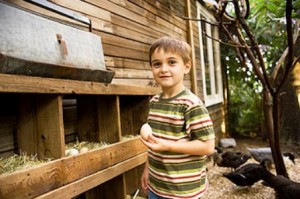
Xander Fries, collecting eggs for the pages of our book [William Wright photo]
Thank you, Kathy and Ed: you threw a doozie of a party. I have spent many fond hours in this magical landscape, but honestly, it has never looked more beautiful. The flowers bloomed larger and brighter, the vines threw out new, spring-green tendrils, the ferns glistened in the dappled light. Our guest-signer, Xander Fries, who is featured on page 73 collecting eggs from the Palais de Poulets, charmed guests by autographing “his page” of the book.
A highlight for me was seeing so many dear friends in my (former) Seattle gardening community. It has been nearly two years since I left for LA, and it was a treat to return for this celebration. Owners of all nine Washington sheds featured in our pages came to help celebrate. Without them, we wouldn’t have completed this awesome project and we are honored they came and helped mark the publication!
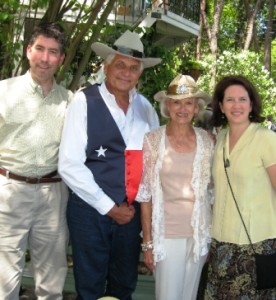
Bill, Steven and Sylvia Williams, and me
But the prize goes to Sylvia and Steven Williams, who traveled from Texas to attend the party! Only two weeks after throwing a party for us at Stonebridge, their garden in Bertram, Syliva and Steven flew to Seattle to join us. They represented their home state in Texas style, dazzling everyone with their out-sized friendship, not to mention cowboy hats.

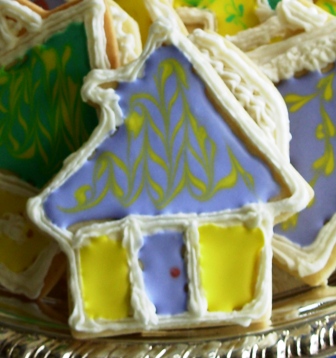
The party treats were simply fabulous, including Kathy’s elegant version of my amateurish “shed cookies.” She gets the “Martha Prize” for decorating with a piping tube and marbling the frosting. Really, Kathy. You are amazing.
Posted in Creativity, Entertainment, Playfulness, Shed Glossary | No Comments »
May 30th, 2008

Los Angeles Convention Center – BookExpo 2008
I’ve heard about Book Expo for years and lucky for me, the venerable trade show and book-sellers’ extravaganza came to Los Angeles this week.
We authors often toil alone in our little offices, sitting at keyboards, staring at monitors, listening to the phrases roll around in our heads and banging out one word; then the next one, plus one more . . . all to string together a well-crafted sentence. I’m very dependent upon my sources, designers, gardeners and homeowners who generously share their stories with me. But in the end, I am alone with my words.
So the 65-mile drive to downtown LA was a big adventure that got me out of the office, into the car (fueled by $4.09/gallon gas) and on a route involving no fewer than five freeways! I arrived at the GIANT LA Convention Center on Figuero Street around 10 a.m. and found a $10 parking lot across the street. Thank goodness for my Garden Writers Association Press Pass: it easily earned me a badge and press access to the giant exhibition hall.
Some people would be overwhelmed by the aisles and rows of publisher displays. But not book people. It’s reassuring to see how many titles are still printed (albeit in Asia). Ink letters appear on paper pages, 4-color photographs are splashed between blocks of text. Hundreds of sheets are stitched together with thread and glued into a hard-back binding to build a book cover. It’s then wrapped in a colorful jacket and included in a sales catalog. And eventually, that book is touched by the hands of a customer, which is our ultimate goal, isn’t it? Sharing words, photographs and creative ideas with readers. It’s still a noble pursuit and a rewarding profession.

Look v-e-r-y closely. You can see Stylish Sheds and Elegant Hideaways between the heads of the two women in Crown’s booth.
I knew that Stylish Sheds and Elegant Hideaways wouldn’t receive much play in the ENORMOUS Random House/Crown Publishing booth. Let’s call it a quadruple booth! Filled with slim, stylish marketers and aloof publicists with interesting eye wear, the RH team had hundreds of titles to publicize and promote. And, as I had been told ahead of time, the emphasis at Book Expo is on fall 08 catalog titles, not spring 08. So, there wasn’t really an opportunity to be the star of the show. My expectations were low. But still, I had to check it out.
I really did find my book on the back shelf in the booth. And, hey, I’ve got connections! As I was standing there, hoping to meet someone interested in talking with me, who should walk by but a college friend of mine who is PRESIDENT of a major university book store Co-op! I haven’t seen him for years, but we rowed crew together and had an immediate recognition and friendly reunion. I actually “sold” him my book while standing in Random House’s booth. How cool is that?
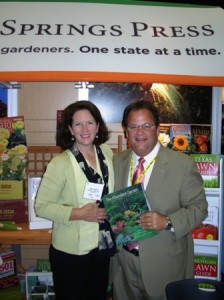
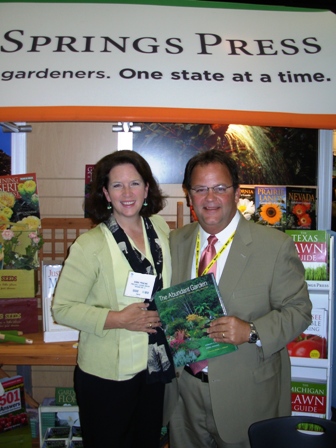
Debra with Roger Waynick, president & publisher of Cool Springs Press
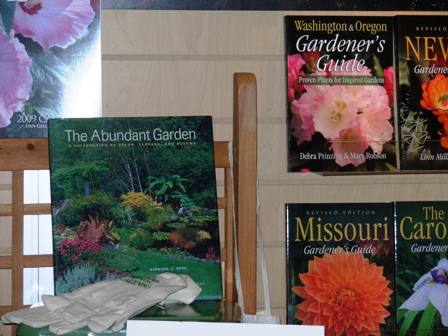
Next, I ventured over to see my former publisher at Cool Springs Press, Roger Waynick. Bless CSP, which “birthed” two of my books and is – remarkably – the ONLY publisher from which I’ve ever earned royalty checks! CSP is still selling The Abundant Garden (with photographer Barbara J. Denk) and the Washington & Oregon Gardener’s Guide (with co-author Mary Robson).
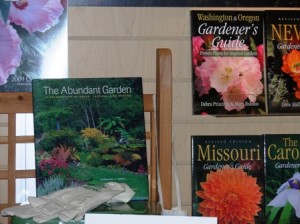
The Abundant Garden (left) and Washington & Oregon Gardener’s Guide (right)
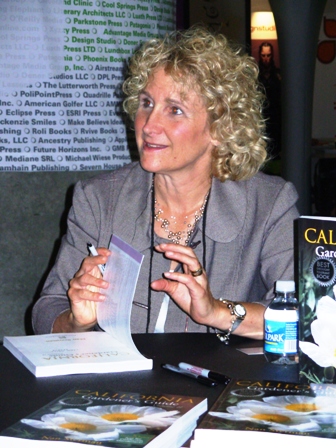
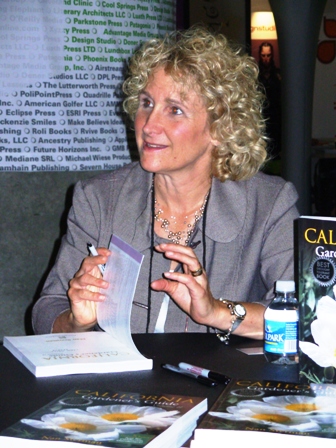
 Roger & Co. were actually happy to see me. They wanted to brainstorm ideas for the future. It was really nice to feel welcomed. My pal, Nan Sterman, author of the California Gardener’s Guide, did a book-signing and was enthusiastically greeted by convention-goers. I was proud of her and her wonderful book.
Investigating Book Expo was educational and insightful. Books are still alive and well, and cherished. I’m glad I took the time to attend – and I’m grateful for the connections I made today.
Here are links to a couple recent media mentions:
The first comes as a complete surprise from Newsday’s “Garden Detective” columnist Jessica Damiano. On May 22nd, she ran a column called New Gardening Books, from organics to landscapes:
“It seems every year around this time, bookstore shelves swell with gardening tomes. Most go back whence they came after I drain my latte cup. But a select few stand out. Here are my picks for books that should actually make it out of the store. Drink up! . . .
The Abundant Garden: A Celebration of Color, Texture, and Blooms (Cool Springs Press, $29.99), by Debra Prinzing with photographs by Barbara J. Denk, is one of those books you flip through, drool overthe photos and then try in earnest to recreate what you see in your own patch of dirt. And that’s pretty easy, as the photo captions actually include names of plants depicted, a rarity in the garden-book world. But this guide’s beauty lies deeper than its color glossies. There’s actually a science to the beauty of abundance, which is defined, in part, by the lack of visible soil or mulch between plants. Readers learn nine specific design principles of creating abundance by studying photos and descriptions of gardens on Bainbridge Island in Seattle.”
It’s so wonderful to receive a review from someone like Jessica, a Master Gardener and editor who is a passionate plantswoman. It’s even more gratifying that she could sift through three years’ worth of garden book releases to unearth and highlight our book. Thank you!
Next, thanks to Diana Ransom, a small-business columnist for Smart Money, who features three Stylish Sheds and Elegant Hideaways shed owners in today’s story about creative home-office solutions. Entitled: “Designing a Dream Home Office,” the article includes quotes and Bill Wright’s gorgeous images of our “shedistas” and their locations: Joseph Marek (landscape architect), Liz Lyons Friedman (print maker) and Amy Bloom (best-selling novelist).
The key to a perfectly productive work space, says Debra Prinzing, a Los Angeles author who has interviewed a number of home-based business owners for her new book, “Stylish Sheds and Elegant Hideaways,” is detachment. “You have to be able to walk into this space and have it be fully dedicated,” she says. A truly separate space boosts productivity – and “quality of life so so much more enhanced,” she adds.
Wow, that’s a lot of good news for one day. Nice to end the week on a high note.
Posted in Book reviews, Writing | No Comments »
May 24th, 2008

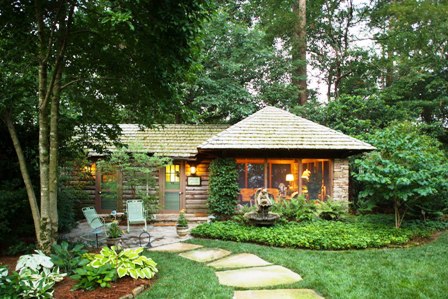
Mary Martin, with Wallace, her cockapoo; photographed on July 5, 2007 by William Wright
Mary called me on May 15th from Atlanta to tell me of her sudden diagnosis of brain cancer. Four days later, she died, after doctors tried to relieve the bleeding and remove her tumor. How can one so vibrant and full of creative energy disappear from our lives so quickly?
Featured in “Personal Space,” one of the first chapters in Stylish Sheds, Mary Martin was a consummate Southern lady. She embraced this book with incredible passion and support, investing her own time, money, and energy to promote it to clients of her fine gift business, Mary’s Garden Champagne Savers.
I met Mary through Atlanta landscape designer David Ellis, of Landshapes Garden Design. I fondly remember when Wendy Bassett, my Atlanta “shed angel” (aka fairy godmother), drove me to meet Mary and see her little cabin on a chilly day in January 2007. We came down the driveway, turned the corner into her gorgeous backyard (even in winter, it was in perfect, tip-top shape!), and were immediately drawn down the curving stepping-stone path toward a charming split-log style haven.
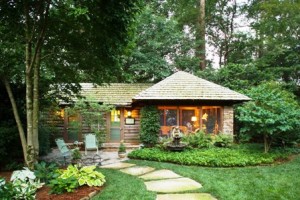
A curved path made with stepping stones large enough for two to walk side-by-side travels across the lawn from Mary’s house to her personal backyard retreat
While she wasn’t sure of its provenance, Mary guessed that the rustic, 1930s-era shed might have been purchased by earlier owners from a mail-order catalog, perhaps as a potting shed. She updated the 240-square-foot hut, painted the board-and-batten walls of its two interior rooms in pistachio green, added a fresh coat of bay-green paint to the two cottage doors and “moved in.”
Beyond the walls of her rather grand Southern Colonial-style home, Mary could be found, secreted away in her backyard studio, which served as a potting shed, storage for beekeeping and honey making, a painter’s easel and a writing room.
“When I first saw it, I thought, What a wonderful place for gardening, but it has also become a nice little project building,” she told us.

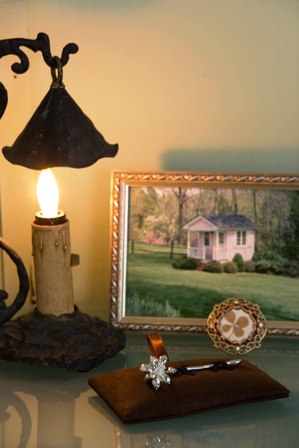
Her love of this little building, which Mary later expanded by adding a 16-by-17 foot screened room, was rooted in memories of a childhood playhouse. She played outside and cooked on a real stove inside a little pink playhouse her father, John Martin, built for Mary and her younger sister, Ann. On her desk inside the cabin, Mary kept a framed photograph of the tiny, sweet structure.
“I do think my childhood memories of that pink playhouse tie into my enjoyment of this very private, peaceful ‘retreat’ where I feel hundreds of miles away from the city when I’m inside it,” she said.
I spoke today with Janell Knox, a friend of Mary’s since college, and she told me that Mary faced the news of her illness with incredible courage. “She was out in the cottage on Sunday,” Janell says. Later that day, the pain in her head was so severe that doctors had her taken to Piedmont Hospital in Atlanta. Efforts to relieve the bleeding failed. In her last moments, Mary was surrounded by friends and loved ones, including her parents, John and Elizabeth Martin. The Atlanta Journal-Constitution’s obituary of Mary aptly described her as having “enthusiasm for life.”
Selfishly, I am so pleased that in her last year, Mary befriended Bill Wright and me. She had an intensity about everything she did in life, including the way she devoted herself to friends. We will miss her spirit, although having a glimpse of her in the pages of our book is a quiet comfort.
I end with a quote that Mary loved. It is from her late grandfather, Rudolf Anderson, who was a landscape designer and widely known for his camellia and azalea breeding throughout the Southeast. It sums up her philosophy, as well, evident in the way Mary drew her beloved plants and garden into her life.
“I’ve always felt that anybody looking at beauty in nature cannot help but have more noble thoughts.” (Rudolf Anderson, 1967)
Posted in Creativity, Spiritual Practices, Writing | 3 Comments »
May 20th, 2008
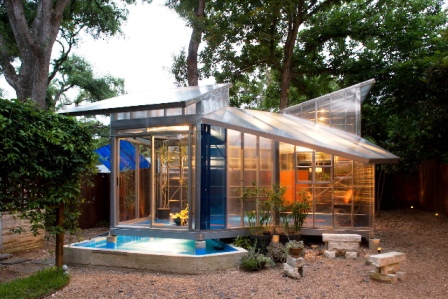
Design/construction by Harrison Bates for Loretta and Terrill Fischer [photography by William Wright]
“Plant conservatory meets pool party when a brother-and-sister team designs a steel-framed backyard shed.”
This opening line to the “Mod Pod” chapter in Stylish Sheds introduces one of the hottest projects we’ve come across. It resides in a modest Austin backyard. Owner Loretta Fischer wanted a greenhouse to store her tropical plants during the winter months. When she asked her brother Harrison Bates to build it, the project quickly changed from ordinary to outrageous. These two know how to have fun. Their project started out as a rectangular building with a traditional pitched roof. Things changed dramatically, seemingly overnight, when Harrison’s wild imagination exploded to create the hippest greenhouse ever built.
Here is the original design, sketched by Harrison on a post-it note:
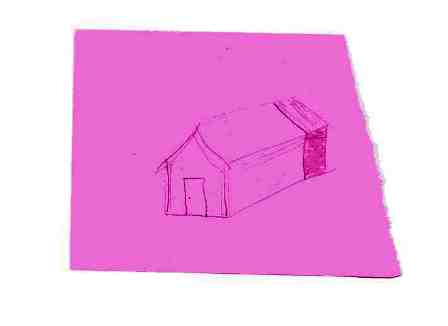
As Harrison recalled when I interviewed him last year: “Loretta said, ‘why don’t you build me a greenhouse?’ So I gave her a sketch and said, ‘here’s your greenhouse with a little pointy roof.'”
The rest is history. For his second version of the design, Harrison addressed Loretta’s concern about wanting to see into her yard (she didn’t want the shed to block her view of the rest of the garden) and to save a mature bur oak.
According to Loretta, Harrison’s new design blew her away: “The next day he brought me this elaborate drawing of a fancy, modern greenhouse. I don’t even know what he was thinking. We both love modern architecture, but I was really surprised with his sketch.”
Here’s what the Pod schematic looked like after Harrison “tweaked” it.
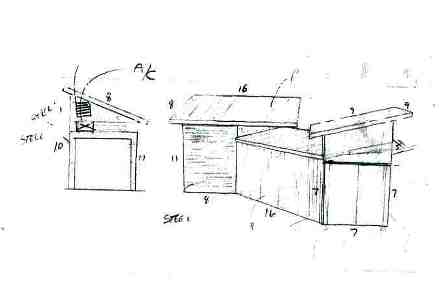
Elevation of new shed
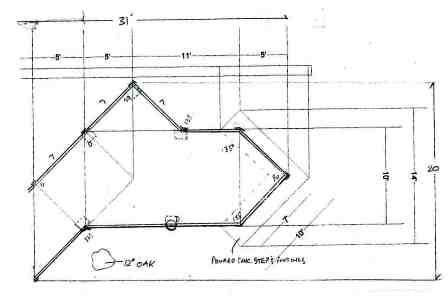
Floor plan, showing where the shed wraps around the bur oak
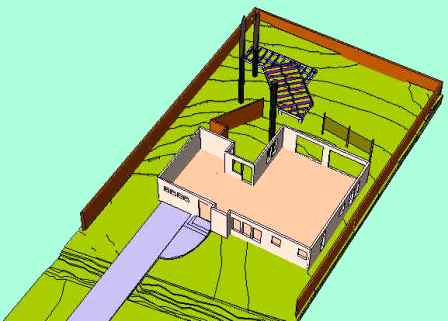
Site plan showing how the footprint of the Mod Pod fits into the Fischer backyard
Harrison designed the asymmetrical, V-shaped structure with roof sections tilted at shallow angles. He used combinations of 7-foot squares and right-angle triangles to engineer this wildly imaginative building. A slant on its south side wraps around the oak tree and juts toward Loretta and Terrill’s house.
I love this story about Loretta and Harrison because it encourages the breaking of conventions, the bending of rules — coloring outside the lines, so to speak. Who says a greenhouse has to be shoebox-shaped? Why can’t it be a parallelogram? Surrounded by a pentagonal moat-fountain? Built from conventional materials in an highly unconventional manner?
Today I stumbled across a surprise from Harrison. He visited our book’s page on Amazon.com and posted photos taken from design-through-construction of his sister’s playful structure. Here is the link. You’ll enjoy the slide show! Thanks, Harrison – you rock!

P.S., I couldn’t resist this photo of the Bates kids playing in the swimming pool one Texas summer decades ago. With their brother Doug (left), Harrison (center) and big Sis’ Loretta (right), this Polaroid shot hints at the future pool-inspired water element that Harrison and Loretta created surrounding her Mod Pod (Photo and illustrations: courtesy Harrison Bates)
Posted in Architecture, Creativity, Playfulness | 6 Comments »
© Debra Prinzing, all written and photographic content. Website design/development by Willo Bellwood/Metric Media