The Slow Flowers Podcast is the award-winning show known as the “Voice of the Slow Flowers Movement.” Launched in 2013 as the original flower podcast, we’ve devoted more than 10 years to covering the business of flower farming, floral design, and the Slow Flowers sustainability ethos. Listen to a new episode each Wednesday, available for free download here at slowflowerspodcast.com or on iTunes, Spotify, and other podcast platforms.
January 20th, 2009
Uncle Wilco, my UK penpal who presides over We*heart*Sheds and Readershed blogs, has announced his 2009 Shed of the Year Contest.
I encourage anyone who owns a backyard shed to log onto his site and enter. Submit your photographs – we need international participation, folks!
Of course, I am angling to be tapped for the popular competition’s “International Guest Judge” slot, but I may have to butter up Uncle Wilco with chocolate chip cookies (or more likely, a keg of good English ale). I’m not sure what it takes to bribe these Brits, but flattery and admiration should help, right? He shouldn’t forget that I’m the gal who named him the “Bad Boy of Sheds” – a term of endearment, of course.
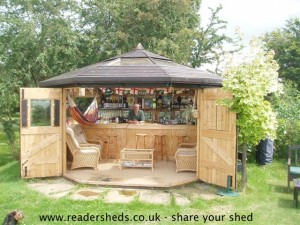
Here are some details on last year’s winner, a decidedly Man Cave sort of place that is part shed-part pub (pictured above). Very cool – congratulations, Tim!
Here’s Uncle Wilco’s official announcement:
Take Part in Shed of the Year 2009
“Do you have a garden shed that is unique?” asks Uncle Wilco, head sheddie of www.readersheds.co.uk.
“Maybe it’s your own little bolthole away from the trials of life. Maybe you have converted your humble garden building into a pub, or are a treehugger at heart and are building an eco shed, or maybe it’s just a normal wooden building that’s special to you.”
If you as a sheddie are proud of your shed then now’s the time to enter this year’s ‘Shed of the Year’ competition, which takes place during the third National Shed Week commencing July 6th 2009.
Entries are already flooding in for Shed of the Year 2009 and you can add your shed online using this link
This year’s celebrity judges are Radio 2 presenter Chris Evans, shed fancier and property guru Sarah Beeny and shed-based inventor of the windup radio, Trevor Baylis. They will be joined by shedworking expert Alex Johnson from shedworking.co.uk, eco architect Lloyd Alter, and Uncle Wilco, head sheddie from readersheds.co.uk and organiser of National Shed Week.
Together they will be deciding if your shed will make the grade and take the top shed crown.
[Hint to Wilco: What about DEBRA as your guest North American judge?!!!]
Following a public vote starting June 2009 which will produce a shortlist of winners, the judges will pick their “Shed of the Year 2009” during National Shed Week itself.
Last year’s winner was Tim from Suffolk with his amazing octagonal Pub Shed. Sheddies can join Tim – whose shed was featured in national newspapers and on television – and the hundreds of other sheddies by ‘sharing your shed’ on the internet’s favourite shed fan site, www.readersheds.co.uk
Last year there were more than 800 sheds fighting for the title of Shed of the Year from garden pubs, TARDIS sheds, allotment sheds, ones hand made from English Oak, cabins, summerhouses and even a shed on wheels.
National Shed Week 2008 was mentioned both on-line and off-line by national and international press.
Comments included:
“The excitement! The anticipation! Shed Week 2008 starts on Monday, and we sheddies are in a frabjous state. Shed Week celebrates the importance of the shed, hut or gazebo in our culture as a place of refuge, storage and amusement” – The Times
“I can say that Tim in Suffolk did a wonderful job with his pub shed, with complex framing and difficult trapezoidal skylights” Lloyd Alter – treehugger
“All things shed-like are being celebrated up and down the country.” -Radio 4’s Women’s Hour
“It’s been a while since sheds came into it – and in the interval this splendid blog devoted to sheds and shedmen” – Brian Appleyard
“National shed week was the result of a typical touch of creative thinking from long term enthusiast Uncle Wilco” – The Daily Express
“Shed of the Year is a great excuse to wallow in the gorgeousness of all our sheds – and aren’t they all fine” -Sarah Beeny, judge of Shed of the Year 2007, 2008 and 2009
Posted in Creativity, Sheds & Havens | 1 Comment »
January 19th, 2009
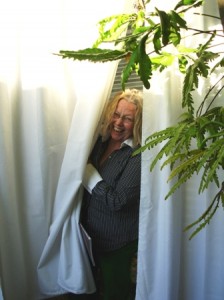 Literary agent Charlotte Gusay has a delicious secret. She recently shared it with me and gave me permission to write about it here.
Charlotte contacted me after reading about my shed expertise (also known as an “obsession”) in Dwell magazine:
“[I] saw the recent issue of Dwell (Feb. 09) with your article on ‘backyard’ sheds. So disappointed we did not find each other before this article and/or your book . . . .
“I have a swell little ‘postmodern shed’ that my husband Bobby Milder and I built about 5 years ago. . . .”
She sent along a few photographs to tempt me. What else would a nosy reporter such as me do next? I called Charlotte and invited myself over for a visit. Paula Panich, my writing mentor and friend, came along last week when we drove over to Charlotte’s after lunch.
Her house sits quietly on a tree-lined city street, just a block or so away from a major thoroughfare. It is nice to know these inviting residential pockets exist here in LA, right in the city. I love it!
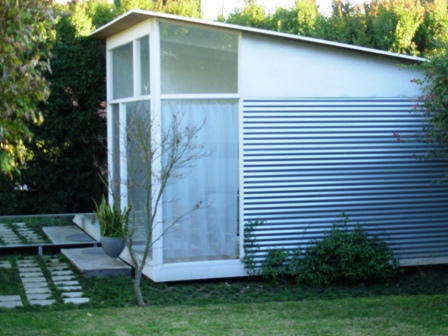
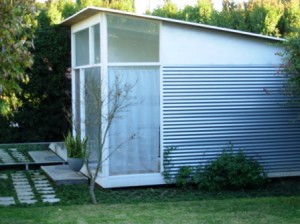 This irresistible 10-by-14 foot haven is tucked comfortably into a far corner of Charlotte’s urban lot, hidden from everyone’s view but hers. Because of the way it has been sited, the shelter is first seen “in profile,” its longer side and angled shed roof-line emphasized. When glimpsed by newcomers (such as Paula and me) the shed reveals its see-through quality, thanks to a wraparound glass “corner” that connects two outer walls. The white-painted framework around the windows and door outlines and emphasizes vertical and horizontal lines of the design (almost Mondrianesque in its geometry).
I like how Charlotte described the shed to me in her first email note: “It floats elegantly in the backyard, just beyond our 1944 mid-century house in West Los Angeles.”
READ MORE…
Posted in Architecture, Creativity, Gardening, Landscape Design, Playfulness, Sheds & Havens | 4 Comments »
January 17th, 2009

Sparkling and serene, this is a tiny garden that oozes romance and mystique (design and photo, Laura Morton)
I believe that the paths we walk lead us to the people we need to know in our lives.
Case in point: A week or so after I insisted that my friend Shirley Bovshow, an LA garden media personality and talented designer, bunk with me for 2 nights at the Portland Garden Writers Association annual symposium, she invited me to join an Association of Professional Landscape Designers’ lunch meeting at her home in Woodland Hills. Since Shirley and I live relatively close to one another (by LA standards), I took her up on the invite. The other guests were fellow members with Shirley in APLD’s LA chapter. Plus, Shirley’s garden is a wonderland of plants and design ideas.
The Association of Professional Landscape Designers is an impressive organization. I have met, interviewed and written about APLD members (and their work) in many venues, including Seattle, Los Angeles and beyond.
The September gathering introduced me to several Southern California garden creators, including Shirley (Edenmaker), Jennifer Gilbert Asher of TerraSculpture (I’ve recently written about her work), and Laura Morton of Laura Morton Garden Design.
When Laura casually mentioned to me that one of her projects won the 2008 APLD “Gold Award” for residential landscape design, I went a little crazy. “Has it been published?” I quizzed her. “No,” she admitted.
No sooner than I heard this – and no sooner had Laura sent me several photographs and a little movie about her design for Mala Vasan’s Hollywood Hills backyard, than I was on the phone to LA Times HOME section editor Craig Nakano. As I suspected, he was very interested in seeing what Laura had to share.

Open air living: Designer Laura Morton changed a plain backyard at Mala Vasan’s home into an Indian-tinged outdoor living room with a reflecting pool, fire pit and garden (Laura Morton photograph)
The story about Mala’s garden, inspired by her own multicultural interests and designed by Laura Morton, appears in today’s LA Times Homes section. Here are the opening lines:
HER PASSAGE TO INDIA: A Hollywood Hills bungalow’s small backyard is transformed into an exotic, cozy retreat and social spot.
 If you’re looking for a good excuse to invest in landscaping, Mala Vasan’s is hard to beat. She credits her dreamy mix of Indian and Moroccan inspiration for seducing her sweetheart.
“My garden brings out an inner magic,” says Vasan, a producer of TV commercials who was going out to eat with screenwriter Brian P. Regan when he saw the enchanting outdoor space and said, “Forget it. Let’s stay here and order Chinese food.”
With scented blossoms, dancing flames, the sound of spilling water and chaises large enough for two, the intimate setting is, indeed, full of romance. (“Our first dates were on those couches,” Vasan says.) The garden also is an artful antithesis of what it used to be: a driveway too small for a car and a 560-square-foot backyard dominated by a wobbly brick patio and views of a boxy air-conditioner hanging from the neighbor’s garage.
The transformation of this Hollywood Hills property earned its creator, Laura Morton of Laura Morton Design in West Hollywood, a gold medal last year from the Assn. of Professional Landscape Designers. For Vasan, the thoughtful design was proof that tiny details and a vivid imagination could turn a prosaic space into a pretty and practical retreat.
The Times’ online photo gallery features several before-and-after shots, including a darling photo of designer Laura Morton and client Mala Vasan, seated in the garden. You can see the gallery here.
Here are a few more photographs, courtesy of Laura Morton. Visit her web site to see many more of her projects – inspiring and alluring spaces that will get you thinking about turning your own backyard into an exotic oasis with plants, cushy textiles, the presence of water, candles to illuminate and other sensory pleasures.
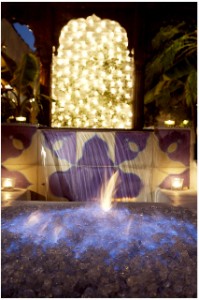
A curtain of water spills over the reflecting pool’s tiled edge into a hidden channel behind the fire pit (Laura Morton photograph)

Romantic chaises, piled with textiles and cushions, create a luxurious outdoor living room (Laura Morton photograph)
In my interview with Laura, she described how a feeling of intimacy can be created in a garden:
“Enclosed spaces instill a sense of intimacy, and within that, your own sense of paradise is possible.”
Posted in Creativity, Landscape Design, Plants, Shed Glossary | 2 Comments »
January 16th, 2009
Dateline: Thousand Oaks, California
Zone 10
Well, I’m one-day late, but that’s because I spent most of January 15th sitting on an airplane.
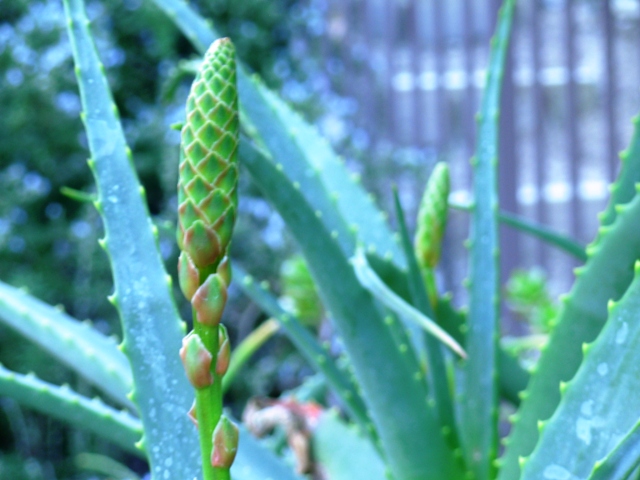
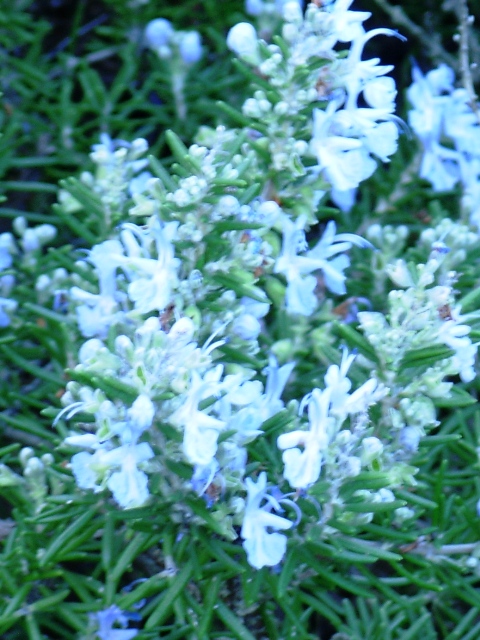
So I’m back in Southern California – and hurrah! It’s supposed to be 80 degrees outdoors today. Early this morning, I snuck out to see what my garden has to share with you. Four new blooms, intentionally selected to show you something different from my December blooms. All of these came into my possession from the prior owners of our home, which we bought in August 2006.
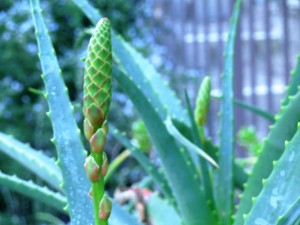
A beautiful, mature Aloe – about to bloom
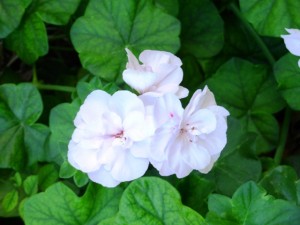
A sprawling Pelargonium – planted as a ground cover
Rosemary – blue blooms to blanket my hillside
Silvery lavender foliage offsets a rare late bloom
Happy New Year to each of you, and may the garden feed your heart, health and soul!
Inspired by the words of Elizabeth Lawrence, “We can have flowers nearly every month of the year,” Carol of May Dreams Gardens started Garden Bloggers Bloom Day. On the 15th of every month, garden bloggers from all over the world publish what is currently blooming in their gardens, and leave a link in Mr. Linky and the comments of May Dreams Gardens.
Posted in Gardening, Plants | 6 Comments »
January 13th, 2009
Yes, it may only be the second week of January, but our Noble firs and cedar boughs are now past their prime (and in my case, at least) cut up and ready for recycling in the yard-waste bin.
 Onward to spring!
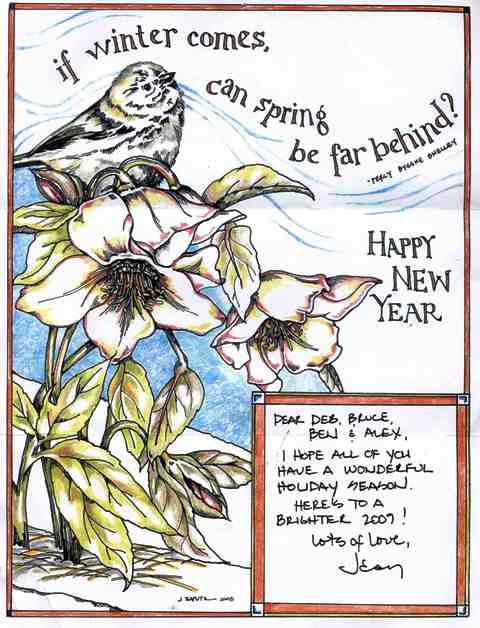
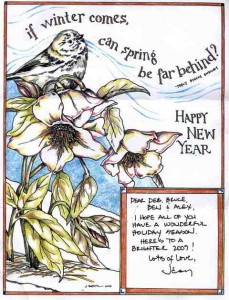
To get me in the mood, I have this inspiring drawing pinned next to my desk.
My friend Jean Zaputil, an artist and garden designer, illustrated and hand-colored it as a most charming New Year greeting.
The scene depicts a songbird perched on top of a hellebore, with the wistful and compelling lines, which read:
“If winter comes, can spring be far behind?”
[attributed to Percy Byssne Shelley]
Perhaps this saying will give you something to hold onto in the dormant months of winter! Spring is coming soon!
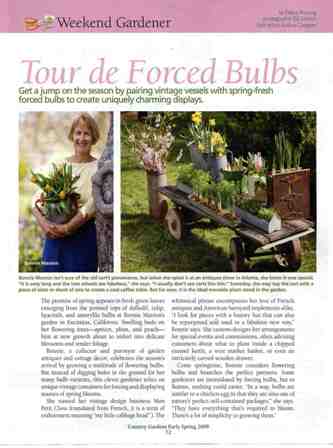
 Also getting me in the mood for spring: Country Gardens’ early spring 2009 edition, which just arrived in my mailbox.
I opened it up to find my story about friend and designer Bonnie Manion, owner of Mon Petit Chou, a vintage design business based in Encinitas, California. Bonnie blogs at VintageGardenGal – a cheery and charming spot to visit – you’ll want to do so frequently!
The story, commissioned by James A. Baggett, editor of Country Gardens, is called “Tour de Forced Bulbs,” and it features Bonnie’s designs pairing forced spring bulbs with forced flowering branches – arranged in vintage containers.
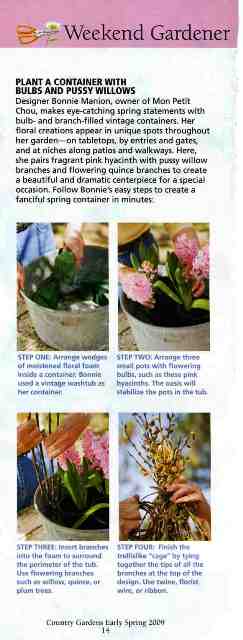
Here is the story in its entirety. A shorter version appears in the magazine, along with the step-by-step instructions for planting a container with hyacinth bulbs and pussywillow branches. The story was photographed by Ed Gohlich and produced by field editor Andrea Caughey.
TOUR de FORCED BULBS: Get a jump on the season by pairing vintage vessels with spring-fresh forced bulbs to create uniquely charming displays.
The promise of spring appears in fresh-green leaves emerging from the pointed tops of daffodil, tulip, hyacinth and amaryllis bulbs at Bonnie Manion’s garden in Encinitas, California. Swelling buds on her flowering trees – apricot, plum and peach – hint at new growth about to unfurl into delicate blossoms and tender foliage.
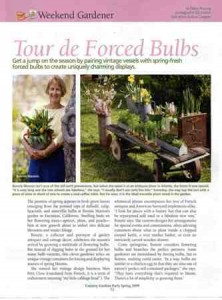 Bonnie, a collector and purveyor of garden antiques and cottage décor, celebrates the season’s arrival by growing a multitude of flowering bulbs. But instead of digging holes in the ground for her many bulb varieties, this clever gardener relies on unique vintage containers for forcing and displaying masses of spring blooms.
She named her vintage design business Mon Petit Chou (translated from French, it is a term of endearment meaning “my little cabbage head”). The whimsical phrase encompasses her love of French antiques and American barnyard implements alike.
“I look for pieces with a history but that can also be repurposed and used in a fabulous new way,” Bonnie explains. She custom-designs her arrangements for special events and commissions, often advising customers about what to plant inside a chipped enamel kettle, a wire market basket or even an intricately-carved wooden drawer.
Come springtime, Bonnie considers flowering bulbs and branches as the perfect partners.
 Some gardeners are intimidated by forcing bulbs, but to Bonnie, nothing could easier. “In a way, bulbs are similar to a chicken egg in that they are also one of nature’s perfect self-contained packages,” she says. “They have everything that’s required to bloom into a flower. There’s a lot of simplicity to growing them.”
Using fresh-cut branches, the flower and leaf buds of which have yet to open, requires little effort, Bonnie adds. Whether brought indoors for flower arranging, or used as accents to planted containers, the tiny buds slowly open until flowers gracefully unfurl. “They last quite a while, especially if you keep the branches in water,” she advises.
With a spring palette ranging from soft pastels to bright primary colors, bulbs and branches pair companionably with timeworn artifacts of the past. “I like the yin-and-yang of it. To me, the weathered patina of old containers goes well with the colors of my spring bulbs.”
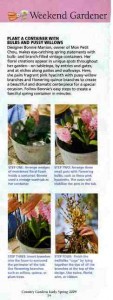 To grow bulbs in containers, Bonnie begins with the right vessel, selecting an eye-catching piece with a generously-sized opening at the top. Bulbs don’t require much root space, meaning that even a four-inch-deep wooden box is adequate as a planter. Deeper containers can be used as well. “You can keep the soil level low around the bulbs, and use the height of the container to support bulbs such as paper whites or amaryllis, as they grow tall and reach for sunlight,” Bonnie says.
Interesting vintage containers include chicken feeders, tool carriers, old boxes or pails, hay racks, sugar tins, large and small funnels, oil cans, children’s wagons or carts, old urns, kitchen strainers – “virtually any container with a wonderful vintage character,” she says.
Bonnie’s finished designs look spontaneously fresh. “I get a lot of my plant and container ideas from my travels,” explains this vintage garden gal.
She frequents large and small flea markets and other off-beat vintage garden antique sources around the country and occasionally visits Europe for inspiration. “I might see a single potted rose in a Paris flower shop. Or, I’ll discover a dramatic floral arrangement in a London hotel lobby and try to recreate it at home.”
Bulb-filled vintage containers never fail to make a statement. “Put them in a setting in your 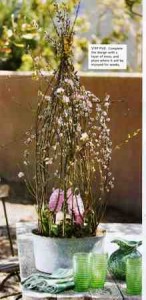 garden where you need some ornamentation,” Bonnie suggests. “You can have fun bringing old pieces back to life and making them functional again. Get as creative as you like, and your pieces will be uniquely you!”
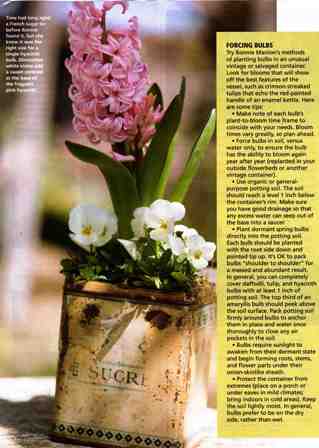
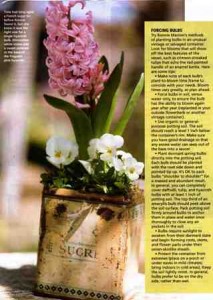
Forcing Bulbs
Try Bonnie Manion’s methods of planting spring-flowering bulbs in an unusual vintage or salvaged container. Look for blooms that will show off the best features of the vessel, such as crimson-streaked tulips that echo the red painted handle of an enamel kettle. Here are some tips:
- Make note of each bulb’s “Plant-to-Bloom” timeframe to coincide with your needs. Bloom times vary greatly and you will need to plan ahead when planting.
- Forcing bulbs in soil, versus water only, will ensure the bulb has the ability to bloom again year after year (replanted in your outside flower beds or another vintage container).
- Use organic or general-purpose potting soil. The soil should reach a level one-inch below the container’s rim. Make sure you have good drainage so that any excess water is able to drip out of the base (you may need to use a saucer to protect furniture or windowsills from water damage).
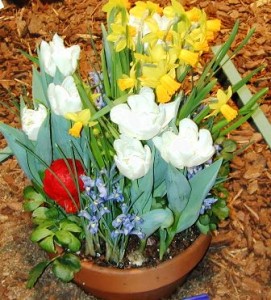 Plant dormant spring bulbs directly into the potting soil. Bulbs should be root-side down and pointed-tips upward. It’s okay to pack bulbs “shoulder to shoulder” for a massed and abundant result. In general, you can completely cover daffodil, tulip and hyacinth bulbs with at least one inch of potting soil. The top third of an amaryllis bulb should peek out above the soil surface. Pack potting soil firmly around bulbs to anchor them in place and water once thoroughly to close any air pockets in the soil.
- Bulbs require sunlight to awaken from their dormant state, and begin forming roots, stems, and flower parts under their onion-skin-like sheath.
- Protect the container from extremes (place on a porch or under eaves in milder climates; bring indoors in colder ones). Do not let the soil dry out, but keep it lightly moist. In general, bulbs prefer to be on the drier side, rather than wet.
- If you want maximum versatility with your designs, plant bulbs in small plastic nursery pots. One or two bulbs will fit inside a six-inch, soil-filled pot. You can plant up dozens of bulbs and care for them using directions above. Once they begin to bloom, arrange the bulbs inside larger containers and layer Spanish moss on top to cover your secret.
Check out one of Bonnie’s favorite bulb sources: Easy-to-Grow Bulbs.
Forcing Branches
Young branches of woody trees and shrubs are supple and pliable in the spring. This makes them easy to weave into trellis-like designs as Bonnie has done. If you cut the branches before their flower or leaf buds open, you can bring them indoors for long-lasting vase arrangements. Better yet, add cut branches to outdoor containers as a complement to spring bulbs. Here are some general guidelines:
- Look around your landscape for inspiration. Do you have a golden forsythia, coral-bark maple, or flowering plum? As many of these woody plants are in need of early spring thinning or pruning, save the cut branches for container or vase designs. A neighbor might also allow you to lightly prune a few branches. In late winter or early spring, local markets or florists are good sources for cut branches, such as curly willow, quince, or witch hazel.
- Use a pair of clean, sharp garden shears, secateurs or loppers to branches at a 45-degree angle. Make the cut at the bottom of a stem where it joins a larger branch.
- You can stick the pointed base of each cut branch directly into the planting soil, at least three inches deep. As you water your bulbs, the branches will soak up needed moisture to keep the buds plump until they bloom.
- You can also arrange cut branches in a water-filled vase. Flower preservatives can keep the water muck-free, but nothing’s better than replacing water daily.
Posted in Creativity, Gardening, Plants, Playfulness | 3 Comments »
January 12th, 2009
 Nothing like getting away from the daily grind – to a distant and beautiful place where nature commands my attention. I have written about Ojai (pronounced Oh-Hi) before. It is a very special historic town, located about 1 hour north of Thousand Oaks, where I live.
How is it possible that a mere seven days after the so-called HOLIDAYS, we are back to normal routines that exhaust us and keep us distracted from our inner thoughts and honest conversations with ourselves? What happened to those resolutions anyway?
The door tag in our hotel room read: “Seeking Serenity” rather than “Do Not Disturb.” It implies a choice, an intentional decision, rather than a command or a warning. I like that notion.
My youngest son and I tagged along on my husband’s school retreat at Ojai Valley Inn and Spa. This is the type of 5-star destination one can’t justify paying for out of personal funds [although we did pay for it (indirectly) through his graduate school tuition].
The gardens, setting, and plants made for a serene, visual sort of therapy. Our 7-1/2 mile bike ride on Sunday morning added to the sense of respite and rejuvenation.
Too soon we had to return to the everyday. But the 24-hour getaway was a reminder that whenever we can leave behind the commonplace – and instead seek nature, wilderness, gardens or plants – we are intentionally moving toward serenity in our lives.
Posted in Creativity, Shed Glossary, Spiritual Practices | 3 Comments »
© Debra Prinzing, all written and photographic content. Website design/development by Willo Bellwood/Metric Media