The Slow Flowers Podcast is the award-winning show known as the “Voice of the Slow Flowers Movement.” Launched in 2013 as the original flower podcast, we’ve devoted more than 10 years to covering the business of flower farming, floral design, and the Slow Flowers sustainability ethos. Listen to a new episode each Wednesday, available for free download here at slowflowerspodcast.com or on iTunes, Spotify, and other podcast platforms.
July 17th, 2009
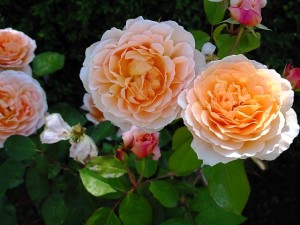
A glorious English rose, photographed in Skagit Valley on a summer day
Flowers lovers understand me when I talk about the disconnect that’s going on between the demand for organically-grown food and the miniscule desire for organically-grown flowers. I guess the argument goes: As long as I’m not EATING those flowers, why should I be bothered that a few chemicals were used on them in the field or after they were harvested?
Gardeners and flower fanatics alike have Amy Stewart and Flower Confidential to thank for heightening our awareness of this contradiction. The idea that we can enjoy the beauty of a bouquet’s stems and blooms while knowing that the growing process may have harmed the earth and those who grew the flowers is crazy! How can we honestly enjoy flowers in our homes or as symbols of our most sentimental occasions when they were drenched in chemicals or shipped thousands of miles on a jet flying across the ocean?
Thankfully, there is a burgeoning “slow flower” movement afoot, and I urge you to join me as we use our pocketbooks and consumer influence to encourage reversal of flower-growing practices that use herbicides, pesticides and non-organic fertilizers. I hope the momentum continues and becomes an ever-present conversation between flower purveyors and flower consumers. I can’t tell you how many times I witness friends ask a waiter if the fish on the menu was “wild catch” or “farm raised.” Similarly, when I buy flowers, I want to know: Were they were grown organically?
”]![From our piece in Sunset: Erin with her son Jasper [David Perry photograph]](https://www.slowflowerspodcast.com/wp-content/uploads/2009/03/erinbenzakein001-237x300.jpg "erinbenzakein001") In addition to the essays in Flower Confidential, I have Erin Benzakein to thank for my education about seasonal, sustainable and local flower-growing. Erin owns floret flowers, a Mount Vernon, Wash.-based micro-farm where she uses organic practices to raise beautiful, unusual blooms for bouquets, floral designers and wedding clients. Erin is featured in a recent issue of Sunset magazine, along with my short Q-and-A and a gorgeous photograph by David Perry.
In addition to the essays in Flower Confidential, I have Erin Benzakein to thank for my education about seasonal, sustainable and local flower-growing. Erin owns floret flowers, a Mount Vernon, Wash.-based micro-farm where she uses organic practices to raise beautiful, unusual blooms for bouquets, floral designers and wedding clients. Erin is featured in a recent issue of Sunset magazine, along with my short Q-and-A and a gorgeous photograph by David Perry.
For David and me, the desire to meet, interview, photograph and document organic flower growers has been under our skin for a few years now. Other creative projects, family demands, and sheer marketplace apathy have slowed us slightly. But we both keep returning to the subject of organic flowers. I can’t let go of the notion that this is an important topic – one that needs to be shared in order to educate, inform, inspire and – change – the relationship people have with the flowers.
While in the Northwest two weeks ago, I had a wonderful chance to visit yet another organic flower farm: Jello Mold Farm. The project of Diane Szukovathy and Dennis Westphall is an example of priorities put into practice for a commercial venture. As they write on their beautiful web site (you’ll see many of David’s photographs there), “Our flowers are safe to sniff.”
My cohort, David, an amazing photographer with whom I’ve been on this occasional journey, drove me north to Skagit Valley. We had a few stops along the way, including a sandwich at a cool roadside deli and a quick visit to Christianson’s Nursery to feast our eyes upon the cottage borders (Christianson’s is one of my favorite charming places – where plants happily coexist with weathered farm buildings).
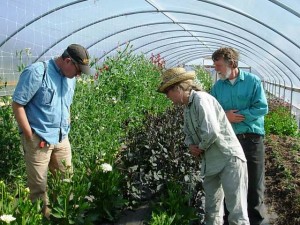
David Perry, Diane Szukovathy and Dennis Westphall at Jello Mold Farm
We arrived at Diane and Dennis’s place as they came home from a day of making deliveries to customers in the Seattle area. They deliver a heady array of fresh, field-cut flowers every Monday and Thursday to Seattle area designers, event planners and retail florists.
Time to sit down for a cold one and a good gab around the kitchen table, as we all got to know one another and talk about the flower biz.
Here are some snippets from our four-way conversation. It will give you a flavor for the longer feature story we want to publish about them:
+First things first. The name Jello Mold Farm is a curious one that always invokes a question. It is an offshoot of Diane and Dennis’s gardening business, Jello Mold Landscape, which got its name from a crazy building in Seattle’s Belltown neighborhood that Diane once covered with 400 copper-hued jello molds of all shapes and patterns. Read that history here.
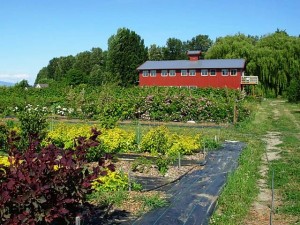
Jello Mold Farm, fields, and barn
+Diane and Dennis have converted an 8-acre farm and its former horse pastures into a bountiful flower farm. They grow 150 varieties of blooms . . . with many, many more on the way.
+After years of estate gardening, Diane yearned to put her energy into a venture that combined her obsession for plants and her values. “I needed to do something else with my energy for my living. (Estate gardening) doesn’t fully feed my soul.”
+They started selling flowers last year and 2009 is their first season to have scheduled deliveries to wholesale customers. Diane emails an “availability list” to a growing group of flower buyers twice a week.
+In Seattle, you can find their flowers at Best Buds (Madison Park), Ballard Market, and several floral studios, including Terra Bella, an organic florist in the Greenwood District.
+They like to use the term “sustainably grown,” rather than organic. “Quality is our best calling card,” Diane says. “Fresh and local sells.”
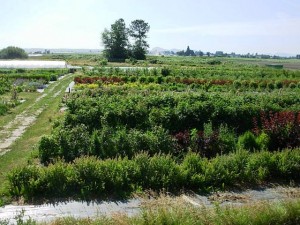
Rows upon rows of flowers ready to cut
+This is hard work, requiring 14 to 16 hour days. “There’s a whole romantic idea that we are so lucky to work on a flower farm,” Dennis admits. “People have no idea how hard we work.” Yet the couple believes they can make a decent living growing flowers rather than food, a lesson they learned after volunteering with a local CSA farmer. “There’s no way we could make a mortgage growing food,” Dennis points out.
+Making bouquets is extremely time-consuming, so Jello Mold often sells straight bunches of a single type of flower, such as dahlias. But when they do make bouquets, “I always try and put in something unique, to create a following,” Diane says. As an example, she showed me a simple bouquet with five dark pink peonies gathered within a pillow of lime-colored Alchemilla mollis (Lady’s-Mantle). They also use a lot of food in their bouquets, like berries, vines and fruiting branches.
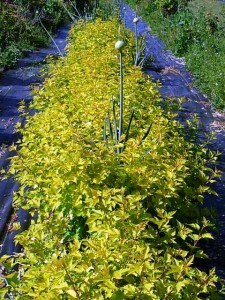
A stray allium puts a smile on my face
+Organic growers are not able to command a higher price for their cut flowers. They have to meet the same market prices charged by growers using standard, non-sustainable practices.
+Slowly, over time, this may change. But only when consumers value the health benefits (to themselves and to the planet) of bringing home an organic, sustainably-grown bouquet. “It’s in the food movement already,” Diane says. It’s only a matter of time for the floral trade (and their customers) to catch up.
+This is an emotion-based business. One of passion and conviction. Diane and Dennis take delight in seeing people make an emotional connection to their flowers. They want to take care to grow sustainably in a world where such practices don’t make financial sense to larger growers. “Ours is a better way to grow a business,” Diane says.
It was so hard to leave with our conversation just getting started. But I’m inspired and encouraged to know these new friends. And to know they are living their passion and convictions every day.
Posted in Creativity, floral design, Plants | 12 Comments »
July 10th, 2009
Lessons from a Low-Water Landscape and a Garden Evening with Friends
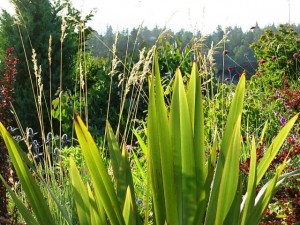
Back-lit by the late afternoon sun, the phormium glows in Stacie's front border
Last week’s Seattle visit included quite a bit of garden touring, and I feasted my eyes on some gorgeous places. One of my stops was to see fab designer Stacie Crooks, whose work has set a standard for sustainable beauty. Stacie and our friend Tina Dixon, also a widely published designer who specializes in container gardens, hosted a Garden Soiree for some of their gal pals. They were sweet to arrange the dinner around my time in town, ensuring that I got to see some of my very favorite women, including those shown here:
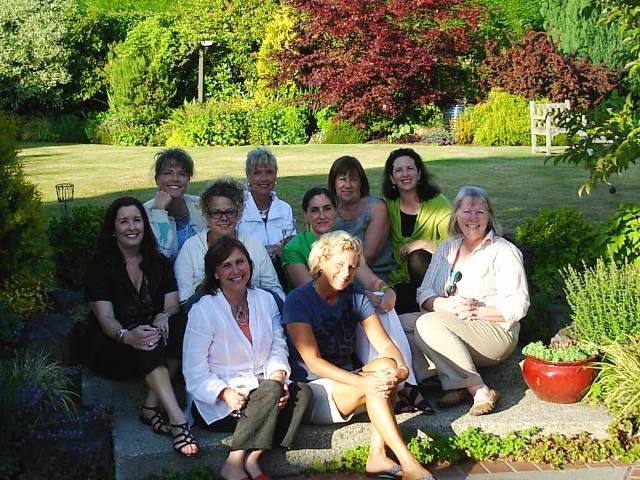
Back row, from left: Tina Dixon, Nita-Jo Rountree, Gillian Matthews, me; Center row, from left: Janet Endsley, Wendy Welch, Kathy Fries, Marty Wingate; Front row, from left: Lorene Edwards Forkner, and Stacie Crooks
My article about Stacie and her husband Jon’s vibrant, textural garden appeared in the May 2008 issue of Seattle Homes and Lifestyles, accompanied by some pretty awesome photography by Allan Mandell. I have included the full text of that story below – it explains Stacie’s inspiring design philosophy and tells the story of how she created this very special place. I snapped a few photos at the party, to share with you here:
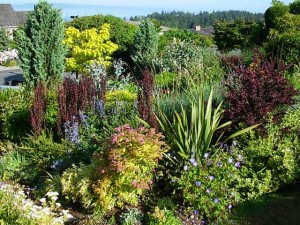
Wine and gold textures are lovely and drought tolerant
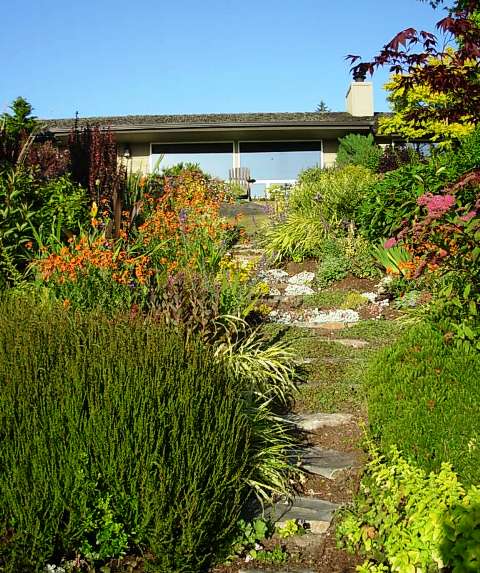
Stepping stones make it easy for Stacie to garden and lure visitors through the sea of foliage, blades and blooms. She uses punches of orange to brighten the scheme (Epilobium californicum 'Dublin' and Calluna vulgaris 'Firefly' are favorites)
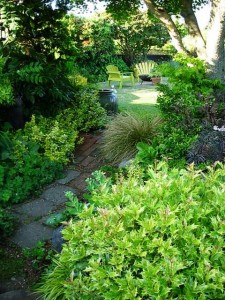
A shady path in the back garden leads to an inviting fire pit and seating area
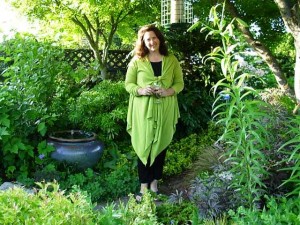
Debra in green, on the path
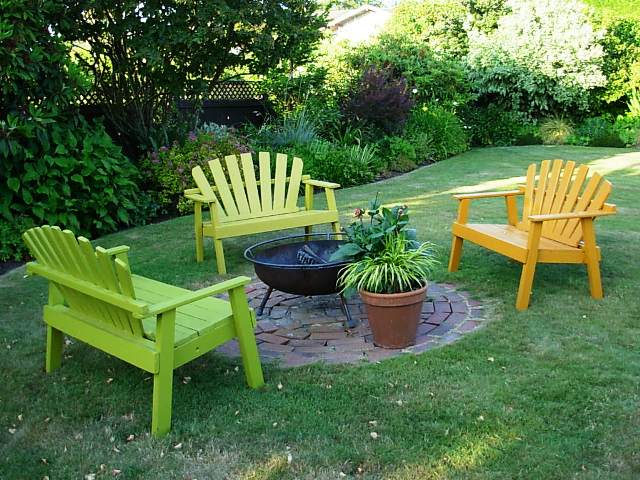
Colorful Adirondack benches, each painted a different color to match the foliage

A perfect end to an unforgettable evening with my garden friends
Here’s the story:
 Water-Wise & Wonderful: Lessons from a lush, low-water landscape
Written by Debra Prinzing | Photographs by Allan Mandell
(May 2008, Seattle Homes & Lifestyles)
The rich palette of golden, green, burgundy and silver foliage plants thriving in Stacie and Jon Crooks’ Shoreline garden north of Seattle suggests that theirs is a well-pampered landscape.
But the opposite is true.
Stacie, owner of Crooks Garden Design, has transformed a sloping half acre into a harmonious tapestry of beds and islands that explodes with interest in every season. The design features trees, shrubs, ornamental grasses, succulents and perennials that are adapted to harsh conditions: western exposure, maritime gusts, poor soil and no irrigation.
 That it’s also gorgeous offers an inspiring lesson to countless young designers and students who have taken Stacie’s classes through the Saving Water Partnership, a consortium of local water districts.
“Among our focus groups, there is a misconception that a water-wise garden is a bunch of unattractive natives, cactus and gravel, that it can’t be beautiful,” says Elizabeth Fikejs of Seattle Public Utilities, organizer of the Savvy Gardener workshops. “Stacie allows people to truly experience the water-wise garden in three dimensions,” rather than just seeing plants in photographs, she raves.
Having trained with painter William Cumming at Seattle’s Burnley School for Professional Art, Stacie spent several years working as a commercial artist before embracing horticulture as her preferred medium in the early 1990s. Her passion included founding a neighborhood garden club and joining the executive board of the E. B. Dunn Historic Garden Trust, an Olmsted-designed landscape where Stacie developed the education and docent program.
In 1991, Jon, Stacie (pregnant at the time with her second son, Trevor) and four-year-old Dylan, moved to a 1950s rambler in Innis Arden, a neighborhood overlooking Puget Sound. The half-acre lot and sweeping views were the property’s best features. “Because of its age and architecture, this house had teardown potential, but we worked with it,” Stacie says. Although overgrown rhododendrons and shrubs dominated the property, they saw the potential for creating a vibrant, new garden here
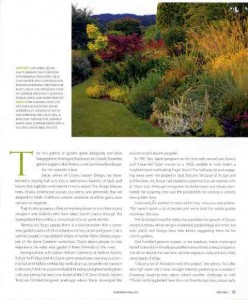 Stacie and Jon wanted to work within their resources and abilities. “We haven’t spent a lot of money and we’ve built the whole garden ourselves,” she says.
The landscape’s transformation has paralleled the growth of Stacie’s business, which designs residential gardens large and small. She tests plants and design ideas here before suggesting them for her clients’ gardens.
One hundred percent organic in her practices, Stacie challenged herself to transform the playground-like front yard into a textural tapestry. She did so, despite the vast lawn, western exposure, rocky soil, and almost twenty-percent grade change.
“I faced a lot of limitations with this project,” she admits. “But after one high water bill, I chose drought-tolerant gardening as a solution.” Choosing tough-as-nails plants solved another challenge, as well: “There’s nothing planted here that can’t handle two boys, soccer balls, a Frisbee and a Jack Russell terrier named Rita. This isn’t a fussy garden.”
Stacie and Jon rented a sod-cutter, and removed and gave away the turf in their expansive front yard. They tilled up rocks and roots and incorporated 30 yards of organic planting mix to improve the native soil. Stacie borrowed extension cords from neighbors, laying out the shapes of her new planting beds to create a sinuous wraparound border that encompasses a 70-by-40 foot irregularly shaped island at the center (grassy strolling paths link the beds, allowing for people and pets to navigate the “circuit”).
Her artist’s eye looked beyond northwest native varieties to include plants adaptable to similar dry summer-wet winter growing conditions, regions considered “Mediterranean”: Australia, Chile, South Africa and countries on the Mediterranean Basin.
Sophisticated in its palette and overall composition, the garden uses a surprisingly ordinary selection of plants. Mostly evergreen varieties appear and are often repeated, including wine-colored barberries, Viburnum ‘Davidii’, Osmanthus burkwoodii, dwarf golden false cypress (Chamaecyparis pisifera ‘Mops’), winter-blooming heathers, Euonymus fortunei ‘Emerald n Gold’, New Zealand flaxes, golden carex and Cotoneaster glaucophyllus.
“I choose colors I like – golds and burgundies,” Stacie says, likening her saturated palette to the medieval tapestries she loved seeing in Europe both as a student and later in the mid-1990s. “Plus, I am the texture queen.” As a designer, she is drawn to strong plant shapes that play off of each other. “I like to alternate spiked, round, lacy and layered forms. It’s like a puzzle that has to fit together.”
The garden gains architectural height and fluid movement from ornamental grasses like Miscanthus sinensis ‘Gracillimus’ and blue oat grass (Helictotrichon sempervirens). Joe Pye weed (Eupatorium purpureum ‘Gateway’), a long-blooming perennial, soars overhead. While foliage delivers volumes of color, flowers are strong accents. Planted en masse, low-water perennials punctuate the design, including purple coneflower, fire tail persicaria and show-stopping ‘Pikes Peak Purple’ and ‘Sour Grapes’ penstemon.
Last summer, this garden existed on minimal watering, Stacie says. “When temperatures hit 85-degrees, I finally turned on the water for a couple of hours at night and gave the roots a deep soaking.” But she resorted to this method only four times between May and October.
In addition to saving natural resources, the easy-care plants are compatible with Stacie’s busy schedule. Like many baby-boomers, she wants to enjoy, but not constantly tend to, her garden. “I’m choosing plants that can care for themselves and accommodating the space they require to reduce the need for any pruning.”
This philosophy has led to judicious editing out of a few perennials that require extra attention like deadheading and dividing. “As this garden matures, I’m using only low-maintenance perennials that have seasonal interest and great fragrance,” she adds.
Stacie takes comfort in knowing that her pioneering design philosophy is beginning to inspire some to try a different way of gardening. Dwindling water supplies and global warming may influence others. “Eventually, everyone will have to garden the way I do – they won’t have a choice,” she says.
Lucky for us, she proves sustainable can be beautiful too.
Posted in Creativity, Gardening, Landscape Design, Plants, Writing | 11 Comments »
July 8th, 2009
Just received this hand-addressed mailing from famous landscape architect Richard Haag of Seattle. I really like the title he gave me – GARDEN PUNDIT! I would now like to be addressed as “Ms. Debra Prinzing, Garden Pundit.”

Posted in Creativity, Playfulness, Writing | 2 Comments »
July 1st, 2009
Seattle in June.
Blue skies, expansive views of water and mountains, blooming gardens, great friends.
Here are some photographs of two days in Seattle: Saturday and Sunday, June 27th and 28th:

The view from Ivar's on Lake Union: Seattle's skyline and the iconic Seattle Space Needle

My dear friend Lorene Edwards-Forkner was my dining companion, along with fellow Pacific Horticultural Foundation board members
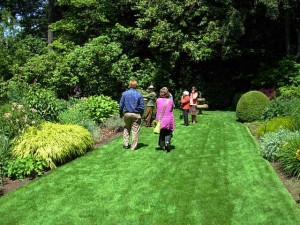
Garden touring in the Seattle garden of Mrs. Alison Andrews
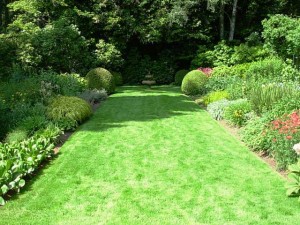
Here's that garden without people

My friend garden designer and writer Robyn Cannon joined me at the Andrews garden
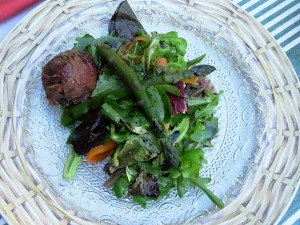
Robyn's delicious salad with asparagus and a yummy fig wrapped in prosciutto - unforgettable!
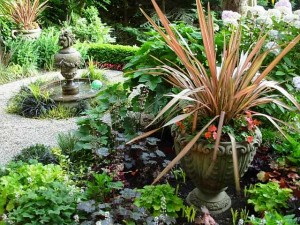
Robyn and Don Cannon's oft-photographed Seattle hillside garden - inspiring and lavish
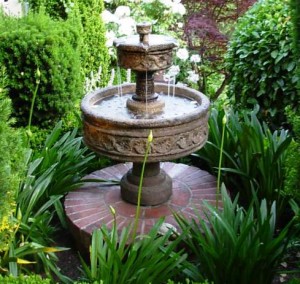
Elegant and cool, a splashing fountain in the heart of Robyn's garden
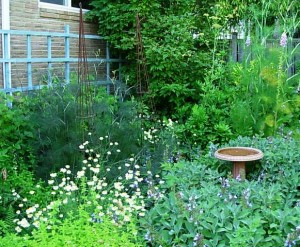
Stopped by my friend and garden muse Jean Zaputil's for a view of her beautiful herb garden
Posted in Creativity, Gardening, Landscape Design, Plants, Shed Glossary | 2 Comments »
June 28th, 2009
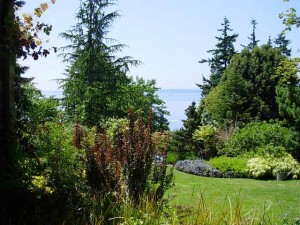
Here's the view from Betty Miller's house on a picture-perfect Saturday in June
Looking out the windows of the house that Betty Miller lived in until her death, I admired a perfectly-framed view of The Elisabeth C. Miller Botanic Garden, located in Seattle’s elite gated community, The Highlands.
Her garden, now a private, nonprofit botanical garden, is a sparkling palette of green-gold, lime, dark green and silvery-blue. Impressions: Touches of burgundy Japanese Maples appear, peeking through the multilayered branches of a mostly green woodland understory. Lichens and moss create irregular patterns on grey bark. Gentle mounds. Draping foliage. A shadowplay of bright and dark. Alluring. Inviting.
I spent all day indoors, at a Pacific Horticultural Foundation board meeting (thank goodness for “lunch break”) and I will be back tomorrow morning for yet another half-day of meetings. It’s a good group and we are excited about some of our new projects and plans for the essential publication for gardeners in the West.
If you want to take advantage of a special Pacific Horticulture magazine 5-for-the-price-of-4 issues subscription rate, let me know and I’ll send you a coupon ($28/year).
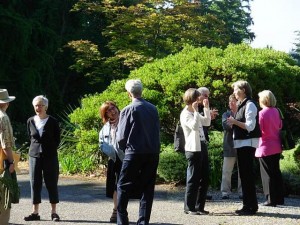
Work. It's "work," people. My fellow board members gathered outdoors before being dragged to the conference table
If you like the photos you see here, you can actually see this garden for yourself. There are two ways to tour the Miller Garden. First of all, call for a tour appointment. Tours are limited, due to the fact that the property is in a residential community. They also fill up fast (check the web site for details about early-in-the-year-registrations).
You also have the opportunity to take a class at the Miller Garden, offered through the Northwest Horticultural Society, ongoing education series. Check out their web site for details.
In preparation, enjoy this visual tour of Seattle in June. I’ll be posting photos of my travels here in the PNW (at the Miller Garden and in other awesome gardens) all week.
The Miller Garden is the quintessential Seattle garden. It is cared for by some very talented horticulturists, including my friends Greg Graves and Richie Steffen, along with many regular volunteers. I have wonderful memories of coming here to work on Northwest Horticultural Society projects with former director Richard Hartlage (who was president of NHS when I was editor of Garden Notes) and with his successor Carolyn Jones, who is a good friend and garden gal-pal. The Miller Garden is at the heart of the plant-obsessed Seattle gardening community. You’ll see why below.
Enjoy these awesome photos from today’s tour:
Posted in Creativity, Gardening, Landscape Design, Plants | 3 Comments »
June 22nd, 2009
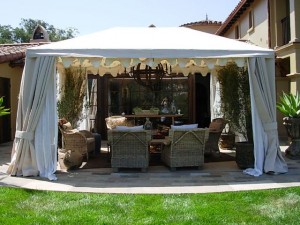
A custom tent with side draperies and scalloped details creates a secluded, breezy patio retreat
Interior designer Deborah Campbell knows how to turn an ordinary patio into a place you’ll want to visit often — and perhaps never leave. Use her design ingredients to create a private respite where you can rejuvenate and collect your thoughts.
The Santa Barbara-based principal of Deborah Campbell Interior Design transformed two private patio spaces into outdoor rooms at Casa Robles, the design showcase that benefits CALM (Child Abuse Listening and Mediation, a Santa Barbara nonprofit organization whose mission is to end child abuse).
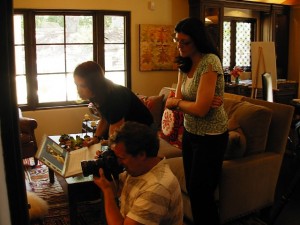
On location: Gary Moss, photographer (kneeling), as he perfects his shot in the family room. His assistant Pam is to his left; 805 Living editor Lynne Andujar is at right
As part of the 805 Living Magazine team that created the CALM Showcase program, I wanted to see the finished project in person before the public tours close this coming Sunday, June 28th (see details below). 805 Living is the presenting sponsor of the event, and editor Lynne Andujar asked me to write a feature story about the home and interiors for our November 2009 issue. This morning I drove to Santa Barbara to see and tour the project. Lynne was there with photographer Gary Moss, shooting the interior and exterior spaces for my story. They captured some gorgeous, evocative shots! Can’t wait to see them in print.
I also met several of the designers involved in creating the new house, including Annette Flower (who created the family room off of the kitchen), Gillian Amery of The Kitchen Company, and Deborah Campbell. The other key persons on the creative team include Christy Martin of Studio Encanto, the primary interior designer; Harrison Design Associates, the architecture firm; Lindsay Adams Construction, the contractor; and Katie O’Reilly Rogers, ASLA, landscape architect (who created the patio’s proportions and selected the beautiful Ashlar-laid stone).
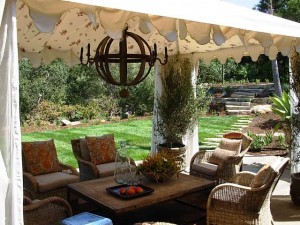
Create an outdoor room with a Sunbrella fabric tent lined with sheer panels and Morrocan print fabric on ceiling
Deborah Campbell’s design for the living room patio is completely enchanting. In studying and photographing it, I realized that her design, which she calls “Soft Summer Breezes,” offers a perfect recipe for decorating any patio.
Of course, it would be tres bien to turn your own patio into an open-air Kasbah with a custom-made canvas tent lined with sheer fabric and Moroccan toile draped across the ceiling.
But if you can’t do that, try creating an overhead fabric ceiling from yardage, sheets or tablecloths that suit your fancy.
Remember when you were a kid and you clipped two sheets to a clothesline and then pulled them out at the bottom to anchor as the “sides” of your makeshift tent? Ingenuity like that is priceless – we all need to remember our childhood shelter-making ideas and re-purpose them as adults.
Here’s a quote from Deborah:
“I am inspired by the Mediterranean architecture and Santa Barbara’s mild, year-round climate. I wanted to create outdoor rooms to capture that casual lifestyle. My personal style is always loose, relaxed, and eclectic. Nothing is perfectly arranged . . . because I wanted to give a sense of our California casualness.”
DECORATE YOUR PATIO
Try these patio design elements to decorate your outdoor room, straight from Deborah’s drafting table:
Rugs: A vintage Moroccan area rug is layered over a jute outdoor rug. The rug is protected from sunlight and rain. If you don’t have a covered area, look for one of the new, cool weatherproof rugs, such as Pier 1 imports’ selections. The Moroccan rug is from Upstairs at Pierre LaFond, Santa Barbara. Also shown here is the rattan “Poof” floor cushion, from Porch in Carpinteria. It echoes texture from the wicker chairs and invites you to perch, curl up your legs, and rest your drink on the coffee table.
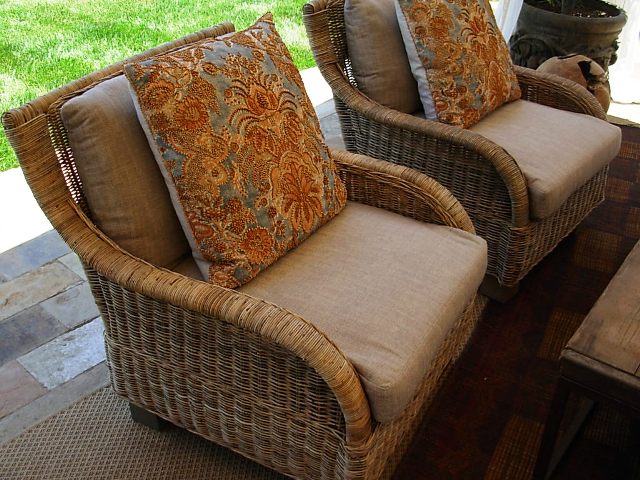 Seating: Deborah selected wicker occasional chairs and piled them high with eclectic textile pillows and basic driftwood-colored linen cushions. The chairs evoke life at the beach, from Porch in Carpinteria.
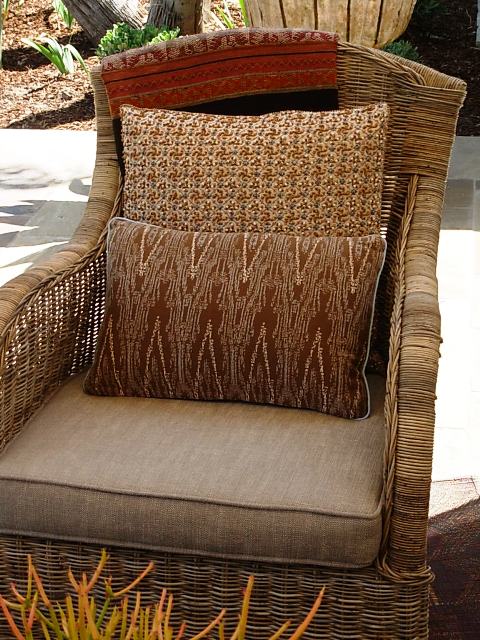 Textiles: Pillows galore lend one-of-a-kind interest and beautiful textures. They tell a narrative of an owner who has traveled widely and who loves to pair old with new; worn with polished; rustic with refined. Pillows from Upstairs at Pierre LaFond and Rooms & Gardens, both in Santa Barbara.
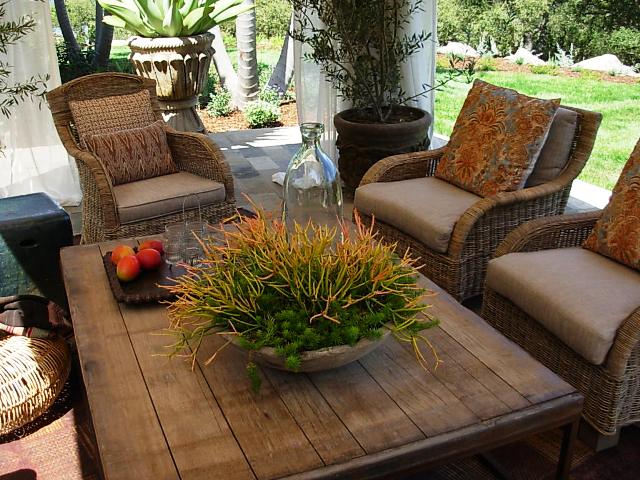 Tables: Weathered and worn, the plank-topped coffee table is large enough to do double-duty as an al fresco dining table. It is by Brick Maker, available at Porch.
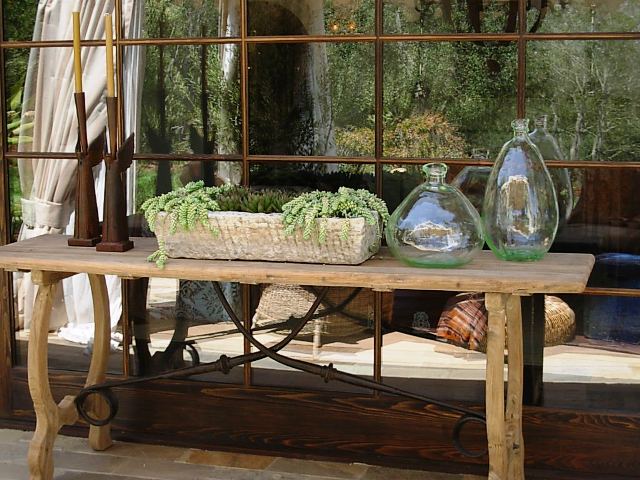
The “Scroll” console table is perfect for displaying objects or setting up a picnic buffet on a cool summer evening.
 Lantern: Okay, the over-sized lantern is a gorgeous thing to behold. I love, love, love that Deborah went BIG in scale in selecting this element of her design. It is called a “Wine Stave” chandelier, made from old wine barrels. You can kind of see the influence in the wood rings. I wish I could have photographed it while lit, but if you squint, you’ll get the idea. This lamp-chandelier makes the design sing! It’s from Porch.
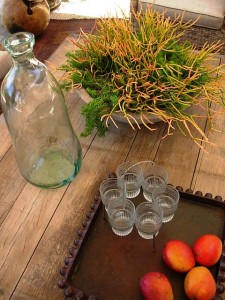
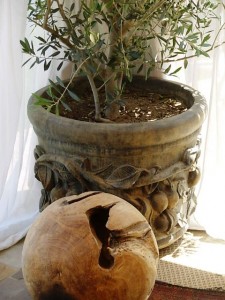
Objects: Decorative orbs (right) are made from burl root and lend another distressed texture to the space. Spanish hand-blown glass bottles look like beach glass (left). All of these items are from Porch.
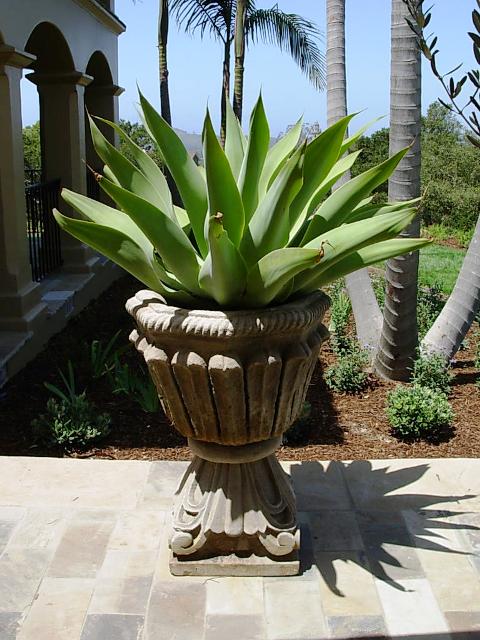 Plants: Drama is key. Each plant needs to have presence in the space, almost as sculpture. The mature Agave, potted in a cast concrete urn, is one example. (Above): The cast-concrete bowl, planted with Euphorbia ‘Sticks of Fire’ is another.
MORE DETAILS:
Casa Robles is an exquisite, historic property originally designed by Chester Carjola in 1948. The modest California ranch, situated on a oak-studded hillside with views of the famed Santa Barbara Mission, has been completely transformed and reimagined to capture the essence of a California Spanish Colonial estate. Most of the rooms open onto an interior courtyard, outdoor patios and second floor terraces. Enlarged to 4,500-square-feet, the home is situated on a two-acre garden.
In addition to the generous homeowners, volunteer architects, interior designers, landscape architects, contractors, craftspersons and artists have come together to create, furnish and landscape a beautiful showcase home. It is open to the public through June 28th to benefit CALM. Tickets are $30. Click here for more information.
Deborah Campbell Interior Design: 805-969-9657.
Posted in Architecture, Creativity, Entertainment, Furniture design, interior design, Landscape Design, Shed Glossary | 4 Comments »
© Debra Prinzing, all written and photographic content. Website design/development by Willo Bellwood/Metric Media