The Slow Flowers Podcast is the award-winning show known as the “Voice of the Slow Flowers Movement.” Launched in 2013 as the original flower podcast, we’ve devoted more than 10 years to covering the business of flower farming, floral design, and the Slow Flowers sustainability ethos. Listen to a new episode each Wednesday, available for free download here at slowflowerspodcast.com or on iTunes, Spotify, and other podcast platforms.
March 31st, 2013
Beauty from Branches
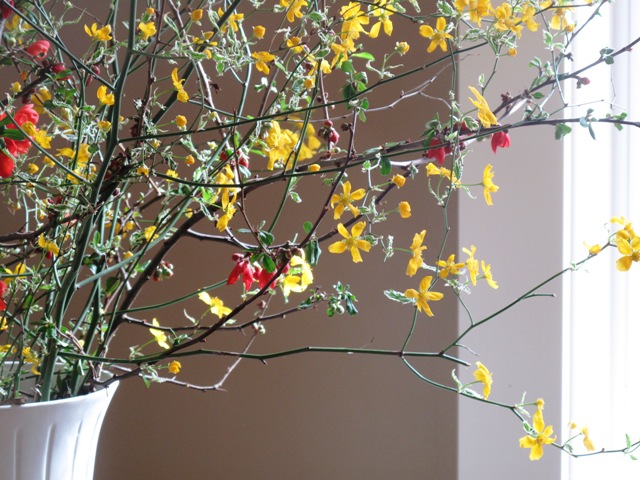
A wistful combination of two spring-flowering branches, captured in the morning light. Aaah!
Ingredients:
Kerria japonica ‘Variegata’, which has white-edge leaves
Flowering quince (Chaenomeles x superba), available in coral, red, pink or white
Vase:
17-inch tall x 7-inch diameter cream urn. This is my go-to vase for last-minute arrangements and it is tall enough to handle the branches, which are nearly three feet long.
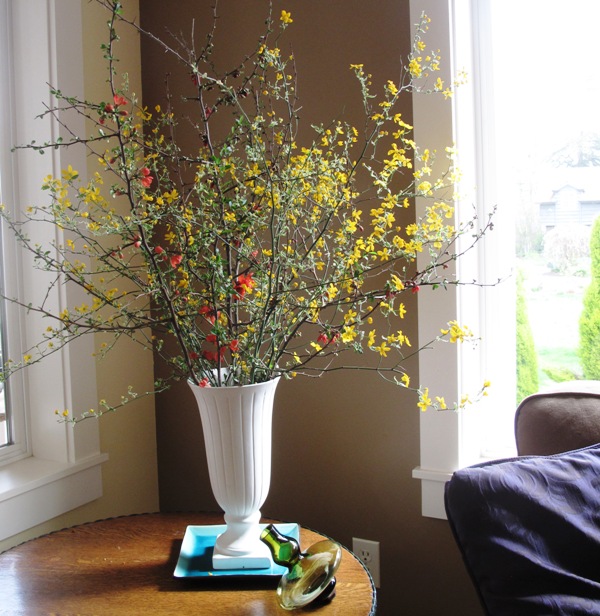
If you add cut branches to the vase when the flowers haven’t yet opened, the warmth of your home will coax them into flowering indoors. . . for up to two weeks.
From the Farmer
Jump-start spring: Many flowering shrubs and trees are suitable for indoor forcing. In addition to Kerria and quince, you can cut the bare branches of forsythia, witch hazel and numerous fruit trees. Harvest branches when their buds begin to swell, taking care to use proper pruning techniques. Re-cut the stems on a 45-degree angle and place them in a vase of clean water. Over time, the buds will respond to your home’s warmer temperature and begin to flower. Be sure to change the water as you would with any floral arrangement.
NOTE: Each Sunday of this year, I will post my photographs, “recipe” and tip for that week’s floral arrangement, created for my new book, Slow Flowers.
Enjoy the floral journey through 52 weeks of the year~
Posted in Creativity, floral design, Gardening, General, Landscape Design, Plants, Slow Flowers: 52 Weeks, Writing | No Comments »
March 24th, 2013
Zen in Bloom
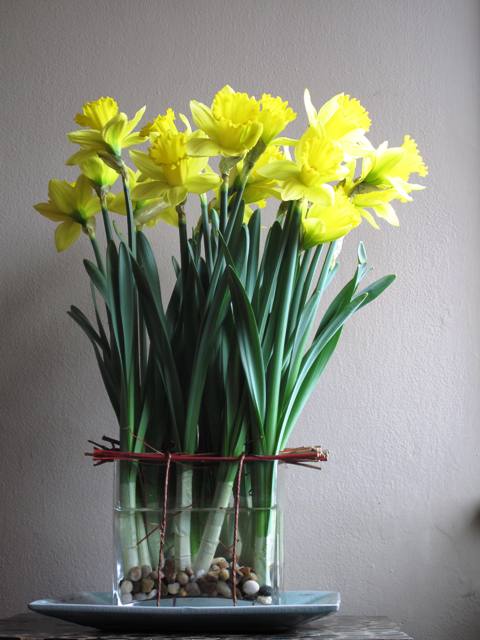
Showcasing a single type of flower – here, it’s spring daffodils – this technique is easy and carefree.
Ingredients:
15 stems common daffodils, from my garden
Multiple lengths of coral-pink twig dogwood, cut approximately 2 inches wider than the vase opening. Any straight, woody branch will work, including vine maple, pussy willow or the colorful twig dogwood (Cornus sanguinea or C. sericea)
Vase:
6-inch tall x 6-inch square glass vase (this design adapts to any square or rectangular glass vase)
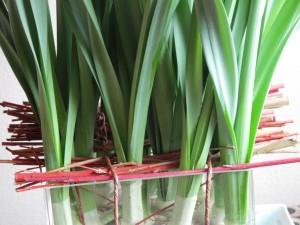
The daffodil stems are stabilized by a “raft” of twigs, lashed to cover the opening of the vase.
Other supplies:
Decorative pebbles
Twine-wrapped wire (available at craft stores in natural or green)
Design 101
Borrow inspiration: The idea for this bouquet came from a project featured in Design, a publication of The Flower Arranging Study Group of the Garden Club of America. Whenever you’re inspired by another designer’s technique, it’s important to give it your own twist rather than make a direct copy. For example, the original creation used florist’s foam inside the container, but I found it unnecessary, especially since the pebbles and twigs are enough to hold the daffodil stems in place.
NOTE: Each Sunday of this year, I will post my photographs, “recipe” and tip for that week’s floral arrangement, created for my new book, Slow Flowers.
Enjoy the floral journey through 52 weeks of the year~
Posted in Book reviews, Creativity, floral design, Gardening, General, Plants, Playfulness, Slow Flowers: 52 Weeks, Writing | No Comments »
March 15th, 2013
MAGNOLIAS AND MORE
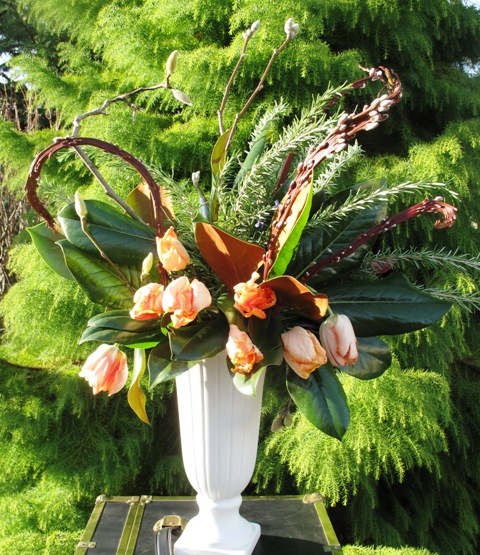
Evergreen magnolia (Magnolia grandiflora), parrot tulips, rosemary, Japanese fantail willow and bare magnolia branches in bud fill one of my favorite white vases.
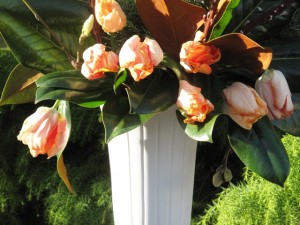
A sweet detail of those luscious tulips – don’t they play nicely with the rusty side of the magnolia foliage?
Ingredients:
5 stems southern magnolia (Magnolia grandiflora), harvested from my neighbors’ garden
12 stems apricot-hued parrot tulips, grown by Alm Hill Gardens
5 stems evergreen rosemary (Rosmarinus officinalis), harvested from my garden
3 stems Japanese fantail willow (Salix udensis ‘Sekka’), grown by J. Foss Garden Flowers
3 stems deciduous magnolia in bud, harvested by Oregon Coastal
Flowers
Vase: 17-inch tall x 7-inch diameter cream urn
Design 101
Proportion and Scale: These two related principles are among the most challenging to pull off correctly – in interiors and garden design, as well as in a vase. Proportion usually refers to size relationships within a composition, such as how each of the botanicals in this tall vessel is visually powerful. There are no wispy ingredients and the height of the arrangement is equal to the height of the vase. Scale indicates size in comparison to some constant, such as the human body. That’s where the terms “small scale” or “large scale” come in, since they refer to the out-of-the-ordinary size of things. With that in mind, think about the ideal interior setting for this vase. I think it would look stunning as the welcoming urn in a grand foyer or at the center of a large buffet table.
TULIPS & TWIGS
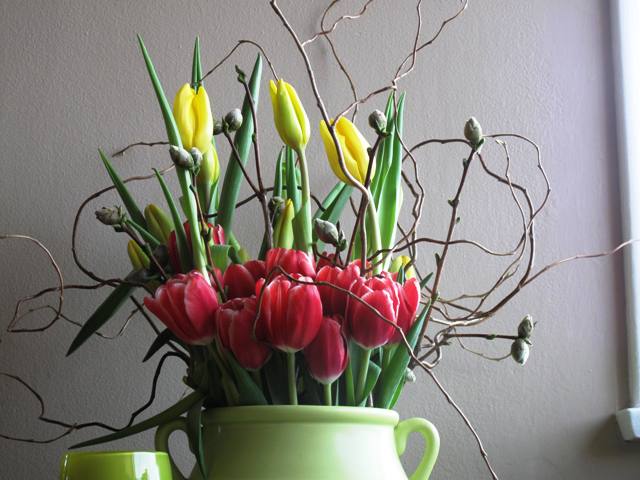
My cover shot, a perfect way to kick off springtime! Tulips, willows and camellia branches – all contained in a brilliant, matte green urn.
Ingredients:
12 stems red tulips and 10 stems yellow tulips, grown by Alm Hill Gardens
6 stems curly willow (Salix matsudana ‘Tortuosa’), grown by Oregon Coastal Flowers
8 stems Camellia japonica, from my garden
Vase:
5-inch tall x 6-inch diameter matte green urn with handles
From the Farmer
Water lovers: Unlike most floral design ingredients, tulips and willow branches seem to keep growing in a vase of water. You’ll notice that the tulip stems elongate a little each day. Some designers prefer to take the arrangement apart and re-cut the lengthened stems, but I like to observe the changes that occur. Willow is a water-loving plant, so you may discover that it sprouts tiny white roots under water and that small green leaves will push open, as if it is growing in soil. Enjoy a few days of this ever-changing dynamic.
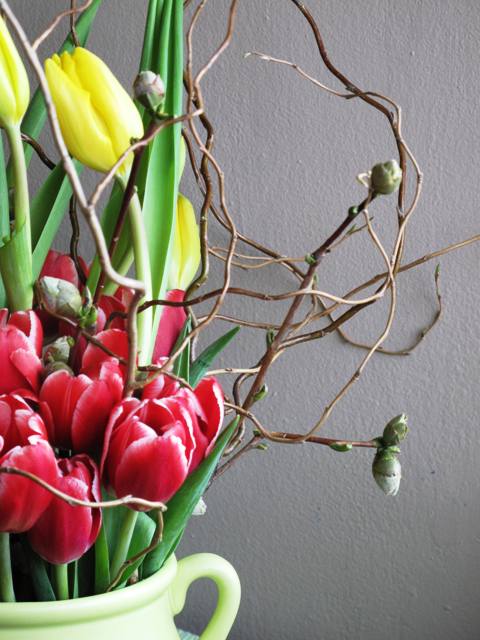
A detail of the colors and textures of springtime.
NOTE: Each Sunday of this year, I will post my photographs, “recipe” and tip for that week’s floral arrangement, created for my new book, Slow Flowers. Enjoy the floral journey through 52 weeks of the year~
Posted in Book reviews, Creativity, Entertainment, floral design, Gardening, General, Plants, Writing | No Comments »
March 3rd, 2013
Been busy here . . . in the midst of Flower & Garden Show season, so I missed last week’s bouquet. Let’s play catch up and here, I’ll feature Week 8 and Week 9:
“JUST ADD LIME”
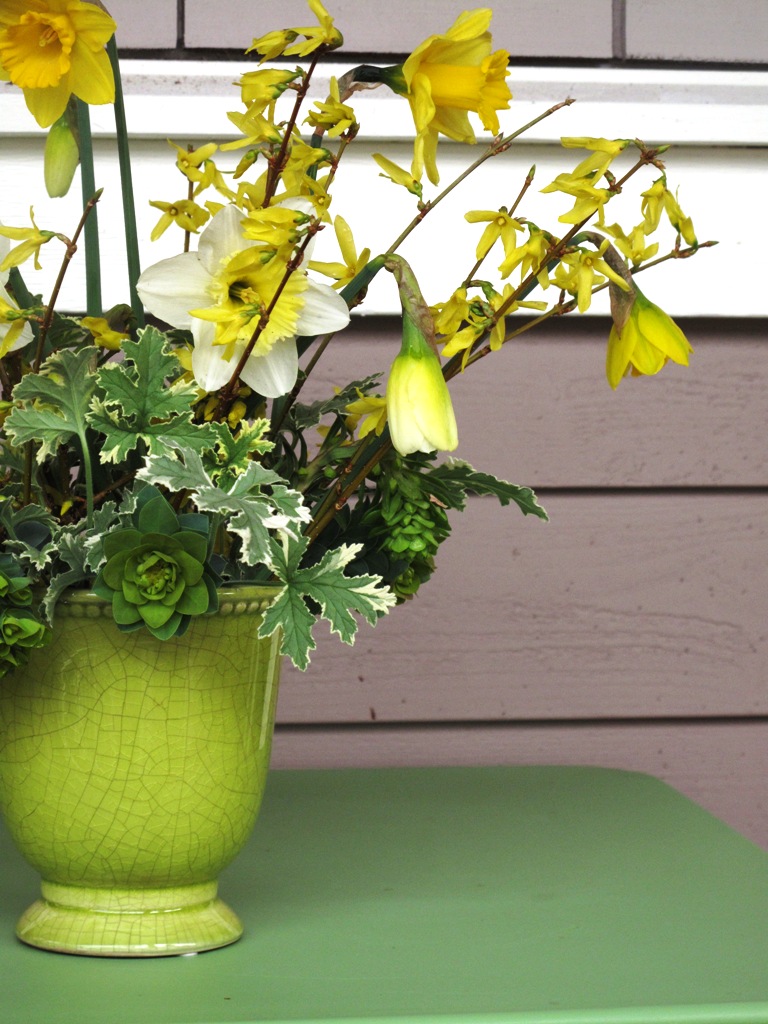
Oh how I love this combination of everyday garden blooms, including daffodils, forsythia and euphorbia – with a few sprigs of variegated geranium for contrast.
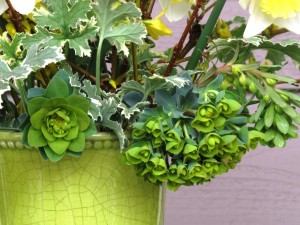
The spring green color of new growth is indescribably beautiful.
Ingredients:
All ingredients were harvested from my Seattle garden:
- 5 stems donkey tail spurge (Euphorbia myrsinites)
- 3 stems Euphorbia characias
- 5 stems variegated rose mint scented geranium (Pelargonium Graveolens Group ‘Variegata’)
- 7 stems forsythia branches (Forsythia x intermedia)
- 7 stems daffodils (Narcissus sp.), unknown cultivars
Vase:
5¾-inch tall x 5-inch diameter glazed ceramic vase
From the Farmer
Working with euphorbia: Most plants in the spurge family produce a milky-white substance when cut. It can be irritating to the skin, so be sure to wear gloves when handling the plant. While harvesting, I place the stems in a bucket of water, separating them from any other cut ingredients. Then I bring them into my kitchen where I dunk the tip of each euphorbia stem into a bowl filled with boiling water from the teakettle. This seals the stems. Some experts recommend searing the tips in a stove top flame, but that has proven too messy for my liking.
“HEADY HYACINTH”
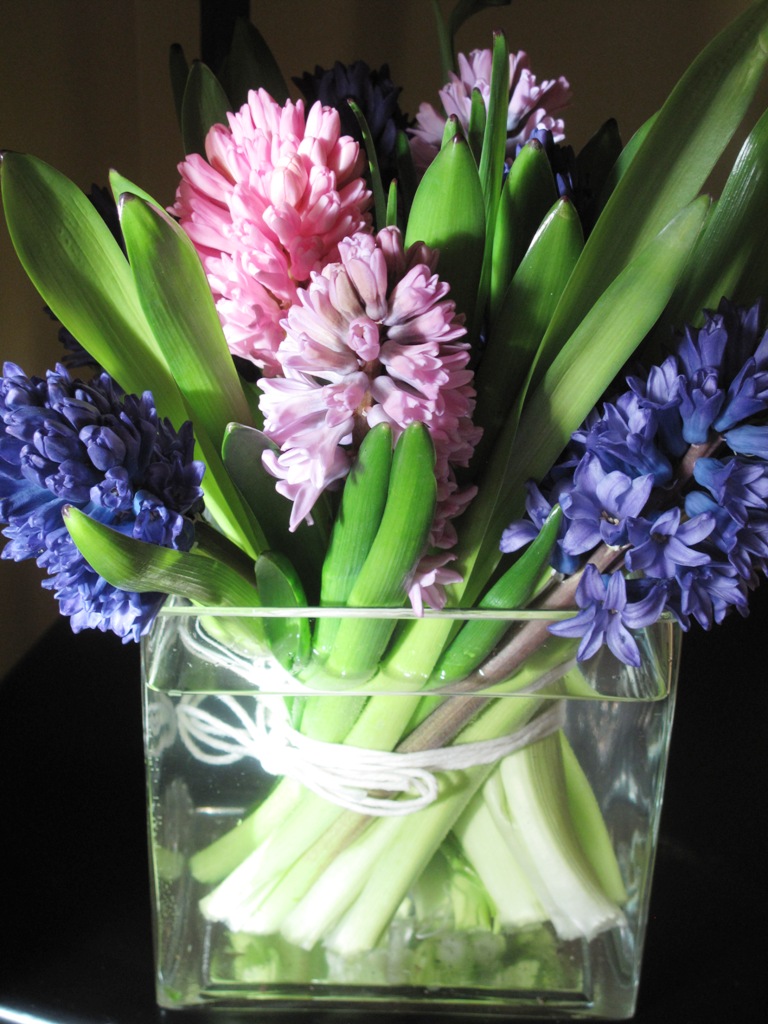
A simple length of linen twine gathers these garden hyacinths. They practically arrange themselves!
Ingredients:
8 stems hyacinths (Hyacinthus orientalis), grown by Alm Hill Gardens
Vase:
7-inch tall x 7-inch square glass cube
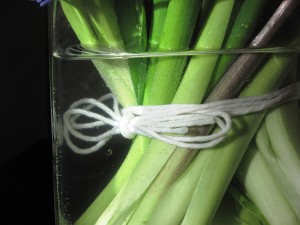
Detail of the gathered bouquet
Seasonal Choices
About those long stems: The typical garden hyacinth blooms on a relatively short stem – maybe 4-5 inches at the most. This limits the way hyacinths can be used in floral arrangements. According to Gretchen Hoyt, the way to stretch those stems is to trick them into wanting more light. “The longer you can deny them light, the more they stretch,” she explains. At the commercial flower farm, this process begins in dark coolers where bulbs are pre-chilled. When they are transferred to the greenhouse, the hyacinth crates are placed (in the shadows) beneath tables where tulips grow. If Gretchen wants to elongate those stems even further, “I’ll throw newspaper over them,” she says. Leaving bulbs on the stems is optional, but some designers do so to give the arrangement a rustic appearance.
Posted in Creativity, floral design, Gardening, General, Plants, Slow Flowers: 52 Weeks, Writing | No Comments »
February 17th, 2013
“Lilies, Two Ways”
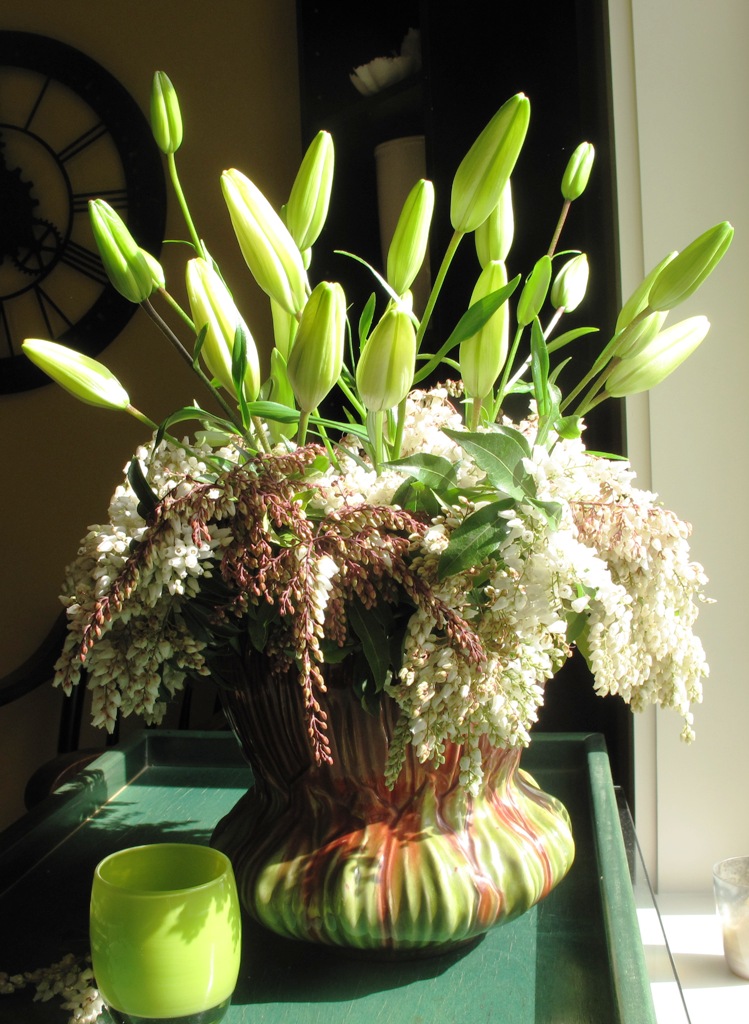
Two “lily” elements fill my antique majolica cachepot, set in the dining room window to catch the rare winter rays of sunshine
Ingredients:
12 stems lily-of-the-valley shrub (Pieris japonica), harvested by Oregon Coastal Flowers
5 stems white ‘Navona’ Asiatic lilies, grown by Peterkort Roses
Vase:
9-inch tall x 9¼-inch diameter majolica cachepot from the late 1800s. I found this unique piece in Palm Springs, in a shop otherwise filled with 1950s art glass. I simply couldn’t resist the botanical charm of the piece, so I splurged and ended up flying home with it on my lap!
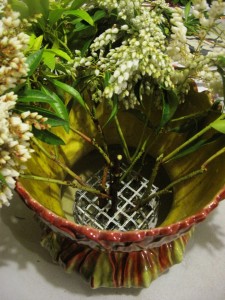
A detail from inside the vase . . .
Eco-technique
Flower frogs: I’ve made it a personal goal to stabilize flower stems with organic methods rather than the conventional florist’s foam or “Oasis.” That product, I have learned, contains formaldehyde and does not break down in landfills. An old-fashioned flower frog (in ceramic, glass or metal) is a great alternative. You can find flower frogs at flea markets or tag sales for a few dollars (or raid your grandmother’s supply). One of my favorites is a half-dome cage. It sinks to the bottom of the container and has ¾-inch square openings, ideal for woody stems. This is an arranging tool of the past, seriously useful for the present-day!
NOTE: Each Sunday of this year, I will post my photographs, “recipe” and tip for that week’s floral arrangement, created for my new book, Slow Flowers. Enjoy the floral journey through 52 weeks of the year~
Posted in Creativity, floral design, Gardening, General, Plants, Playfulness, Slow Flowers: 52 Weeks, Writing | No Comments »
February 13th, 2013
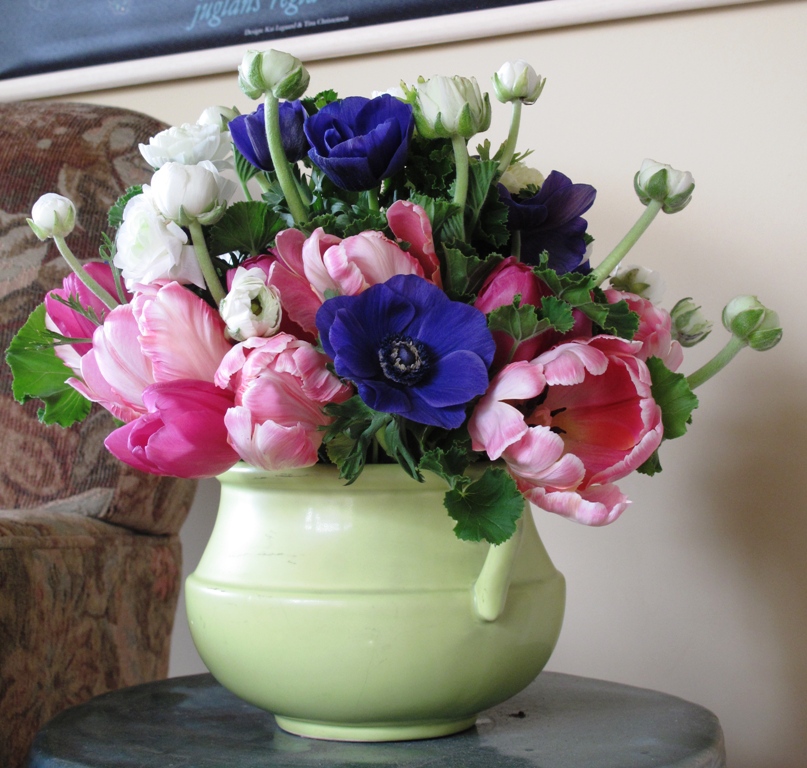
SPRING: Two types of pink tulips, Oregon grown; plus pelargonium foliage, white ranunculus & deep purple-blue anemones from California
I came home Sunday from a weekend in Portland, where I lectured about “Slow Flowers” and demonstrated eco-floral design techniques at the Yard, Garden and Patio Show. It was a great way to kick off the 2013 flower & garden show season, thanks to the very warm and supportive welcome of the Portland community.
I enjoyed a very special treat because some longtime family friends, including Donna Davey and her husband Bill Davey came to the event. In 1984, Donna designed the flowers for Bruce’s and my wedding. Pretty amazing for both Donna and me to reminisce about her influence on me . . . 28-plus years later! The bridal bouquet she designed used gardenias and I will always associate that wonderful fragrance with our marriage.
Live demos always have their surprises and this one was no different. My tulips had very floppy stems and they did not cooperate. It was my intention to recreate the bouquet on the cover of Slow Flowers, but the tulips I procured from a local Oregon grower the day before didn’t play nicely with my scheme.
READ MORE…
Posted in General | No Comments »
© Debra Prinzing, all written and photographic content. Website design/development by Willo Bellwood/Metric Media