Debra Prinzing

Get the Email Newsletter!

Archive for the ‘Landscape Design’ Category

What to do with salvaged shutters

Thursday, November 18th, 2010

Read on to learn what I'm going to do with these amazing shutters!

I recently spent the morning at a cool local flea market in Seattle. I was up early and out the door by 7:15 a.m., ready to get my creative juices going.

My mission: to discover as many castoffs from others that could make their way home with me.

The destination: 2nd Saturdayz, a popular flea market where vendors, dealers and designers come together to do business with salvage-savvy shoppers.

The apt motto: A Saturday Market of Fine Tastes and Curious Treasures.

Once inside the doors of a huge hangar (yes, the flea market is held at a decommissioned Naval base), I met up with Jean and Gillian. But not too much socializing is encouraged at these events. That is, IF you want to get the best deals. First-come, first-serve is the motto. Or: Every woman for herself.

I shouldn’t limit this endeavor to the female salvager because there were many men in attendance at 2nd Saturdayz. But still, you know what I mean. It’s a gal’s paradise.

Galvanized chicken feeder. 30 sizeable oval openings. A succulent planter or a flower holder? Or both?

Lately, I’ve been collecting vintage flower frogs, which makes sense since I’m living and breathing floral design. But this time, instead of finding glass and metal frogs, cages and stem-holders to displace the dreaded florist’s Oasis, I picked up a galvanized metal chicken feeder.

Think of a loooong ice-cube tray with oval cutouts. In metal. Very cool. Now that I’m looking at it again, I may just use this nifty piece as a planter for hardy succulents. It’s probably leaky so that’s going to give the drainage I’ll need.

A nearly-pristine child's typewriter complements my grown-up Underwood.

I also picked up a vintage child’s typewriter. It can play nicely with my retro black Underwood typewriter that we bought back in 1985 at the Rotary Club Auction on Bainbridge Island. I think I paid $5 back in the day.

Those old typewriters, truly relics, are now priced at $50 on up. And to think so many of them have been dismantled to make jewelry from the letter keys. I’m guilty of buying one of those alphabet bracelets, too.

When I walked into one small “booth” with my friend Jean, an awesome Seattle landscape designer, I found myself absent-mindedly stroking the frame and spindles of a cast iron baby crib. The vendor had taken off one of the crib’s side-rails and piled pillows and cushions on the springs and against the three remaining railings.

Here's the end of the baby crib. Next time you see this, I'll be lounging against some cushy pillows, perhaps under a shade tree. This crib will become my garden bench.

What did it recall? Yes, a very fashionable garden daybed or bench. And for $100, I totally lucked out. My friend Gillian, who is a pro at this sort of buying-and-selling of antiques and vintage items at Ravenna Gardens, pulled me aside to share the secret that she’s seen other dealers selling cast iron baby cribs for $600. I don’t have a “garden” in which to place this bench right now, since I’m in a rental house and I’m not yet ready to invest energy on land I don’t own. But . . . I did decide to bring this crib home and store the pieces in the garage until the next garden comes along. Luck-ee me!!!

I couldn’t ignore the central element inside the warehouse – a little hamlet of potting sheds. Their perky corrugated metal roofs, topped with finials created from shiny bits and pieces, stood high above the flea market’s landscape.

While gazing at the rustic but stylish potting sheds, I met designer/builder Bob Bowling. Owner of Bob Bowling Rustics of Whidbey Island, this engaging shed artist greeted me and generously shared his story.

Turns out, like some of the talented folks we featured in Stylish Sheds and Elegant Hideaways, Bob makes unique structures using reclaimed and recycled materials. Whimsical and playful, and finished off with salvaged windows, doors and other artifacts, the Rustics sheds are each a delight to see.

Bob's cool garden shed was hard to miss.
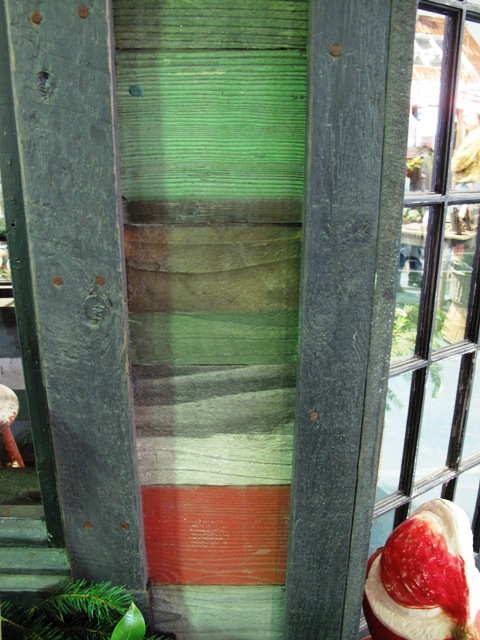
The "stripes" come from variously-stained boards.

The prices are reasonable, too. I should know. For $3200, you can get this “Rasta” shed. It measures about 7-by-7 feet in diameter (plus or minus) and features cool details, like the exterior of alternating stripes of differently-stained boards and the window boxes, door hardware and towering finial.

You could easily spend this much for a pre-fab storage or tool shed on the lot of your local big-box store. Which would add more art and style to your life, while also being quite functional?

All this thrifty flea-market shopping had energized me and made me feel quite artistic.

And then I met that shutter duo that called my name. Loudly. They appear to be half-circle crowns or eyebrow tops from a set of plantation shutters.

Wooden, with 2-inch deep slats, these pieces were displayed separately. Once I noticed both of them, I was not going to leave with just one! I don’t think I got a huge bargain, since I paid $28 apiece (but the seller insisted she had just cut the price in half). Whatever. When you spy something so uncommon, you have to act.

Other than changing the depressing buff-colored paint job to something more lively, what on earth do you suppose I will do with these crescent-shaped pieces?
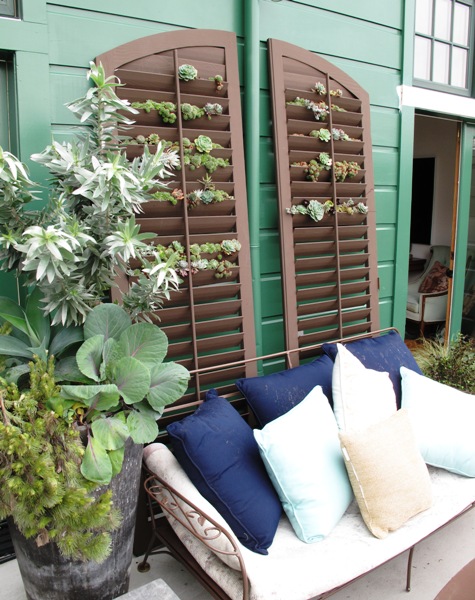
Hello! You two are pretty darned cute. That Baylor Chapman is uber-talented!
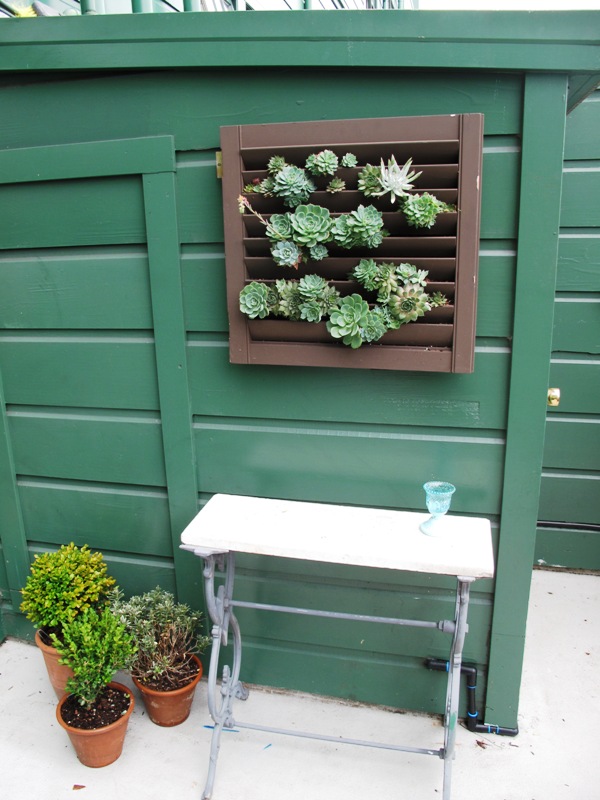
Here's another small shutter-turned-wall garden, compliments of Baylor Chapman.

For inspiration, I hearkened swiftly to my visit to Baylor Chapman, a talented San Francisco floral and garden designer I recently profiled for A Fresh Bouquet. After my friends Susan and Rebecca took me to meet Baylor at her floral studio, the three of us accompanied her to her loft apartment in SF’s Mission District.

And there on the outside roof deck, were some pretty amazing succulent gardens – PLANTED IN SHUTTERS!!!

Naturally, I am going to draw from this incredibly clever idea and put those twin shutters to very good use with a vertical planting of hardy succulents. It may take until next spring, but stay tuned. And if you have any suggestions on what color I should use to upgrade the crappy paint color, please chime in.

The trick, according to Baylor, is to secure a layer of landscaping cloth like a little pocket or envelope behind each shutter opening. Then you can add potting soil and plant your sedums, succulents or whatever else seems fitting. You know, I really do love that chocolate brown finish on the shutters. Doesn’t it nicely offset the silver, gray, blue and green foliage of the succulents?

Well, all in day’s work. More to come as I execute these big plans.
Fall design inspiration: foliage, flowers, fruit and architecture

Monday, November 1st, 2010

“It would be worthwhile having a cultivated garden

if only to see what Autumn does to it.”

–Alfred Austin, The Garden that I Love (1894)

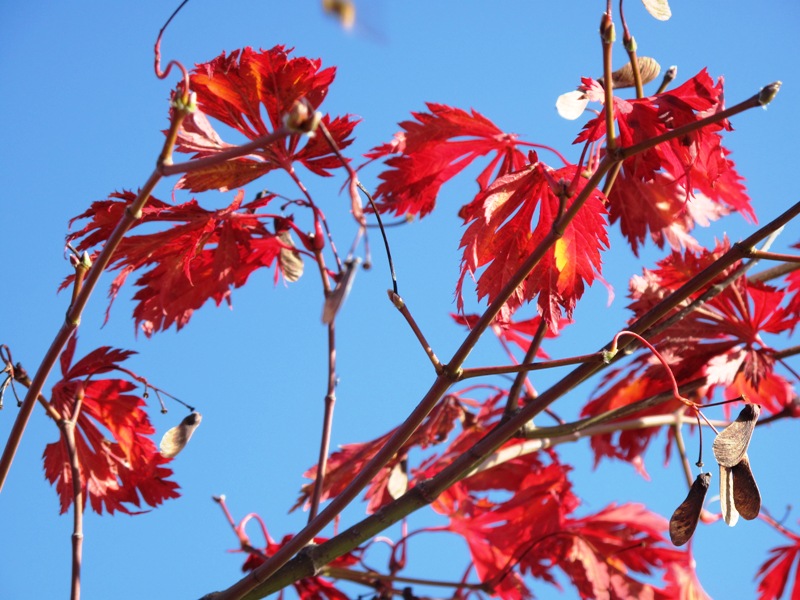
Acer japonicum 'Aconitifolium'

Whether emulating what you see in nature or combining plants to masterful heights, gardens that excel in the fall are ones that showcase the best of the season. 

There are certain trees, shrubs, perennials, ground-covers and vines that you may not notice during the rest of the year. But somehow, once the temperatures cool and the sun’s arc lowers in the sky (lighting foliage and plant forms from the side, rather than from overhead), a fall glow illuminates – and we see the garden in a new way.  

Last Friday I gave a presentation entitled “Gardens that excel in the fall: Something for everyone” at the Garden Conservancy’s one-day seminar in the San Francisco Bay Area. Called Fourth Quarter Gardens: An August to December Romance, the symposium featured several really inspiring speakers on design, horticulture and the unique gardening culture of the west. 

I was thrilled to be part of this cohort, which included Bob Perry, Katherine Greenberg, Nicholas Staddon, Elizabeth Murray, Chris Jacobson and Brian Kemble. The highlight for me was a tour of Katherine Greenberg’s all-native garden in Lafayette (an East Bay community). It was the three-dimensional, living embodiment of her lecture “Greens, Grays and Golds in a Native Garden.” 

My talk was a visual meditation of what inspires me this time of year: foliage, flowers, fruit and architecture in the landscape. 

I started by sharing the excitement I feel about the season as I design for texture in a new way; find unexpected plant pairings (not just those Halloween hues, either); tend to the harvest and see the bones, lines and structure emerge as leaves fall and flowers fade. My attention is drawn to the aging beauty of what some may call “decay.” Yet those yellowing hosta leaves and nearly-bare branches are a sign to me that the garden in every phase of growth is to be celebrated. 

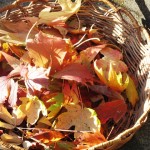
This lovely melange shows the amazing diversity of fall leaf color.

I also shared a lay-person’s explanation of why leaves change color in the fall. I quoted from Brian Capon’s book Plant Survival

“. . . the cool night temperatures and shorter days of September and October are sure to start the season’s normal color changes in leaves and . . . trigger their falling from the trees. 

“Leaves change color when the green pigment, chlorophyll, decomposes in leaf cells to reveal orange and yellow pigments, present all summer but hidden from sight by the more abundant chlorophyll. 

“In some trees, the unmasking of the yellow-orange pigments is accompanied by production of brilliant red ones, made from sugars and other substances in the leaves. The purpose of this last-minute display of added color is not known.  

“In the green leaf, both green chlorophyll and yellow-orange carotenoid pigments are contained in tiny chloroplasts. Because there is more chlorophyll than carotenoid, the leaves appear green. In fall, after the chlorophyll decomposes, only carotenoides remain to give the leaf its glowing, golden color. In some plants, the leaf cells produce red pigments, anthocyanins, that are stored in the vacuoles. As the anthocyanins collect and mask the carotenoids, the leaf turns red.” 

A lot has been written about fall gardening and much of it focuses on the importance that gardeners in the west do fall planting! 

Witch hazel is espaliered along a lattice arbor at the Center for Urban Horticulture in Seattle.

I embrace and endorse this strategy, since it accomplishes so much that one may not have energy to tackle six months hence. It gets us out into nurseries and weekend plant sales, heightening our sensory response to a plant’s autumn form and texture and its promise of spring to come. The season forces us down on our knees to plan, prepare and place those treasures, brought home with the admonition (at least in the Pacific Northwest) to “plant before frost.” California gardeners want to plant in the fall for an entirely different reason — to capture any winter precipitation for good root establishment. 

If only to think about springtime, I will plant peony crowns in the fall. But then, I pause and remember what occurs after the blowsy bloom of Mother’s Day; and the sultry autumn glory of peony foliage comes to mind. Appreciating both the youth of spring and the maturity of fall is one of those wonderful surprises that comes from having plant lust. 

If you, too, are a fall-planting advocate, then what may be second-most on your mind is the design of an autumn landscape. 

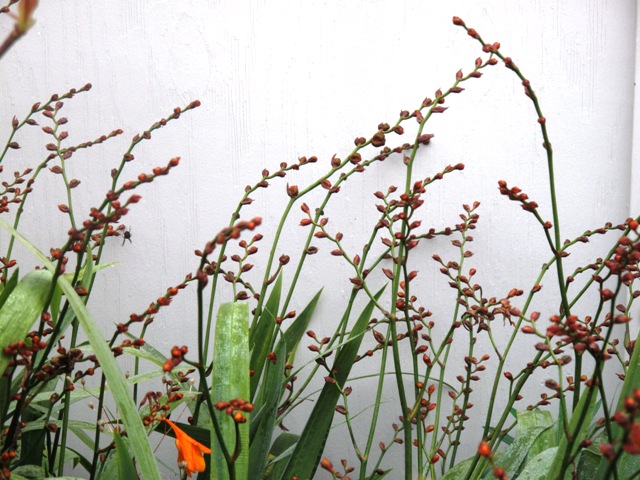
I love the architectural form of "spent" crocosmia blooms. These seed-heads are as beautiful as the flowers themselves.

Seasonal changes, at least at the beginning of the fourth quarter, work their magic here in the west. The light changes, the moisture content heightens, and the foliage reddens. The garden’s edges soften in some places (perennials go to seed; grass plumes explode; greens turn tan) and become more acute in other places (the architecture of deciduous plants is more pronounced; evergreen plants move to the foreground; anything that blooms is undoubtedly noticed as well). 

It’s almost as if the feminine personality of spring and summer steps aside for the more masculine personality of fall. Yet when I posed this theory to my friend Betsy Flack, she argued that “I’ve always thought (fall) was my own season—sort of the ample-bosomed (billowy) matron . . . after Spring’s sprite.” 

Our differing opinions reveal that the autumn garden is one we can all embrace. 

To me, there are four aspects to the 4th quarter garden that I consider when planning, touring and evaluating the well-designed landscape: 

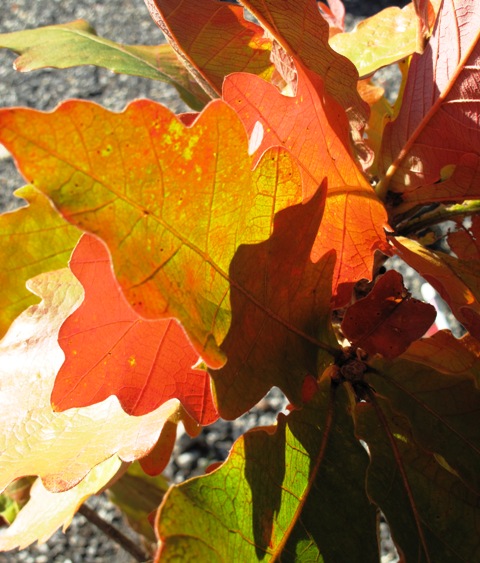
This is some kind of wild-looking oak, isn't it?

Foliage: 

Cooling temperatures and shortening days bring out the fall glow we so admire. Yet it’s not just color (golds, coppers, wine reds and dark purples) that I’m in search of. I also consider broadleaf evergreen plants with graphic foliage, as well as conifers that change with the season, taking on their own non-green hues. 

Laura Morton, a Hollywood designer, uses echinacea and asters in this yummy fall combo

Flowering plants: 

If you find a fall-blooming perennial that you like, plant it not once but thrice. 

Some of my favorites include Japanese anemone, heaths and heathers (Calluna vulgaris cultivars are especially gorgeous when the temperatures drop) and asters (A. novi-belgii; A. novae-angliae; A. lateriflorus). 

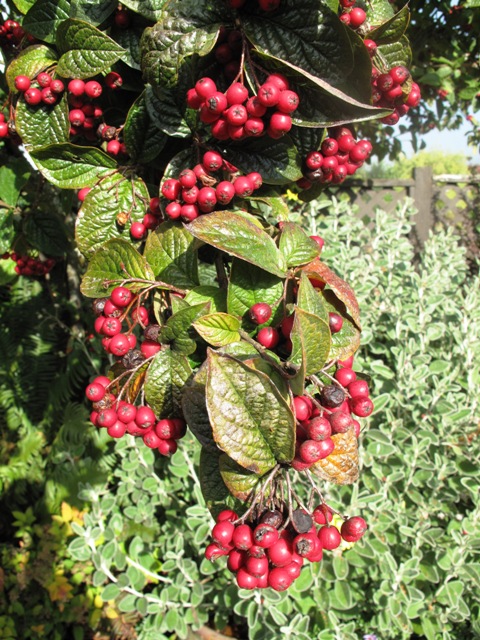
Fruit: Edibles and ornamentals unify in the autumn garden, lending a sense of “harvest” and hearkening 

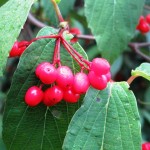
This cotoneaster will delight birds and humans alike.

back to the ritual and sustenance of gleaning fruit from the earth. Nuts, berries, pods, seeds, fruit – for eating or just eye-feasting – are essential elements of the autumn garden. Because I am a floral designer, I take particular interest in gathering rose hips, crabapple fruit, seed heads and even spent grapevines (with tendrils and curls) from the garden for use in my vases. 

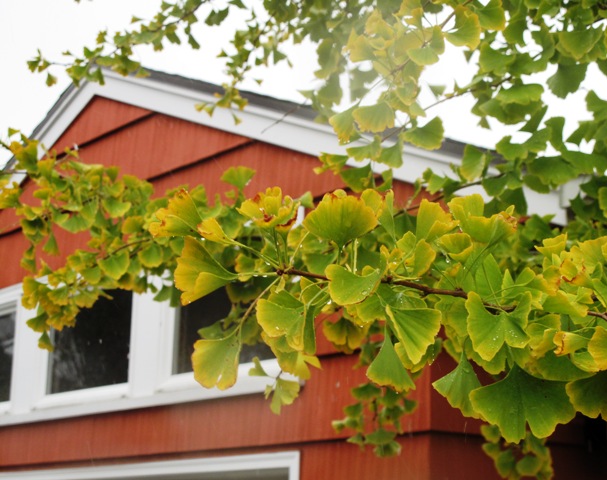
The yellowing gingko against a pumpkin-colored garage is a perfect fall scene.

Architecture: It goes without saying that structure is the backbone of 4th quarter gardens. Deciduous trees and shrubs, dormant perennials, disappearing annuals . . .they can do their thing and yet the arbors, gates, patios and pathways remain – thankfully. I take special note of the shadow-play created by light as it moves through a garden, catching shapes made by architectural elements and throwing those alluring patterns against walls and fences. 

Here are a few more seasonally-appropriate quotes to enjoy: 

” . . . asters: purple asterisks for autumn.” Conrad Aiken, Preludes for Memnon (1930) 

“Hurrah!  . . . it is a frost! — the dahlias are dead.” R.S. Surtees, Handley Cross (1843) 

A mosaic of autumn impressions: 

Clever candles for outdoors (and inside, too!)

Sunday, October 10th, 2010

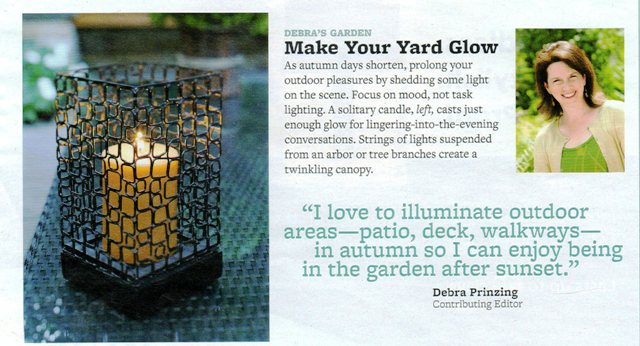
October is well underway, and here is my little “Know-How” piece from the October 2010 issue of Better Homes & Gardens.

It was inspired, in part, by my past visits to my friend Kathy’s garden. She uses outdoor candles incredibly well.

I have always loved the look of luminarias, the traditional candle-lit lanterns that illuminate walkways and paths for Southwest-style holiday celebrations. Modern re-interpretations use paper bags or Mason jars weighted down with a layer of sand in the base holding votive candles inside.

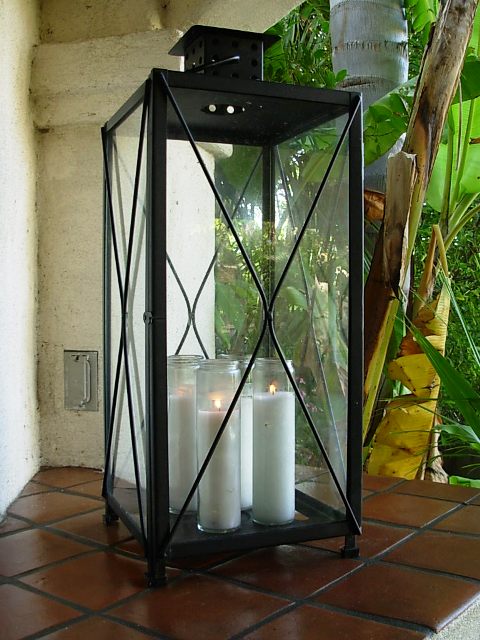
For a fresh twist that takes the luminaria idea and improves upon it, look for 7-Day Candles, also called altar candles. I first saw the brilliant display of these Mexican chapel candles in Kathy’s Southern California garden. Of course, it’s easy to dine and entertain out-of-doors here all year long. But even if you reside in cooler parts of the country, you can still borrow her idea!

White, red, blue or green wax is poured into an 8-inch-tall cylindrical glass container. “You can burn them 15 hours a day for a week,” Kathy says. “Imagine, 110 hours of candlelight for about one dollar!”

You can often find them at Mexican grocery stores or 99-cent/Dollar Stores. I found several styles on the shelf of my local Safeway grocery store – in the Mexican food aisle. And yes, they cost 99-cents!

A cluster of 7-Day candles looks brilliant inside a traditional hurricaine lantern.

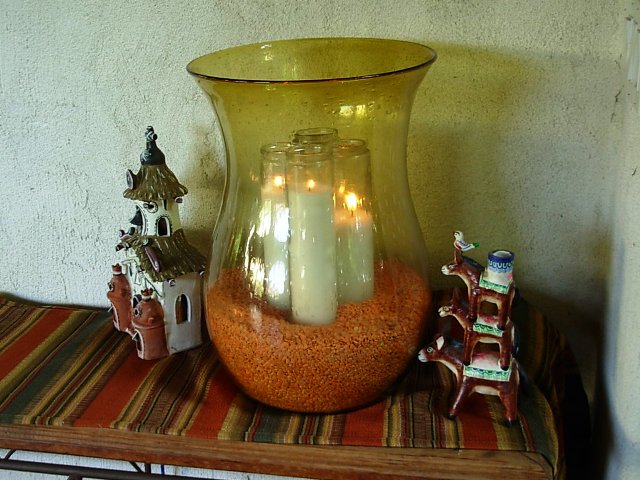
Here are some of the tall, slender, long-burning candles nestled in a base of dried lentil beans. Perfect for autumn decor!

Kathy began decorating with these clean-and-simple altar candles after too many dinner parties where one-inch votives burned out before the evening was over. She lined her outdoor fireplace mantle with a row of the 7-Day candles, which glowed and sparkled during her al fresco dinners.

Kathy also groups three or four candles inside a large, glass vase for impact. A few inches of dry black beans or orange lentils in the base serve as a stabilizer. Try a variation of your own and you’ll enjoy hours of romantic flickering candlelight.

As for displaying 7-Day candles outdoors, such as on a porch, patio or front walkway, don’t worry that they’ll blow out.

Kathy calls the glass cylinders “little hurricane lamps.”

Here are some additional “illuminating” ideas for your after-dark garden enjoyment:

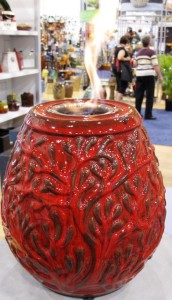
  • Burn a flame:  also adds warmth after dusk. At the Independent Garden Center Show in August, I was amazed at the number of vendors who are introducing these ceramic bowls, lanterns or pots that contain a small metal insert that burns a “gel fuel.” In one catalog, from Napa Home & Garden (see lantern here), the liquid fuel is described as being manufactured from recycled, post-consumer waste – a recycled and sustainable product. The decorative ceramic container burns a long-lasting flame. In the garden, you can illuminate the edges of a pathway or group several lanterns together on a tabletop for after-dark enjoyment.
  • String up lights: Create a twinkling overhead canopy with strings of carnival lighting, holiday strands or small lantern lights. When suspended from an arbor or tree branches, the tiny lights lend a flickering, romantic accent – and just enough light for sitting outdoors with a hot drink.

ILLUMINATION UPDATE: My friend Kathy Purdy, at Cold Climate Gardening, just suggested that I check out solar fireflies: “Personally, I can’t see using these if you have the real McCoy, but I’ve learned that not all areas of the country do,” she writes. Kathy, you’re right. West coast gardeners are not as fortunate as you East coast gardeners. I haven’t seen a real firefly since July 2000, when my family visited friends in Washington, D.C. and we lay on our backs (on their front lawn) late at night – watching the magic!

A true blue garden with a heart of gold

Sunday, August 8th, 2010

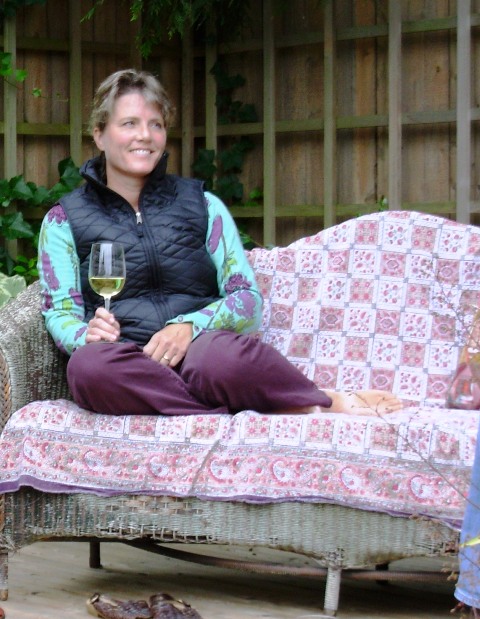
Tina sure knows how to enjoy herself in the garden! Here she is, resting on my vintage wicker in my former Seattle garden, 2006.

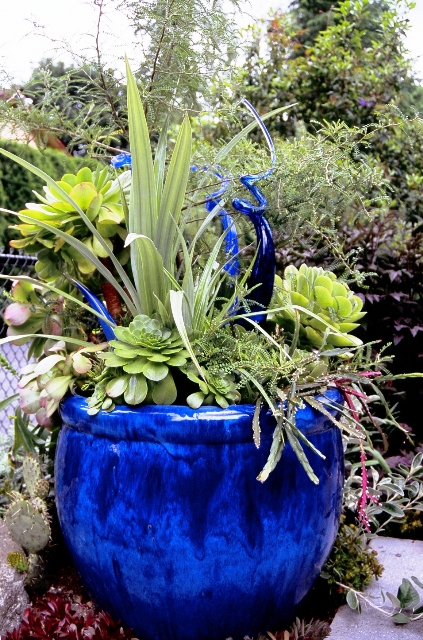
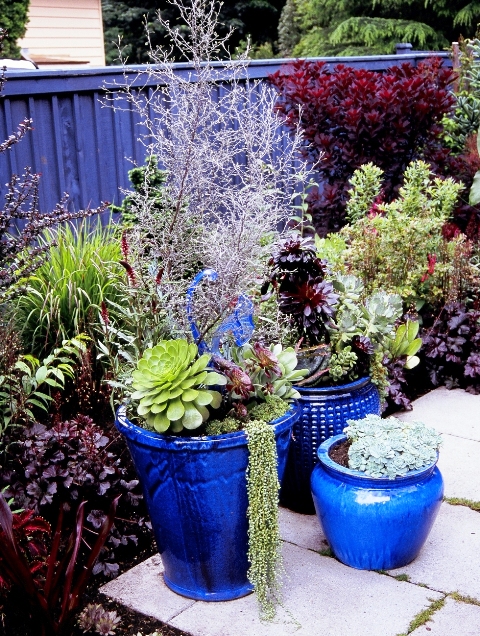
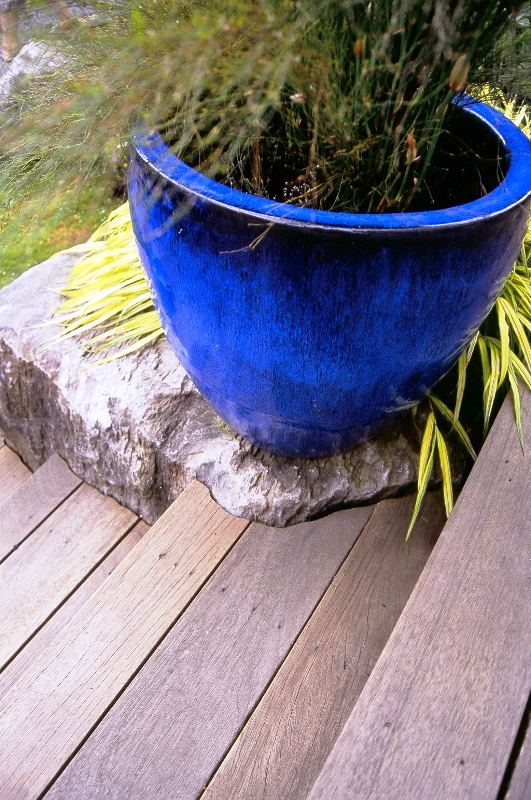
Great container design paired with whimsical glass art makes this pot a stunning focal point in Tina and Paul's garden.

I first met Tina Dixon in the early 2000’s when I was asked to join her as a judge for the Washington State Nursery & Landscape Association design awards.

Her bubbly personality and welcoming nature included me in the circle of other judges, most of whom had previously served together. Our judging session took place at her home in Bothell, just north of Seattle, allowing me to gain a better sense of just who Tina is. In short, Tina is a connector. She connects colleagues, clients and friends, helping everyone feel part of the Seattle horticultural community. You can’t help but have fun when she’s in the room (or on the tour bus or in the garden).

Through Plants a la Cart, her container design business, Tina creates breathtakingly gorgeous planted pots for some of the Seattle area’s poshest addresses.

Several years ago, she turned her attention to the property she owns with her husband Paul Stredwick. Their hand-crafted garden is a vibrant, color-infused, texture-layered, art-filled spot on the map. And garden tour-goers, if they are lucky, can occasionally get beyond the denim blue-stained gate to see the surprising horticultural world inside.

The photographs shared here are ones I took in 2006 when Tina and Paul opened their Golden Trowel Award-winning garden to the Hardy Plant Study Weekend participants. I served on the event’s planning committee that year, so I knew what a treat was in store for the several hundred participants who flocked there during the Open Garden schedule.

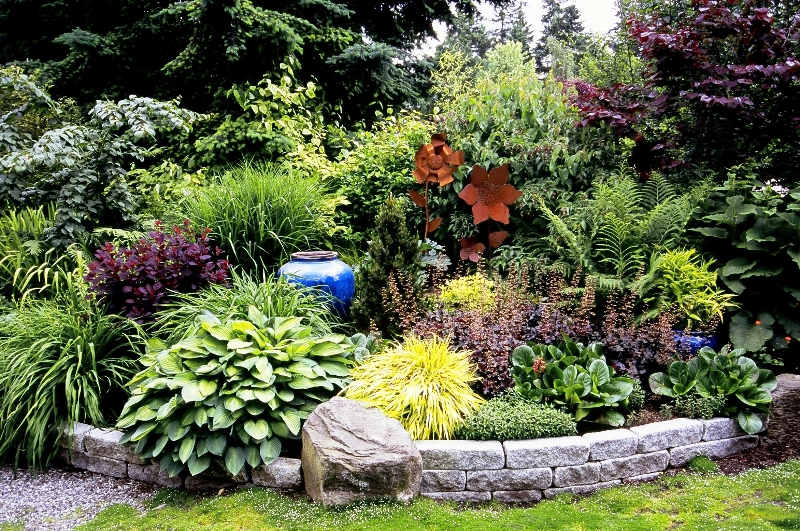
In 2007, Garden Design magazine awarded Tina and landscape designer Mike Jeppesen the Golden Trowel Award for this gorgeous Blue-Themed landscape

Since then, I know that Tina and Paul have received numerous requests to add their garden to area tours. They recently decided to open the property to benefit a cause that they personally support, Hopelink. Hopelink is an United Way agency that offers an array of programs that enable families in crisis to make progress toward and achieve self-sufficiency.

You can see the garden next Sunday, August 15th, at two different events. An evening Garden Party (6-8 p.m.) includes wine, hors d’oeuvres and music by The Chromatics. Knowledgeable docents will be on hand to answer questions during the festivities. Tickets to the private garden gala are $150 with a portion tax-deductible. Register online or call 425-897-3703.

The Dixon-Stredwick garden is also open earlier in the day, Noon-5 p.m. for a $50 donation to Hopelink. You can pre-order tickets for the tour here. Or call the number above.

For some background on this garden, here is the story I wrote in April 2007, which appeared in Seattle Homes & Lifestyles magazine. Subsequently, their garden has been featured by other publications, so I feel pleased that Tina said “yes” to me first!

True Blue: Designed with a harmonious blue-hued palette, a Bothell garden shows off art, architecture and plants

Written by Debra Prinzing

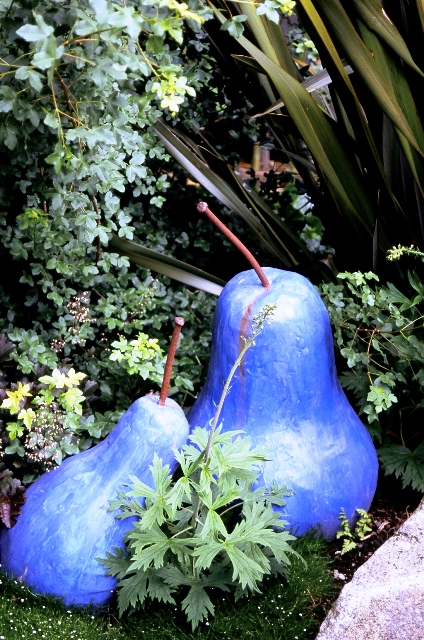
Painted periwinkle, two concrete pears by Woodinville artist Judy Thomas continue the color story.

If, as color theorists say, blue has therapeutic qualities, then Tina Dixon is a very healthy woman. Whether it’s a bright or subdued blue, Tina thrives on the hue.

Owner of Plants a la Cart, a successful container-garden design service, Tina considers the serene hue her signature color. Although she doesn’t limit clients to her preferred palette, Tina is well known for filling azure- and cobalt-glazed urns with dazzling combinations of leaf shapes, textures and colors.

Her penchant for blue infuses her own landscape, giving it a cohesive theme. “Blue is my favorite color,” she proclaims.  

When they bought a one-third-acre Bothell pasture in 1983 (previously inhabited by a lone calf), Tina and her husband, Paul Stredwick, were in their late 20s and intent on building their first home, a gray, barn-shaped Dutch colonial, trimmed in blue. Landscaping was not on their minds or in their budget.

By 1987, Tina abandoned an office job for a horticultural career. She studied landscape design at Lake Washington Technical College and launched Plants a la Cart. The pasture was by then home to two rambunctious golden retrievers.

Occasionally, Tina and Paul had time to tackle their own backyard. They renovated a deck and planted an 80-foot-long mixed perennial border against the south fence. “Paul and I were trying to pick away at the landscape,” she recalls. “Wherever we stopped one year, we started there the next. It wasn’t quite flowing.”

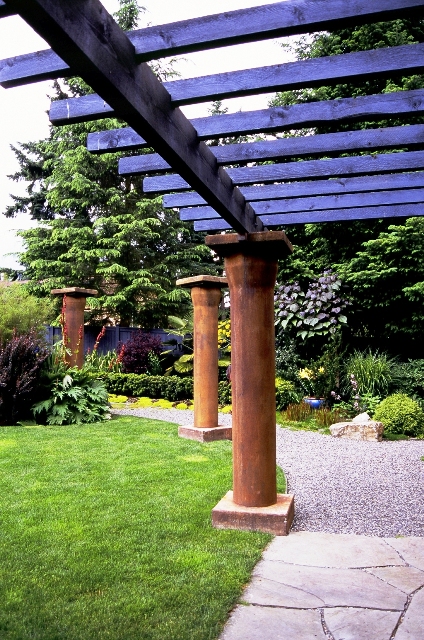
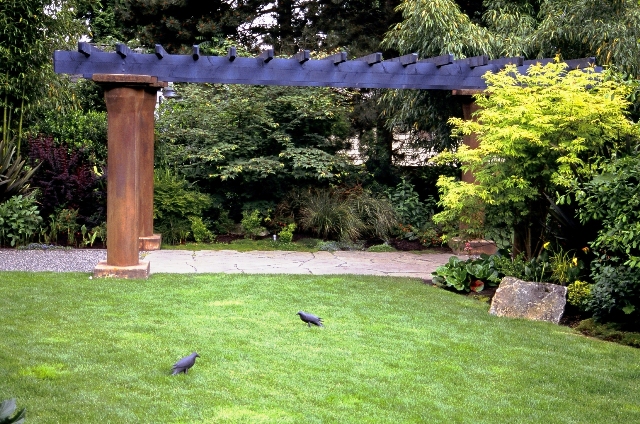
The blue-stained arbor is supported by DIY columns.

In 2002, knowing they wanted lighting, irrigation and hardscaping in the garden, Tina and Paul agreed to ask a landscape designer for an overall plan.

It was almost inevitable that Mike Jeppesen of Sammamish Landscape would help the couple create their blue-themed dream garden, since he and Tina had collaborated earlier that year on a gold-medal “Blue Garden” for the Northwest Flower & Garden Show. With a blue-stained gate and arbor, Pennsylvania bluestone pavers, blue Asian pots and collections of blue-tinged conifers, the designers made a rare statement with this cool palette. The design also earned them the Pacific Horticulture Award.

“Like Tina, I prefer to deal with foliage—this garden is virtually a tapestry of texture and leaf color,” Jeppesen says. “I also knew that even though Tina and Paul and the dogs needed to enjoy the garden, it also had to be a space for her to show off what she does best—it’s a garden that people will visit.”   

Tina and Paul’s garden invites visitors to enter along a charming walkway, pass through an oversize blue gate and pause at a dramatic “foyer” where one of eight ochre-stained concrete columns appears as a focal point.

From here, a 4-foot-wide strolling path meanders clockwise around the garden’s perimeter. An irregular section of lawn is reserved at the center for playing ball with the dogs. More free-standing columns punctuate the heavily planted borders, drawing the eye through the landscape to a four-column pergola in the distance.

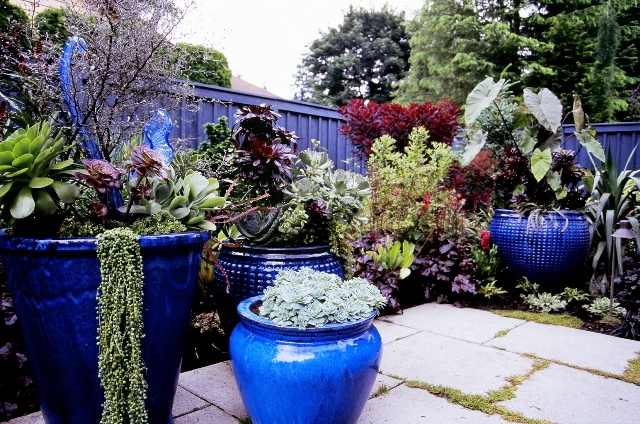
A grouping of blue Asian pots presents Tina’s favorite container designs, incorporating bear’s breech (Acanthus mollis), golden smoke bush (Cotinus coggygria ‘Golden Spirit’) and Canna ‘Tropicanna’.

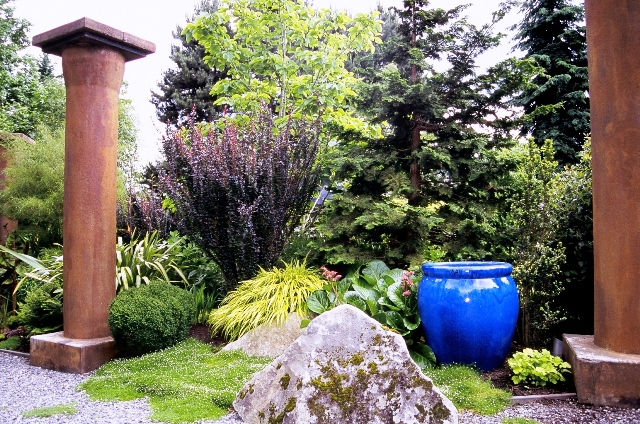
“Columns were on my wish list but were killing the budget,” Tina admits. Jeppesen suggested using concrete waste-water pipes, set on end, to serve as columns. At $80 each, the 8-foot-long pipes were a perfect solution. Tina asked artist Johnny Ward to transform the ordinary concrete with a rich gold-brown patina. Blue-stained lattice boards and rafters form the pergola, complementing a Pennsylvania bluestone terrace beneath.

To give the landscape the feeling of maturity, Jeppesen and his crew placed boulders, large rocks and stone steps throughout the landscape. He also encouraged Tina and Paul to incorporate large trees and shrubs into the design. “Even though Tina deals more with perennial-style plants, I wanted her to use trees and shrubs to provide interest when there are no flowers in bloom,” he says. “They give substance to this landscape.”

Tina and Paul agreed and headed to Oregon, where they used Tina’s wholesale connections with a tree farm. They selected trees to complement the scale of their house, including several hinoki false cypress (Chamaecyparis obtusa>‘Gracilis’), plume cryptomeria (Cryptomeria japonica ‘Elegans’), weeping copper European beech (Fagus sylvatica ‘Purpurea Pendula’) and a flowering dogwood (Cornus x rutgersensis ‘Constellation’).

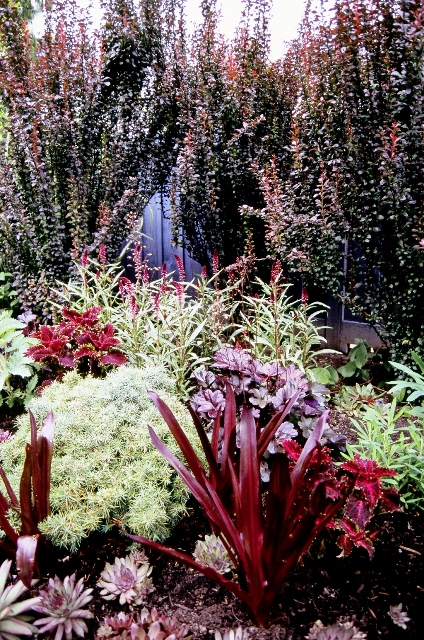
Wine, burgundy and maroon foliage are great complements to blue tones.

One-color gardens are appealing because of their simplicity, allowing plants and constructed elements to speak a common design language. Tina recognized that gold, lime, wine and silver foliage plants gain a visual boost when placed near blue pots and architecture.

She adapted container design techniques when planting the landscape. “Because I work on such a small scale, it was an overwhelming thought at first,” she says, “but you just have to take the principles of putting the right leaf shapes and textures together and use them in the larger context.”

Blue-glazed Vietnamese pots hold everything from gold-leafed ornamental trees and striped tropical plants to exuberant vines and silvery succulents. Tina’s adventurous designs rely on attention-grabbing plants that look even better when paired with blue. “I’ve been really tempted to use other container colors,” she says. “But that would feel like a mixed jar of jelly beans. Instead, I decided to be bold and consistent. The blue pots make sense and tell a story.”

Landscape designer-contractor: Mike Jeppesen, Sammamish Landscape, (360) 435-3769 or amjeppesen@earthlink.net

Container designer: Tina Dixon, Plants a la Cart, (425) 481-2194 or stredson@aol.com

Carpenter (pergola, entry arbor and fence): Cliff Chatel, Woodmark Construction, (425) 827-5242

More photos to delight – and tempt you to attend next Sunday’s tour and garden party:

There is a small patch of dog-friendly lawn in this garden, yet Tina can't resist placing sculptural black crows on its surface.

Another detail shot revealing Tina's incredible container design talent and her color sensibility.

A brilliant, blue-glazed urn is a delightful counterpoint to trees, shrubs and rock.

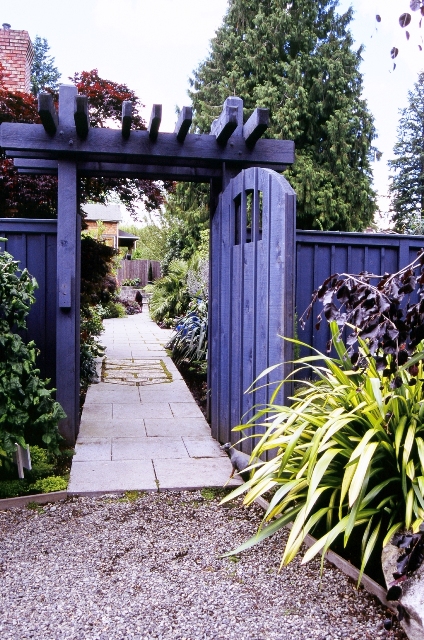
Playful “hopscotch” pavers guide visitors to the blue-stained entry gate (a hand-painted sign nearby reads “All who enter must hop” and another, inside the garden, asks “Did you hop?”).

Here's a cool detail showing how Tina and her landscape cohort Mike Jeppesen carved the decking around a piece of basalt - just like a puzzle piece.

Not much to say but: "Feast your eyes on this tapestry of texture and color"

A horticultural “welcome home”

Saturday, August 7th, 2010

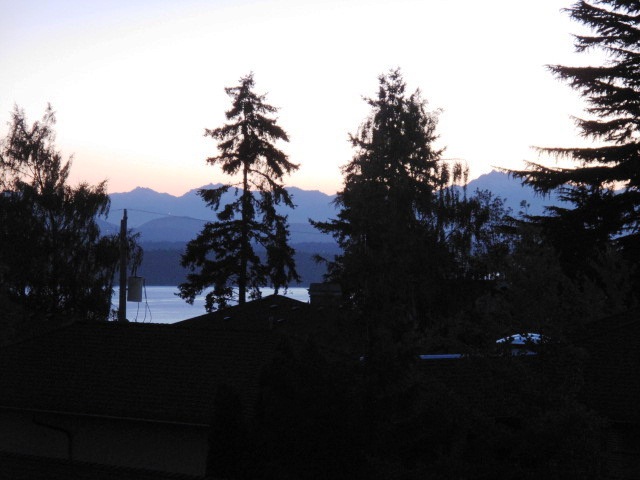
The view from our rental house in West Seattle at sunset. It reveals the purplish silhouette of the Olympic Mountains and a peek of Puget Sound.

I drove into Seattle on Monday, July 19th after spending three days on the road from Ventura County. My husband and two sons were already settling into our new rental home in West Seattle while I hung out with the (not fun) packers and movers in Southern California.

FINALLY – the house was emptied, cleaned and ready to wow potential buyers. And it was time for my return to Seattle. With the Volvo station wagon crammed to the brim with breakable garden sculpture and pottery, the many plants I couldn’t say good-bye to, a few pieces of clothing and my faithful Lab, Zanny, I left for my Pacific Northwest destination. I hit the road Friday evening with four books on tape and a tank full of gas. One night bunking at the borrowed home of Palo Alto friends who left me a key, followed by one night in an artist’s rental apartment that Amy Stewart found for me in Eureka, Calif., and a third overnight at a dog-friendly hotel in Portland . . . and we got here by noon on Monday.

I was happy to unload the car, although with 20-plus steps from sidewalk to house, I burned quite a few calories doing so. It took nearly 2 hours to unload properly and check that my mostly succulent menagerie was unbruised and that nothing was damaged due to my occasional need to slam on the brakes!

But there really wasn’t time to dawdle because I had to get cleaned up and dressed for my friend Stacie’s garden gal’s soiree, the second annual event. While vacationing in Seattle last summer, I was able to attend Stacie’s delightful summer garden party in her highly-published North Seattle landscape. Earlier this year, way back in February, Stacie asked me to let her know when I might be back in Seattle so she could work around my travel schedule for her 2010 soiree plans.
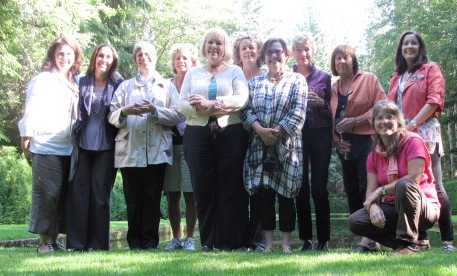
The garden gals, from left: Me, Kathy Fries, Deborah Cheadle, Stacie Crooks, Marty Wingate, Wendy Welch, Lorene Edwards Forkner, Nita-Jo Rountree, Gillian Mathews, Janet Endsley and Tina Dixon (kneeling)

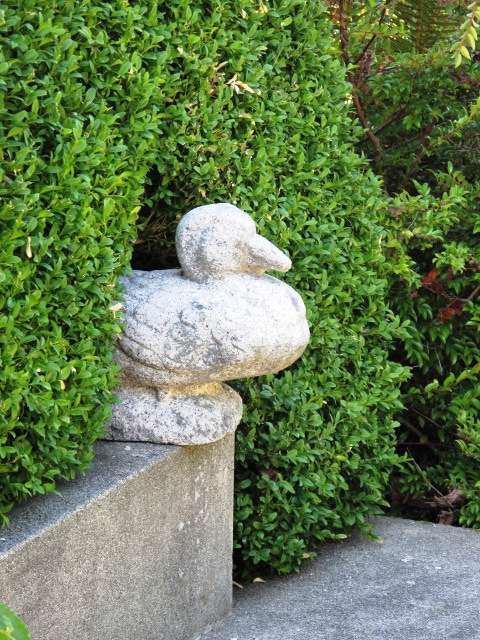
I was greeted by a charming stone duck - peeking from a hedge at the Bloedel Reserve.

As it turns out, I anticipated being at a family wedding in mid-July so I assured her that something around July 19th would be ideal. Little did I know that (a) the bride and groom would skip the formal wedding for a simple civil ceremony (and three-week honeymoon in Mexico) and (b) that I would not be vacationing here in July but MOVING HERE!! Life occasionally throws us some very wonderful surprises and this one came courtesy of the company my husband works for deciding quite recently to relocate its corporate headquarters from Pittsburgh to Seattle.

Back to Stacie’s party. This one was scheduled for late afternoon-early evening when the light is quite delicious and the day’s temperatures begin to cool. A gifted landscape designer and sustainable gardening educator, Stacie recently joined the board of trustees for the Bloedel Reserve on Bainbridge Island.

For some magical reason, she obtained permission to host a private gathering on a day when the garden isn’t normally open.

Let me tell you, the prospect of joining Stacie and some of my very favorite Seattle women friends kept my eyes on the road and my foot on the pedal while I drove from LA to Seattle over that long weekend.

Here’s some background on Bloedel Reserve, excerpted from the 9th edition of the Northwest Gardener’s Resource Directory(Sasquatch Books, 2002), my very first book project that I inherited from the wonderful, late Stephanie Feeney:

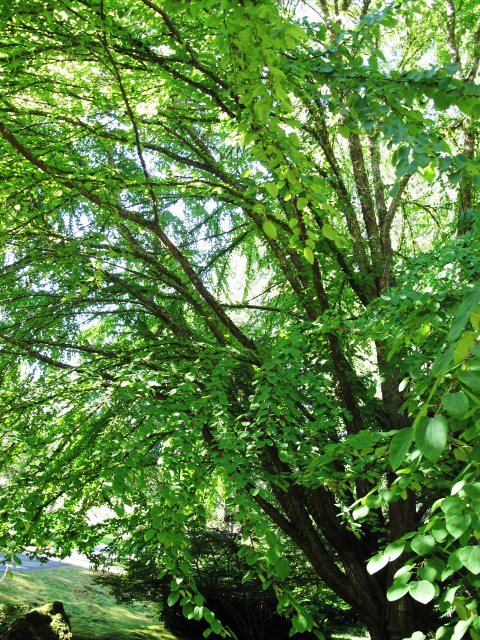
The most massive Katsura tree I've ever seen.

From the time Prentice and Virginia Bloedel acquired this 150-acre property in 1951, they began a sensitive courtship aimed at marrying the designing hand of man with the natural attributes of the woodland setting. Over a period of 30 years, and with the commissioned partnerships of wisely selected professionals (Fujitaro Kubota, for help with the Japanese Garden, and landscape architects Thomas Church, Richard Haag, and the firm Environmental Planning and Design), Prentice Bloedel orchestrated the development of many garden rooms set in the varied landscape of second-growth hardwood and conifers, meadow and wetlands, glens and gullies.

While incorporating influences from the Japanese and the European gardening traditions, a respect for the natural attributes of the land prevailed and pervaded. There are now 84 acres of second-growth forest and 66 acres of altered landscapes. The result: a native woodland crisscrossed with shady paths, meadows, and a broad selection of formal and informal gardens.
So here is a selection of photos taken that lovely day, including a group shot that we staged by placing self-timing cameras on the bench perfectly aligned with the reflection pool (above). At the bottom of this post, I have included details on visiting Bloedel. The garden is more accessible to the public than ever and offers some delightful summer concerts, guided tours, classes and other events. It is worth a visit and you’ll want to set aside a full day to do so.
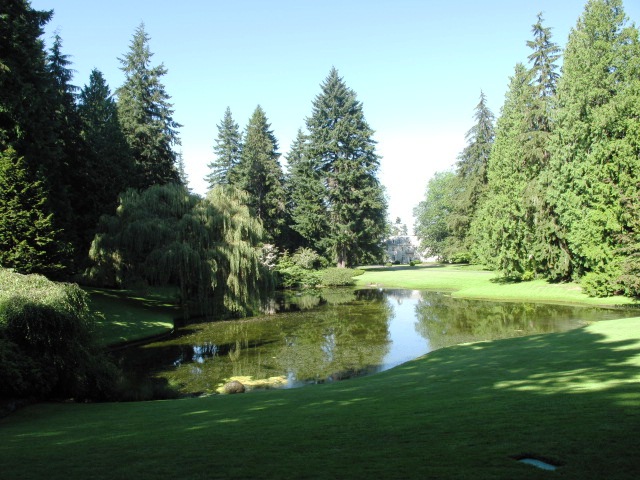
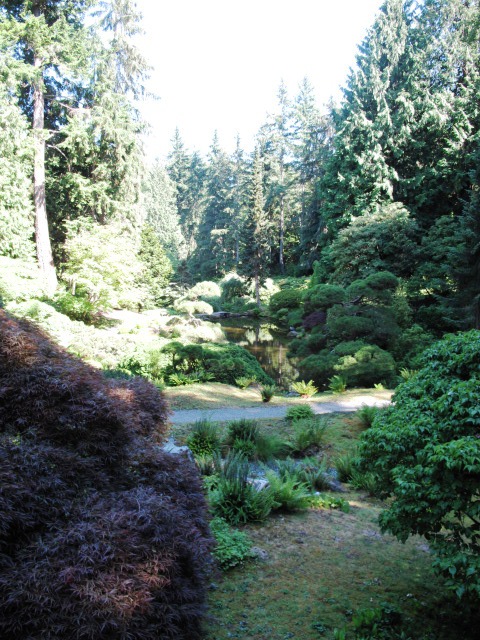
This is the quintessential photograph often captured by amateurs and professionals alike. The perspective is elegant and inviting, with the Bird Refuge and pond in the foreground; the original estate framed by native northwest conifers, in the distance.

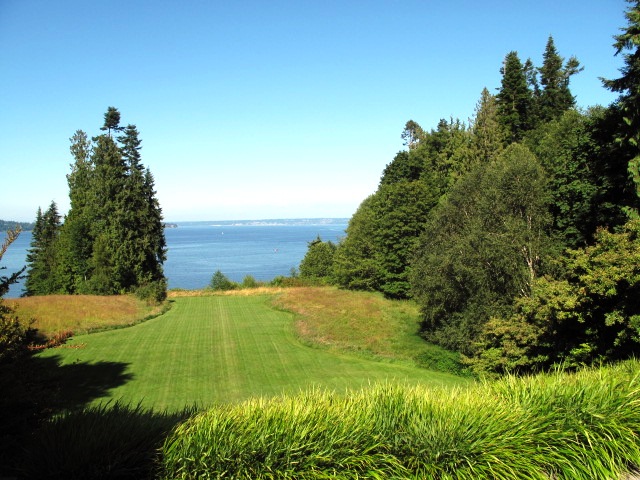
On the east side of the estate, there are brilliant views of Puget Sound facing Seattle. The massive planting of Hakonechloa macra in the foreground emulates soft ripples of the water.

A view through the towering trees and sun-dappled understory, taken from the deck outside the Japanese-inspired tea house where we gathered

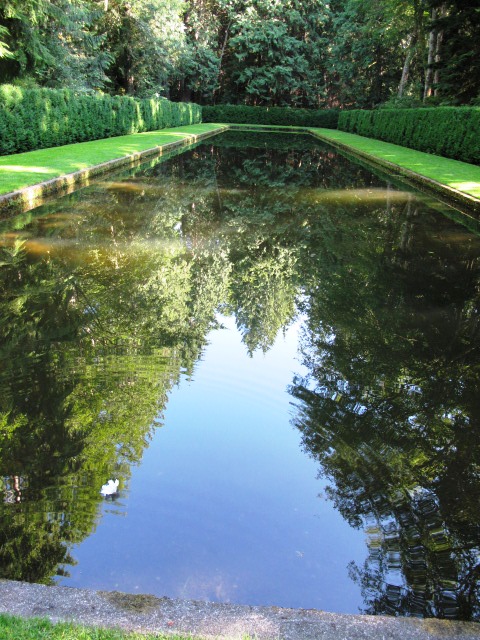
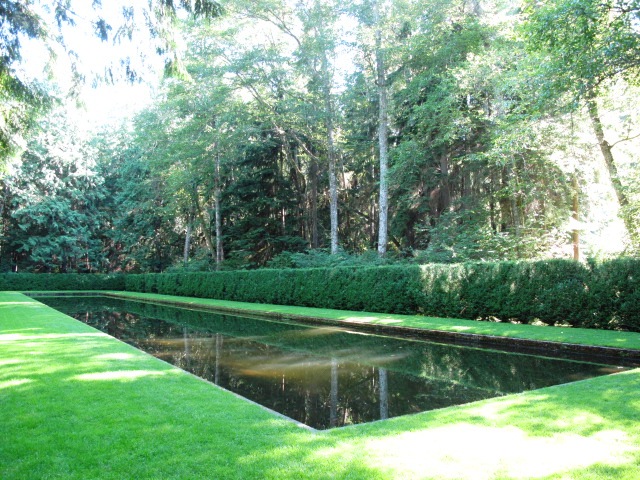
The Reflecting Pool mirrors the sky and treetops.

The Reflecting Pool is contained by a wall of green hedging, making it separate from the semiwild woodland.

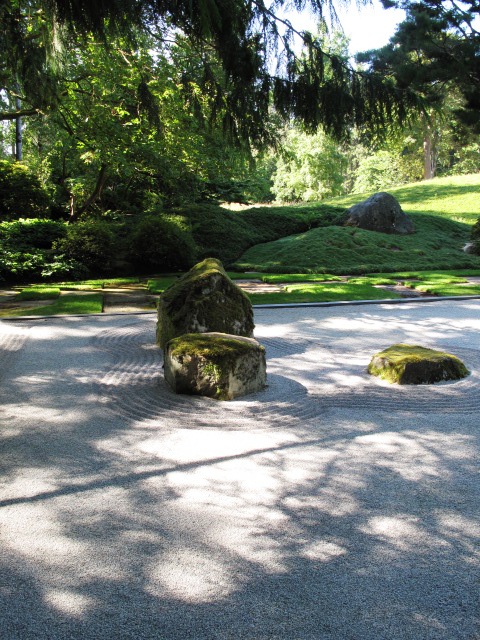
Fujitaro Kubota's Japanese garden, a quiet, contemplative space.

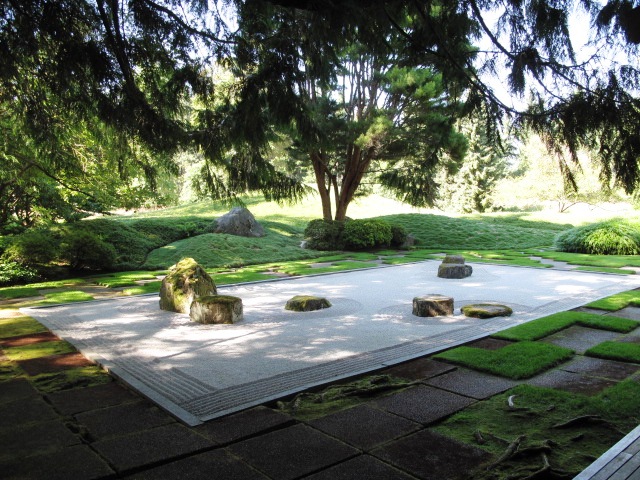
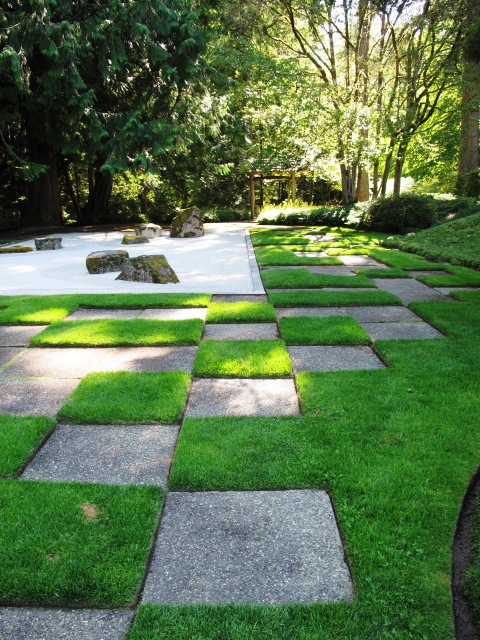
One of my favorite design details at Bloedel is this alternating turf-and-stone pattern next to the Japanese gravel garden.

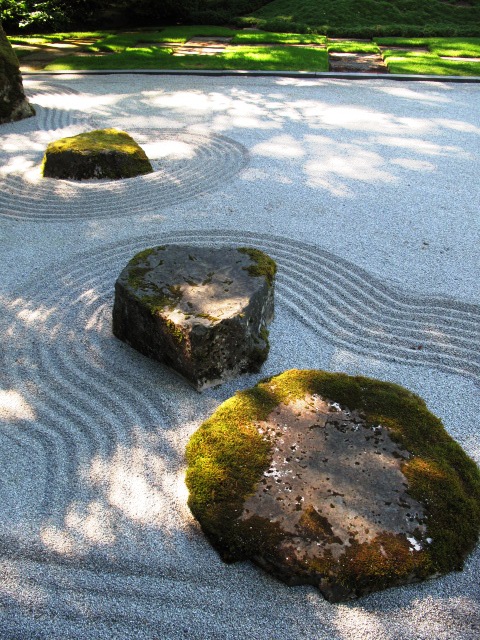
Observe and appreciate the hand-raked lines in the gravel.

Dapple light plays on stone, gravel and moss of the Japanese garden.

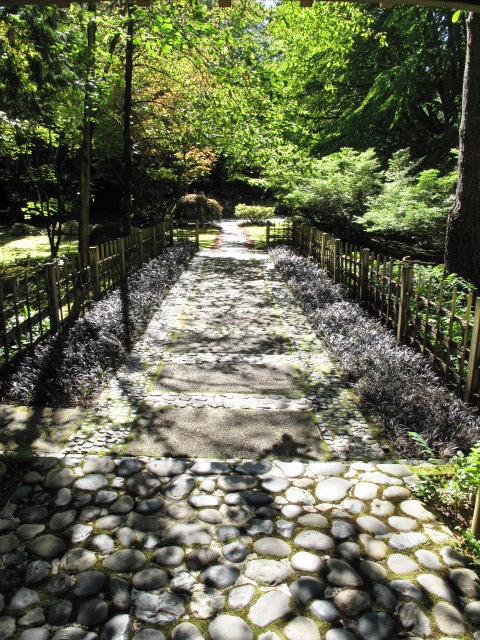
The cobbled walkway leads toward the Japanese teahouse. Note the attractive low fencing on either side, made from lashed bamboo poles.

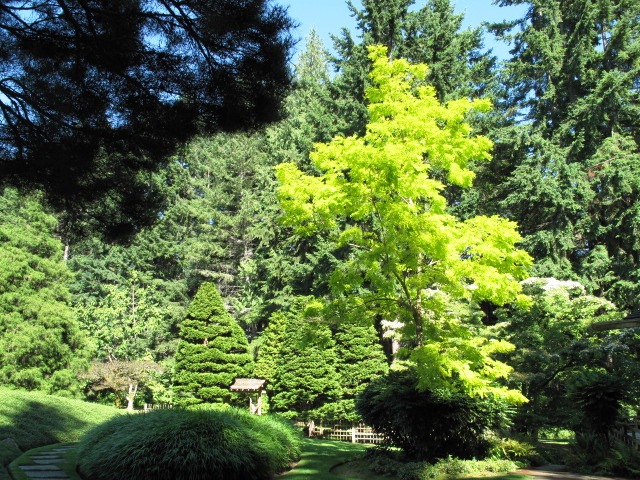
I think this is a golden form of black locust (Robinia pseudoacacia), glowing against the darker evergreens.

Bloedel Reserve, 7571 NE Dolphin Drive., Bainbridge Island, WA 98110-1097

phone: 206-842-7631

Open: 10 a.m.-4 p.m. Wednesday-Saturday (summer hours – open 10 a.m.-7 p.m., Wednesday-Friday); Sunday 10 a.m-4 p.m. (open Memorial Day, July 4th and Labor Day).

Admission: $12 (discounts for seniors, military and children 5-12; children under 5 are free).

Membership info: At $55, the basic annual membership is a great bargain because a single membership entitles you to bring a total of 4 people each visit.

Chocolate flowers for your garden

Tuesday, August 3rd, 2010


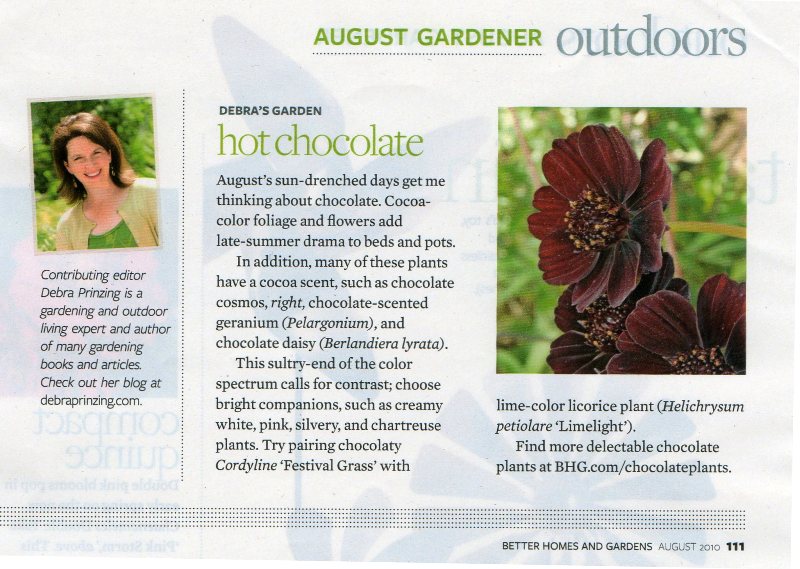
BH&G's August issue features my "Debra's Garden" column about "hot chocolate" plants

Chocolate flower and plant update:

Better Homes & Gardens readers who see this month’s “Debra’s Garden” piece on cocoa-colored and chocolate-scented plants might be interested in reading my post from last July. You can find it below.
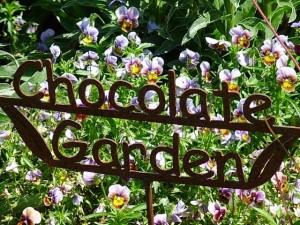
Just last summer, I visited the famed Chocolate Flower Farm in Langley, Wash., on Whidbey Island – and wrote about my tour of the charming and inspiring nursery with owner Marie Lincoln.
Several readers have already contacted me to mention Chocolate Flower Farm as a great source for dark-colored and sweet-fragranced plants, including the chocolate cosmos, featured above right.
 
In fact, if you turn to the Resource section in the August issue, you’ll discover that we did indeed feature this great resource for all things chocolatey. The web site is: www.chocolateflowerfarm.com.
As with the edible kind of chocolate, one can never have too many yummy, delicious chocolate plants. Enjoy – and please let me know how you are using this sultry color in your own garden.
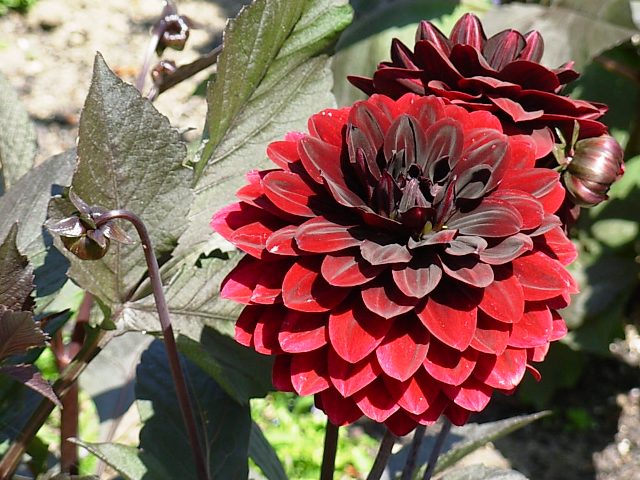
Dark chocolate brushes the tips of this multi-petaled dahlia called 'Karma Choc'

Dark chocolate brushes the tips of this multi-petaled dahlia called 'Karma Choc'

chocolategardenThe flowers that Marie Lincoln and Bill Schlicht cultivate at their Whidbey Island nursery specialty nursery are good enough to eat. That’s because Chocolate Flower Farm’s mocha, bittersweet chocolate, cinnamon, cocoa and espresso-hued blooms and foliage plants are as satisfying to the senses as a Fran’s caramel-filled chocolate sprinkled with grey sea salt (well, almost).
My friend Stacie Crooks, of Seattle-based Crooks Garden Design, was my escort to Whidbey last Tuesday. We’d only slightly recovered from our late night festivities in her superb, often-photographed drought-tolerant  garden, where a gaggle of garden gals gathered (isn’t that alliterative?) for a lovely sunset soiree.  I spent the night at Stacie’s and we set off the next morning for the ferry from Mukilteo to Clinton on Whidbey Island.

The ferry crossing was short – 20 minutes – but beautiful in its grey-blueness with sunlight pushing through the morning haze. I breathed Seattle’s maritime air and that made me happy.

I had a lovely visit to Marie Lincoln of Chocolate Flower Farm on Whidbey Island outside Seattle

I had a lovely visit to Marie Lincoln of Chocolate Flower Farm on Whidbey Island outside Seattle

After visiting one of Stacie’s inspiring and impressive design projects, the subject of which I hope will soon appear in one or two of my articles, we drove to Chocolate Flower Farm to meet Marie. I first met this dark-plant purveyor by telephone when I called her last December to request an interview. I wanted to include her “sweet” plant passion in my February “In the Garden” column for 805 Living.

Like most of my writing efforts, there’s a back story on the piece, entitled “Brown is Beautiful: Sweet Tips for Growing a Chocolate Garden.”  Last fall, my editor Lynne Andujar made an off-the-cuff comment to me: “Oh, our February issue is going to be the CHOCOLATE issue, but I’m not really sure if there’s a fit for the gardening column,” she said.

“You bet there’s an angle,” I replied. “We’re going to feature chocolate-scented and chocolate colored plants!”

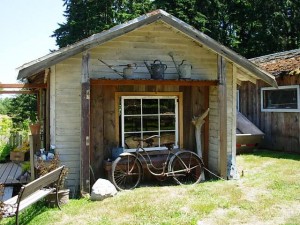
A little shed houses the nursery sales area

A little shed houses the nursery sales area

Marie Lincoln shows off her plants to garden designer Stacie Crooks

Marie Lincoln shows off her plants to garden designer Stacie Crooks

Marie and Bill started the Chocolate Flower Farm in 2005 to grow and promote dark-colored plants. 

The display beds and nursery area have expanded around their 1923 farmhouse and outbuildings (sheds!) to the former horse pasture.

As the “hot chocolate” trend grew, the couple searched for even more plants on the dark end of the spectrum, selecting unusual sports to propagate and sell as exclusive named cultivars. Marie jokes that her nursery reflects “a collision of two passions,” as it introduces new and veteran gardeners to the beauty of chocolatey colors in the landscape (not to mention a few very special chocolate-scented plants that invoke memories of grandmother’s Nestle Toll House cookies coming out of the oven).

READ MORE…

Good-bye my sweet garden

Wednesday, July 7th, 2010

The move from Southern California to Seattle is underway.

We are up to our ears in boxes, cleaning supplies, disassembled X-box game systems, piles of things to take to the Goodwill, and four years of memories.

Today, for a moment, I decided to hit the pause button and enjoy my backyard. I discovered that watching pollinators move from nectar source to nectar source is the very best therapy for an overly-tired body and soul.

Here is a little show, from me to you:
httpv://www.youtube.com/watch?v=DR7vytPzWBU

Behind the scenes with Garden Design

Wednesday, June 23rd, 2010

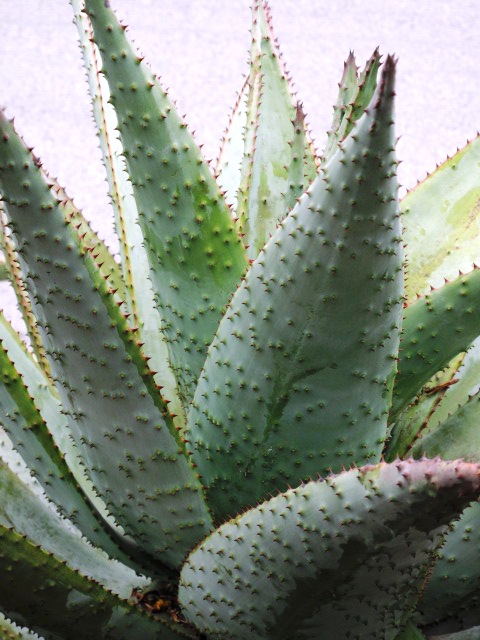
A pretty stunning aloe-as-sculpture in one of Joseph Marek's gardens.

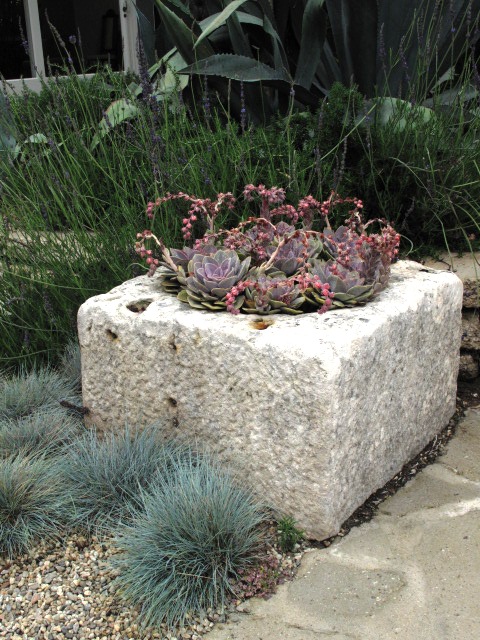
Scott Shrader turned an ancient millstone into a succulent planter

Garden Scouting: It sounds so luxurious, doesn’t it?

Spending four days scouting some of the most beautiful and unique residential landscapes in and around Los Angeles! 

I do it all the time – visit and tour gardens that might just make it onto the pages of the magazines and newspapers to which I contribute. And yet, achieving the “get” is not always that luxurious. It’s fun and rewarding. But also hard work. 

Successful garden scouting requires lots of telephone calls to set up appointments. It means I have to lean on my personal connections to cajole invitations from reclusive garden owners or rock star designers. And it demands that I put way too many miles on my Volvo odometer. A lot! (Thank goodness for NPR.) 

Most of all, this job means being extremely open to everything I see, while also keeping out a discerning eye for that magical glimpse of a perfect story. 

It’s alot like being on a treasure hunt when you don’t know the ending, but I wouldn’t have it any other way! 

Jenny Andrews, executive editor for Garden Design, one of the magazines for which I am contributing editor, was in Los Angeles a few weeks ago for a four-day scouting marathon. As she put it, it felt like we were college roommates for four days . . . probably because Jenny ended up staying with me for most of the time. She got to experience the craziness of the Prinzing-Brooks household with kids, dog, schedules, and more. And, we put 700 miles on my car in four days. We were both exhausted by the end. 

READ MORE…

More spheres in my garden

Saturday, June 19th, 2010

Tempest holds a stainless-steel Mesh orb in its arms. The piece measures 70 inches tall.

As a follow-up to my last post about round objects in the landscape, I thought I’d show off a few more of my spherical works of art, from my backyard. You can see how appealing it is to start with a shape and then repeat it often. Some of the orbs in my garden are more obvious than others. One of the round forms is quite subtle. It is part of a sculpture called “Tempest” by my friend Jennifer Asher and her collaborator-fabricator Mario Lopez.

Jennifer owns TerraSculpture with Karen Neill Tarnowski  and the two women never cease to amaze me at their innovation and talent. These pieces fill a void in the outdoor sculpture world – bringing contemporary sculpture to the residential setting at far below the huge price tags you usually see.

Tempest, closer up

TerraSculpture originally created Tempest in a powder-coated bright orange finish. My husband Bruce was interested in the piece but suggested that we have Jennifer and Mario make the base in weathered steel, which somehow fits our style better.

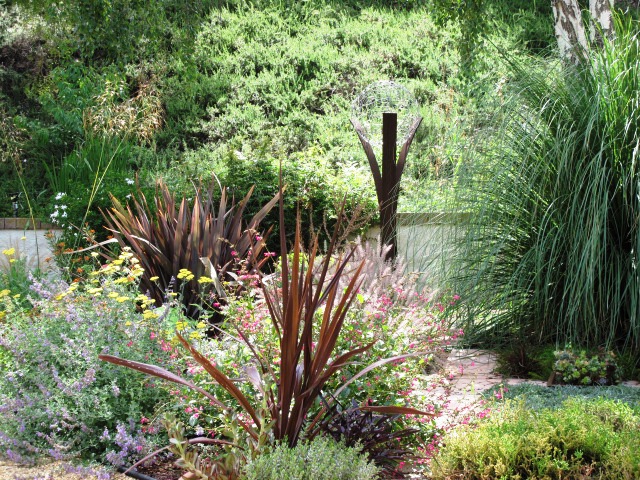
I love the shape of the base – three “arms” join together and then gradually open to cradle a stainless steel mesh ball. The weathered steel (some might call it “rust”) echoes the dark burgundy-rust blades of my garden’s New Zealand flax and Cordyline plants. There’s something really wonderful about the piece’s see-through quality, too. Upon seeing “Tempest” standing in our garden, visitors are likely to utter a gasp of delight, followed by the immediate question: Where did you find that awesome piece?

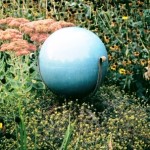
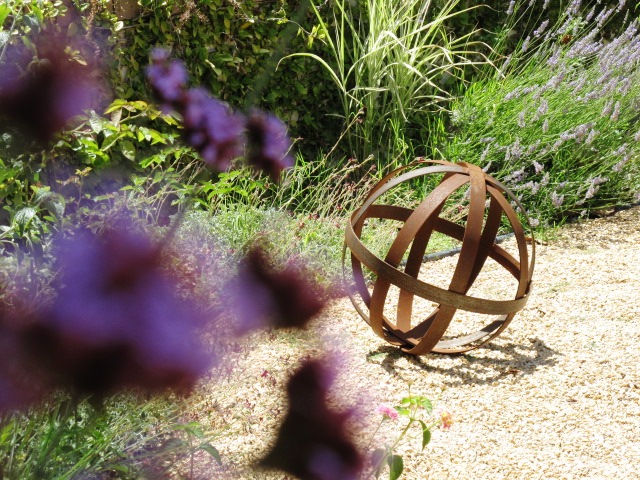
My weathered steel orb - a pretty object in the garden.

More steel – also rusted – appears in the 24-inch orb I purchased from my friends Annette Gutierrez and Mary Gray of Pot-ted in Los Angeles. I’ve shown earlier pics of their tangerine and aqua-finished objects.

For me, the weathered steel works well with everything else in my garden. See how pretty this piece looks on the “California Gold” crushed gravel? On the other hand, if Annette and Mary ever decide to make their metal orb series in lime green, I will be the first in line to snag a small-medium-large trio!

The perennial bed is dotted with orbs, from Bauer Pottery

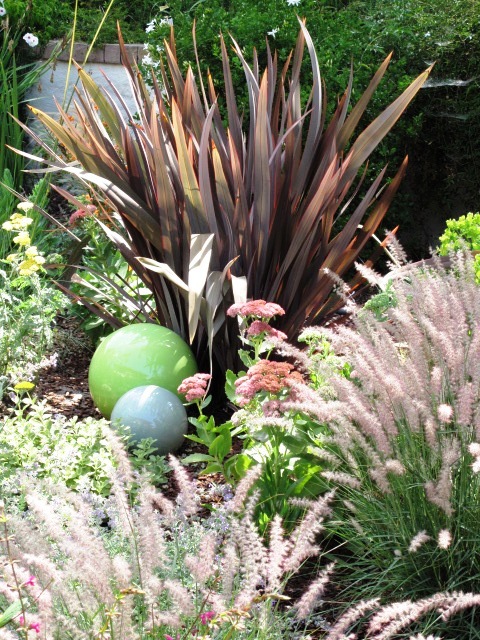
And what about those awesome Bauer balls? I think I have six of them (it’s an ever-changing number). Here are two of them, looking nice and settled-in at the base of a New Zealand flax. These Bauer glazes are called Lime Green (15 inch size) and French Blue (8-inch size).

The glossy finish and classic round forms add up to nothing short of stunning, especially when surrounded by foliage, flowers and ornamental grass plumes.

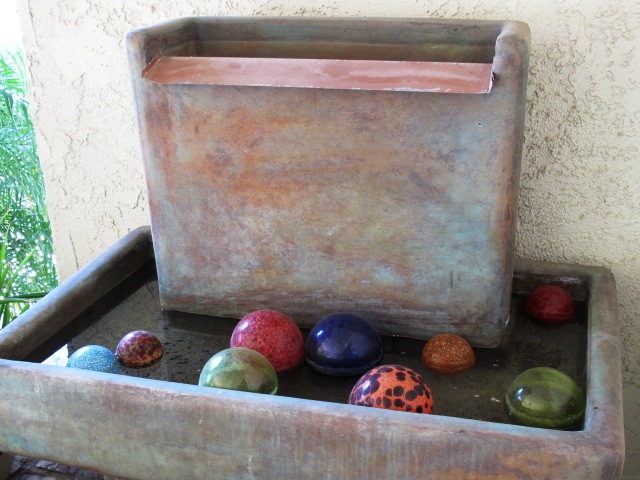
Colorful glass floats add a lot of character to this fountain.

I have a thing for floating glass balls, too. Here is a little cluster of them, floating in the fountain on our entry porch. There are several glass artists who make these decorative balls. You can usually find the artists and their wares at major flower shows.

One of my favorite sources is Glass Gardens NW. Owner-artist Barbara Sanderson makes a rainbow of glass floats and orbs, as well as larger sculpture pieces for the garden. Check her out!

Finally, the garden has curves of a more organic nature – and that is in the outline of two crescent-shaped perennial beds. With so much linear geometry in my backyard (the horizontal lines of the house, patio, pergola, wall and pathways) it’s nice to visually break up these forms with sinuous curves.

Food for the Wild: best plants for hummingbirds & butterflies

Wednesday, June 16th, 2010

ATTENTION Better Homes & Gardens readers! Thank you for visiting! Click here to see my gallery of circles, orbs, spheres, and globes in the garden. 

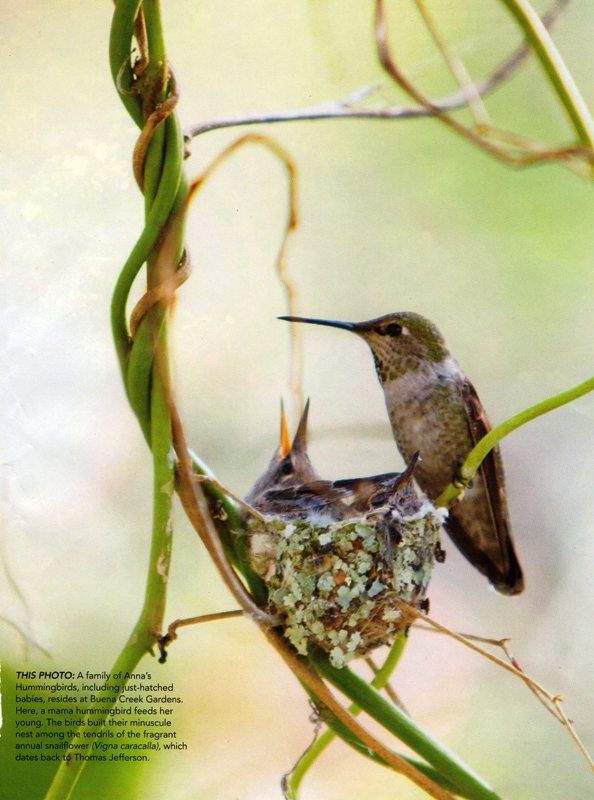
The Summer 2010 issue of Nature’s Garden (a Better Homes & Gardens title edited by the very talented Jane Austin McKeon) features two articles by me. Here’s a sneak peek at those stories. 

The fist one, titled “Got Nectar?”, is about naturalists and nursery owners Steve and Donna Brigham

The story, produced by Andrea Caughey and photographed by Ed Gohlich, describes how the Brighams created a 1/4-acre Hummingbird and Butterfly Garden at their former nursery in the San Diego area. 

Buena Creek Gardens is now owned by Steve and Shari Matteson, and you can visit year-round for a great selection of native and wildlife-friendly plants. You can read the full article, here. 

If you’re inspired to attract more hummingbirds and butterflies to your backyard, take a gander down these two lists, shared by Steve Brigham. 

You can meet Steve and hear him lecture in Pasadena on Septemer 25th, as part of Pacific Horticulture’s symposium, “Style and Whimsy in the Sustainable Garden.” Steve will speak on “Attracting Birds & Butterflies to Your Garden and Keeping Them There.”  

”]Top Nectar Plants for Hummers 

Brazilian verbena (Verbena bonariensis); 3-6 ft., summer 

*Butterfly bush (Buddleja davidii and hybrids); 3-10 ft., spring and summer 

Bottlebrush (Callistemon citrinus and hybrids); 10-15 ft., spring and summer 

Coral bell (Heuchera sp.); 1-2 ft., spring to fall 

Firecracker flower or cigar plant (Cuphea ignea or C. llavea); 1-3 ft., spring and summer 

*Flowering sage (Salvia sp.); countless varieties in perennial (1-3 ft.) and shrub (2-5 ft.) forms, spring to fall 

Fuchsia (Fuchsia x hybrida), 3-6 ft. or trailing type for hanging basket, summer 

Grevillea (Grevillea sp.), shrub form (3-8 ft.), summer 

*Milkweed (Asclepias tuberosa), 3 ft., summer 

Penstemon (Penstemon sp. and hybrids), 1-2 ft., spring to fall 

Peruvian lily (Alstroemeria hybrids), 1-2 ft., summer 

Torch lily (Kniphofia hybrids), 2-5 ft., summer to fall 

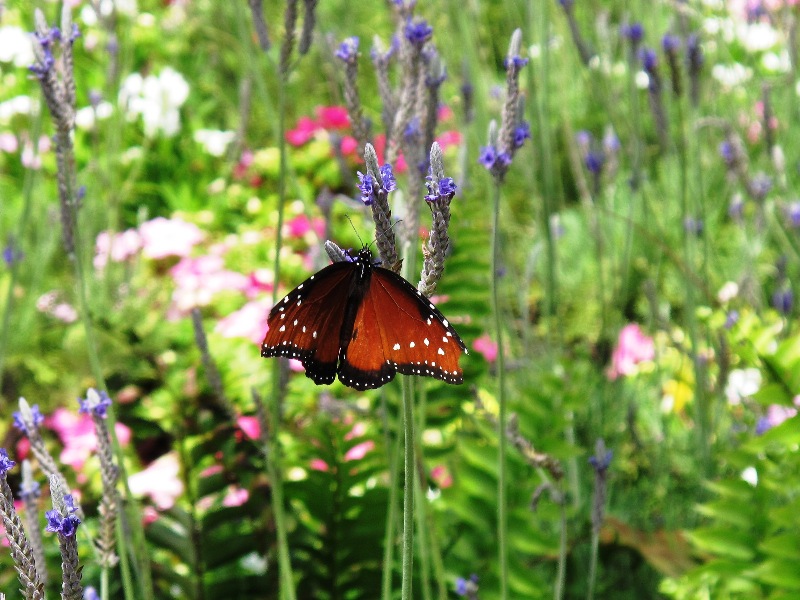
Butterflies and lavender - a scene from Epcot's International Flower & Garden Festival

Top Nectar Plants for Butterflies 

Butterfly flower (Gaura lindheimeri), 2-4 ft, spring to fall 

Gloriosa daisy (Rudbeckia hirta), 3-4 ft., summer 

Heliotrope (Heliotropium arborescens), 3-4 ft., summer 

Jupiter’s beard (Centranthus ruber), 3 ft., summer and fall 

Lantana (Lantana hybrids), 2-5 ft., summer 

Marigold (Tagetescultivars), 2-4 ft., spring and summer 

Mexican sunflower (Tithonia rotundifolia), 2-3 ft., summer 

Pincushion flower (Scabiosa columbaria), 2 ft., summer 

Purple coneflower (Echinacea purpurea), 3-4 ft., summer 

Shasta daisy (Chrysanthemum maximum), 2-4 ft., summer and fall 

Tickseed (Coreopsis grandiflora and cultivars), 1-2 ft., summer 

Yarrow (Achillea millefolium and hybrids), 2 ft., summer 

Here’s how to find Buena Creek Gardens: 418 Buena Creek Rd., San Marcos, California, 760-744-2810; www.buenacreekgardens.com 

Three native plants + one terra cotta pot to satisfy hummingbirds

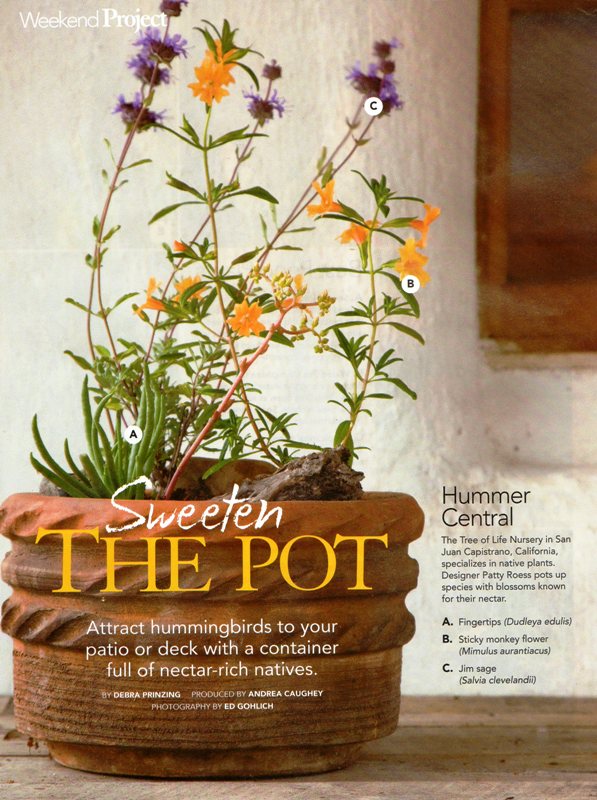
My second story is part of the magazine’s “Weekend Project” – an easy-to-accomplish design idea created by Patty Roess of the Tree of Life Nursery in San Juan Capistrano, California.

“Sweeten the Pot” includes all the steps you need to attract hummingbirds to your patio or deck with a container full of nectar-rich native plants. 

Here are the ingredients: 

  • a decorative container, at least 18 inches in diameter, to accomodate three plants
  • broken pottery shards
  • good-quality (organic) potting soil
  • native plants with features hummingbirds appreciate (tubular blooms, hot or bright colors, lots of nectar); Tree of Life suggests Dudleya edulis, Mimulus aurantiacus and Salvia clevelandii.
  • natural accents, such as stones and branches

1. Use one or more pieces of broken pottery to cover the drainage hole. 

2. Fill approximately 1/4 to 1/3 of the container with high-quality potting soil. Tree of Life Nursery uses a special fast-draining mix developed for native plants. To make your own mix, combine equal parts regular potting soil and commercial potting mix formulated for desert or cactus plants. 

3. Arrange plants in the container, placing the tallest plant toward the back. Add soil until it reaches 1/2- to 1-inch below the pot’s rim. Add decorative accents, such as mementos you have gathered in nature. Water thoroughly. In warm climates, you can transplant these California natives to a sunny garden as soon as they finish blooming.

Enjoy!