

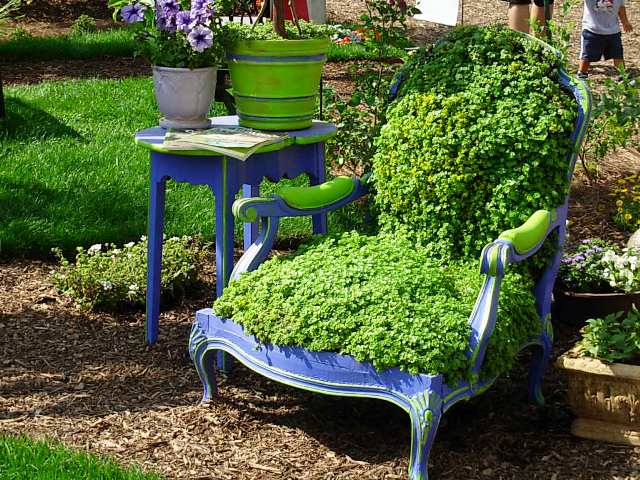
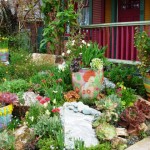
A sedum armchair. Lush and fluffy. Makes you want to sink right in. I love that the lime green arms have been painted to pick up the bright foliage.
Ever since I can remember, I was in love with a 3-piece set of wicker furniture that stood inside the enclosed porch of my grandmother Helen Winslow Ford’s home in Hammond, Indiana.
After I wrote the above paragraph, I started asking myself “what was it about the wicker porch furniture that tugged at my heart?” Vintage wicker somehow symbolizes all the feelings of comfort, care and love that I always felt at Grandma’s house. Those emotions continued with my own mother and the home she created and kept for her family. And now, maybe I can emulate those traits here in my grownup life, for the husband and sons I care for.
That timeworn wicker – a love seat, arm chair and rocking chair – made its way from Grandma’s home on Florence Street to my mother Anita Ford Prinzing. I first remember seeing the pieces in our Portland, Ore., house (perhaps Mom inherited the furniture after Grandma passed away – I’ll have to ask her).
Mom updated the 1940s seafoam green wicker with a coat of 1970s chocolate brown paint. She replaced the aging seat covers with cushions of a quilted rust-orange-sunflower yellow patchwork print.
Soon after Bruce and I married in 1984, Mom gave me the rocking chair. I took off the curved “rocker” sections and converted the piece into an armchair. I painted the woven wicker a soft blue-gray. The new cushion was covered in a tiny blue-and-raspberry polished cotton print. I also gathered and piped a cover to hide one of the chewed up arms.
The shredded weft and warp of the wicker was the fault of mom and her brother’s childhood dog. Consequentially, the chair was always considered a bit junky because you couldn’t sit in it without your sweater sleeve snagging on the bits of wire sticking in every direction.
Later, my parents shipped me the wicker love seat. I am not sure how I got so lucky because I know my brother Scott and his wife Kris used it for a while. But somehow my teenage “request” to inherit the piece lodged in my mom’s memory and she sent me the brownish wicker love seat in 1997, after she had owned it for more than two decades.
That was the year we lived in a 2-bedroom apartment with a newborn (Alex) and a 5-yr-old (Benjamin) in Seattle’s Madison Park while building our dream house in nearby Seward Park. I remember the enormous box arriving from UPS or some other shipping service. I had to open it in the courtyard outside, because there simply was no space in our apartment to do so.
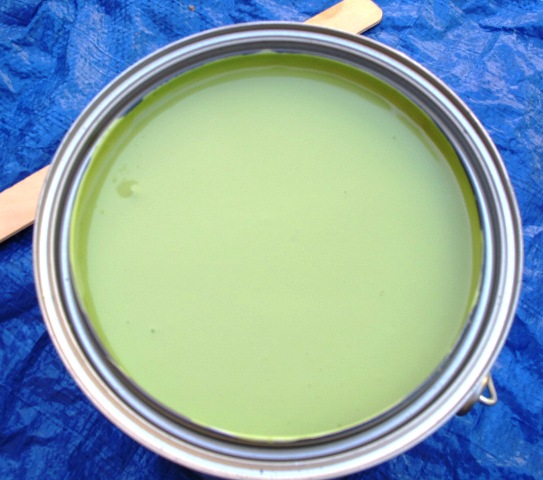
My yummy green paint choice - a perfect garden color!
Recently, after downsizing, my parents arrived to see us in Southern California while en route to their place in Mesa. The “good” wicker armchair (the one the dog didn’t eat!) was wedged into the back seat of their car. Personally delivered by my folks, the chair has joined its love seat companion on our back patio. Both pieces now need a face lift but they are in good shape considering they are at least 70 years old. I’m thinking of painting them glossy black and adding lime green cushions with black piping. Won’t that look modern?!
Mom told me, “I’m going to give you the nice chair but only if you promise to get rid of the one that’s unraveling.”
I said, “Okay, I’ll stop using it to entertain garden guests. But is it okay if I find a spot for it as a piece of art in the garden?”
She couldn’t say no!
- Today I started the makeover of my Grandmother’s wicker chair

Last fall, I removed the disintegrating cushion and seat, and placed the bottomless chair out in the garden. Yup, it’s in the right place. For months, I’ve wanted to paint it lime green and “plant” the seat and torn-up arm section with sedums and other succulents.
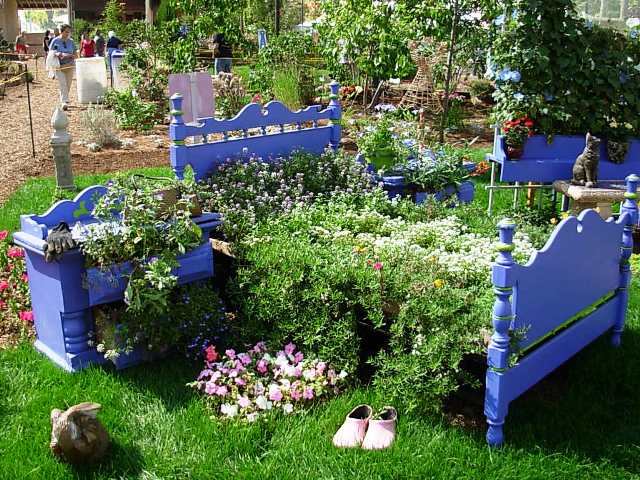
I have admired planted chairs before. Last summer I saw a peacock blue chair in a garden display at the Ventura Co. Fair. Its seat and back were planted with succulents. Luscious! [see my photo – above]
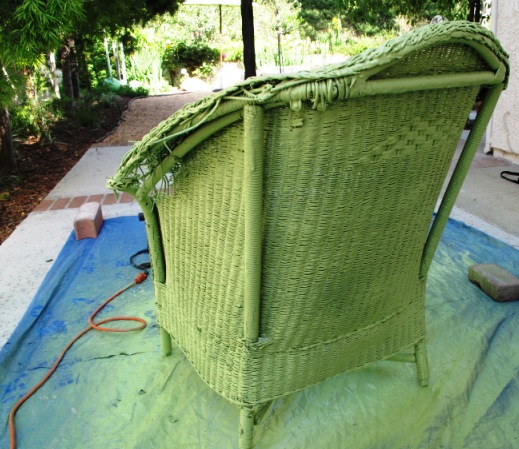
So today, my Mother’s Day gift to myself was to dig out the electric paint sprayer, clean off the chair’s wicker framework, and head to the hardware store for paint. I came home with an outdoor-ready semigloss in a color I can only think to call guacamole green.
The painting is finished. Doesn’t it look great? Perhaps it needs a second coat after this one dries. I’ll do that tomorrow, before the demands and deadlines of the coming week take over my calendar.
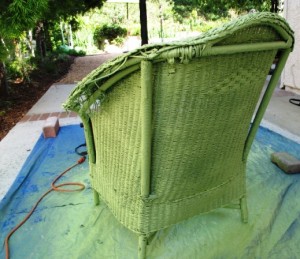
- The new-leaf green, aka “guacamole green” will transform the old wicker
Next: I want to fill the empty seat area with a panel of 1/4-inch mesh sheeting. I have a piece lying around from a planting project a few summers ago. I used it to anchor some succulents into a path and stop some critters (rabbits? possums?) from digging up the plants each night.
The mesh will create a supporting base for moss, which will be covered with a shallow layer of potting soil-cactus mix as my planting medium. Into that, I’ll plant a new “cushion” of all sorts of sedums. Voila! My long-awaited planted chair.
I’ll post photos as I go along. I’m also thinking of using the mesh to contain soil behind the gaps created by Mom’s hungry dog so I can plant a few more succulents there.
I don’t remember much about her family pet other than that the dog’s name was Sue-Sue. According to Mom, my grandfather used to open the front door and call out to the dog: “Oh, Susanna!”
That’s a silly story, but I remember it made me laugh as a girl.



 Her new book, Fearless Color Gardens: The creative gardener’s guide to jumping off the color wheel (

 ONE TO WATCH:
 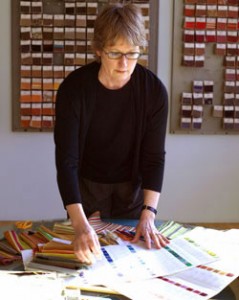 The designer, manufacturer and entrepreneur trained in fine arts and textiles at the University of Washington before earning a MFA in textiles from Cranbrook and studying at the Royal Academy of Arts, Crafts and Design in Stockholm. She launched Sina Pearson Textiles in 1990.
 Q. How have you re-imagined outdoor fabric as something more than utilitarian?
 A. A space where the interiors blend with nature as occupants move from indoors through a covered area to the outdoors. I love to see complementary fabrics and colors in all three environments. I don’t design my outdoor fabrics separate from my interiors collection. My outdoor fabrics look and feel just like indoor textiles, yet they are made with high-performance fibers for resistance to sun, mold and mildew.

 What makes this garden and its home sustainable?








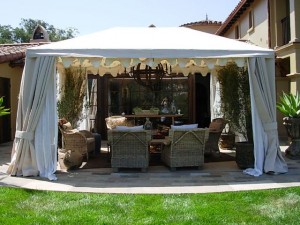
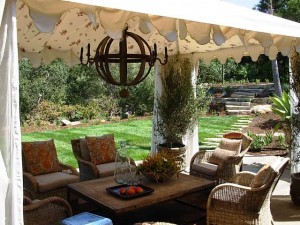
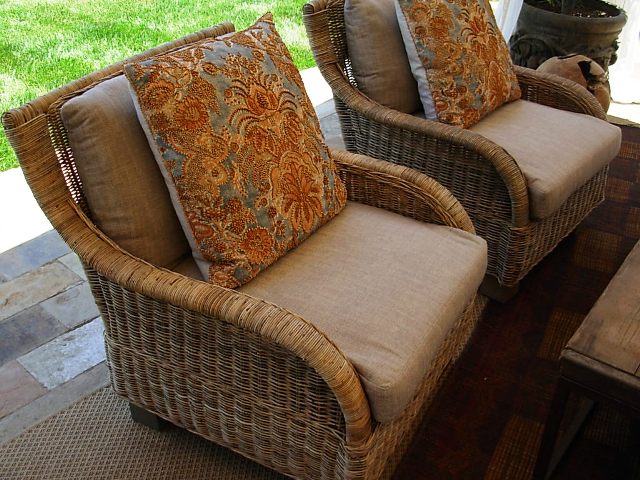 Seating: Deborah selected wicker occasional chairs and piled them high with eclectic textile pillows and basic driftwood-colored linen cushions. The chairs evoke life at the beach, from Porch in Carpinteria.
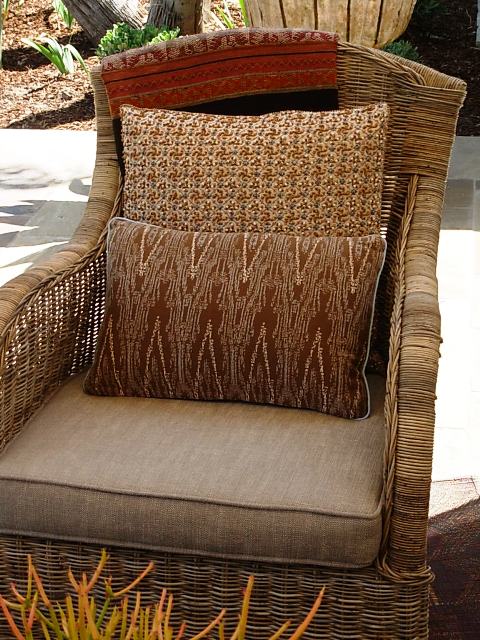 Textiles: Pillows galore lend one-of-a-kind interest and beautiful textures. They tell a narrative of an owner who has traveled widely and who loves to pair old with new; worn with polished; rustic with refined. Pillows from Upstairs at Pierre LaFond and Rooms & Gardens, both in Santa Barbara.
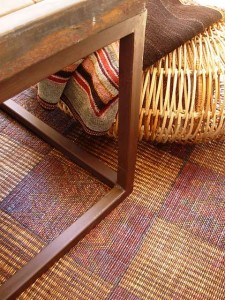
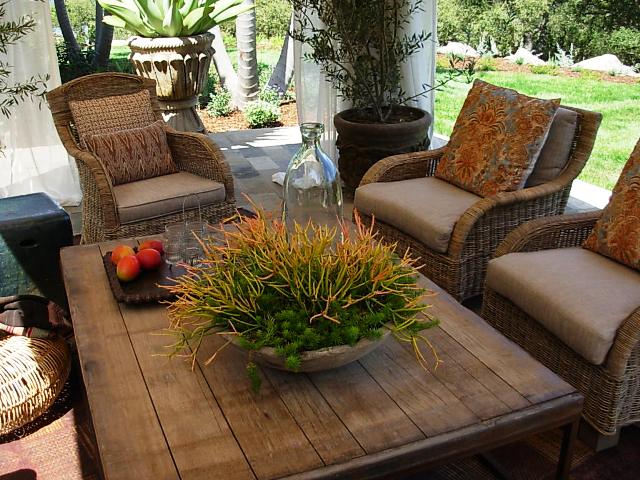 Tables: Weathered and worn, the plank-topped coffee table is large enough to do double-duty as an al fresco dining table. It is by Brick Maker, available at Porch.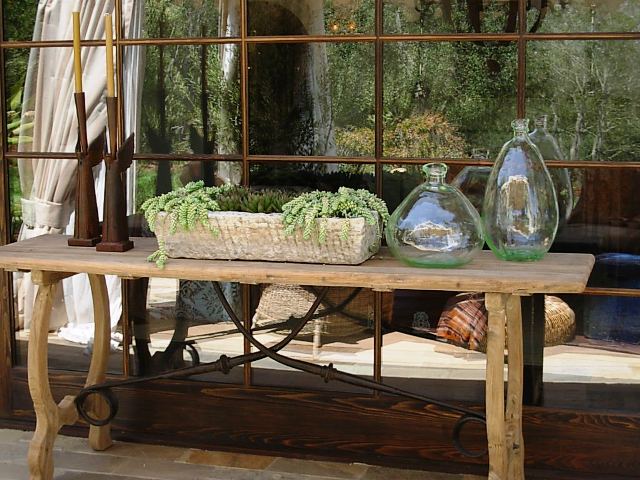
 Lantern: Okay, the over-sized lantern is a gorgeous thing to behold. I love, love, love that Deborah went BIG in scale in selecting this element of her design. It is called a “Wine Stave” chandelier, made from old wine barrels. You can kind of see the influence in the wood rings. I wish I could have photographed it while lit, but if you squint, you’ll get the idea. This lamp-chandelier makes the design sing! It’s from Porch.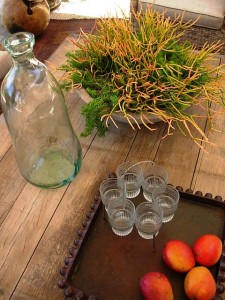
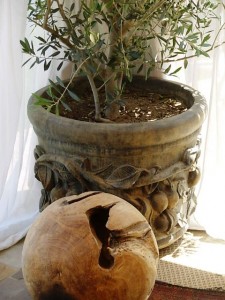
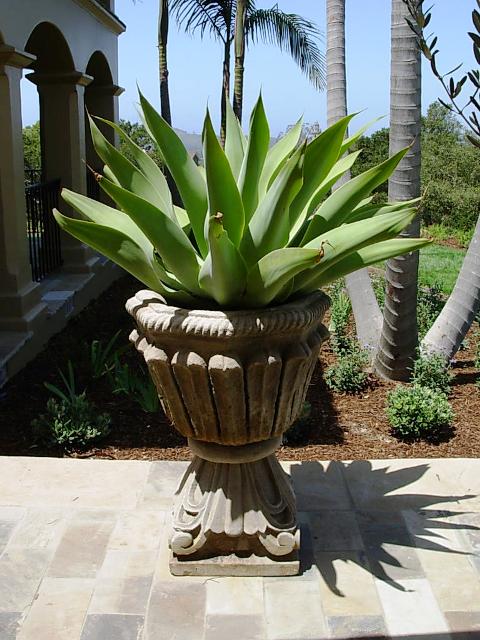 Plants: Drama is key. Each plant needs to have presence in the space, almost as sculpture. The mature Agave, potted in a cast concrete urn, is one example. (Above): The cast-concrete bowl, planted with Euphorbia ‘Sticks of Fire’ is another.
 The 6th annual CA Boom Show
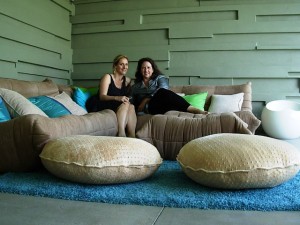

 I sat down with Charles Trotter (right), founder and producer of CA|Boom, and asked him how things were shaping up for next weekend’s show: