Debra Prinzing

Get the Email Newsletter!

Archive for the ‘Creativity’ Category

Word of the year: “Locavore”

Thursday, December 13th, 2007

Editors at the New Oxford American Dictionary recently announced that “locavore” is their word of the year.

Locavore: someone who eats locally grown food.

Watching this wonderful word move into the mainstream is both gratifying and a little worrisome. Will locavore become a politicized label, like recent research reports concluding that owners of hybrid cars are active, educated and Democrat? Will locavore suffer from overuse, watered down for marketers’ convenience, as “organic” and “all-natural” have been? I hope neither. I hope, like the Slow Food movement, that this word will remain a cherished symbol of grassroots passion about the character (and food) of a specific place on earth. Namely: your own backyard. And for this reason, I maintain that gardeners at their very hearts, are also locavores.

Animal-Vegetable-MiracleAnimal, Vegetable, Miracle, a wonderful new book by Barbara Kingsolver, Stephen L. Hopp and Camille Kingsolver, is the authentic locavore manifesto. In it, megastar novelist Kingsolver and her family document “a year of food life,” in which they attempted to grow and produce as much of their own food as possible. And when the food doesn’t come from their own small farm in the southern Appalacians, it is supplied by local farmers who use sustainable practices. I received this book as a gift from my dear friend Britt Olson. Reading it this autumn has given me renewed hope in the power of one’s own small patch of soil — and what can be grown there.

As I’m trying to renovate a sterile, suburban backyard so that it can be planted next March, I’m thinking about all the delicious, nourishing vegetables and herbs that it will produce (not to mention seasonal flowers that I can enjoy and use in arrangements). I’ll never reach the status of a 100-percent locavore, but if I can at least grow some of my own food supply, it will be a start. It is a gardener’s obligation, I think, to grow edible as well as ornamental crops.

cauliflowers

Cauliflowers from Underwood Family Farms in Somis, CA

The farmer’s market is open this afternoon, and I’m off to buy organic eggs (although one has to arrive at 2 p.m. on the spot in order to get the lovely blue-green Araucana eggs), fingerling potatoes, colorful cauliflowers, and autumn fruit. Perhaps I’m a locavore-wannabe, but it’s sure better than the alternative.

Texas wildflowers: My first movie effort

Wednesday, December 12th, 2007

During our many road trips to produce Stylish Sheds and Elegant Hideaways, I

More British shed news

Monday, December 10th, 2007

In an earlier post, I mentioned that TWO “shed guys” from the U.K. have been in touch with Shedstyle.com. If Uncle Wilco of readersheds.co.uk is the “bad boy” of sheds, then Alex Johnson is the shed-dweller’s “boy-next-door.” I’m happy to have them both on my team!

When I first discovered Alex’s site — Shedworking — I was thrilled to learn he was the online voice of a community of people who have shunned the office cubicle for their backyard studios and ateliers. He has successfully identified and tapped into a groundswell of shed users – across Britain and (increasingly) on U.S. soil. I’m glad to join this international conversation and want to introduce my Shedstyle readers to Alex.

Q. Please provide us with a brief bio:

Alex JohnsonA. I’m a 38-year-old journalist, living in St. Albans, England (just outside London) and have worked on national newspapers and magazines in the U.K. and Spain for the last 15 years, as well as being an editorial consultant for several major charities. I’ve focused particularly on over-50s issues, Spanish culture (I lived in Madrid for several years) and over the last two years, the world of ‘homeworking,’ with an emphasis on shedworking, using a garden office as an alternative to the traditional office workplace.

Q. How/when did you get the idea to start shedworking.co.uk?

A. When I bought my own garden office four years ago, there seemed to be growing interest in the U.K. (and also to some extent the U.S.) in not only working from home, but particularly from a shed-like atmosphere at the bottom of the garden. I felt that this group wasn’t being catered to by the traditional mainstream media — indeed often patronised by it — and so decide to launch “The Shed” as a free PDF magazine to try and bring this dispersed community together. The magazine has recently celebrated its second birthday and now has 1,500 readers in countries around the globe (U.K., U.S., Spain, Italy, France, Brazil, Canada, Australia and New Zealand). I launched the Shedworking blog site just over a year ago and that has also taken off nicely – I blog daily, sometimes posting three or four times.

 Q. To what do you attribute the explosion of interest in backyard office-sheds?

A. The increasing belief that the current way we work is simply not applicable any more to 21st century living and that ‘presenteeism’ is largely unnecessary. Offices as factories is a fairly recent phenomenon, largely the result of the industrial revolution, and working from home is superior in many ways – it cuts out the commute, it improves life/work balance, it can be a lot more eco-friendly, it’s more productive . . . the list is endless. And there’s a really impressive range of garden offices available on the market, too, so whatever your wallet size or architectural interest, it’s likely there’s something for the proto-shedworker out there.

Q. Who are your ‘readers’?

A. A large number work in creative industries, particularly the media, with a roughly 50-50 split between men and women. The beauty of shedworking is that while the traditional allotment shed is still something of a male domain, the trend towards shedworking has enfranchised women to own their own sheds and work from them. Many readers are particularly interested in green issues.

Q. Are you working from a backyard shed? Describe it, please.

Alex’s shed-office

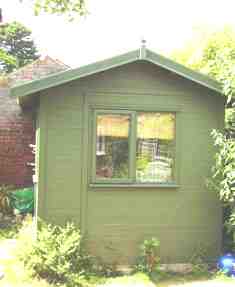
Alex’s “shedquarters” in St. Albans, England

A. I am indeed. It’s a green Homestead Timber Building’s garden office, a Marlow model, rather traditionally shedlike architecturally. It’s perfect since I don’t need a vast amount of space and our back garden is fairly modestly sized. It has full insulation, a heater, electrics, wi-fi and as an office it also handles my overflow for books from the house and minor bits of gardening (I keep my home-brewed cider in here).

Q. Please tell me about your online magazine, “The Shed,” and how people can subscribe to it.

A. It’s a lifestyle magazine for people who work in garden offices, sheds and other shedlike atmospheres. It covers homeworking issues such as what to wear to homework, interesting garden office structures, poetry (we have a poet in residence called Shedman, John Davies, who has just released a new collection of poems, largely about sheds), humor and the latest news about garden offices and accessories. To subscribe, just email me at alex@splashmedia.co.uk.

Q. Can you share details about your forthcoming book?

A. “Shedworking: the alternative workplace revolution,” will be published by The Friday Project in the U.K. in July 2008 during the second “National Shed Week.” It will look, in more depth, at the issues and structures touched on in the magazine and on the site, from historic sheds and shedworkers to examples of how people run businesses from their garden offices in the 21st century to dealing with issues such as isolation and the future of shedworking as microarchitecture starts to really take off. There’ll be plenty of examples to enjoy but it will also be a good read. I’m just finishing writing at the moment.

Q. What do you plan to do next?

A. I’d like to put together a book about shepherd’s huts – these sheds on wheels are becoming increasingly popular in the U.K. as garden offices and backyard structures (both original and reconstructed) but there are also more concrete examples around the world from Romney Marsh in eastern England (where they are called ‘Lookers Huts’) to New Zealand.

Thank you, Alex! It will be great fun to follow your progress and keep up with you!

As always, they do it better across the Atlantic

Sunday, December 9th, 2007

Last week’s posting on Shed design tips yielded response from two of the U.K.’s shed experts who have their own awesome blogs. I first discovered Readersheds last spring, while working on “Stylish Sheds and Elegant Hideaways,” my book project.

So it is with great delight that I can share the first of two Q&As with my British Shed Pals. Appearing here is my email conversation with the “Prince of Sheds,” aka Uncle Wilco. Uncle Wilco runs a popular web site: www.readersheds.co.uk (he blogs at shedblog.co.uk).

Q. Please share your bio with us:

uncle wilcoA. I am Uncle Wilco and I am a sheddie. I’m 36 and I live near Pontypridd (where singer superstar Tom Jones comes from ) in South Wales in the U.K. I’m not sure if Tom has a shed; I’ve never had a reply from him. But I love sheds!

Q. When/how did you launch readersheds.co.uk?

A. Readersheds started as an idea in early 2000. I was looking for information about building a garden shed, but could not find much online, so I thought I might as well start a website, where people “shared their sheds” and told us how they went about it.

Ironically, the shed I went with in the end was ordered online and I just erected it instead of building from scratch. But the idea for “readersheds” had started and it just took on a life of its own! The shedblog.co.uk came later, but has been great in promoting Shed Week (details on this below)! And my general musings on shed-related matters.

Q. What was your first introduction to a shed? Did you grow up with a tool shed or potting shed in your backyard?

A. My grandfather (who turned 90 in November) used to have a big allotment garden in the Welsh Valleys. There he used to grow vegetables – and of course (it) was a place the men used to go to escape the wife!

All the allotmenters had sheds they built from scrap wood and anything else they could find. They were recycling before it was fashionable. I used to spend a lot of time there when I was younger. I don’t recall my parents having a shed, but my dad had a garage converted into a wood-shop, so the idea was there!

Q. Please describe your own shed.

uncle wilcos shedA. I have two. Technically, one is a normal garden shed, but it is the hub of my ‘shed empire.’  The other one is a summerhouse, which is Mrs. Uncle Wilco’s domain, so is not on the site yet, but very soon.

Q. Tell me about the response you’ve had, both in the U.K. and around the globe.

A. It was slow to start with, but I never did any advertising or Search Engine Optimisation really for the site. Over the past three years the site has gone from strength to strength in terms of global visitors. And of course sheddies from most continents have shared their sheds, from your basic off-the-shelf to unique cabins and buildings of beauty.

Q. How many readers have posted photos of their sheds on your site?

A. We have around 730 sheds on the site currently, with around 100 that have been added since “Shed of the Year 2007,” but we are looking for many more and your readers can share their sheds here.

Q. When did you start the Shed of the Year competition?

Tony’s Roman Temple ShedA. 2007 was the first year, but I had a small shed competition a few years ago. I can’t wait for Shed of the Year 2008. Not sure if we can top last year’s winner: Tony’s Roman Temple Shed. We have a good selection so far, but we have six months to go, so hopefully we will have some unique sheds.

Q. Tell me about the National Shed Week – it seems like it has been wildly popular with great press coverage.

A. I decided that here in the U.K., we should have a week that celebrates all things sheds. I tried to petition the U.K. government, but to no avail, as they said the idea “was intended to be humorous, or have no point about government policy.”

So I thought, well I have a shed site so I will run it myself. National Shed Week was born with the aim of getting sheds recognized. [Editor’s note: National Shed Week is scheduled to begin July 7, 2008.]

I think having U.K. property guru and sheddies favourite Sarah Beeny signed up as a judge may have helped with the press coverage, but of course the British have a love affair with the shed, so really it’s just snowballed. I was lucky to do a few radio interviews. I got the impression they thought I was a nutter . . . ! But at least people realise that I have a passion for sheds, so that’s all that matters.

Q. What do you plan next?

A. Well, Shed of the Year 2008 is my next big thing. I hope to be more organised than this year – in fact I have already signed up four judges including TV property guru Sarah Beeny, the famous wind-up radio inventor Trevor Baylis, Alex from shedworking.co.uk and renowned beach hut expert Dr. Kathryn Ferry.

I hope we get lots more unique sheds on the site, as they are the lifeblood of Shed Week! I am talking to sponsors at the moment, so we should have some great shed prizes to give away as well.

After 2008, well, not sure. Hopefully, 2009! And then, Shed World Domination.

December, Pacific-style

Wednesday, December 5th, 2007

alex at beach

Alex, barefoot at the beach

“We have snow in Seattle!” my friend Robyn exclaimed, her voice coming through my cellphone headset.

It was in the low-70s. I was driving home, south on Highway 101 with the Pacific Ocean and the afternoon sun over my right shoulder. It was December first.

Life is certainly a study in contrasts. While my heart is constantly in the Pacific Northwest, and while I can just picture the beautiful fluffy snow landing ever so gently on the railings surrounding Robyn’s decks, the reality is: I’m here. And this week, I’m enjoying the beginnings of winter, Southern California style.

seaside gardensOn Saturday, a road trip was called for. We hopped in the Subaru and headed north, up the Ventura Freeway in the sunshine…(yes, like the song), to Seaside Gardens in Carpinteria.

This is a very cool place. Not only is there an amazing selection of not-so-common landscaping plants here, there is an abundance of design ideas presented in the display gardens. Located just a stone’s throw from Santa Claus Beach, where my son Alex and I stopped on the way home to dip our toes in the sand and saltwater, and watch the kite-surfers, Seaside Gardens is arranged like a small botanical garden.

deb plant shoppingalex at seaside gardensWe were lured by the colorful postcard that arrived in the mail box, inviting us to a holiday open house (complete with hot cider and hors d’oeuvres). Weather report: Intense sun, powerful wind. No potted plant over 2-feet-tall was immune from the swift breezes coming inland from the ocean.

But we had fun nonetheless. Shopped for succulents: we brought home lots of 2-inch pots of echeverias for $2.49 each, plus we snagged four really enticing 4-inch pots of Sedum hispanicum‘Purpureum’ (delicate 1- to 2-inch high groundcover stonecrop that spreads up to 18-inches…unfortunately, I’m afraid the rabbits might like this one, time will tell).

seaside gardens map

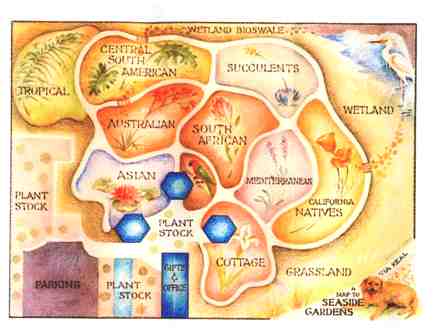
Map depicts the wonderful display areas at Seaside Gardens

We took a breezy tour through the display gardens, spotting plants that caught our eyes and snapping photos to capture the moment. No thoughts of buying a Christmas tree, yet. But planting a sedum wreath, maybe!

Alex with Abyssinian banana

Abyssinian banana-tree-hugger!

encircled by cycads

Surrounded by Cycads

toes and sand

20 Toes…can’t resist!

Shed design tips

Monday, December 3rd, 2007

Atlanta shedA nice surprise arrived in my email in-box last week. It was a note from someone who has discovered shedstyle.com: 

Dear Debra, My husband and I are building a potting shed. We have a footprint and general design concept.  What we haven’t been able to find are ideas or samples of interior space allocation.  I’ve preordered Stylish Sheds and Elegant Hideways from Random House but now is the time I most need some of your knowledge/experience.  Is there another source (I’ve also read your internet magazine) that you can direct me?  Is there any information you can provide? I’ve literally been hoping for this building ever since my husband and I bought our home – 27 years ago.  I’d really appreciate your help. Thank you! (signed, MARY) 

book coverWow, thank you, Mary! She actually pre-ordered Stylish Sheds and Elegant Hideaways! Very exciting news, especially since it won’t be on bookstore shelves until April 29, 2008. Mary’s note prompted me to think about what kind of Shed Design Checklist I would give a nascent shed-builder.  

shelf and stained glassHere are some general tips: First, of all, remember that there are infinite ideas to play around with. Think carefully about the interiors. So many people build gorgeous pieces of architectural wonder but then leave the shed’s inside ordinary-looking, dusty and filled with cobwebs. Even a functioning potting shed should be beautiful and reflect your own style. 

interior with pegboard

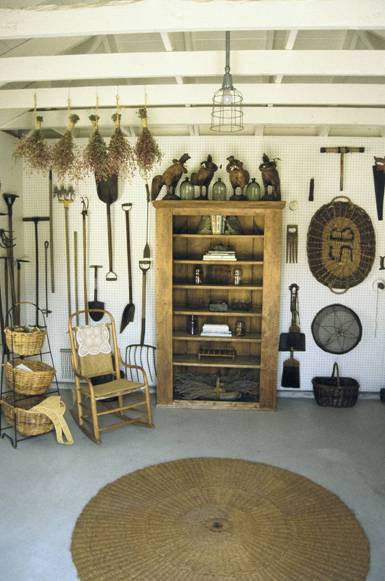
Pegboard walls and exposed rafters give this shed a barn-like feeling, while a cozy area rug and rocking chair ensure comfort

Treat the interior space allocation as you would design any room of your house. What will you do with the wall? It’s fine to leave the rafters and studs exposed, but can you paint them or mount shelves or hooks for displaying collections? One woman I know lined the walls of her potting shed with pegboard and hung from it all her antique gardening tools.  

kathy’s potting bench

Kathy’s potting counter

If you want a work counter or potting bench, consider the dimensions and proportions of the interior counters that feel best to you. Is your kitchen counter the correct height and depth? Do you like it deep enough to allow room for stacks of flowerpots or rows of gardening books to be displayed across the back? Is there storage room underneath?

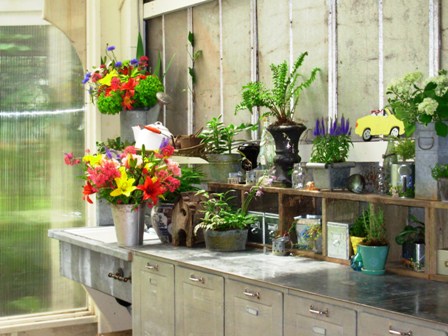
Some of the most attractive countertops I’ve seen are covered in a sheath of copper or zinc. Kathy Fries, a Seattle gardener who has no fewer than four “shed” structures on her property, bought a salvaged section of classroom cabinets (probably used in a high school wood-shop or science class), complete with countertop and storage bins — voila! The perfect potting bench for her garden house.

window1Windows: Can you add a valance or lace panels? Can you make sure there’s a nice deep ledge for potted herbs or anything else that makes you happy? Windows should definitely be operable so you can adjust temperatures, create ventilation and — most important — hear the sounds of your garden while inside the shed. Swishing grasses, the whir of a hummingbird, bird-songs and a fountain’s trickling water are essential sounds you wouldn’t want to miss.

doorwayDoors: Just as with your home, you want the threshold and portal that lead from the “external world” to your “inner sanctum” to be symbolic of powerful and nurturing emotions: shelter, safety and haven. Don’t settle for an ordinary door from the big-box home center when you can do a little hunting to find something special. A salvaged door, especially one with glass, is a nice choice. You can add color or (as we did in our Seattle garden) allow the elements to continue the peeling process that reveals decades of life.

roman paversterra cotta paversFloor: Remember this is an outdoor structure. It’s okay if you have a cement floor, but perhaps you should paint it and put a drain in the center so any gardening projects can be easily cleaned up. I’ve visited numerous sheds with wood plank flooring, vinyl tile, terracotta tile, flagstone, wall-to-wall carpeting and the aforementioned concrete. It really depends on the function of the room. 

Space-planning: Even if this is going to be a space for working on gardening projects, designate one wall or corner for R&R; A bench with cushions, a wicker chair and good reading lamp (of course, this means electricity), a desk for your reference books, correspondence or even a small tea party. Again, look to the room-like proportions of your home. One couple we interviewed/photographed for the book built their tea-house on the exact proportions of their dining room because to them, it was a comfortable space. 

debra’s Seattle shed

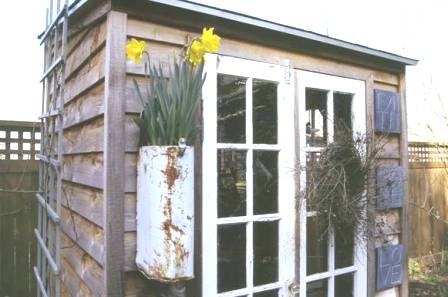
On the potting shed in my former Seattle garden, designer Jean Zaputil used salvaged French doors donated by a contractor-neighbor. The weathered mailbox became the perfect planter-box for daffodils and a rose hip wreath hangs on one door

Here are some other questions to ask yourself:

  • What activity draw us outdoors? Are you creating art, making music, writing, gardening, arranging flowers, playing with children, stargazing, entertaining friends, seeking solitude or meditating?
  • What role will the structure play in the landscape? Is it a design focal point or is it intentionally hidden from view? Will it be a surface or “wall” in the garden for climbing vines or roses? Will you use it as a gallery for hanging objects, mirrors, artifacts? Will it hide or disguise an unsightly view (such as the back of a neighbor’s garage)? Is it for pure function or pure folly…or a little bit of both?
  • detail1To create an appropriate shelter or structure to house your activity, take time to address these functional choices: placement (where will you site the structure? how will it be oriented?); size and scale (check your local building codes to determine the maximum size allowed without a construction permit; it is often around 100 square feet); what materials will complement your home’s architecture? what utilities do you need (electricity, water, heat?); and, of course, the fun part: how will you decorate, embellish and adorn the structure?

In her book Hideaways: Cabins, Huts, and Tree House Escapes, French author Sonya Faure explores some of the emotions that the word “hideaway” can conjure. I’d like to share them here:

“The dictionary defines a hideaway as ‘a secluded spot.’. . . There are plenty of synonyms for the word, most of which emphasize its protective function: cover, den, haven, hideout, refuge, retreat, sanctuary, shelter. . . . The noun ‘hut’ and the verb ‘to hide’ share the same Indo-European root – skeu – meaning: to cover or to conceal.”

In the end, your shed should be designed for your private and personal delight. It is the place where you will feel safe, feel free to create and contemplate, and take refuge from the everyday demands of life. “Shed” also is a verb that has several meanings, most of which hint at “letting go” (as in shedding tears, sending forth, losing by a natural process). There’s something very symbolic in that notion as well. We “shed” our burdens, our cares, our sadness or pain, when we can escape into our secret backyard place.

Captured in silver

Monday, November 26th, 2007

mary and debra at peninsula hotel

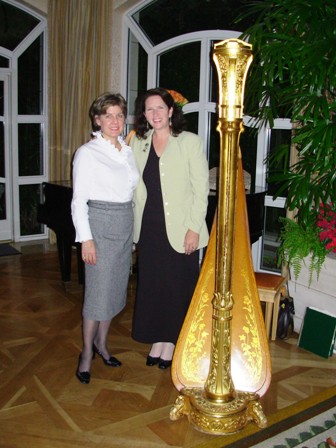
I joined Mary Martin for high tea and harp music at the Beverly Hills Peninsula Hotel

Every now and then we gardening gals have to get gussied up and leave the jeans and rubber clogs behind for the glimmer of the big city. Today was that day for me. Yup, I even wore heels and makeup!

My big trip to Beverly Hills brought me to the swanky Peninsula Hotel to meet my Atlanta friend Mary Martin for “high tea.”

Mary and her shed-studio will be featured in the pages of Stylish Sheds and Elegant Hideaways in a chapter called “Personal Space.” She is an incredible artist, writer, musician, and entrepreneur.  Bill Wright and I visited Mary in early July to photograph the 1930s-era “log cabin” shed that she’s transformed into an art studio and screened-in entertaining room.

debramary

Bill Wright photograph

Debra and Mary in front of her Atlanta “shed” on July 5th

The 12-by-20 foot building, which Mary suspects was originally a children’s playhouse or potting shed, was standing, neglected, on the property when she moved there in 1986. She fell in love with the rustic structure and eventually renovated it, adding the 16-by-17 foot screened porch.

Inside the older cabin-like section, work tables hold prototypes for her latest project, Mary’s Garden Champagne Savers. And it was this project that brought her today to Beverly Hills and the Neiman Marcus store.

neiman marcus display

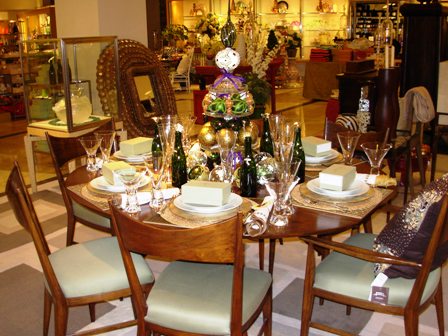
An elegant tabletop at Neiman Marcus features Mary’s Garden Champagne Savers

camellia

Bill Wright photograph

Camellia japonica ‘Taylor’s Perfection’ – captured in sterling and displayed in the just-opened bottle of Veuve Clicquot

Here is some background:
For years, Mary envisioned using a piece of sterling shaped like a leaf or a twig to preserve champagne once a bottle was opened. She kept looking for something like it to appear in the marketplace. Then in 2002, she was tending to her perennial flower bed while planning a dinner party. “I kept getting this recurring idea: to have an elegant object for saving open bottles of champagne. I even knew what it should look like,” Mary says. “Finally, I decided to create it myself.”

Five years of experimentation and testing later, she launched Mary’s Garden Champagne Savers. The sterling silver sculptures are a genuine first, and include nine botanical designs, created from favorite plants and flowers in Mary’s own backyard. “They are an accent for the home and for entertaining,” she says of the life-sized sculptures of camellia, dogwood, bearded iris, edgeworthia, trillium, violet, and daylily.

Made in the USA and packaged like fine jewelry, the champagne savers are sold by select Neiman Marcus stores and at Bergdorf Goodman. She considers them gifts for the collector, hostess, bride, or groom. “With these pieces, I have translated my love of nature into an art form with a true purpose,” Mary says. “The idea of having something used for celebration and pleasure that also contributes beauty is essential in today’s world.”

She is reminded of a favorite quote from her grandfather Rudolf Anderson, a nurseryman and southern landscape designer who bred camellias, rhododendrons, and azaleas. She has in fact embraced his words, using them as a theme for Mary’s Garden Champagne Savers.

“I’ve always felt that anybody looking at beauty in nature cannot help but have more noble thoughts.” –Rudolf Anderson, 1967.

Product details:

Mary’s Garden Champagne Savers are cast in sterling silver and finished by hand. Offered in nine botanical designs ranging from 3-3/4 inches to 6-1/8 inches, the pieces are made in the USA and sold individually. Retail prices are approximately $195-$450 each.

Presented in a custom keepsake soft green gift box, each champagne saver is secured on a suede-textured chocolate brown pillow with criss-crossed elastic bands.

Rhythm: a design principle

Sunday, November 25th, 2007

pebble path at Lotusland

A pebble pathway at Lotusland creates a pleasing rhythm

Here is the piece I referenced in my last post. I wrote it in early 2002 for Bud Merrill’s Landscape Design II (LHO125) class at South Seattle Community College.

RHYTHM: Creating a Pattern for the Landscape

Webster’s dictionary defines rhythm as “the patterned, recurring alterations of contrasting elements.”

In design, the term relates to time and movement. According to Marjorie Elliot Bevlin, author of Design through Discovery: The Elements of Design (my college design text), rhythm is a principle that works in concert with two other important principles: Balance and Emphasis.

In design, the dynamic of rhythm creates a visual flow. As a beat is to music, as choreography is to a dance, rhythm adds vitality to a garden. In landscape design, rhythm creates physical sensation. It may cause people to move quickly, slow down or even pause before continuing on again. By repetition of like forms or evenly-spaced points of emphasis, a rhythmic design is naturally expressed.

a rhythmic water rillOne of the most successful ways to incorporate an instant feeling of rhythm or movement into the garden is with a dry creek-bed. The cascading path of smooth river-rocks mimics the flowing sensation of water, adding energy to the setting. [Photo illustrates a water-pattern created by a narrow rill that disects a stone staircase.]

Using key design elements in various patterns, the garden designer can lead visitors through the landscape, giving the viewer visual cues. As Booth and Hiss (in Residential Landscape Architecture) write: “We tend to view various portions of a composition in sequence, often mentally collecting them to form patterns.”

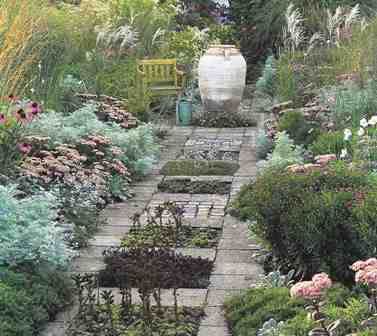
anja maubach pathway

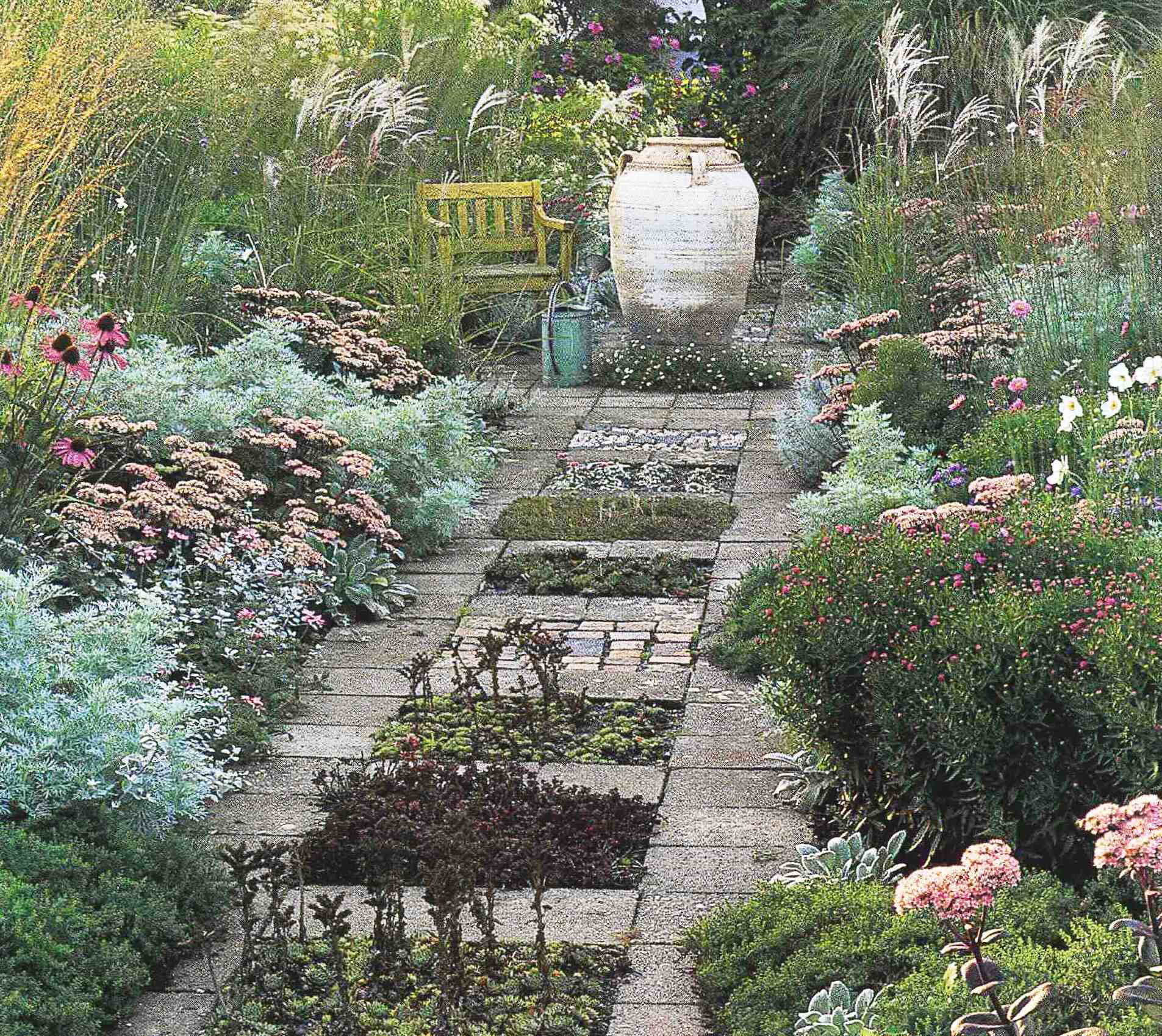
At Ahrends Nursery in Dusseldorf, landscape architect Anja Maubach alternates ordinary paving stones with square plantings of hardy succulents – the resulting pattern is rhythmic and alluring (photo from Country Gardens 2000 by Nicola Browne)

I began looking at the pattern-rhythm concept to see how various designers drew on this principle. Repetition, alteration, inversion and gradation all lend visual rhythm to the landscape. Anja Maubach, a German landscape designer, uses repeating squares of densely-planted sedums interspersed with concrete pavers to jazz up an otherwise generic path. Anja cites Pattern Language, a classic architect’s text, as her influence.

In this 1977 book, the authors Christopher Alexander, Sara Ishikawa, Murray Silverstein (with Max Jacobson, Ingrid Fiksdahl-King and Shlomo Angel) describe more than 250 “patterns” as solutions to design problems. The patterns follow design principles, but are also deeply rooted in nature and human history, which makes them resonate with us. (Perhaps that’s what the term ‘good design’ is all about.)

Pattern No. 247 – Paving with Cracks Between the Stones – talks about the need to “walk from stone to stone and feel the earth directly underfoot.” The authors continue, “As time goes by, the very age and history of all the moments on that path are almost recorded in its slight unevenness.”

Essentially, the spaces make a static path come alive – and have a certain rhythm.

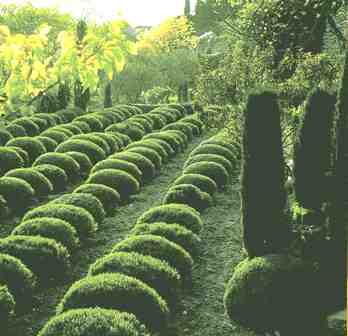
john brookes lavender

Lines of lavender play on graphic qualities found in commercial herb farms (from Natural Landscapes, 1998)

English garden designer John Brookes incorporated rhythm into a client’s French garden with the use of just one plant: lavender. He drew inspiration from the neatly clipped rows of lavender in nearby farms. “Lines of lavender play on the graphic qualities found in commercial cultivation of the herb,” Brookes explains in his book Natural Landscapes.” And the garden deliberately emphasizes the shapes and textures of this tough region.”

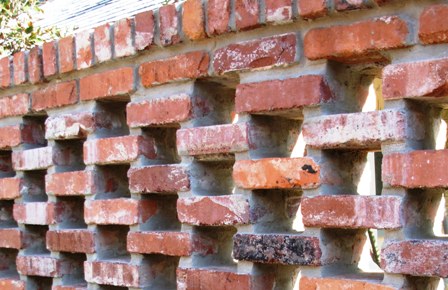
Rhythm is essential as a design principle. It’s the organic motion, the fluid character that every garden needs to come to life for those who enjoy it.brick patterns

Fridays with Bud

Tuesday, November 20th, 2007

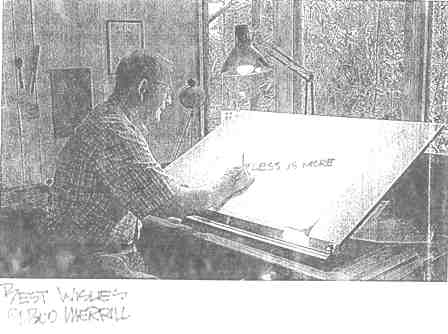
budmerrill001.jpg

Bud at his drafting table. He added the words “less is more.”

Last night, while searching my files for notes from my landscape design coursework, I came across a favorite project from 2002. The project was to write and illustrate a report on a principle or element of design. I chose rhythm.  I figured it would be a fun piece to share here on ShedStyle.com, but after looking through my folders, spiral-bound sketchbooks and flimsy tissues filled with drawings and concepts, I found myself reflecting on the individual who made my year studying landscape design such a powerful experience.

He was the late and legendary G. Bud Merrill, my design instructor at South Seattle Community College. Bud greatly influenced my aesthetic attitudes toward residential design. He was an un-arrogant design talent, generous with his craft and nurturing of anyone who was willing to work hard and be open to his guidance. He had a great wit and a passion that made him a fabulous teacher.

design toolsDuring the 2001-2002 school year, I had the privilege of spending three quarters with Bud and his wonderful “assistant,” daughter Ann Merrill Lantz, also a talented garden designer. Every Friday, all day, we would gather in the design lab. Each student had her/his own stool and drafting table. As we sat surrounded by the tools of the trade – a rainbow of Prismacolor markers, templates with tree and shrub shapes for plan drawings, oversized pieces of tissue and that trusty eraser, Bud’s words and wisdom filled our minds. He would lecture for an hour or so, and that was when the raw material of his design philosophy began to seep into our collective and individual psyches.

One of Bud’s mandates, well before most of the design world latched onto the buzzword “sustainable,” was to practice Environmentally Responsive Design.  He shared many other “Budisms” with us during that year and luckily Ann collected them for us. I have listed many of them below.

After Bud’s morning lecture we worked on any number of drawing, drafting, rendering and design projects. Bud spent one quarter teaching us the rich and varied history of landscape design – a wonderful experience that has helped frame so much of my understanding of those talented and often unsung men and women of the 18th, 19th and 20th centuries.

There was something pretty wonderful about our Fridays with Bud. He seemed to relish the chance to share tales, plans and plant lists of specific projects he’d designed. (No question was too ridiculous to address, no plant unworthy of examination.) He told stories about the early days of Seattle’s landscape architecture scene, when he and others (the who’s who of landscape architecture) would drive up to the Cascades and collect — rootball and all — native conifers, broadleaf evergreen shrubs and swordferns to help populate Seattle’s emerging suburban landscapes. Clearly, that practice was eventually discouraged, but the idea – of drawing from the wild for a natural-looking garden setting – was carried through all of Bud’s work.

At the end of the 2001-2002 school year, Bud retired. He wasn’t really ready to, I don’t think. But I’m sure the administration thought he was ancient. What a mistake. Bud was a true design influence – a visionary voice – and those of us who studied with him were enriched for having done so. At the end of the third quarter, Bud gave us a letter summarizing his thoughts about our progress. I’m so thankful that I saved the letter. Here are a few sentences that I really love:

“Unless we accept the responsibility and discipline that good design requires, we will fall short of our goals and those goals are to design landscapes that enrich the qualities of people’s lives with a respect to environmentally sensitive work.

“Remember to walk with nature. Design that which is practical and aesthetically pleasing. Simplicity with interest; stay away from overcomplication. Less is more! And by all means enjoy what you are doing.”

Clearly, I am not a professional garden designer. I find my satisfaction writing about and reporting on great design. But many of my fellow classmates from what was Bud’s last year of teaching Landscape Design I, II and III, have gone on to create beautiful residential gardens and enjoy success as professional landscape designers. They have done so by honoring Bud’s plea for environmentally and architecturally responsive designs. I hope to add some of their comments about studying with Bud in future days.

Bud died in September 2003, and I’ve just learned from his daughter Ann that work is nearing completion on a community garden in Indianola, Wash., that will be called the “Bud Merrill Pavilion,” in his honor. She writes: “He had originally designed it but in time the structure needed new posts and beams, surfacing enlarged and plantings replenished.  The community has stepped forward in amazing ways and the North Kitsap Herald has been documenting the heartwarming progress (“Pavilion Project Nears Completion“).  I can’t tell you what an absolute treasure this has been.  It has been so fun remembering all that Dad stood for (Budisms) and incorporating that into the park.” 

To wrap things up, here is a partial list of “Budisms.”

>Complex things are easy to do. Simplicity is the real challenge.

>One of the many paradoxes in designing the small garden is that one must think BOLDLY.

>A thing that is pleasing to look at is easy to use.

>The crux of what total design is all about is the realization that everything that surrounds us is interrelated.

The Moonlight Gardener

Sunday, November 18th, 2007

paula panichIn September, I was a lucky participant in a two-part writing class with Paula Panich. The focus of her class, “Ever Changing/Never Less Than Whole: Writing the Getty Garden,” was perception. She wanted us to consider how, as writers, we truly perceive the world around us.

Paula spent about six months between March and August visiting the Getty Center’s famed Central Garden several days each week. She took photographs and made notes, but didn’t start writing, even after she’d practically memorized each plant in the garden. Similarly, Paula wanted us, her writing students, to “see with intelligence and sharpness; to notice; to be open to surprise and delight – to smell with your eyes, hear with your nose, touch with your ears, taste with your hands.” In other words, she urged each of us to respond on the page with our whole bodies, hearts, minds, spirits.

Most writing courses are very task-oriented. You get an introduction and do some nifty exercises; then you have an assignment, a very tangible assignment (like conduct an interview and write a profile or write a description of a garden and then analyze the adjectives).

paula deb

Celebrating Paula’s birthday in early November

But Paula is a thinking writer’s writer. Enough of that linear, journalistic stuff that’s safe and straightforward. She jolted me out of my comfort zone with a gentle plea (and then a downright challenge) that I change the way I see the world. “If we could only turn off our brains and use our eyes alone,” she said quoting Picasso.

The idea of using our senses to write appeals to me. In writing about well-designed landscapes, I often try to highlight the sensory elements such as fragrance, the music of water, the visual allure of tall grasses dancing in the wind, the strokable lamb’s ears, the tart taste of blueberry on one’s tongue. So following Paula’s coaching, I tried very hard not to THINK but to look, smell, listen, touch, taste and observe. “Things that seep through your feet have a voice and intelligence,” she said, quoting the artist Ann Hamilton.

After a one-hour break during which we wandered the Robert Irwin-designed garden, took notes, absorbed the environment (I sat on the lawn and rested my back against the warm limestone block walls of the museum while studying the copse of sycamores), we regrouped and discussed the practice of writing. Something Paula asked really shocked me to consciousness: “Do you approach your work with reverence, or do you give it the back of your hand?”

Hmm. What a compelling thought. So often I approach my work as a must-do, rather than as a sacred privilege. I’m glad she made me face that question and invited an honest response.

Paula gave her students a writing assignment for the second session, which was scheduled two weeks later. She asked participants to write a piece in response to the garden, a poem, article, critique or essay. To another student and me she said: I’m throwing down the gauntlet to you two. An article comes easy (we were both published features writers) so your challenge is to write a piece of fiction!

Yikes. Fiction? Huh? Not for me, I’m not a “creative” writer, I keep telling myself, repeating what I’ve said since my college newspaper years. That fiction stuff is strictly uncharted and uncomfortable territory. But for Paula, I would do anything. She knew just what kind of challenge I needed to nudge me off of that comfortable perch.

A week later, I found time to return to the Getty Gardens. I got some lunch at the cafe (the perfect procrastination move) and observed an interesting guy eating his lunch. I started writing about him. Not sure where this little paragraph will end up, but here’s what I wrote:

“He was having a bottle of AltaDena milk with his lunch. This seemed a bit in contrast to his graying ponytail, worn denim shirt and wire-rimmed glasses.”

Okay, that wasn’t so bad. But then my soup bowl was empty and it was time to get moving. I had an hour before having to race home to (what else?) meet the school bus.

So I found a comfy spot on the lawn and again leaned back against the warm stone, and just started writing about the garden….and wow- just like those famous novelists say in interviews about the “craft” of fiction-writing – the character Flora presented herself to me. Oh, but first before I introduce her, I have to mention the brilliant writing-coach trick Paula played on me. When she gave me the “fiction challenge,” she mentioned having overheard a Getty docent who was leading around a group of school children. “I heard her tell the children that there is one person who gets to work in the garden AT NIGHT when no one else is here,” Paula said, almost secretively. “And that person has to clap very loudly to scare away the deer that would otherwise come into the garden and eat the plants.”

Paula was so enchanted by this notion that she even tried to track down its veracity. To this day, she doesn’t know if it was true or pure nonsense, but she likes the imagery of a person alone in the garden at night. So she suggested this tale as a possible starting point for my story. Well, I kind of took it and ran with it….but of course, so far, I haven’t figured out how to work in the hand-clapping or the appearance of deer in the garden. But here is what I did write. It’s a start. It wasn’t as painful as I feared; in fact, I have a warm affection for my protagonist. Maybe I’ll finish this tale some day. But as it stands, as a short piece, I like it.
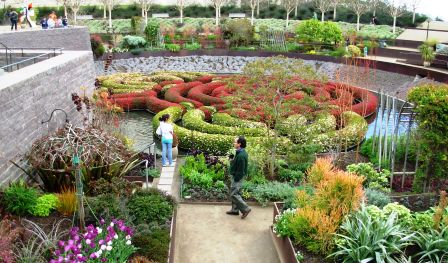
the azalea maze

The Moonlight Gardener

Follow the maze from the center through the garden. That was her idea at least. Flora knew she couldn’t really walk the Robert Irwin azalea labyrinth, but mentally, she would take its journey.

She was alternately mesmerized by its beautiful pattern and frustrated with its abrupt dead-ends. It appeared symmetrical when it really wasn’t. In a garden designed as perfection, Flora knew its beauty was in the imperfection. Otherwise, why was she here?

The petite gardener, who worked with mostly burly guys, stuffed a ponytail under her baseball cap and shoved her Felcos into the back pocket of her jeans. This ritual so familiar and mindlessly repeated had formed a pruner ‘outline’ on the faded denim. Like an etching that you would want to touch.

Working mostly alone, Flora felt she knew many of the garden’s trees, flowers and leaves on a personal level. She conducted silent conversations in her head, talking to each plant, saying: “Oh, you have been busy with the pollinators,” or: “Your orange blooms look exotic against the purple foliage of your companion.” She wondered whether if by listening closely enough she could hear – really hear – a plant’s response. In reality, her plant-conversations were mostly nonverbal exchanges.

Flora believed this artist-designed garden was never finished because of Nature’s nonhuman hand. Perhaps this is why, after 10 years, when the garden’s sycamore trees had grown to thirty feet tall, Flora’s supervisor created the Moonlight Crew.

Once a week she and two others clocked in at closing, prepared to work through the night. Now, Flora’s journey is ceremonial. She arrives for work early, thirty minutes before the last guests leave. As the crowds walk down the limestone steps, she ascends, hugging the hand rail and feeling almost invisible to the museum goers. Yes, it is a job. But it is also an honor to be the Getty’s plant steward, she reminds herself.
bougainvillea

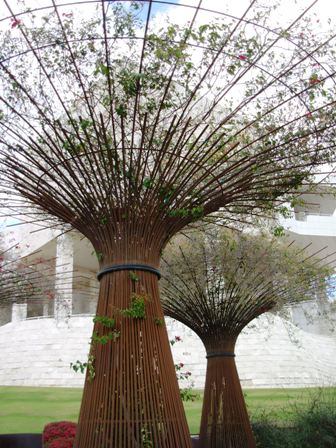
Bougainvillea, just beginning to leaf out in early springtime, to create magenta canopies on sculptural umbrella-like forms

Flora checks into the shed where the landscaping crew’s tools are stored. Hauling loppers and ladder, under moonlight or cloud cover, she comes to the magical garden. The gardeners work on hard-to-tackle jobs, the ones the administration doesn’t want the public to see: “editing” the sycamore leaves to create a dappling effect, or standing on a tall ladder to clip the bougainvillea “umbrellas.” Silent and almost prayerful, they tend, groom and haul away the remnants of too-vigorous California plant growth.

It was during her overnight shift that Flora first really noticed the power of Irwin’s complicated maze. Before, under the intense noonday sun, it had just been a group of curved hedges, tedious to clip. But when viewed at night, the vegetation almost vibrated with energy. There is a rhythm to the repetition of shapes, especially at nighttime when the silhouettes of arcs and crescents appear long before you notice the color or texture.

azalea maze 2For Flora, the series of circles-within-circles is a living reminder of the paradox of a gardener. No clear path; organic, repetitive, incomplete. We bring life, but can’t prevent death; we tend, but can’t control; we admire, but it is a fleeting admiration. Beauty ends and then we wait for it to begin again.