

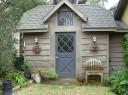
 A nice surprise arrived in my email in-box last week. It was a note from someone who has discovered shedstyle.com:
Dear Debra, My husband and I are building a potting shed. We have a footprint and general design concept. What we haven’t been able to find are ideas or samples of interior space allocation. I’ve preordered Stylish Sheds and Elegant Hideways from Random House but now is the time I most need some of your knowledge/experience. Is there another source (I’ve also read your internet magazine) that you can direct me? Is there any information you can provide? I’ve literally been hoping for this building ever since my husband and I bought our home – 27 years ago. I’d really appreciate your help. Thank you! (signed, MARY)
 Wow, thank you, Mary! She actually pre-ordered Stylish Sheds and Elegant Hideaways! Very exciting news, especially since it won’t be on bookstore shelves until April 29, 2008. Mary’s note prompted me to think about what kind of Shed Design Checklist I would give a nascent shed-builder.
 Here are some general tips: First, of all, remember that there are infinite ideas to play around with. Think carefully about the interiors. So many people build gorgeous pieces of architectural wonder but then leave the shed’s inside ordinary-looking, dusty and filled with cobwebs. Even a functioning potting shed should be beautiful and reflect your own style.
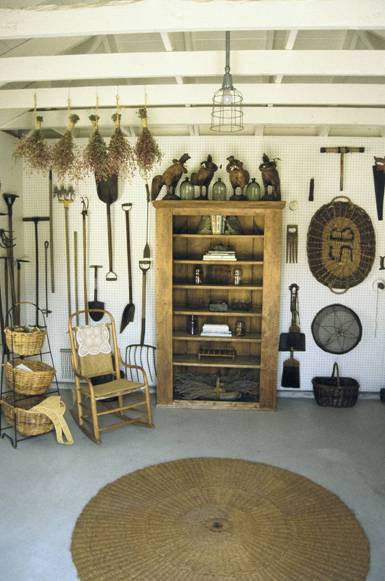
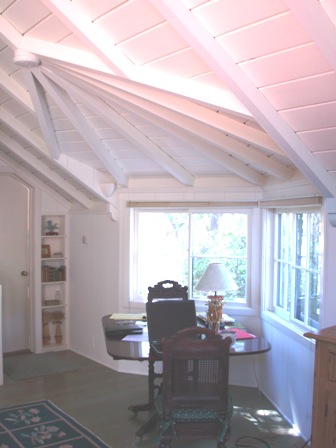
Pegboard walls and exposed rafters give this shed a barn-like feeling, while a cozy area rug and rocking chair ensure comfort
Treat the interior space allocation as you would design any room of your house. What will you do with the wall? It’s fine to leave the rafters and studs exposed, but can you paint them or mount shelves or hooks for displaying collections? One woman I know lined the walls of her potting shed with pegboard and hung from it all her antique gardening tools.
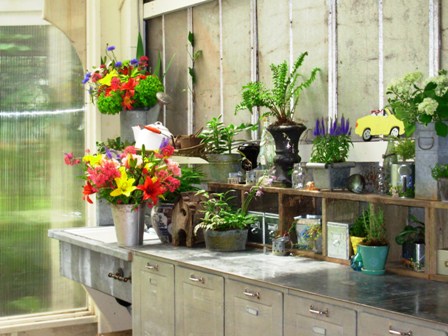
Kathy’s potting counter
If you want a work counter or potting bench, consider the dimensions and proportions of the interior counters that feel best to you. Is your kitchen counter the correct height and depth? Do you like it deep enough to allow room for stacks of flowerpots or rows of gardening books to be displayed across the back? Is there storage room underneath?
Some of the most attractive countertops I’ve seen are covered in a sheath of copper or zinc. Kathy Fries, a Seattle gardener who has no fewer than four “shed” structures on her property, bought a salvaged section of classroom cabinets (probably used in a high school wood-shop or science class), complete with countertop and storage bins — voila! The perfect potting bench for her garden house.
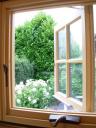 Windows: Can you add a valance or lace panels? Can you make sure there’s a nice deep ledge for potted herbs or anything else that makes you happy? Windows should definitely be operable so you can adjust temperatures, create ventilation and — most important — hear the sounds of your garden while inside the shed. Swishing grasses, the whir of a hummingbird, bird-songs and a fountain’s trickling water are essential sounds you wouldn’t want to miss.
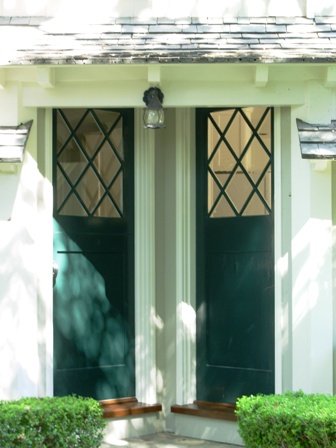
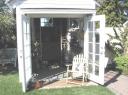 Doors: Just as with your home, you want the threshold and portal that lead from the “external world” to your “inner sanctum” to be symbolic of powerful and nurturing emotions: shelter, safety and haven. Don’t settle for an ordinary door from the big-box home center when you can do a little hunting to find something special. A salvaged door, especially one with glass, is a nice choice. You can add color or (as we did in our Seattle garden) allow the elements to continue the peeling process that reveals decades of life.
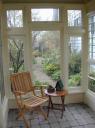
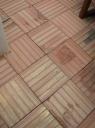 Floor: Remember this is an outdoor structure. It’s okay if you have a cement floor, but perhaps you should paint it and put a drain in the center so any gardening projects can be easily cleaned up. I’ve visited numerous sheds with wood plank flooring, vinyl tile, terracotta tile, flagstone, wall-to-wall carpeting and the aforementioned concrete. It really depends on the function of the room.
Space-planning: Even if this is going to be a space for working on gardening projects, designate one wall or corner for R&R; A bench with cushions, a wicker chair and good reading lamp (of course, this means electricity), a desk for your reference books, correspondence or even a small tea party. Again, look to the room-like proportions of your home. One couple we interviewed/photographed for the book built their tea-house on the exact proportions of their dining room because to them, it was a comfortable space.
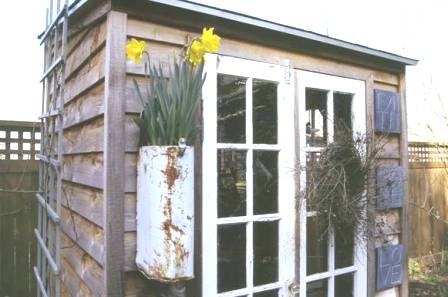
On the potting shed in my former Seattle garden, designer Jean Zaputil used salvaged French doors donated by a contractor-neighbor. The weathered mailbox became the perfect planter-box for daffodils and a rose hip wreath hangs on one door
Here are some other questions to ask yourself:
- What activity draw us outdoors? Are you creating art, making music, writing, gardening, arranging flowers, playing with children, stargazing, entertaining friends, seeking solitude or meditating?
- What role will the structure play in the landscape? Is it a design focal point or is it intentionally hidden from view? Will it be a surface or “wall” in the garden for climbing vines or roses? Will you use it as a gallery for hanging objects, mirrors, artifacts? Will it hide or disguise an unsightly view (such as the back of a neighbor’s garage)? Is it for pure function or pure folly…or a little bit of both?
 To create an appropriate shelter or structure to house your activity, take time to address these functional choices: placement (where will you site the structure? how will it be oriented?); size and scale (check your local building codes to determine the maximum size allowed without a construction permit; it is often around 100 square feet); what materials will complement your home’s architecture? what utilities do you need (electricity, water, heat?); and, of course, the fun part: how will you decorate, embellish and adorn the structure?
In her book Hideaways: Cabins, Huts, and Tree House Escapes, French author Sonya Faure explores some of the emotions that the word “hideaway” can conjure. I’d like to share them here:
“The dictionary defines a hideaway as ‘a secluded spot.’. . . There are plenty of synonyms for the word, most of which emphasize its protective function: cover, den, haven, hideout, refuge, retreat, sanctuary, shelter. . . . The noun ‘hut’ and the verb ‘to hide’ share the same Indo-European root – skeu – meaning: to cover or to conceal.”
In the end, your shed should be designed for your private and personal delight. It is the place where you will feel safe, feel free to create and contemplate, and take refuge from the everyday demands of life. “Shed” also is a verb that has several meanings, most of which hint at “letting go” (as in shedding tears, sending forth, losing by a natural process). There’s something very symbolic in that notion as well. We “shed” our burdens, our cares, our sadness or pain, when we can escape into our secret backyard place.