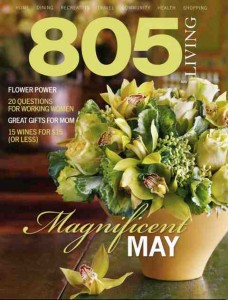
 My “In the Garden” column for 805 Living’s May issue is all about great gardening books to give Mom (or keep for your own shelves).
Grow your garden library: Just like plants, you can never have too many books that inspire and intrigue
By Debra Prinzing
I was on the East Coast recently to lecture at the Philadelphia Flower Show. While sharing gossip and a glass of chardonnay with my NYC-based literary agent, Sarah Jane Freymann, conversation turned to the sorry state of book publishing.
“When I give a gift,” she proclaimed in her always-alluring British accent, “I only buy books.” Her singular gesture of thoughtfully choosing, buying and giving a book (rather than an impersonal gift card) might be an important element of the reading person’s economic stimulus package.

In early March, I visited Philadelphia and met up with book-lover and awesome agent, Sarah Jane Freymann
Books, especially when they are hand-picked for the reader, convey as much about the giver as the recipient.
For my birthday, my writing mentor, Paula Panich, recently gave me American Writers at Home, by J.D. McClatchy, a fitting tome for a journalist who covers architecture, interiors and the garden – all aspects of the home. When Britt Olson, my best friend from high school, recently wed, she spent hours at the book store, choosing just the right hard-bound volume for each of her attendants. For me, she selected Barbara Kingsolver’s lovely memoir of a year growing her own food, Animal, Vegetable, Miracle, which fed my spirit and mind alike.
If you’re like me, you can “read” a person by observing the titles that fill her bookcase. So here’s a peek at what’s on my bedside table (a new crop of gardening books). Whether for Mother’s Day, a friend’s birthday, or just for your own pleasure, give the gift of a book. As the author of five books, I thank you.
A Rose by Any Name
By Douglas Brenner and Stephen Scanniello [Algonquin Books of Chapel Hill, 2009, 320 pp., $19.95]
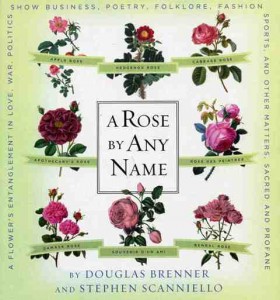 I met Stephen Scanniello, president of the Heritage Rose Foundation, in a Chicago radio studio several years ago. We enjoyed our banter with the host of a garden show, but the conversation continued well after the gig was over. His favorite subject? Roses. Scanniello lives, breathes, and designs gardens with roses. Not those scentless, thornless pageant variety roses, but ones with storied pasts and interesting pedigrees. He teamed up with co-author Douglas Brenner, a former Martha Stewart Living garden editor, to document the origins, history, and lore of more than 1,200 rose names.
Their enchanting narrative follows the trials and tribulations of this beloved flower through the centuries to modern time. The rose has been entangled in love, war, politics, show business, fashion, sports and even automobiles (yes, the ruby-red ‘Chrysler Imperial’ rose was bred in the 1950s, right here in California).
A Rose by Any Name features all sorts of facts and anecdotes about the world’s most popular flower. There is even a chapter devoted to celebrity-named roses, including ‘Barbra Streisand’, a glamorous purple-blushed lavender rose that the star selected from a field of potential candidates. Even we nobodies can have a personalized flower. “As with vanity license plates, anybody can have his or her name officially conferred upon a rose,” the authors write. “All it takes is a phone call and a big check.”
Designer Plant Combinations
By Scott Calhoun [Storey Publishing, 2008, 240 pp., $18.95]
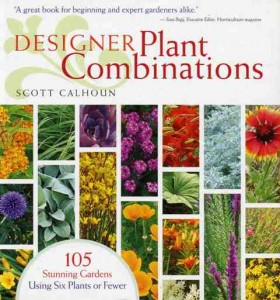 I’m a sucker for artful color combos,and I can often be found playing with paint-chip samples at the hardware store or mixing and matching blooming plants at the nursery. But here’s a guide that color-dreams for me. Designer Plant Combinations features inspiring techniques the pros use to pair color, texture, scale and form in the garden.
Tucson-based garden designer and book author Scott Calhoun is easy to envy for his writing and photography talents. Except that since he’s so likeable and engaging, I end up hungrily waiting for the next installment of his thoughts and images that appear in book form. And this vibrant guide doesn’t disappoint. Calhoun crisscrossed the country visiting the best residential and public landscapes to study and photograph stunning plant vignettes. Each of the 105 design schemes include six plants or less, which will inspire both designers and non-designers in their garden-making efforts. Detailed plant lists and photographs show you how to replicate the ideas in your own garden.
The book’s oh-so-alluring imagery is more than just eye candy, though. Calhoun explains why these perennials, ornamental grasses, annuals, ground covers, woody plants and dramatic accent plants are hardworking ingredients of successful garden design (look for useful designer tips, such as “when using one color, use different textures”).
A consummate plantsman, Calhoun is convinced that non-plant elements are crowding his beloved specimens out of the landscape. He writes, ” . . . good plant combinations are a little like the stanzas of a poem. That is, like the stanza, they are not trying to be a whole garden but a self-contained little part of one.” Whether bold or subdued, the groupings you’ll find here will give your garden personality and elevate it to something more than ordinary.
The New Terrarium
By Tovah Martin (photography by Kindra Clineff) [Clarkson Potter/Publishers, 2009, 176 pp., $25.00]
 Devoted subscribers of the original Victoria magazine know the work of garden writer Tovah Martin. In her stories, Tovah brings a sense of wonderment to each of her subjects, be they gardens, gardeners or the plants they love.
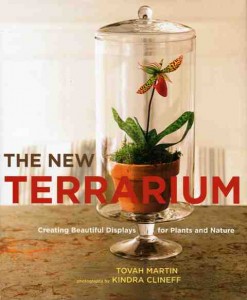
Likewise, her latest project, The New Terrarium, is a magical tome filled with small, planted scenes, diminutive landscapes, twee still-lifes and dwarf collections – all under glass. This dreamy book is captured on film by photographer Kindra Clineff.
The New Terrarium pays homage to the conservatory gardens of the Victorian era, as they were the first to perfect the art of gardening under glass. According to Martin, in today’s go-go, hard-to-find-time to garden world, the terrarium may be the best way to bring something from nature into your life. “A terrarium is any transparent confine that allows you to nurture the elements of the green world,” Martin writes. “[It] is truly a small world . . . a mini-environment that provides an atmosphere of elevated humidity for all the botanical contents it embraces.”
This idea is appealing – and relatively simple to do yourself. Martin presents an array of cool glass containers suitable for planting: Traditional cloches, “Wardian” cases (miniature glass greenhouses), hurricane lamps, recycled aquariums, vases and repurposed glass domes typically used to cover cakes or cheese platters. What to grow under these unique vessels? Martin provides a comprehensive plant encyclopedia, including orchids, ferns, heucheras, begonias, mosses, African violets, bromeliads, ivies, ornamental grasses, and more.
This writer’s enthusiasm for gardening under glass inspired me to buy a small potted fern and contain it under a cloche (also called a bell jar). Living in its charming covered world, the fern, I think, will be happy. And I know I will be, too.
Home Outside: Creating the Landscape You Love
By Julie Moir Messervy [The Taunton Press, 2009, 240 pp., $30]
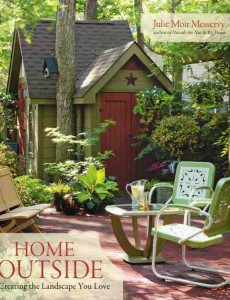 Julie Moir Messervy is an amazing landscape designer, author and teacher who teamed up with the likes of Yo-Yo Ma to create the Toronto Music Garden, and with architect Sarah Susanka to co-write Outside the Not So Big House.
In her new book, Messervy asks, “Why do we spend the bulk of our resources on the inside of our house, while settling for so little on the outside?” In response, she walks readers through the process of turning any property into the “home outside” they’ve always dreamed of. If, like her, you believe that the nurturing nest, the place called home, begins at the edge of your property and encompasses everything within its boundaries (the porch, the patio, the lawn where your children play – even the pathways, edges and corners), then Messervy’s book is the ideal reference to inform and inspire your design decisions. If you haven’t thought of the landscape in this way, her design approach is the perfect starting point. It will equip you with both basics and intricacies necessary to create a personal outdoor space that feeds the eyes and the spirit.
Bursting with instructive illustrations and before-and-after photographs of do-it-yourself gardens, Home Outside helps you see a property the way a landscape designer views it. Messervy breaks down the design process into manageable pieces. Take her “Designer’s Personality Test” and learn more about your style of garden-making. After completing the quiz, I discovered that I’m more expressive (versus reserved) and more relaxed (instead of orderly).
Our Life in Gardens
By Joe Eck and Wayne Winterrowd [Farrar Straus Giroux, 2009, 322 pp., $30]
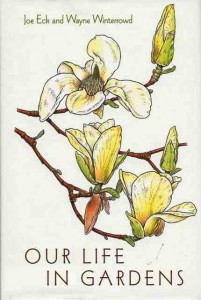 My aforementioned agent, Sarah Jane, has a saying about what makes a good cookbook. “It must transcend the recipes,” she posits. In other words, we can now find recipes anywhere – in magazines, on the web, in grandmother’s dog-eared “Joy of Cooking.” But what makes a great cookbook resonate is the way it touches our universal relationship with food.
Similarly, Joe Eck and Wayne Winterrowd, Vermont-based garden designers and authors, transcend the typical gardening book in Our Life in Gardens. Their collection of nearly 50 essays (arranged logically from Agapanthus to Xanthorrhoea quadrangulata) is so engaging, so gratifying to read, that you truly forget it came from the section of a bookstore otherwise filled with “how-to” titles. There is a lot to learn from these celebrated designers, but I think the lesson is more about observing and cherishing everyday life in the garden than about how to grow delicious peas.
For example, in “Pea Season,” a chapter illustrated with one of Bobbi Angell’s charming plant drawings, Eck and Winterrowd philosophize on the rewards a gardener receives outside of the vegetable plot. The chapter opens with these lines: “No one can say that a gardening life is rich in leisured holidays, but a gardener’s rewards are festivals, big and small, though we make little distinction there, for they are all wonderful. There are other activities in which effort and labor are so certainly followed by achievement and celebration, and anyone who takes an active hand in shaping life must know equal causes for joy. We know only our life, which is largely one of gardening.”
Written with passion and honesty, this book is a keeper. Buy two copies. One to delight in yourself and the other to share with someone who needs to be lured outdoors.



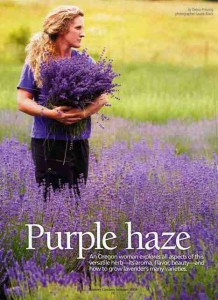 She lives and breathes all things lavender. When gentlewoman-farmer Sarah Bader isn’t working side by side with a few employees to propagate lavender cuttings and harvest armloads of the aromatic herb, she’s walking along hazy purple rows to evaluate her best-performing lavender cultivars. She gardens with lavender, cooks with lavender, perfumes her home with lavender, and is even writing a book about lavender.
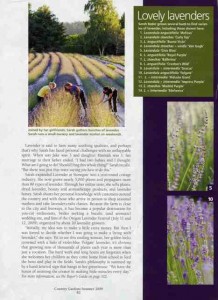 I called Sarah this morning to see how she thought the final story and photography turned out. She was so pleased.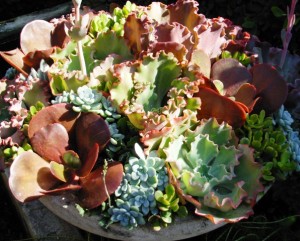
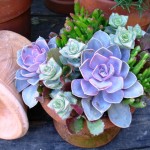
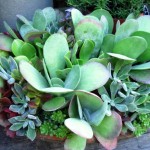
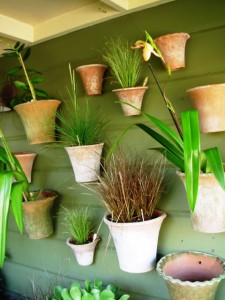
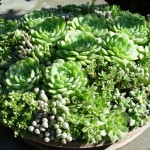 In 2007, Kate Karam and I produced a story about Botanik’s luscious succulent designs for a future Cottage Living story. We had such a great time working with Erin and Molly that day. The designs they came up with were to die for! Sadly, as you all know, Cottage Living ceased publication after the December 2008 issue and we all miss it (we miss garden editor Kate, too!) Who knows where that film will surface or whether it will at all (I’m hoping Sunset picks it up, since it’s a sister magazine).