


 Spring is here and many homeowners equate March’s arrival with a long list of chores. But those to-dos don’t have to be a drag. Backyard improvement projects can yield satisfying results now and through the year.
“You can think about your garden as purely a place to grow plants or a place to entertain,” says Lauren Hall-Behrens, designer and principal of Portland-based Lilyvilla Gardens. “But it can also be something that transforms you at the end of your day, giving something back to you – a connection with nature.”
It’s possible to move practically any activity in your lifestyle to an exterior setting. In a 2012 residential-trends survey by the American Society of Landscape Architects’ (ASLA), nearly 92 percent of respondents rated outdoor areas for kitchen and entertaining as “somewhat to very popular.” The study also found that grills, fire pits, lighting, seating/dining areas and weatherized outdoor furniture continue to be top landscape amenities for the residential backyard. Yet people apparently also want to spend less time taking care of such spaces, with nearly all respondents in the ASLA study giving “low-maintenance landscapes” a popularity rating.
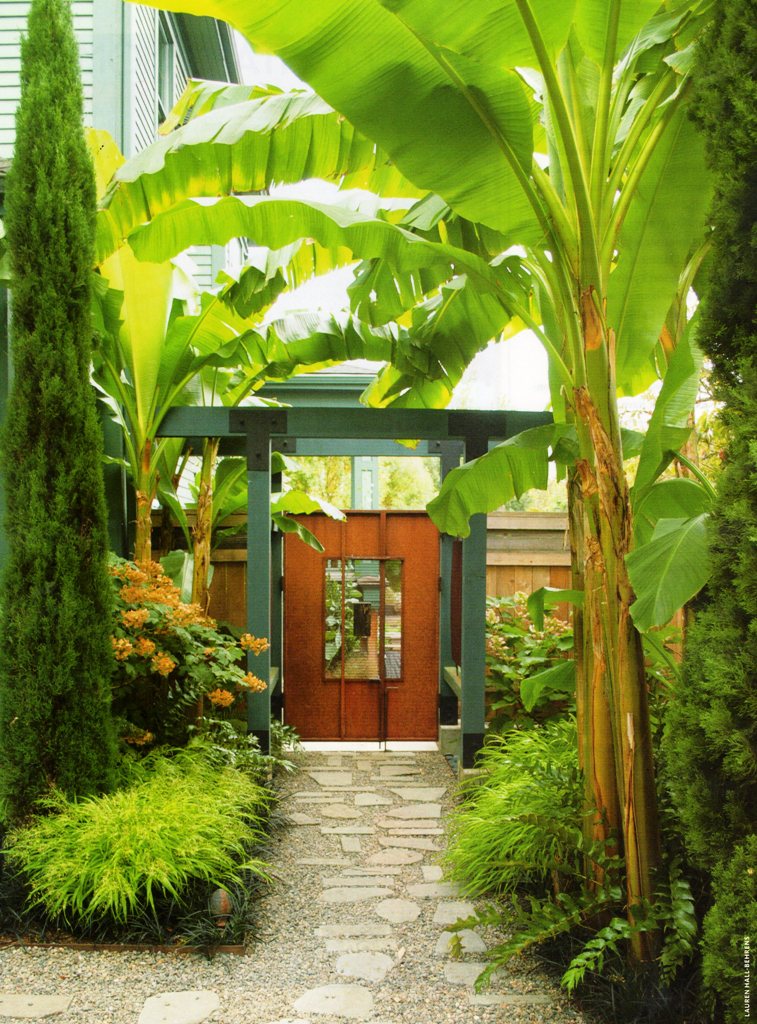
Portland landscape designer Lauren Hall-Behrens turned a small city lot into what she describes as a “Pan Asian Tropical Refuge” for gardening, relaxing and entertaining.
If you’re going to invest extracurricular energy into a gardening project, it had better promise a payoff. You also want to relax in your garden, not work overtime to help pay for it. These two issues—time and money—are at the heart of the garden tips recommended here. Read on to see what the experts suggest:
1. Appraise your garden’s assets and limitations.
Observe your environment – at different times of the year and times of the day – so you’re tuned into what that space is like throughout each season, says Billy Goodnick, a Santa Barbara-based landscape architect and author of the new book Yards: Turn Any Outdoor Space into the Garden of Your Dreams (St. Lynn’s Press, 2013). Goodnick says that homeowners should draw a quick sketch of their outdoor environments. The exercise will likely reveal the plusses and minuses of their properties.
“Make a list of all your wants and desires—from room for the kids to play to a summer napping spot,” Goodnick advises. “I tell my clients to figure out their ‘needs’ and make the most of out of the space they have. Gardens are for living in, so prioritize based on the pleasure you’ll deriive from and the frequency you’ll use each feature.”
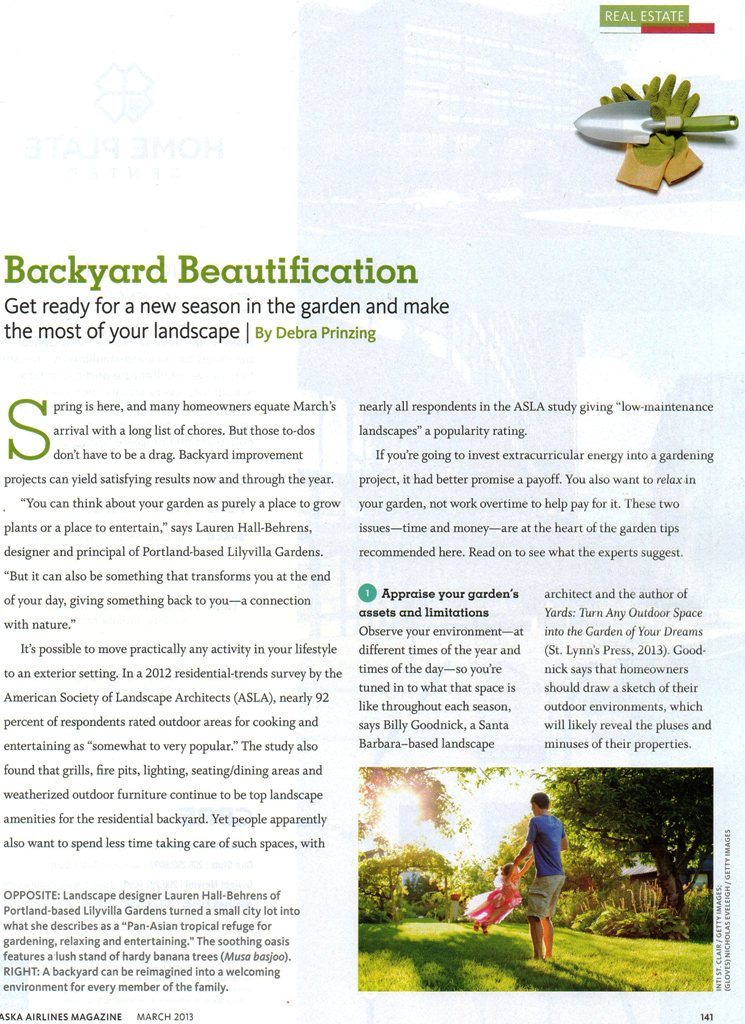
A backyard can be reimagined into a welcoming environment for every member of the family.
Atlanta-based landscape architect Mary Palmer Dargan, author of Timeless Landscape Design (GibbsSmith, 2007) and Lifelong Landscape Design (GibbsSmith, 2012), offers ideas about how homeowners should view their properties when making landscaping decisions. She advises dividing the garden into four important parts, each with its own unique role. There’s the entry to the property, including where people park and how they walk to the front door (which Dargan calls the “approach/arrival”); there is the structure of the home, itself, (the hub); the places where homeowners go to enjoy their family and friends outside (perimeter spaces); and the places further from the home where one might grow a vegetable patch, store gardening equipment or play (linkages/destinations).
“When these four areas are in harmony with one another, the property purrs like a well-oiled piece of machinery,” Dargan maintains.
2. Explore local resources for inspiration:
To develop ideas for those four areas of the garden, homeowners should look around their own community for inspiration. That file folder stuffed with magazine tear sheets is certainly a source of design ideas, but there’s nothing like a three-dimensional landscape to give you a sense of a tree’s grandeur.
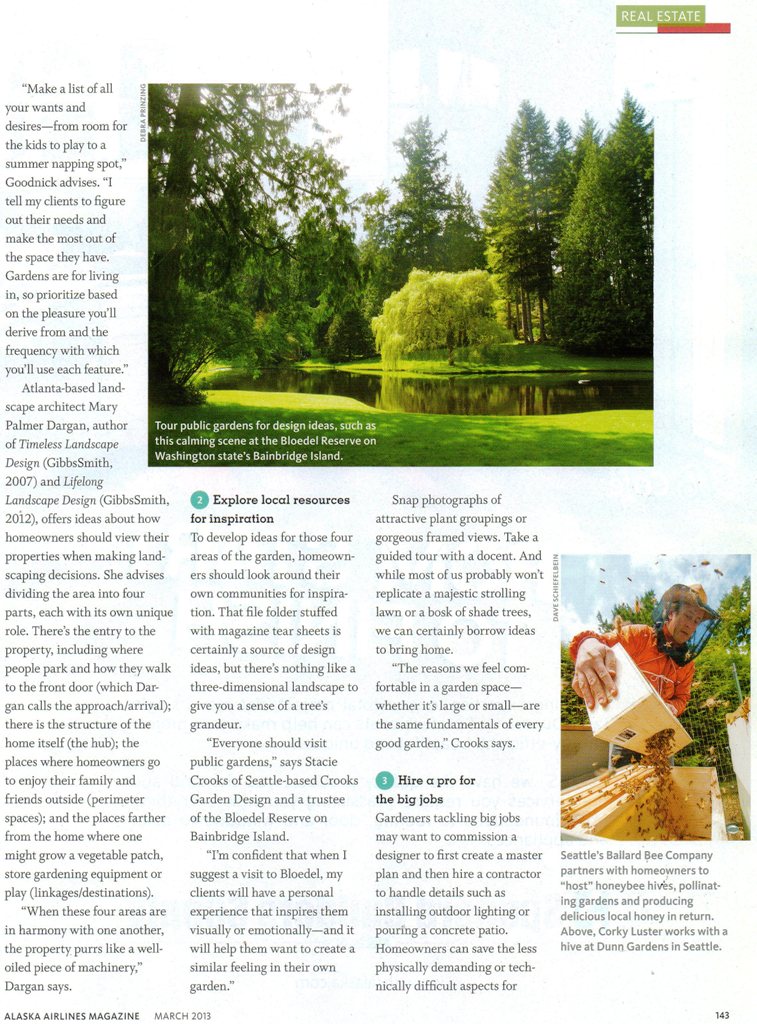
Tour public gardens for design ideas, such as this calming scene at the Bloedel Reserve on Washington state’s Bainbridge Island.
“Everyone should visit public gardens,” says Stacie Crooks of Seattle-based Crooks Garden Design and a trustee of The Bloedel Reserve on Bainbridge Island.
“I’m confident that when I suggest a visit to Bloedel, my clients will have a personal experience that inspires them visually or emotionally – and it will help them want to create a similar feeling in their own garden.”
Snap photographs of attractive plant groupings or gorgeous framed views. Take a guided tour with a docent. And while most of us probably won’t replicate a majestic strolling lawn or a bosk of shade trees, we can certainly borrow ideas to bring home.
“The reasons we feel comfortable in a garden space – whether it’s large or small — are the same fundamentals of every good garden,” Crooks says.
3. Hire a pro for the big jobs:
Gardeners tackling big jobs may want to commission a designer to first create a master plan and then hire a contractor to handle details such as installing outdoor lighting or pouring a concrete patio.
Homeowners can save the less physically demanding or technically difficult aspects for themselves, such as the actual planting. Also, start with the front yard and enjoy it for a few years before tackling the backyard. In other words, pace yourself.
 The amount you will spend varies widely, from hiring a relatively unskilled day laborer to haul away debris for $10-per-hour to a professional designer or landscape architect whose fees can range from $75-per-hour to much more, depending on where you live. Ask friends and neighbors for referrals’; solicit quotes from multiple companies; and check references. Most states have a nursery-and-landscaping trade association that can also provide suggestions, such as whether it’s better to negotiate an hourly fee or a per-project rate. Just remember that you get what you pay for: Cheapest is rarely the best option, especially when it comes to investing in your home and landscape. “It’s all about knowing your strengths and abilities,” says Anthony Tesselaar, cofounder and president of international plant marketer Anthony Tesselaar International. “You may only need a pro to shift that tree that looked good when you first planted it; but now it’s too big or overgrown.”
The International Society of Arboriculture (www.isa-arbor.com) maintains a searchable database of tree-care professionals who can tackle such a project. Hall-Behrens, of Lilyvilla Gardens, believes that working with a designer who understands a gardener’s personal style can help them get much closer to their ideal garden.
“I’m interested in helping clients get as much out of their garden as possible and that often starts with helping them know what they want,” she says.
Sharing the practical aspects of your lifestyle can greatly help a designer, Hall-Behrens says. “If you know you always entertain 30 people at a time, or that you definitely want a place to barbecue or lounge, it will make the whole process so much easier and affordable.”
4. Plant Trees
Spring is a great time to plant trees because so many wonderful specimens are in bloom, says Nancy Buley, communications director for J. Frank Schmidt & Son Co., wholesale tree growers based in Boring, Ore., outside Portland.
“Obviously, you should plant trees for their beauty, but they also have great environmental value,” she says.
However, homeowners need to do their homework to choose the right tree for their properties’ sites and scales. Many communities have resources to help, be it a city arborist or a utility district. Public gardens and universities also evaluate best trees in regions around the country.
For example, in the maritime Northwest, the Great Plant Picks program (www.greatplantpicks.com) lists the best residential trees, while California property owners can view Cal Poly’s SelecTree recommendations (www.selectree.calpoly.edu). Midwest gardeners will find great backyard trees at Missouri Botanic Garden’s Plants of Merit program (www.missouribotanicalgarden.org), while the Pennsylvania Horticultural Society’s Gold Medal Plants highlight best area trees at www.goldmedalplants.org.
If making a beautiful addition to one’s landscape isn’t enough reason to invest in trees, Buley points to a recent U.S. Forest Service study of Portland neighborhoods, which determined that street trees growing in the right-of-way in front of homes added an average of $8,870 to the sales price and reduced the time a home was on the market by 1.7 days.
“Aesthetically, trees are the ‘bones’ of the landscape – they set the tone for the overall look of the garden,” Buley says. “Therefore, it is important to choose wisely, and where space is limited, choose one that will serve multiple purposes.”
5. Barter, borrow or trade
Gardeners on a budget should try embracing some old-fashioned practices and join the new barter economy. Like homesteaders and pioneers before us, today’s enterprising homeowners are finding and creating non-cash solutions for home and garden projects.
According to Steve Couche, founder of the Southeast Portland Tool Library (www.septl.org), this movement is based on equal parts need and creativity.
In 2010, as part of a neighborhood sustainability coalition, Couche and fellow volunteers started a tool-lending center, now one of 40 such programs around the country. The idea is that a gardener may only need a tool for a specific, one-time project. So rather than purchase it, borrow it. “It’s similar to joining a book library,” he explains.
Some tool libraries have been in operation for decades, while others are just getting started. Programs vary, such as one operated through the public library system in Berkeley, California, to others begun by neighborhood groups.
To address growing interest, founders of the West Seattle Tool Library designed a “Starter Kit” that addresses everything from liability issues to planning a budget. It is available for free at http://sharestarter.org/tools/.
At the Southeast Portland Tool Library, More than 2,000 cardholders are able to check out 1,200 tools, mostly donated—from axes to wrenches to more expensive tools. “Young people just starting out want to borrow tools, but retired people do, too,” Couche says. “One of our board members remodeled his house entirely with tools from the library.”
The spirit of the tool library is also similar to garden-sharing cooperatives in which people with extra square-footage allow those who need a plot to grow vegetables, flowers or even host beehives in exchange for a percentage of what they produce.
Ballard Bee Company (www.ballardbeecompany.com), an urban pollination service in Seattle, is one such venture. Founder Corky Luster or a member of his crew set up hives in the residential backyards of neighborhood hosts, as well as in spaces like restaurant gardens or hotel rooftops; the company has also set up apiaries in Dunn Gardens, a beautiful, historic public garden in Seattle.
Property owners pay a small fee and in return receive a “personal pollination station” in their garden and a regular supply of the hive’s honey. As bees forage for pollen in urban backyards, they create a lightly floral, golden, and, of course, delicious product. Plus, it’s safe, explains Luster. “Honeybees are really gentle. When you have a hive, you can experience watching the bees, benefit from the pollination and enjoy some of the honey.”
6. Eat what you grow
Whether it’s because of concerns about the economy, food security, or simply a desire to grow and cook with fresh ingredients, the kitchen garden continues to be an important feature of American backyards.
Gardening with vegetables remains a top consumer priority, according to a recent survey conducted by the Garden Writers Association (www.gardenwriters.org). The study found that over the past three years, the number of households engaged in vegetable and fruit-growing has remained fairly constant at nearly 54 percent of those with a yard or garden.
To begin this project, “forget about seeds,” suggests Willi Galloway, Portland-based author of Grow, Cook, Eat (Sasquatch Books, 2012) and host of www.digginfood.com, a gardening-cooking blog. “Buy veggie starts (rooted seedlings available in 4-inch pots at most garden centers) because they’re already growing and ready to plant.”
Galloway recommends that novice food gardeners should begin growing plants they already like to eat. “Grow a cherry tomato with some lettuce. Or plant some peas with arugula,” she says. “Herbs are great because you can work them into any existing sunny flower border in your yard or grow them in containers.”
Vegetable gardening is a great family activity, Galloway adds. “Kids like anything they can pull up out of the ground, like carrots and beets. And digging up potatoes is like finding buried treasure.7.
7. Make the garden kid-friendly
When my sons were young, I grew lots of berries, greens, vegetables and fruit for the simple reason that I wanted them to know that food came from the earth—not from a shrink-wrapped tray at the supermarket.
By the time my children reached elementary school, we discovered the power of school gardens – “living classrooms” that engage youngsters in fascinating experiences like worm composting, seed sprouting and eating what you grow. There are many resources available to teachers and parents, including the National Gardening Association’s Kids Gardening program (http://www.kidsgardening.org/), which lists lessons and activities, as well as a guide for starting a youth garden. It’s easy to begin small, with just a few flower pots of carrot and radish seeds, and “grow” from there.
Helping children engage positively with the natural world is one objective of the Seattle Children’s PlayGarden (www.seattlechildrensplaygarden.com), a nonprofit program for children of all abilities. Executive director Liz Bullard and landscape designer Wendy Welch say the PlayGarden is an important teaching tool for children with diverse physical and developmental skills. More than one thousand children participate annually in the PlayGarden’s preschool, field trips, afterschool programs and popular summer camps, where play is an equalizer for all children ages 4 to 12.
No one says “don’t pick that” here, says Welch, the program’s lead designer and owner of Wendy Welch Garden Design. “Everything we plant is provocative for kids in some way – from the scent to the texture, to the taste. There are endless amounts of flowers to pick and berries that kids can eat to their heart’s content,” she says. “But then again, this is a public park – and the plants have to stand up to teenage boys playing basketball. So we’ve chosen varieties that are super tough like Joe Pye weed, rudbeckia and solidaster. These are workhorse plants that are hard to kill, but they are also colorful and good for pollinators.”
These lessons of a public park can be adapted to any home garden where children may congregate. “In a garden, kids change their relationship with nature, with their siblings, with other children,” Welch says. “It’s really about creating a welcoming place to play. It doesn’t take any money to build a mud puddle, after all.”
8. Plant for birds, bees and beneficial insects
Bird watching is popular nationwide, with the annual economic impact of bird enthusiasts valued at $32 billion a year, according to the U.S. Fish & Wildlife Service. The agency reported that in 2011, 22.5 million people 16 years old and older took trips away from home to feed, observe, or photograph wildlife.
But these same enthusiasts also enjoy wildlife in their own backyards. Bringing birds into your garden “is probably the easiest connection you can make with wild nature,” says Jim Carpenter CEO of Indianapolis-based Wild Birds Unlimited, a backyard bird feeding specialty chain. “When we provide good habitat, feeding stations, water and a place for birds to raise their young, they reward us with song, beauty, wildness – they bring what may already be a beautiful garden to life.”
9. Recycle, repurpose, re-use
Giving new life to someone else’s throwaways is the idea behind Building Resources (www.buildingresources.org), a 19-year-old construction and landscaping materials center in San Francisco. What began as a way to limit landfill waste has grown into a model emulated all around the country and a way for gardeners to save money and be environmentally sensitive.
Program manager Matthew Levesque says enthusiasm for recycled building materials began to increase five years ago. “People who never before expressed interest in re-use are now interested.” And it’s not just for the do-it-yourself crowd. Patrons include artists, designers, educators and anyone interested in sustainable practices.
“Yes, our growth is economically driven,” Levesque maintains. “That’s because during leaner times, people get more creative. There’s also a growing sense of environmental awareness as people realize there is good material here to be reused.”
10. Make it yourself
Related to the growing “hand-made” movement, make-it-yourself projects can stretch a home and garden decorating budget, allow homeowners to put a personal stamp on their environments.
Picking up a tool and learning a new skill—from floral design to furniture-making—satisfies those who desire unique over the mass-produced, says Dan Benarcik, a horticulturist at Chanticleer, a nonprofit estate garden outside Philadelphia. Benarcik began teaching students seven years ago how to build garden chairs based on The Red Blue Chair, designed in 1917 by Gerrit Rietveld, a Dutch carpenter and artist. Benarcik was surprised when his first students were mother-and-daughter teams.
Women continue to sign up for Benarcik’s furniture-making classes, often given by botanical gardens and horticultural societies. Benarcik thinks the success of his workshops is due in part to the “I want to do it myself” mindset.
“I’m amazed at the momentum,” he says of the do-it-yourself movement. “Most of my students arrive saying, ‘I’ve never built anything else before,’ but I’ve had 100-percent success rate.”
11. Tailor your garden to fit your lifestyle. “Think of your outdoor spaces as adding more rooms to your house,” say landscape architect Goodnick. “The patio is another dining room; the quiet refuge under a tree is your den; the fire pit is your family room.” Even if you make one change in your landscape this spring, you’ll find yourself drawn to the great outdoors more frequently as the season unfolds.
Debra Prinzing is a Seattle-based garden and design writer and outdoor living expert. Learn more at www.debraprinzing.com.